
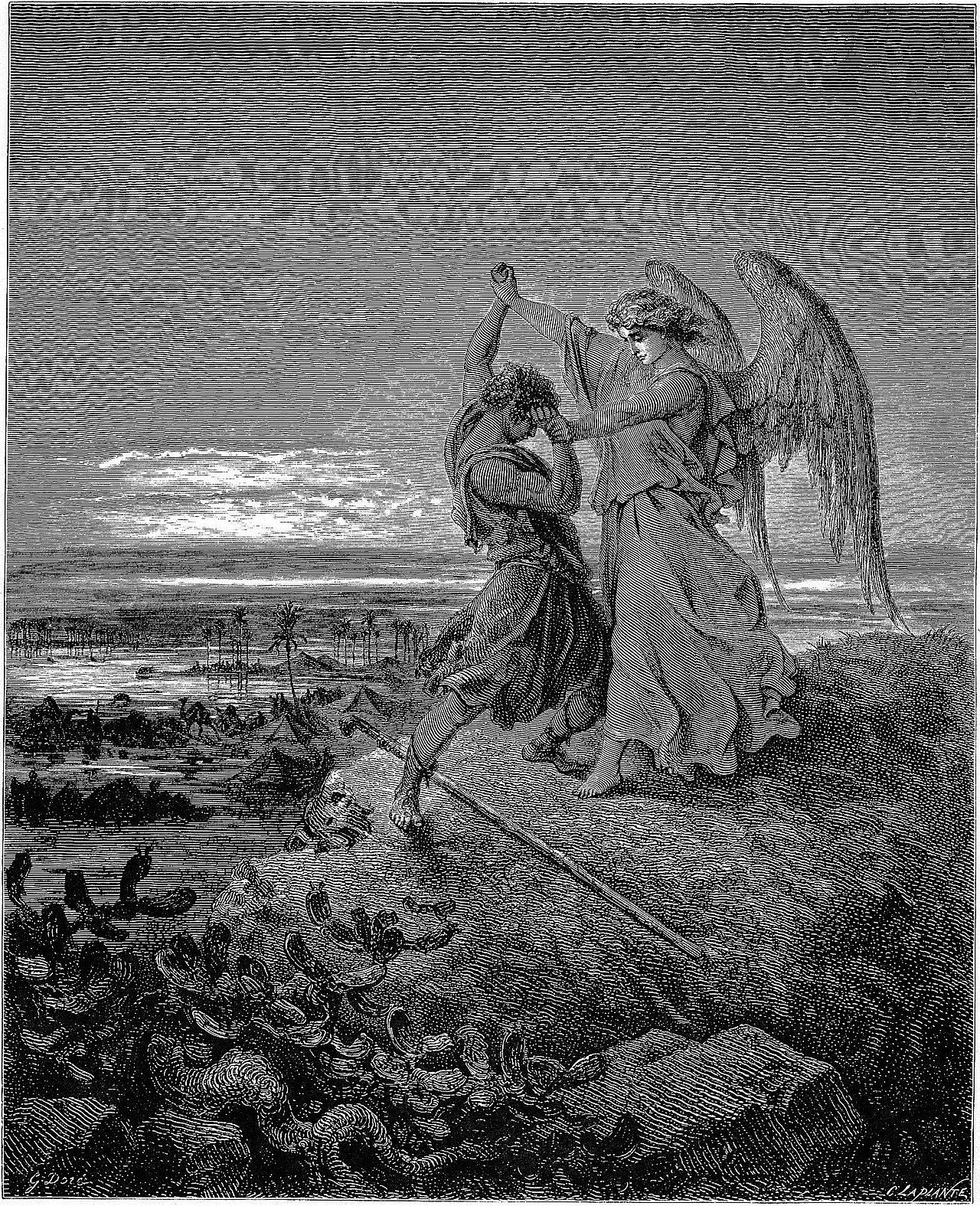
Genesischapter 32
32 verses · Moses, by tradition · 15th to 13th century BC · The Law
When the messengers returned to Jacob, they said, “We went to your brother Esau, and now he is coming to meet you—he and four hundred men with him.”
Introduction
Moses, by tradition, The Law, Genesis Overview.
This chapter was first heard by a people who carried the name it gives. Jacob is on his way home after twenty years, and the brother he cheated stands between him and the land. It is a chapter about fear and about what a man does with it. Listen for the word camp, which the chapter keeps returning to, and for how often faces are mentioned. Notice the first prayer Genesis records from Jacob, and what he asks God to remember. Its closing lines explain a food custom Israel kept for generations.
Context
- Who
- Israel in the wilderness, the nation that carries the name given on this riverbank
- What
- A narrative of Jacob's return toward Canaan, his prayer before meeting Esau, and the night he wrestles at the ford of the Jabbok and is renamed Israel.
- Where
- East of the Jordan, from Mahanaim to the ford of the Jabbok, where the river cuts a deep gorge down to the Jordan valley.
- When
- About 1909 BC by the traditional dating, in the same year Jacob parted from Laban.
- Why
- To show how the man who had grasped at blessings was brought to cling to God for one, and received the name the nation would carry.
Historical context
The chapter is Jacob's, and he is coming back into the land as the head of a large household with a brother ahead of him who had sworn to kill him at Genesis 27:41.
Show the rest of the historical context, 5 more paragraphs
The ground is the east side of the Jordan, from Mahanaim to the ford of the Jabbok, which cuts a deep gorge and makes a natural boundary.
The occasion is the meeting with Esau, reported by messengers who come back with a number and no answer.
A first hearer knew what the drove sent ahead was. Sending gifts before an unwanted meeting, in separate droves with a space between them and with servants briefed on what to say, is how a weaker party approached a stronger one, and the gift here is counted out animal by animal at verses 14 and 15.
He also knew that four hundred men could be an escort or a war band and that Jacob had no way to tell which, so splitting the camp was ordinary caravan prudence in dangerous country.
The wrestling leaves him lamed at the hip socket and renamed. A new name given by a superior was a change of standing, and the man who had grabbed at a heel is now called one who struggles with God and prevails. The chapter ends with a food custom Israel still kept, tied to that injury.
Significance
The nation's own name came from this night, and it came to a man who limped away from the fight holding on until he was blessed.
Show the rest of the significance, 2 more paragraphs
Jacob's prayer at verses 9 to 12 is the first prayer Genesis records from him, and it is the first in the book to hand God back God's own promise and God's own command. That became the shape of Israel's praying.
The sun had gone down on him at Genesis 28:11 as he left the land, and it rises on him here as he comes back into it.
This chapter in Jewish lifeWhat this chapter is in Jewish life and reading.
What is done
Two things a reader of an English Bible has to be told fall in this chapter. The first is a seam of the reading cycle: the portion Vayetzei ends and the portion Vayishlach begins inside it, so the chapter is heard across two Sabbaths (src/lib/hebraic/readings.ts, the entries for portions seven and eight). The second is that the seam sits at a place where the Hebrew and the English verse numbers part company. The same file records that Vayishlach opens at Genesis 32:4 in a Hebrew Bible and at 32:3 in an English one, and the corpus fetched for this chapter numbers its commentary by the Hebrew count throughout, so every reference below runs one verse ahead of an English Bible. The chapter also carries the oldest food custom in Scripture. This site's own pages record that Israel does not eat the sinew of the hip, that Genesis gives this night as the reason, and that Jewish practice later worked the custom out in detail, the sinew removed by a trained hand before the meat is used, and honoured it as usage rather than as a command written in the Torah (src/app/featured/jacob-wrestles-the-angel/page.tsx and scripts/data/historical-context/ch2-genesis-late.mjs).
How it is read
Rashi reads the chapter as a handover between two companies of angels and then as a night of fear honestly told. The angels who meet Jacob at the opening are "The angels who minister in the Land of Israel came to meet him in order to escort him into the Holy Land", on Genesis Rabbah 74:17, and the place name of the next verse he takes as the two camps of the escort leaving and the escort arriving, on Midrash Tanchuma, Vayishlach 3 (Rashi on Genesis 32:2:1 and 32:3:1, the Pentateuch with Rashi's commentary by M. Rosenbaum and A. M. Silbermann, 1929 to 1934, public domain). The messengers Jacob sends he takes as angels in the strict sense, on Genesis Rabbah 75:4. Jacob's own message he reads as a disclaimer of the blessing he had taken, a man saying that he had become a sojourner and no prince and that the blessing had not been fulfilled in him (Rashi on Genesis 32:5:1 and 32:6:1). The double word of the eighth verse he divides in two, "He was afraid lest he be killed, and he was distressed that he might have to kill someone", on Genesis Rabbah 76:2 (Rashi on Genesis 32:8:1). At the crossing he hands on the tradition that Dinah was not among the eleven children because Jacob had hidden her: "He placed her in a chest and locked her in so that Esau should not set his fancy upon her", and that Jacob was punished for keeping her from a brother she might have turned back to good (Rashi on Genesis 32:23:1). Of Jacob at the ford he says simply, "He acted as a ferry-man taking them from one side and setting them down on the other" (Rashi on Genesis 32:24:1). Ibn Ezra comments here at 32:1:1 and 32:20:1, and one further comment of Rashi at 32:15:1 stands without English in the corpus, so all three are citations.
What the rabbis say
The corpus records forty rabbinic locators on this chapter, thirty-eight of them Midrash and two Talmud. Bereshit Rabbah carries almost the whole chapter, and the run is nearly continuous: 74:16 and 74:17 at the meeting with the angels, 75:1, 75:5, 75:6, 75:7 and 75:12 through the message to Esau, 76:7, 76:8 and 76:9 through the prayer and the crossing, and 77:1, 78:1, 78:3, 78:4, 78:6 and 68:10 through the wrestling and the naming. Aggadat Bereshit is cited at 46:3, 54:2, 55:1, 58:3, 58:4 and 67:2, Midrash Aggadah at Genesis 32:16:1, 32:20:1, 32:22:1 and 32:24:1, Midrash Lekach Tov at Genesis 32:1:1, 32:19:1 and 32:21:1, Bamidbar Rabbah at 4:1, 15:12 and 18:21, and Bereshit Rabbati at Parashat Vayishlach 7 and 10. Sefer HaYashar is cited once, at the Book of Genesis, Vayetzei 5. The two Talmud locators stand at the new name and at the sinew, in the Hebrew numbering the twenty-ninth and thirty-third verses: Berakhot 13a:11 and Beitzah 12a:10. Rashi hands on further sayings with their locators, among them Genesis Rabbah 74:17, 75:4, 75:7, 76:2, 76:7 and 76:8 and Midrash Tanchuma, Vayishlach 3.
Sources: Rashi, Rashi on Genesis 32:2:1, 32:3:1, 32:4:1, 32:5:1, 32:6:1, 32:7:1, 32:8:1, 32:9:1, 32:10:1, 32:11:1, 32:12:1, 32:13:1, 32:14:1, 32:16:1, 32:17:1, 32:18:1, 32:19:1, 32:21:1, 32:22:1, 32:23:1 and 32:24:1, in the Hebrew verse numbering, the Pentateuch with Rashi's commentary by M. Rosenbaum and A. M. Silbermann, 1929 to 1934, public domain; Rashi on Genesis 32:15:1, cited only; Ibn Ezra, Ibn Ezra on Genesis 32:1:1 and 32:20:1, cited only, no English version in the corpus under a licence permitting quotation; Midrash, Bereshit Rabbah 65:13, 68:10, 74:16, 74:17, 75:1, 75:5, 75:6, 75:7, 75:12, 76:7, 76:8, 76:9, 77:1, 78:1, 78:3, 78:4, 78:6 and 79:5; Aggadat Bereshit 46:3, 54:2, 55:1, 58:3, 58:4 and 67:2; Midrash Aggadah, Genesis 32:16:1, 32:20:1, 32:22:1 and 32:24:1; Midrash Lekach Tov, Genesis 32:1:1, 32:19:1 and 32:21:1; Bamidbar Rabbah 4:1, 15:12 and 18:21; Bereshit Rabbati, Parashat Vayishlach 7 and 10; Sefer HaYashar (midrash), Book of Genesis, Vayetzei 5; Ein Yaakov (Glick Edition), Sanhedrin 4:26; Midrash Tanchuma, Vayishlach 3, as Rashi cites it; Babylonian Talmud, Berakhot 13a:11, Beitzah 12a:10; MannaFest, the annual cycle table, src/lib/hebraic/readings.ts; the sinew of the hip, src/app/featured/jacob-wrestles-the-angel/page.tsx and scripts/data/historical-context/ch2-genesis-late.mjs, 2026.
The heads below are this chapter's scenes. The numbered points under each are its verses.
Esau Comes with Four Hundred Men
Genesis 32:1-2
the angels of God met him: Angels met Jacob at Genesis 28:12 on the night he fled the land, and they meet him here on the road back into it. He names the place Mahanaim, the Hebrew for two camps, and calls what he has seen the camp of God. Camp is the word this chapter keeps counting with.
Genesis 32:1
“Note, Those that keep in a good way have always a good guard; angels themselves are ministering spirits for their safety, Heb. i. Where Jacob pitched his tents, they pitched theirs about him, Ps. xxxiv. They met him, to bid him welcome to Canaan again; a more honourable reception this was than ever any prince had, that was met by the magistrates of a city in their formalities.”
Matthew Henry · Commentary on the Whole Bible (1707-1721)puritan
So he named that place Mahanaim: Jacob named the place for the camp of God, and Mahanaim became a town east of the Jordan given to the Levites at Joshua 21:38. Ish-bosheth reigned there at 2 Samuel 2:8, and David came there fleeing Absalom at 2 Samuel 17:24. God's camp became a camp for kings.
Genesis 32:2
“Mahanaim - The two hosts, if read by the points, the angels forming one, and Jacob and his company forming another; or simply hosts or camps in the plural. There was a city built afterwards here, and inhabited by the priests of God, Jos 21:38. For what purpose the angels of God met Jacob, does not appear from the text; probably it was intended to show him that he and his company were under the care of an especial providence, and consequently to confirm his trust and confidence in God.”
Adam Clarke · Commentary on the Bible (1810-1826)evangelical
Genesis 32:3-5
Jacob sent messengers ahead of him: The Hebrew word for messenger is the word used of the angels in verse 1, and Gill notes that these are Jacob's own servants. Jacob has them say “to my master Esau” and name himself “Your servant Jacob.” Isaac's blessing at Genesis 27:29 had set Esau's family under him. Jamieson, Fausset and Brown read him as leaving that promise with God.
Genesis 32:3
“And Jacob sent messengers before him unto Esau his brother,.... Or "angels": not angels simply, as Jarchi, for these were not under the command, and in the power of Jacob to send, nor would they have needed any instruction from him afterwards given, but these were some of his own servants.”
I have been staying with Laban: Staying is the Hebrew gur, to live as a foreigner in another man's country. Jacob tells his master Esau that his years with Laban were a foreigner's stay. Abraham called himself a foreigner among the Hittites at Genesis 23:4.
Genesis 32:4
“Thus shall ye speak unto my lord Esau - Jacob acknowledges the superiority of his brother; for the time was not yet come in which it could be said, The elder shall serve the younger.”
Adam Clarke · Commentary on the Bible (1810-1826)evangelical
1 more voice on this verse
Genesis 32:4
“Thy servant Jacob--He had been made lord over his brethren (compare Ge 27:29). But it is probable he thought this referred to a spiritual superiority; or if to temporal, that it was to be realized only to his posterity. At all events, leaving it to God to fulfil that purpose, he deemed it prudent to assume the most kind and respectful bearing.”
Jamieson, Fausset & Brown · Commentary Critical and Explanatory on the Whole Bible (1871)reformed
I have oxen, donkeys, flocks: The list tells Esau that Jacob comes home with means of his own and needs nothing of Isaac's estate. Find favor in your sight returns three times when the brothers meet, at 33:8, 10 and 15. Jacob asks for favor and claims nothing.
Genesis 32:6-8
the messengers returned to Jacob: The messengers bring back a number and no answer. Esau is coming with four hundred men, and nothing is reported of what Esau said. Jacob is in great fear and distress, and he divides the people, the flocks and herds and camels, into two camps. He had named the camp of God Mahanaim the day before, and this second pair of camps is his own.
Genesis 32:6
“Esau's studied reserve gave him reason to dread the worst. Jacob was naturally timid; but his conscience told him that there was much ground for apprehension, and his distress was all the more aggravated that he had to provide for the safety of a large and helpless family.”
Jamieson, Fausset & Brown · Commentary Critical and Explanatory on the Whole Bible (1871)reformed
In great fear and distress: Distress is from tsarar, to be pressed into a narrow place. The same root names the day of distress Jacob recalls at Genesis 35:3, when he builds the altar at Bethel. The fear stands beside the promise of 28:15, that God would watch over him wherever he went.
Genesis 32:7
“Jacob, though a man of great faith, yet was now greatly afraid. Note, A lively apprehension of danger, and a quickening fear arising from it, may very well consist with a humble confidence in God's power and promise. Christ himself, in his agony, was sorely amazed.”
Matthew Henry · Commentary on the Whole Bible (1707-1721)puritan
Escape is the Hebrew peletah, a surviving remnant, the camp that is left. Joseph uses the same word at Genesis 45:7, telling his brothers God sent him ahead to save their lives by a great deliverance. Jacob plans for half his house to survive.
Jacob Prays for Deliverance
This is the first prayer of Jacob's that Genesis records. He opens on the God of his fathers Abraham and Isaac, a covenant made with two dead men, and claims nothing of his own. He hands the LORD back His own command of Genesis 31:3, to go back to his country and his kindred, the grandson ordered back into the country Abraham was called out of at Genesis 12:1.
Genesis 32:9
“Such was the humble self-denying sense he had of his own unworthiness that he did not call God his own God, but a God in covenant with his ancestors: O God of my father Abraham, and God of my father Isaac; and this he could the better plead because the covenant, by divine designation, was entailed upon him. Note, God's covenant with our fathers may be a comfort to us when were are in distress.”
Matthew Henry · Commentary on the Whole Bible (1707-1721)puritan
1 more voice on this verse
Genesis 32:9
“O God of my father Abraham, etc. - This prayer is remarkable for its simplicity and energy; and it is a model too for prayer, of which it contains the essential constituents: - 1. Deep self-abasement. 2. Magnification of God’s mercy. 3. Deprecation of the evil to which he was exposed. 4. Pleading the promises that God had made to him. And, 5. Taking encouragement from what God had already wrought.”
Adam Clarke · Commentary on the Bible (1810-1826)evangelical
I am unworthy of all the kindness: The Hebrew behind unworthy is katonti, from the root that means to be small. Clarke renders the clause as being less than all the compassions and all the faithfulness shown to a servant. Jacob measures the twenty years by what crossed the Jordan each way, one staff going out and two camps coming back. Hebrews 11:21 leaves him leaning on that staff.
Genesis 32:10
"With only his staff he crossed the Jordan." It was a wondrous symbol Jacob held in his hand in anticipation—the sign of the cross of the great prophet. He lifted up his feet on to the land of the people of the east, because it was from there that "a light shone out to the peoples."
Aphrahat the Persian Sage · written before 345 · ON PRAYER 6patristic
1 more voice on this verse
Genesis 32:10
“I am not worthy of the least of all the mercies - The marginal reading is more consistent with the original: קטנתי מכל החסדים ומכל האמת katonti miccol hachasadim umiccol haemeth, I am less than all the compassions, and than all the faithfulness, which thou hast showed unto thy servant. Probably St Paul had his eye on this passage when he wrote, Unto me, who am less than the least of all saints.”
Adam Clarke · Commentary on the Bible (1810-1826)evangelical
Genesis 32:11-12
Please deliver me from the hand of my brother Esau: Jacob names the danger as his own death and the mothers and children with him. Clarke reads that as a fear of extermination, and the killing of the children would end the promised line. So he closes on the promise itself, offspring like the sand of the sea. He holds God to God's own words.
Genesis 32:11
“And the mother with the children - He must have had an awful opinion of his brother when he used this expression, which implies the utmost cruelty, proceeding in the work of slaughter to total extermination. See Hos 10:14.”
Adam Clarke · Commentary on the Bible (1810-1826)evangelical
1 more voice on this verse
Genesis 32:11
“The fear that quickens prayer is itself pleadable. It was not a robber, but a murderer, that he was afraid of; nor was it his own life only that lay at stake, but the mothers' and the children's, that had left their native soil to go along with him. Note, Natural affection may furnish us with allowable acceptable pleas in prayer.”
Matthew Henry · Commentary on the Whole Bible (1707-1721)puritan
like the sand of the sea: The words Jacob quotes were spoken to Abraham at Genesis 22:17, offspring like the sand on the seashore. At Bethel God had promised Jacob offspring like the dust of the earth, at 28:14. Jacob claims his grandfather's promise as his own.
Genesis 32:12
“Make thy seed as the sand - Having come to the promise by which the covenant was ratified both to Abraham and Isaac, he ceased, his faith having gained strong confirmation in a promise which he knew could not fail, and which he found was made over to him, as it had been to his father and grandfather.”
Adam Clarke · Commentary on the Bible (1810-1826)evangelical
A Present Sent Ahead in Droves
Genesis 32:13-15
a gift for his brother Esau: The gift is counted out animal by animal, and it opens with 200 female goats and 20 male goats. Jacob had taken the blessing at Genesis 27 wearing the skins of two young goats and carrying a dish cooked from them. Clarke reads the whole drove as restitution for the wrong done to his brother. Henry notes that the man prayed first and then used means.
Genesis 32:13
“Jacob, having piously made God his friend by a prayer, is here prudently endeavouring to make Esau his friend by a present. He had prayed to God to deliver him from the hand of Esau, for he feared him; but neither did his fear sink into such a despair as dispirits for the use of means, nor did his prayer make him presume upon God's mercy, without the use of means.”
Matthew Henry · Commentary on the Whole Bible (1707-1721)puritan
1 more voice on this verse
Genesis 32:13
“And took of that which came to his hand - הבא בידו habba beyado, which came under his hand, i.e., what, in the course of God’s providence, came under his power.”
Adam Clarke · Commentary on the Bible (1810-1826)evangelical
200 female goats, 20 male goats: The males stand at one to ten against the females, the proportion a herdsman keeps for breeding. Jacob sends Esau a herd that will multiply. His skill with breeding flocks was learned in Laban's pastures, as chapter 30 records.
Genesis 32:14
“Two hundred she goats, and twenty he goats, two hundred ewes, and twenty rams. And it seems this proportion of one he goat to ten she goats, and of one ram to ten ewes, is a proper one, and what has been so judged in other times and countries (x). (x) Varro de rustica, l. 2. c. 3. apud Bochart. Hierozoic. par. 1. l. 2. c. 43. col. 439. &c. 53. col. 648.”
30 milk camels with their young: With the goats and sheep of verse 14, the gift comes to 550 grown animals, and the camels bring their young besides. Milk camels were among the most valued animals in an eastern herd. Five kinds of livestock make up the gift.
Genesis 32:15
“Ten bulls - The Syriac and Vulgate have twenty; but ten is a sufficient proportion to the forty kine. By all this we see that Jacob was led to make restitution for the injury he had done to his brother. Restitution for injuries done to man is essentially requisite if in our power. He who can and will not make restitution for the wrongs he has done, can have no claim even on the mercy of God.”
Adam Clarke · Commentary on the Bible (1810-1826)evangelical
Genesis 32:16-18
He entrusted them to his servants: Each herd goes over separately with a space kept between them, so Esau meets the gift again and again. Every servant is handed the same script, and it ends every time on one line, that Jacob is behind us. The lead servant is given Esau's questions in advance. This is the staging of a man who has prayed and is still arranging the answer.
In his orders to the servants, Esau is Jacob's brother. The three questions he puts in Esau's mouth ask for a master, a destination and an owner. The answer of verse 18 covers all three.
Genesis 32:17
“They must call Esau their lord, and Jacob his servant; they must tell him the cattle they had was a small present which Jacob had sent him, as a specimen of his acquisitions while he was abroad.”
Matthew Henry · Commentary on the Whole Bible (1707-1721)puritan
They are a gift, sent to my lord Esau: Gift is minchah, the word for the offerings of Cain and Abel at Genesis 4:3 and 4 and for the grain offering of Leviticus 2. It is also the tribute a lesser man brings a greater, as Ehud carries Israel's tribute to Moab at Judges 3:15. Jacob sends it as a servant to his lord.
Genesis 32:18
“Note, We ought to continue instant in prayer, always to pray and not to faint: frequency and importunity in prayer prepare us for mercy. While Jacob was earnest in prayer, stirring up himself to take hold on God, an angel takes hold on him. Some think this was a created angel, the angel of his presence ( Isa. lxiii.”
Matthew Henry · Commentary on the Whole Bible (1707-1721)puritan
Genesis 32:19-21
He also instructed the second, the third: Verse 20 gives Jacob's own reason, to appease Esau with the gift that goes before him. The verb is kaphar, to cover, the word that stands behind atonement, the covering of an offence. The Hebrew of that one verse says face four times: the gift before his face, the covering of Esau's face, the seeing of his face, and the lifting of Jacob's face. Before morning he names a place for seeing God's face.
Proverbs 21:14 says a gift in secret soothes anger. Abigail meets David's anger the same way at 1 Samuel 25:18 and 19, loading donkeys with gifts and telling her servants to go on ahead with herself coming after. Both gifts go before the giver.
gifts went on before him: Went on before him is the Hebrew for passing over, the verb that carries this chapter. Jacob crossed the Jordan with his staff in verse 10, the herds are told to go on ahead in verse 16, and the family crosses the Jabbok in verse 22. Penuel is passed in the same verb at verse 31.
Genesis 32:21
“So went the present over before him,.... Over the brook Jabbok, after mentioned, the night before Jacob did: and himself lodged that night in the company; or "in the camp" (c), either in the place called Mahanaim, from the hosts or crowds of angels seen there; or rather in his own camp, his family and servants; or, as Aben Ezra distinguishes, in the camp with his servants, and not in his tent, lest his brother should come and smite him; and so Nachmanides. (c) במחנה "in castris", Vatablus, Drusius, Schmidt; "in acie sua", Junius & Tremellius; "in exercitu", Piscator.”
Wrestling Until the Break of Day
Genesis 32:22-23
the ford of the Jabbok: Eleven sons cross the ford of the Jabbok, and the twelfth is not yet born. Benjamin comes at Genesis 35:18, and Rachel dies bearing him. Jacob then sends over the two wives, the two maidservants and all his possessions. Twenty years of gain go to the far bank, and the man who gathered it stays on this one.
Genesis 32:22
“Passed over the ford Jabbok - This brook or rivulet rises in the mountains of Galaad, and falls into the Jordan at the south extremity of the lake of Gennesaret.”
Adam Clarke · Commentary on the Bible (1810-1826)evangelical
1 more voice on this verse
Genesis 32:22
“To us it is highly instructive; showing that, to encourage us valiantly to meet the trials to which we are subjected, God allows us to ascribe to the efficacy of our faith and prayers, the victories which His grace alone enables us to make.”
Jamieson, Fausset & Brown · Commentary Critical and Explanatory on the Whole Bible (1871)reformed
sent them across the stream: The stream is the Jabbok, and its Hebrew name Yabboq sounds like Jacob's name and like the verb for wrestled in the next verse. Deuteronomy 3:16 makes the Jabbok the border of the Ammonites. Its gorge runs west through Gilead to the Jordan.
Genesis 32:23
“And he took them, and sent them over the brook,.... His wives and children, under the care of some of his servants: and sent over that he had: all that belonged to him, his servants and his cattle or goods.”
Genesis 32:24-25
Jacob was left all alone: Jacob is left all alone, and a man wrestles with him until daybreak. The man cannot overpower him, so he strikes the socket of Jacob's hip and dislocates it. Ambrose reads the stripping away of all Jacob owned as what left him free to wrestle. Henry, following Hosea 12:4, says the weapons were weeping and pleading.
Genesis 32:24
“Therefore Jacob, who had purified his heart of all pretenses and was manifesting a peaceable disposition, first cast off all that was his, then remained behind alone and wrestled with God. For whoever forsakes worldly things comes nearer to the image and likeness of God. What is it to wrestle with God other than to enter upon the struggle for virtue, to contend with one who is stronger and to become a better imitator of God than the others are?”
Ambrose of Milan · written before 397 · On Jacob and the Blessed Lifepatristic
2 more voices on this verse
Genesis 32:24
“And there wrestled a man with him - This was doubtless the Lord Jesus Christ, who, among the patriarchs, assumed that human form, which in the fullness of time he really took of a woman, and in which he dwelt thirty-three years among men. He is here styled an angel, because he was μεγαλης βουλης Αγγελος, (see the Septuagint, Isa 9:7), the Messenger of the great counsel or design to redeem fallen man from death, and bring him to eternal glory; see Gen 16:7. But it may be asked, Had he here a real human body, or only its form?”
Adam Clarke · Commentary on the Bible (1810-1826)evangelical
Genesis 32:24
“We are told by the prophet ( Hos. xii. 4 ) how Jacob wrestled: he wept, and made supplication; prayers and tears were his weapons. It was not only a corporal, but a spiritual, wrestling, by the vigorous actings of faith and holy desire; and thus all the spiritual seed of Jacob, that pray in praying, still wrestle with God.”
Matthew Henry · Commentary on the Whole Bible (1707-1721)puritan
he struck the socket: Struck is the Hebrew naga, to touch. The man who cannot overpower Jacob by wrestling disables him with a touch. The hip is yarek, the thigh, and Jacob asks Joseph to place a hand under that thigh for an oath at 47:29.
Genesis 32:25
“The hollow of Jacob’s thigh was out of joint - What this implies is difficult to find out; it is not likely that it was complete luxation of the thigh bone. It may mean no more than he received a stroke on the groin, not a touch; for the Hebrew word נגע naga often signifies to smite with violence, which stroke, even if comparatively slight, would effectually disable him for a time, and cause him to halt for many hours, if not for several days.”
Adam Clarke · Commentary on the Bible (1810-1826)evangelical
The man asks to be let go at daybreak, and Jacob answers by holding on. He will not release him without a blessing, and that refusal is where the night turns. The blessing he took at Genesis 27 by disguise he now asks for out loud. He asks the one man he cannot deceive.
Genesis 32:26
“I will not let thee go, except thou bless me--It is evident that Jacob was aware of the character of Him with whom he wrestled; and, believing that His power, though by far superior to human, was yet limited by His promise to do him good, he determined not to lose the golden opportunity of securing a blessing.”
Jamieson, Fausset & Brown · Commentary Critical and Explanatory on the Whole Bible (1871)reformed
3 more voices on this verse
Genesis 32:26
You see how he does not continue fighting at daybreak. In fact, there is no fight for those who already live in the light. It is fitting for those who have been brought to such magnificence to say, "God, my God, I watch you from the light." And in addition, "In the morning you shall hear my voice, in the morning I shall wait on you, and you shall see me."
Cyril of Alexandria · written before 444 · GLAPHYRA ON GENESIS, 5.3patristic
Genesis 32:26
“In begging this blessing he owns his inferiority, though he seemed to have the upper hand in the struggle; for the less is blessed of the better. Note, Those that would have the blessing of Christ must be in good earnest, and be importunate for it, as those that resolve to have no denial. It is the fervent prayer that is the effectual prayer.”
Matthew Henry · Commentary on the Whole Bible (1707-1721)puritan
Genesis 32:26
“Let me go, for the day breaketh - Probably meaning, that as it was now morning, Jacob must rejoin his wives and children, and proceed on their journey. Though phantoms are supposed to disappear when the sun rises, that could be no reason in this case. Most of the angelic appearances mentioned in the Old and New Testaments took place in open day, which put their reality out of question.”
Adam Clarke · Commentary on the Bible (1810-1826)evangelical
Genesis 32:27-28
The last man who could not see Jacob asked him who he was, and that was Isaac at Genesis 27:19, where the answer was Esau. Here he gives his own name, the name Esau threw back at him for supplanting twice. The confession comes first, and the new name follows it. Israel is given for having struggled with God and with men and prevailed.
Genesis 32:27
“What is thy name? - Jacob (saith he) a supplanter, so Jacob signifies. Well, (faith the angel) be thou never so called any more: thou shalt be called Israel, a prince with God. He is a prince indeed, that is a prince with God; and those are truly honourable that are mighty, in prayer.”
John Wesley · Explanatory Notes upon the Old Testament (1765)evangelical
Israel joins the verb sarah, to strive, with El, God. The renaming is spoken again at Genesis 35:10, and the narrative keeps both names to the end of the book. Abram, renamed at 17:5, is called Abraham from then on.
Genesis 32:28
“Be with me now in thy faithful spirit, holy and blessed Patriarch Jacob, to combat the poisonous hissings of the serpent of unbelief. Prevail once more in thy wrestling with the Man, and, being the stronger, once more entreat His blessing. Why pray for what thou mightest demand from thy weaker Opponent? Thy strong arm has vanquished Him Whose blessing thou prayest. Thy bodily victory is in broad contrast to thy soul's humility, thy deeds to thy thoughts.”
Hilary of Poitiers · written before 367 · ON THE TRINITY 5.19patristic
2 more voices on this verse
Genesis 32:28
“Thy name shall be called no more Jacob, but Israel--The old name was not to be abandoned; but, referring as it did to a dishonorable part of the patriarch's history, it was to be associated with another descriptive of his now sanctified and eminently devout character.”
Jamieson, Fausset & Brown · Commentary Critical and Explanatory on the Whole Bible (1871)reformed
Genesis 32:28
“Yet this was not all; having power with God, he shall have power with men too. Having prevailed for a blessing from heaven, he shall, no doubt, prevail for Esau's favour. Note, Whatever enemies we have, if we can but make God our friend, we are well off; those that by faith have power in heaven have thereby as much on earth as they have occasion for.”
Matthew Henry · Commentary on the Whole Bible (1707-1721)puritan
ConnectionsGenesis 35:10
Genesis 32:29-30
Jacob asks for the man's name and is refused it, and then he is blessed there. He calls the place Peniel, saying he had seen God face to face and his life was spared. Jerome notes the Hebrew form Phanuel, which the later books use. Hosea 12:4 calls the wrestler an angel, Clarke takes him for Christ before the incarnation, and Calvin reads God showing himself in the person of a mediator.
Genesis 32:29
“JACOB had said to the Angel, "Tell me, I pray You, Your name." In answer to that enquiry, he was gently rebuked. The Angel did not come to ratify Jacob's curiosity, but He came as a messenger from God with a blessing—"and He blessed him there." There are a great many things we would like to know when we read the Bible. But if we read it so as to find salvation, that will be much better than having our curiosity gratified.”
Charles Spurgeon · written before 1892 · The Metropolitan Tabernacle Pulpit, Sermon No. 3219: “'He Blessed Him There'” (lightly modernized text, CCEL edition)Particular Baptist
2 more voices on this verse
Genesis 32:29
“But that request was denied, that he might not be too proud of his conquest, nor think he had the angel at such an advantage as to oblige him to what he pleased. No, " Wherefore dost thou ask after my name? What good will it do thee to know that?" The discovery of that was reserved for his death-bed, upon which he was taught to call him Shiloh.”
Matthew Henry · Commentary on the Whole Bible (1707-1721)puritan
Genesis 32:29
“Tell me, I pray thee, thy name - It is very likely that Jacob wished to know the name of this angel, that he might invoke him in his necessities: but this might have led him into idolatry, for the doctrine of the incarnation could be but little understood at this time; hence, he refuses to give himself any name, yet shows himself to be the true God, and so Jacob understood him; (see Gen 32:28); but he wished to have heard from his own lips that name by which he desired to be invoked and worshipped.”
Adam Clarke · Commentary on the Bible (1810-1826)evangelical
Spared is natsal, the verb Jacob used in verse 11 when he asked to be delivered from the hand of Esau. The deliverance he names comes from the face of God. Exodus 33:20 states the danger, that no one can see God and live.
Genesis 32:30
“He does not say, "In this place I wrestled with God, and prevailed;" but, "In this place I saw God face to face, and my life was preserved;" not, "It was my praise that I came off a conqueror, but it was God's mercy that I escaped with my life." Note, It becomes those whom God honours to take shame to themselves, and to admire the condescensions of his grace to them.”
Matthew Henry · Commentary on the Whole Bible (1707-1721)puritan
ConnectionsGenesis 18:1
Genesis 32:31-32
The sun rose above him: The sun had gone down on Jacob at Genesis 28:11 the night he left the land, and it rises on him here as he comes back in. Clarke reads that against Malachi 4:2 and the Sun of righteousness rising with healing in its wings. He goes to meet his brother limping. Israel keeps a rule to this day about the tendon at the socket of the hip, so the nation carries the memory of this night at its table.
Genesis 32:31
“The sun rose upon him - Did the Prophet Malachi refer to this, Mal 4:2: Unto you that fear my name shall the Sun of righteousness arise with healing in his wings? Possibly with the rising of the sun, which may here be understood as emblematical of the Sun of righteousness - the Lord Jesus, the pain and weakness of his thigh passed away, and he felt both in soul and body that he was healed of his plagues.”
Adam Clarke · Commentary on the Bible (1810-1826)evangelical
do not eat the tendon: The tendon at the socket of the hip is the gid hanasheh, which the Israelites identify with the sinew running down the thigh. The rule comes from Jacob's night at the Jabbok, ahead of any law given at Sinai. The Mishnah treats it at length in tractate Chullin.
Genesis 32:32
“Therefore the children of Israel eat not of the sinew - What this sinew was neither Jew nor Christian can tell; and it can add nothing either to science, or to a true understanding of the text, to multiply conjectures. I have already supposed that the part which the angel touched or struck was the groin; and if this be right, the sinew, nerve, or muscle that shrank, must be sought for in that place. The serious reader must meet with much instruction in this chapter.”
Adam Clarke · Commentary on the Bible (1810-1826)evangelical
How this psalm is built
The form: A narrative of return built on the word camp, carrying a prayer and a night encounter at its centre, as Henry classes it.
The patterns in this chapter
| Device | What it does | Where to see it |
|---|---|---|
| Camp, counted through the chapter | Jacob meets the angels of God and names the place Mahanaim, the Hebrew for two camps. When the messengers bring back the number of men coming with Esau he divides his people and herds into two camps of his own. The word the chapter opens on is the word it keeps counting with.Jerome, Hebrew Questions on Genesis, c. 390, on Genesis 32:2. | Genesis 32:2, Genesis 32:7, Genesis 32:8, Genesis 32:10 |
| Face, said four times in one verse | The Hebrew of verse 20 says face four times: the gift going before his face, the covering of Esau's face, the seeing of his face and the lifting of Jacob's face. The verb behind appease is kaphar, to cover, the word behind atonement. Jacob then names the ford Peniel, the face of God, and says at Genesis 33:10 that his brother's face is like the face of God.John Gill, Exposition of the Old Testament, 1748 to 1763, on Genesis 32:19 to 21. | Genesis 32:20, Genesis 32:30 |
| Messenger, of angels and of servants | The Hebrew word for the messengers Jacob sends ahead at verse 3 is the word used of the angels who meet him at verse 1. John Gill notes that these are Jacob's own servants. The chapter opens with God's messengers and immediately sends out a man's.John Gill, Exposition of the Old Testament, 1748 to 1763, on Genesis 32:3 to 5. | Genesis 32:1, Genesis 32:3 |
| What is your name, asked twice across five chapters | The last man who could not see Jacob asked who he was, and that was Isaac at Genesis 27:19, where the answer was Esau. Here the question comes again in the dark and he gives his own name. The name Esau threw at him at Genesis 27:36 for supplanting twice is answered with Israel, given for having struggled with God and with men and prevailed.Matthew Henry, Commentary on the Whole Bible, 1710, on Genesis 32:27 and 28. | Genesis 32:27, Genesis 32:28 |
The historical value
11 more paragraphs on the patterns
The chapter records a food law kept by observance rather than by statute. Verse 32 says Israel does not eat the tendon at the socket of the hip to this day, and gives the reason as this night. It is the one such custom Genesis traces to an event in a patriarch's own body.
The gift is counted out animal by animal at verses 14 and 15, two hundred female goats and twenty male goats, ewes and rams, camels with their young, cows, bulls and donkeys. Adam Clarke reads the drove as restitution, since the blessing had been taken wearing the skins of two young goats at Genesis 27:16.
The place names are the chapter's other record. Mahanaim and Peniel are both named here for what happened at them.
The debated concept
Who the man at the ford was is the chapter's long debate, and the text is careful. Verse 24 calls him a man. Verse 28 has him say Jacob has struggled with God and with men. Verse 30 has Jacob call the place the face of God and say his life was spared. Hosea 12:4 calls the wrestler an angel. Adam Clarke takes him for Christ before the incarnation. John Calvin reads God showing Himself in the person of a mediator. A fourth reading keeps him an angel throughout and takes Jacob's words at verse 30 as what seeing an angel meant to him. Every position has to hold both the man of verse 24 and the God of verse 30, and no position is settled by the site's own earlier publication.
The second question is why the man asks to be let go at daybreak, and Genesis gives no reason. The text says only that he asked and that Jacob would not let go without a blessing.
The New Testament's use
Hebrews 11:21 is the one New Testament place that carries an image from Jacob's later life, where he blesses Joseph's sons and worships leaning on the top of his staff. The staff is the one Jacob names at verse 10, saying he crossed the Jordan with it and has come back as two camps.
Hosea 12:3 and 4 is the Old Testament's own use, and it reads the chapter together with Genesis 25:26 and Genesis 28. It says he grasped his brother's heel in the womb, wrestled with God, struggled with the angel and prevailed, and that he wept and sought His favour. Matthew Henry follows Hosea in naming the weapons of the wrestling as weeping and pleading.
The divine connection
The blessing Jacob took at Genesis 27 by disguise he asks for out loud here, from the one man he cannot deceive. That is the chapter's own argument and it rests on the text rather than on inference: the question at verse 27 is the question Isaac asked at Genesis 27:19, and the name given as the answer is the answer to the name Esau threw at him at Genesis 27:36. At the Evidence Standard the claim goes that far. What the chapter says about the outcome is that he prevailed and was marked for life in the same night, and that he went to meet his brother limping.
Keep studying
Words12
Subjects1
Sources for this chapter
The summary
Jamieson, Fausset & Brown, Commentary Critical and Explanatory; John Calvin, Commentaries; John Wesley, Notes on the Old Testament and Matthew Henry, Complete Commentary.
The form and classifications
Adam Clarke; Ambrose of Milan, On Jacob and the Blessed Life, c. 386, on Genesis 32:24 and Matthew Henry, Commentary on the Whole Bible, 1710, on Genesis 32.
The exposition
Adam Clarke, Commentary on the Bible; Ambrose of Milan, On Jacob and the Blessed Life; Jamieson, Fausset & Brown, Commentary Critical and Explanatory on the Whole Bible; Jerome, Hebrew Questions on Genesis; John Calvin, Commentary on Genesis; John Gill, Exposition of the Old Testament; John Wesley, Explanatory Notes upon the Old Testament; Keil and Delitzsch, Biblical Commentary on the Old Testament and Matthew Henry, Commentary on the Whole Bible.