
Genesis 32:29
in Genesis 32And Jacob requested, “Please tell me your name.” But he replied, “Why do you ask my name?” Then he blessed Jacob there.
BSB
The same verse in ASV and KJV ▾
ASV
And Jacob asked him, and said, Tell me, I pray thee, thy name. And he said, Wherefore is it that thou dost ask after my name? And he blessed him there.
KJV
And Jacob asked him, and said, Tell me, I pray thee, thy name. And he said, Wherefore is it that thou dost ask after my name? And he blessed him there.
⋯
This verse in Genesis 32
Commentary
11 notes on this verseTell me, I pray thee, thy name - It is very likely that Jacob wished to know the name of this angel, that he might invoke him in his necessities: but this might have led him into idolatry, for the doctrine of the incarnation could be but little understood at this time; hence, he refuses to give himself any name, yet shows himself to be the true God, and so Jacob understood him; (see Gen 32:28); but he wished to have heard from his own lips that name by which he desired to be invoked and worshipped.
This site's exposition
Please tell me your name
on Genesis 32:29-30
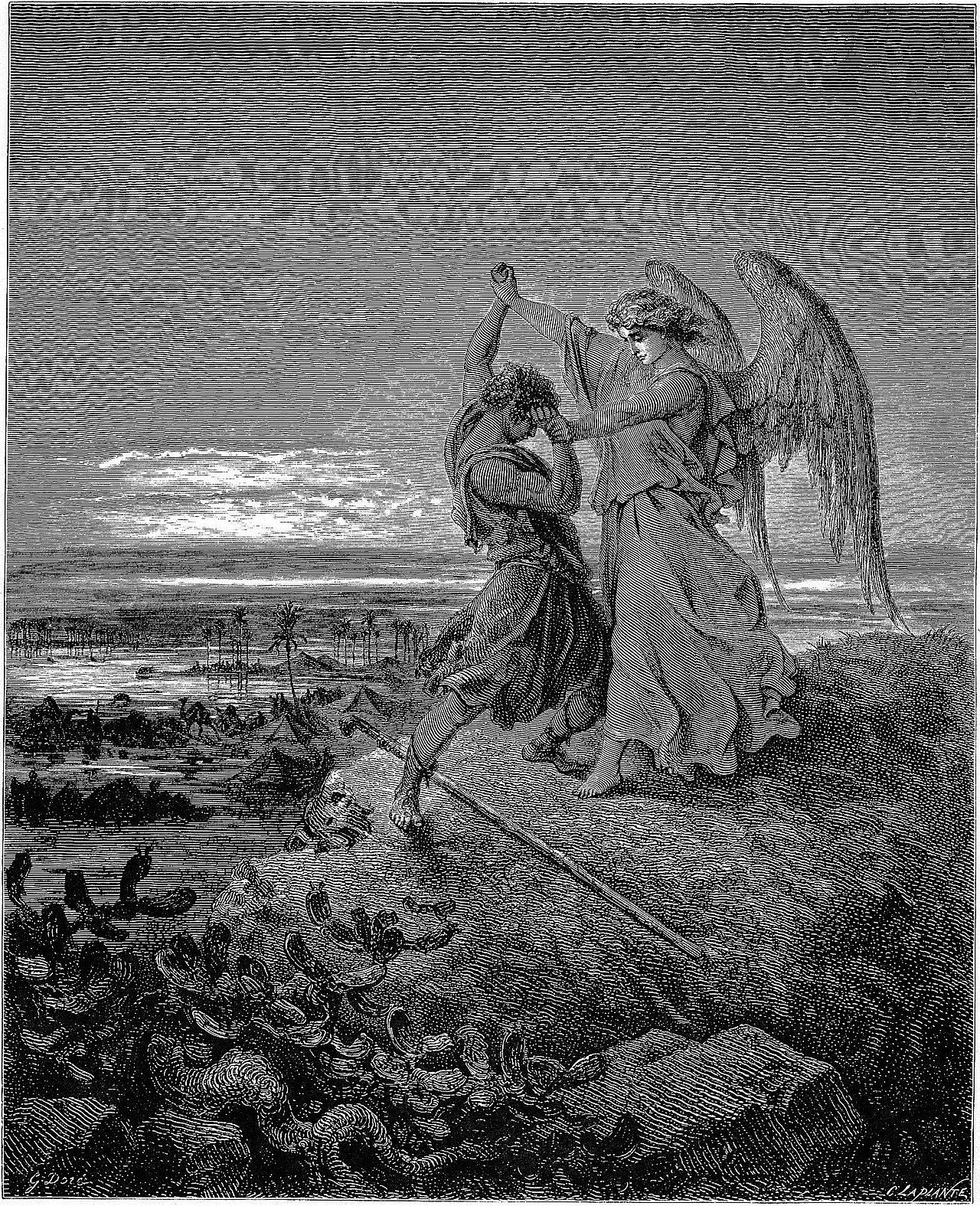
Jacob asks for the man's name and is refused it, and then he is blessed there. He calls the place Peniel, saying he had seen God face to face and his life was spared. Jerome notes the Hebrew form Phanuel, which the later books use. Hosea 12:4 calls the wrestler an angel, Clarke takes him for Christ before the incarnation, and Calvin reads God showing himself in the person of a mediator.
The record, by era
The Church Fathers1 voice
That night an angel appeared to [Jacob] and wrestled with him. He overcame the angel and was overcome by the angel so that [Jacob] learned how weak he was and how strong he was.
The Puritans and the Awakening4 voices
But that request was denied, that he might not be too proud of his conquest, nor think he had the angel at such an advantage as to oblige him to what he pleased. No, " Wherefore dost thou ask after my name? What good will it do thee to know that?" The discovery of that was reserved for his death-bed, upon which he was taught to call him Shiloh.
2 And when Jacob saw them, he said, This is God's host: and he called the name of that place Mahanaim. Jacob, having got clear of Laban, pursues his journey homewards towards Canaan: when God has helped us through difficulties we should go on our way heaven-ward with so much the more cheerfulness and resolution. Here is Jacob's convoy in his journey (
quarantine:debris (2026-07-29) — unbalanced-parens
The discovery of that was reserved for his death-bed, upon which he was taught to call him Shiloh. But instead of telling him his name, he gave him his blessing, which was the thing he wrestled for; he blessed him there, repeated and ratified the blessing formerly given him. See how wonderfully God condescends to countenance and crown importunate prayer?
Lord, what will become of that promise, if they be all cut off? Jacob having piously made God his friend by a prayer, is here prudently endeavouring to make Esau his friend by a present. He had prayed to God to deliver him from the hand of Esau - His prayer did not make him presume upon God's mercy, without the use of means.
4 more voices on this verse
The Puritans and the Awakening1 voice
And Jacob asked him, and said, tell me, I pray thee, thy name,....
The Nineteenth Century3 voices
A commentator
Charles Spurgeon1834–1892
The Metropolitan Tabernacle Pulpit, Sermon No. 3219: “'He Blessed Him There'” (lightly modernized text, CCEL edition) · Written before 1892.
JACOB had said to the Angel, "Tell me, I pray You, Your name." In answer to that enquiry, he was gently rebuked. The Angel did not come to ratify Jacob's curiosity, but He came as a messenger from God with a blessing—"and He blessed him there." There are a great many things we would like to know when we read the Bible. But if we read it so as to find salvation, that will be much better than having our curiosity gratified.
A commentator
Jamieson, Fausset & Brown1802–1910
Commentary Critical and Explanatory on the Whole Bible (1871)
proposed
Jacob asked, Tell me . . . thy name--The request was denied that he might not be too elated with his conquest nor suppose that he had obtained such advantage over the angel as to make him do what he pleased.
A commentator
Charles Spurgeon1834–1892
The Metropolitan Tabernacle Pulpit, Sermon No. 3219: “'He Blessed Him There'” (lightly modernized text, CCEL edition) · Written before 1892.
proposed
JACOB had said to the Angel, "Tell me, I pray You, Your name." In answer to that enquiry, he was gently rebuked. The Angel did not come to ratify Jacob's curiosity, but He came as a messenger from God with a blessing—"and He blessed him there." There are a great many things we would like to know when we read the Bible. But if we read it so as to find salvation, that will be much better than having our curiosity gratified. When we come to hear a sermon, too, we should like, perhaps, to meet with some fine passages, or to have some telling anecdotes that we could carry away with us. But if, instead, the Lord's messenger shall give us a blessing from God, Himself, it will be infinitely better! The disciples, after the Resurrection, wanted to know from the Savior something about the times and seasons, but He did not tell it to them. He said to them, "You shall receive power after that the Holy Spirit is come upon you." That was far better, far more valuable to them—and though for the time it might not please them so much, yet, for all practical purposes, it enriched them far more! Angels' names we can afford to leave, but God's blessing we must have and we cannot do without it! I. Let us just think, for a minute or two, WHAT THIS BLESSING WAS WHICH JACOB GAINED AS THE RESULT OF A NIGHT OF PRAYER. I wonder whether anybody here has ever spent a night in prayer. Is there a man among us who has ever wrestled with the Angel for so long? Alas, I am afraid to put the question and ask for an answer lest I should only gain one through your silence! Brothers and Sisters, it is not easy to continue for a whole night in prayer. It has been well observed that it is easier to hear a sermon two hours long than to pray for an hour. The more spiritual the exercise, the sooner we tire.
The words behind it
14 Hebrew wordsEvery Hebrew word of this verse in the order it stands, with what it means and the door to its own study. The last column counts the times a word stands in the whole Bible: the rarer the word, the more the places it appears belong together.
| Hebrew | Sound | Meaning | Word study | In the Bible |
|---|---|---|---|---|
| וַיִּשְׁאַ֣ל | vaiyishal | and he asked | H7592 → | 171 times |
| יַעֲקֹ֗ב | yaako | Jacob | H3290 → | 350 times |
| וַיֹּ֙אמֶר֙ | vaiyomer | and he said | H559 → | 5305 times |
| הַגִּֽידָה־ | hagidah- | tell ! | H5046 → | 370 times |
| נָּ֣א | na' | please | H4994 → | 404 times |
| שְׁמֶ֔ךָ | shemekha | name your | H8034 → | 864 times |
| וַיֹּ֕אמֶר | vaiyomer | and he said | H559 → | 5305 times |
| לָ֥מָּה | lamah | <to> why? | H4100 → | 752 times |
| זֶּ֖ה | zeh | this | H2088 → | 1180 times |
| תִּשְׁאַ֣ל | tishal | do you ask | H7592 → | 171 times |
| לִשְׁמִ֑י | lishmi | to name my | H8034 → | 864 times |
| וַיְבָ֥רֶךְ | vayvarekh | and he blessed | H1288 → | 330 times |
| אֹת֖וֹ | ʾoto | <obj.> him | H853 → | 10935 times |
| שָֽׁם׃ | sham | there | H8033 → | 834 times |
וַיִּשְׁאַ֣לand he asked
vaiyishalH7592 →171 times
יַעֲקֹ֗בJacob
yaakoH3290 →350 times
וַיֹּ֙אמֶר֙and he said
vaiyomerH559 →5305 times
הַגִּֽידָה־tell !
hagidah-H5046 →370 times
נָּ֣אplease
na'H4994 →404 times
שְׁמֶ֔ךָname your
shemekhaH8034 →864 times
וַיֹּ֕אמֶרand he said
vaiyomerH559 →5305 times
לָ֥מָּה<to> why?
lamahH4100 →752 times
זֶּ֖הthis
zehH2088 →1180 times
תִּשְׁאַ֣לdo you ask
tishalH7592 →171 times
לִשְׁמִ֑יto name my
lishmiH8034 →864 times
וַיְבָ֥רֶךְand he blessed
vayvarekhH1288 →330 times
אֹת֖וֹ<obj.> him
ʾotoH853 →10935 times
שָֽׁם׃there
shamH8033 →834 times
A shaded row is a word that stands 400 times or fewer in the Bible.
The walk
8 stopsEach card is a verse this one points to, and under it the verses that one points to in turn. Where several paths arrive at the same place, that place is listed first: the text keeps returning to it.
Through
Isaiah 9:6For unto us a child is born, unto us a son is given, and the government will be upon His shoulders. And He will be called Wonderful Counselor, Mighty God, Everlasting Father, Prince of…
it leads to
- Luke 2:11
Today in the city of David a Savior has been born to you. He is Christ the Lord!
- Matthew 28:18
Then Jesus came to them and said, “All authority in heaven and on earth has been given to Me.
- Jeremiah 23:5–6
Behold, the days are coming, declares the LORD, when I will raise up for David a righteous Branch, and He will reign wisely as King and will administer justice and righteousness in the land.
- Isaiah 7:14
Therefore the Lord Himself will give you a sign: Behold, the virgin will be with child and will give birth to a son, and will call Him Immanuel.
- Matthew 1:23
“Behold, the virgin will be with child and will give birth to a son, and they will call Him Immanuel” (which means, “God with us”).
- Luke 2:11
Through
Hosea 6:1Come, let us return to the LORD. For He has torn us to pieces, but He will heal us; He has wounded us, but He will bind up our wounds.
it leads to
- Job 5:18
For He wounds, but He also binds; He strikes, but His hands also heal.
- Deuteronomy 32:39
See now that I am He; there is no God besides Me. I bring death and I give life; I wound and I heal, and there is no one who can deliver from My…
- 1 Samuel 2:6
The LORD brings death and gives life; He brings down to Sheol and raises up.
- Job 5:18
Where this verse is studied
On this page
Studies2
On this verse
On this chapter
About Genesis
Who and where
1 name in this verse with a page on the site.
This page draws on 9 works. Open the list of works
This page draws on Adam Clarke, Commentary on the Bible; Charles Spurgeon, The Metropolitan Tabernacle Pulpit, Sermon No. 3219: “'He Blessed Him There'” (lightly modernized text, CCEL edition); Ephrem the Syrian, COMMENTARY ON GENESIS 30:3; Jamieson, Fausset & Brown, Commentary Critical and Explanatory on the Whole Bible; Jerome, Hebrew Questions on Genesis; John Calvin, Commentary on Genesis; John Gill, Exposition of the Old Testament (1748-1763); John Wesley, Explanatory Notes upon the Old Testament and Matthew Henry, Commentary on the Whole Bible.