
Genesis 32:25
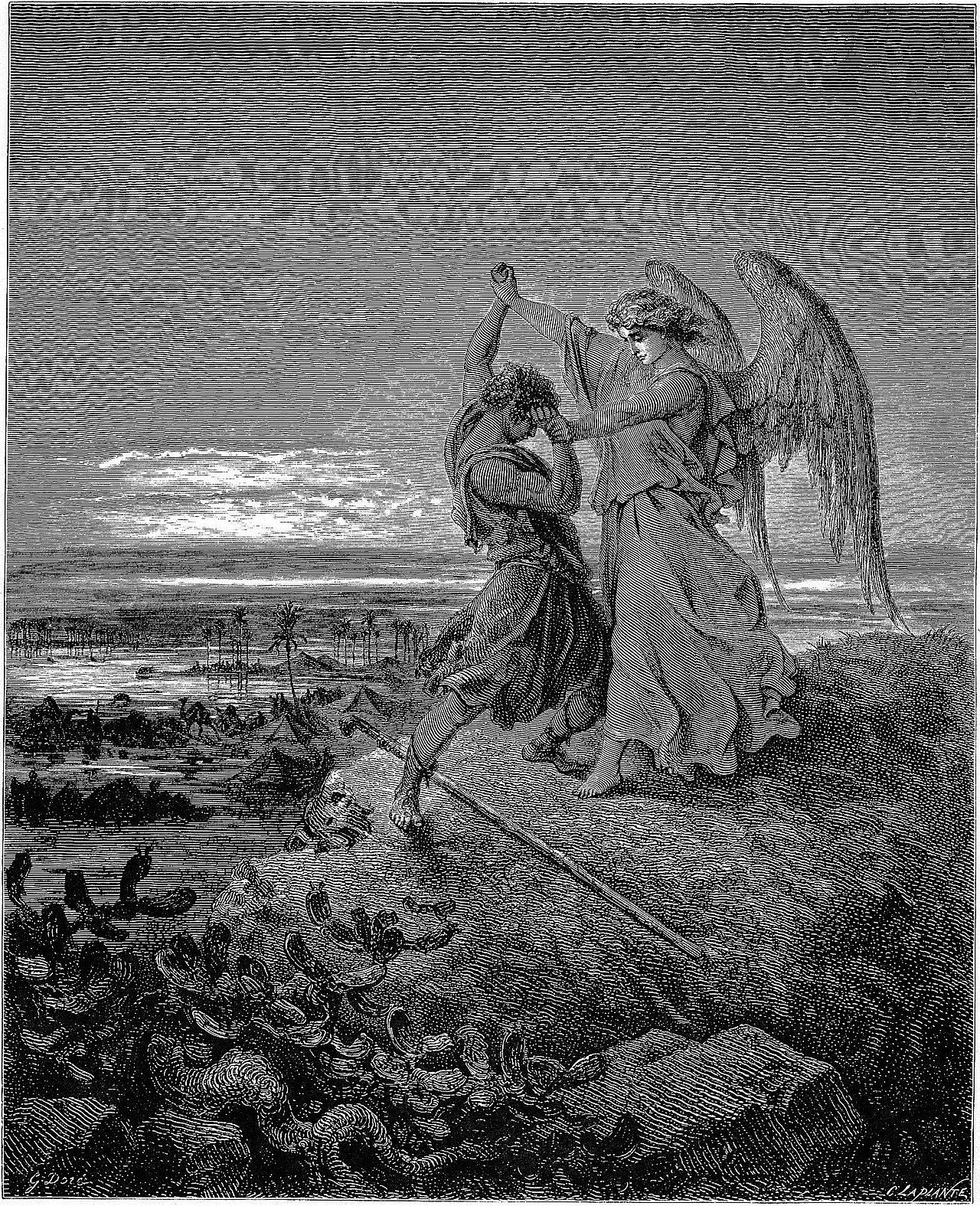
in Genesis 32When the man saw that he could not overpower Jacob, he struck the socket of Jacob’s hip and dislocated it as they wrestled.
BSB
The same verse in ASV and KJV ▾
ASV
And when he saw that he prevailed not against him, he touched the hollow of his thigh; and the hollow of Jacob’s thigh was strained, as he wrestled with him.
KJV
And when he saw that he prevailed not against him, he touched the hollow of his thigh; and the hollow of Jacob’s thigh was out of joint, as he wrestled with him.
⋯
This verse in Genesis 32
Commentary
10 notes on this verseThe hollow of Jacob’s thigh was out of joint - What this implies is difficult to find out; it is not likely that it was complete luxation of the thigh bone. It may mean no more than he received a stroke on the groin, not a touch; for the Hebrew word נגע naga often signifies to smite with violence, which stroke, even if comparatively slight, would effectually disable him for a time, and cause him to halt for many hours, if not for several days.
This site's exposition
Jacob was left all alone
on Genesis 32:24-25
Jacob is left all alone, and a man wrestles with him until daybreak. The man cannot overpower him, so he strikes the socket of Jacob's hip and dislocates it. Ambrose reads the stripping away of all Jacob owned as what left him free to wrestle. Henry, following Hosea 12:4, says the weapons were weeping and pleading.
This site's exposition
he struck the socket
Struck is the Hebrew naga, to touch. The man who cannot overpower Jacob by wrestling disables him with a touch. The hip is yarek, the thigh, and Jacob asks Joseph to place a hand under that thigh for an oath at 47:29.
The record, by era
The Church Fathers3 voices
Jacob's withered thigh stands for bad Christians, so that we find in him blessing and limping. He is blessed with respect to those who live good lives; he limps with respect to those who live bad lives. But each kind is still included in one man. They will be separated and set apart later. This is what the church is longing for in that psalm: "Judge me, O God, and distinguish my case from an unholy people." Yes, of course, because the Gospel says, "If your foot is a scandal to you, cut it off and throw it away. It is better for you to enter the kingdom of God having one foot, than with two feet to go to the everlasting fire." So these bad people have to be cut off in the end. For the time being the church is lame. It puts one foot down firmly; the other one, being crippled, it drags. Look at the pagans, brothers. Sometimes they find good Christians serving God, and they admire them and are attracted and believe. Sometimes they notice those who are living bad lives, and they say, "Look at these Christians!" But those who live evil lives belong to the hollow of Jacob's thigh that was touched, and they have withered. Yet the touch of the Lord is the hand of the Lord, chastising and giving life.
Believing Jews and unbelieving Jews. Where were they first condemned? In the first of them, in the father of all of them, Jacob himself, who was also called Israel. Jacob means "supplanter" or "heel"; Israel means "seeing God." When Jacob returned from Mesopotamia with his children, an angel wrestled with him, representing Christ; and while he wrestled, though the angel surpassed Jacob in strength, he still seemed to succumb to him, and Jacob to prevail. In the same sort of way the Lord Christ too succumbed to the Jews; they prevailed when they killed him. He was overcome by superior strength; precisely when he was overcome, he overcame for us. What's that—when he was overcome, he overcame for us? Yes, because when he suffered, he shed the blood with which he redeemed us.So then, that is what is written: Jacob prevailed over him. And yet Jacob himself, who was wrestling, acknowledged the mystery involved. A man, wrestling with an angel, prevailed over him; and when he said, "Let me go," the one who had prevailed said, "I am not letting you go, unless you bless me." O grand and splendid mystery! Overcome, he blesses, just as having suffered, he sets free; that is when the blessing was completed. "What are you called?" he said to him. He replied, "Jacob." "You shall not be called Jacob," he said, "but you shall be called Israel." The imposition of such a great name is a great blessing. "Israel," as I said, means "seeing God"; one man's name, everyone's reward. Everyone's, provided they believe and are blessed, Jews and Greeks. Greeks, you see, are what the apostle calls all nationalities, the reason being that the Greek language has such prestige among the nations.
So what does it mean, Jacob's wrestling and refusing to let go? The Lord says in the Gospel, "The kingdom of heaven suffers violence, and those who act violently plunder it." This is what we were saying earlier on: struggle, wrestle, to hold on to Christ, to love your enemy. You hold Christ here and now if you have loved your enemy. And what does the Lord himself say, that is, the angel in the person of the Lord, when he had got the upper hand and was holding him fast? He has touched the hollow of his thigh, and it has withered, and so Jacob was limping. He says to Jacob, "Let me go, it is already morning." He answered, "I will not let you go unless you bless me." And he blessed Jacob. How? By changing his name: "You shall not be called Jacob but Israel; since you have got the upper hand with God, you shall also get the upper hand with men." That is the blessing. Look, it's a single man; in one respect he is touched and withers and in another he is blessed. This one single person in one respect has withered up and limps; in another he is blessed to give him vigor.
The Puritans and the Awakening2 voices
), that is, this discouragement did not shake his faith, nor silence his prayer. It was not in his own strength that he wrestled, nor by his own strength that he prevailed, but in and by strength derived from Heaven.
quarantine:debris (2026-07-29) — leading-punctuation+unbalanced-parens
2 And when Jacob saw them, he said, This is God's host: and he called the name of that place Mahanaim. Jacob, having got clear of Laban, pursues his journey homewards towards Canaan: when God has helped us through difficulties we should go on our way heaven-ward with so much the more cheerfulness and resolution. Here is Jacob's convoy in his journey (
quarantine:debris (2026-07-29) — unbalanced-parens
2 more voices on this verse
The Puritans and the Awakening2 voices
Lord, what will become of that promise, if they be all cut off? Jacob having piously made God his friend by a prayer, is here prudently endeavouring to make Esau his friend by a present. He had prayed to God to deliver him from the hand of Esau - His prayer did not make him presume upon God's mercy, without the use of means.
And when he saw that he prevailed not against him,....
The words behind it
14 Hebrew wordsEvery Hebrew word of this verse in the order it stands, with what it means and the door to its own study. The last column counts the times a word stands in the whole Bible: the rarer the word, the more the places it appears belong together.
| Hebrew | Sound | Meaning | Word study | In the Bible |
|---|---|---|---|---|
| וַיַּ֗רְא | vaiyar' | and he saw | H7200 → | 1300 times |
| כִּ֣י | ki | that | H3588 → | 4482 times |
| לֹ֤א | lo' | not | H3808 → | 5168 times |
| יָכֹל֙ | yakhol | he prevailed | H3201 → | 194 times |
| ל֔וֹ | lo | to <the> him | ||
| וַיִּגַּ֖ע | vaiyiga' | and he touched | H5060 → | 150 times |
| בְּכַף־ | bekhaf- | <in> [the] socket of | H3709 → | 192 times |
| יְרֵכ֑וֹ | yerekho | thigh his | H3409 → | 34 times |
| וַתֵּ֙קַע֙ | vateka' | and it was dislocated | H3363 → | |
| כַּף־ | kaf- | [the] socket of | H3709 → | 192 times |
| יֶ֣רֶךְ | yerekh | [the] thigh of | H3409 → | 34 times |
| יַעֲקֹ֔ב | yaako | Jacob | H3290 → | 350 times |
| בְּהֵֽאָבְק֖וֹ | beheaveko | when wrestled he | H79 → | |
| עִמּֽוֹ׃ | imo | with him | H5973 → | 1050 times |
וַיַּ֗רְאand he saw
vaiyar'H7200 →1300 times
כִּ֣יthat
kiH3588 →4482 times
לֹ֤אnot
lo'H3808 →5168 times
יָכֹל֙he prevailed
yakholH3201 →194 times
ל֔וֹto <the> him
lo
וַיִּגַּ֖עand he touched
vaiyiga'H5060 →150 times
בְּכַף־<in> [the] socket of
bekhaf-H3709 →192 times
יְרֵכ֑וֹthigh his
yerekhoH3409 →34 times
וַתֵּ֙קַע֙and it was dislocated
vateka'H3363 →
כַּף־[the] socket of
kaf-H3709 →192 times
יֶ֣רֶךְ[the] thigh of
yerekhH3409 →34 times
יַעֲקֹ֔בJacob
yaakoH3290 →350 times
בְּהֵֽאָבְק֖וֹwhen wrestled he
beheavekoH79 →
עִמּֽוֹ׃with him
imoH5973 →1050 times
A shaded row is a word that stands 400 times or fewer in the Bible.
The walk
8 stopsEach card is a verse this one points to, and under it the verses that one points to in turn. Where several paths arrive at the same place, that place is listed first: the text keeps returning to it.
Through
Matthew 26:41“Watch and pray so that you will not enter into temptation. For the spirit is willing, but the body is weak.”
it leads to
- Luke 22:46
“Why are you sleeping?” He asked. “Get up and pray so that you will not enter into temptation.”
- Ephesians 6:18
Pray in the Spirit at all times, with every kind of prayer and petition. To this end, stay alert with all perseverance in your prayers for all the saints.
- Mark 14:38
Watch and pray so that you will not enter into temptation. For the spirit is willing, but the body is weak.”
- Matthew 6:13
And lead us not into temptation, but deliver us from the evil one.’
- Revelation 16:15
“Behold, I am coming like a thief. Blessed is the one who remains awake and clothed, so that he will not go naked and let his shame be exposed.”
- Luke 22:46
Through
Isaiah 41:14Do not fear, O worm of Jacob, O few men of Israel. I will help you,” declares the LORD. “Your Redeemer is the Holy One of Israel.
it leads to
- Isaiah 54:5
For your husband is your Maker—the LORD of Hosts is His name—the Holy One of Israel is your Redeemer; He is called the God of all the earth.
- Isaiah 43:14
Thus says the LORD your Redeemer, the Holy One of Israel: “For your sake, I will send to Babylon and bring them all as fugitives, even the Chaldeans, in the ships in which they…
- Psalms 22:6
But I am a worm and not a man, scorned by men and despised by the people.
- Isaiah 54:5
Where this verse is studied
On this page
Studies2
On this verse
On this chapter
About Genesis
Who and where
1 name in this verse with a page on the site.
This page draws on 9 works. Open the list of works
This page draws on Adam Clarke, Commentary on the Bible; Ambrose of Milan, On Jacob and the Blessed Life; Augustine of Hippo, SERMON 5.8; Augustine of Hippo, SERMON 229f.2; Augustine of Hippo, SERMON 5.6; John Gill, Exposition of the Old Testament; John Gill, Exposition of the Old Testament (1748-1763); John Wesley, Explanatory Notes upon the Old Testament and Matthew Henry, Commentary on the Whole Bible.