
Genesis 32:26
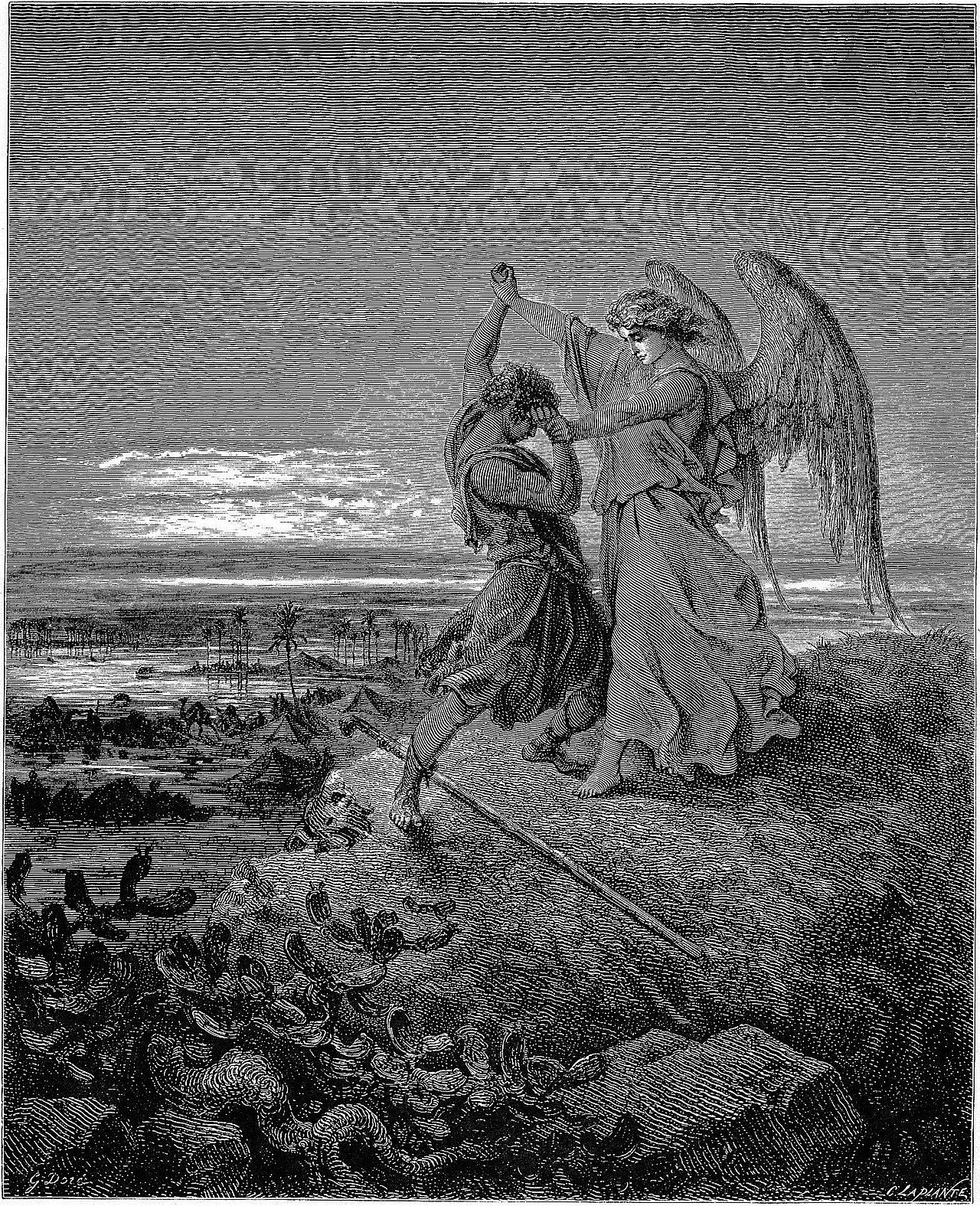
in Genesis 32Then the man said, “Let me go, for it is daybreak.” But Jacob replied, “I will not let you go unless you bless me.”
BSB
The same verse in ASV and KJV ▾
ASV
And he said, Let me go, for the day breaketh. And he said, I will not let thee go, except thou bless me.
KJV
And he said, Let me go, for the day breaketh. And he said, I will not let thee go, except thou bless me.
⋯
This verse in Genesis 32
Commentary
11 notes on this verseYou see how he does not continue fighting at daybreak. In fact, there is no fight for those who already live in the light. It is fitting for those who have been brought to such magnificence to say, "God, my God, I watch you from the light." And in addition, "In the morning you shall hear my voice, in the morning I shall wait on you, and you shall see me."
This site's exposition
Let me go, for it is daybreak
The man asks to be let go at daybreak, and Jacob answers by holding on. He will not release him without a blessing, and that refusal is where the night turns. The blessing he took at Genesis 27 by disguise he now asks for out loud. He asks the one man he cannot deceive.
The record, by era
The Church Fathers2 voices
Now as to the fact that Jacob came to the Jordan and after sending over all his possessions remained alone and wrestled with a man until the break of day.
"Let me go, because it is already morning." "Morning" we understand as the light of truth and wisdom, through whom all things were made. You will enjoy the morning when this night has gone, that is, the iniquity of this world. That's when it will be morning, when the Lord comes, in order to be seen by us as he is already seen by the angels. Because "now we see through a mirror in a riddle, but then it will be face to face." So let us hold fast to this saying, brothers, "Let me go; behold, it is already morning." But what did he say? "I will not let you go, unless you bless me." The Lord, you see, does bless us first through the flesh. The faithful know what they receive, that they are blessed through the flesh. And they know that they would not be blessed unless that flesh had been crucified and given for the life of the world. But how is Jacob blessed? In that he got the upper hand with God, in that he held on bravely and persevered and did not lose from his grasp what Adam lost. So let us, the faithful, hold on to what we receive, in order that we may deserve to be blessed.
The Puritans and the Awakening3 voices
In begging this blessing he owns his inferiority, though he seemed to have the upper hand in the struggle; for the less is blessed of the better. Note, Those that would have the blessing of Christ must be in good earnest, and be importunate for it, as those that resolve to have no denial. It is the fervent prayer that is the effectual prayer.
2 And when Jacob saw them, he said, This is God's host: and he called the name of that place Mahanaim. Jacob, having got clear of Laban, pursues his journey homewards towards Canaan: when God has helped us through difficulties we should go on our way heaven-ward with so much the more cheerfulness and resolution. Here is Jacob's convoy in his journey (
quarantine:debris (2026-07-29) — unbalanced-parens
Could not a mighty angel get clear of Jacob's grapples? He could; but thus he would put an honour upon Jacob's faith and prayer. The reason the angel gives why he would be gone is because the day breaks, and therefore he would not any longer detain Jacob, who had business to do, a journey to go, a family to look after.
4 more voices on this verse
The Puritans and the Awakening2 voices
Lord, what will become of that promise, if they be all cut off? Jacob having piously made God his friend by a prayer, is here prudently endeavouring to make Esau his friend by a present. He had prayed to God to deliver him from the hand of Esau - His prayer did not make him presume upon God's mercy, without the use of means.
And he said, let me go, for the day breaketh,....
The Nineteenth Century2 voices
Let me go, for the day breaketh - Probably meaning, that as it was now morning, Jacob must rejoin his wives and children, and proceed on their journey. Though phantoms are supposed to disappear when the sun rises, that could be no reason in this case. Most of the angelic appearances mentioned in the Old and New Testaments took place in open day, which put their reality out of question.
A commentator
Jamieson, Fausset & Brown1802–1910
Commentary Critical and Explanatory on the Whole Bible (1871)
I will not let thee go, except thou bless me--It is evident that Jacob was aware of the character of Him with whom he wrestled; and, believing that His power, though by far superior to human, was yet limited by His promise to do him good, he determined not to lose the golden opportunity of securing a blessing.
The words behind it
11 Hebrew wordsEvery Hebrew word of this verse in the order it stands, with what it means and the door to its own study. The last column counts the times a word stands in the whole Bible: the rarer the word, the more the places it appears belong together.
| Hebrew | Sound | Meaning | Word study | In the Bible |
|---|---|---|---|---|
| וַיֹּ֣אמֶר | vaiyomer | and he said | H559 → | 5305 times |
| שַׁלְּחֵ֔נִי | shalecheni | let go me | H7971 → | 845 times |
| כִּ֥י | ki | for | H3588 → | 4482 times |
| עָלָ֖ה | ʾalah | it has come up | H5927 → | 890 times |
| הַשָּׁ֑חַר | hashachar | the dawn | H7837 → | 23 times |
| וַיֹּ֙אמֶר֙ | vaiyomer | and he said | H559 → | 5305 times |
| לֹ֣א | lo' | not | H3808 → | 5168 times |
| אֲשַֽׁלֵּחֲךָ֔ | ʾashalechakha | I will let go you | H7971 → | 845 times |
| כִּ֖י | ki | that | H3588 → | 4482 times |
| אִם־ | ʾim- | except | H518 → | 1069 times |
| בֵּרַכְתָּֽנִי׃ | berakhtani | you have blessed me | H1288 → | 330 times |
וַיֹּ֣אמֶרand he said
vaiyomerH559 →5305 times
שַׁלְּחֵ֔נִיlet go me
shalecheniH7971 →845 times
כִּ֥יfor
kiH3588 →4482 times
עָלָ֖הit has come up
ʾalahH5927 →890 times
הַשָּׁ֑חַרthe dawn
hashacharH7837 →23 times
וַיֹּ֙אמֶר֙and he said
vaiyomerH559 →5305 times
לֹ֣אnot
lo'H3808 →5168 times
אֲשַֽׁלֵּחֲךָ֔I will let go you
ʾashalechakhaH7971 →845 times
כִּ֖יthat
kiH3588 →4482 times
אִם־except
ʾim-H518 →1069 times
בֵּרַכְתָּֽנִי׃you have blessed me
berakhtaniH1288 →330 times
A shaded row is a word that stands 400 times or fewer in the Bible.
The walk
8 stopsEach card is a verse this one points to, and under it the verses that one points to in turn. Where several paths arrive at the same place, that place is listed first: the text keeps returning to it.
Through
1 Chronicles 4:10And Jabez called out to the God of Israel, “If only You would bless me and enlarge my territory! May Your hand be with me and keep me from harm, so that I will…
it leads to
- Matthew 7:7–11
Ask, and it will be given to you; seek, and you will find; knock, and the door will be opened to you.
- Psalms 116:1–4
I love the LORD, for He has heard my voice— my appeal for mercy.
- Proverbs 10:22
The blessing of the LORD enriches, and He adds no sorrow to it.
- Jeremiah 33:3
Call to Me, and I will answer and show you great and unsearchable things you do not know.
- Isaiah 41:10
Do not fear, for I am with you; do not be afraid, for I am your God. I will strengthen you; I will surely help you; I will uphold you with My right hand…
- Matthew 7:7–11
Through
Psalms 67:1May God be gracious to us and bless us, and cause His face to shine upon us, Selah
it leads to
- Psalms 4:6
Many ask, “Who can show us the good?” Shine the light of Your face upon us, O LORD.
- 2 Corinthians 4:6
For God, who said, “Let light shine out of darkness,” made His light shine in our hearts to give us the light of the knowledge of the glory of God in the face of…
- Psalms 4:1
Answer me when I call, O God of my righteousness! You have relieved my distress; show me grace and hear my prayer.
- Psalms 4:6
Where this verse is studied
By subject
Prayer34 verses
On this page
Studies2
On this verse
On this chapter
About Genesis
Who and where
1 name in this verse with a page on the site.
This page draws on Adam Clarke, Commentary on the Bible; Augustine of Hippo, SERMON 5.7; Caesarius of Arles, SERMON 88.5; Cyril of Alexandria, GLAPHYRA ON GENESIS, 5.3; Jamieson, Fausset & Brown, Commentary Critical and Explanatory on the Whole Bible; John Gill, Exposition of the Old Testament (1748-1763); John Wesley, Explanatory Notes upon the Old Testament and Matthew Henry, Commentary on the Whole Bible.