
Psalms 133:3
in Psalms 133It is like the dew of Hermon falling on the mountains of Zion. For there the LORD has bestowed the blessing of life forevermore.
BSB
The same verse in ASV and KJV ▾
ASV
Like the dew of Hermon, That cometh down upon the mountains of Zion: For there Jehovah commanded the blessing, Even life for evermore.
KJV
As the dew of Hermon, and as the dew that descended upon the mountains of Zion: for there the Lord commanded the blessing, even life for evermore.
⋯
This verse in Psalms 133
Commentary
12 notes on this verseLike the dew of Hermon, which runs down upon Mount Zion. The dew of Hermon. We read a certain apocryphal book, that at the time when the sons of God descended to the daughters of men, they descended upon Mount Hermon, and there entered into a covenant, how they might come to the daughters of men, and join them to themselves. It is a most manifest book, and it is reckoned among the apocrypha, and the ancient interpreters have said some things about it: but we say this, not for authority, but for remembrance.
This site's exposition
fine oil on the head
on Psalms 133:2-3
The oil is the anointing oil of Exodus 30:30, poured on Aaron, and it runs from the head to the collar. Dew off Hermon settles on the mountains of Zion, and the Hebrew verb behind bestowed is the one for command. What is given there is life forevermore.
This site's exposition
the dew of Hermon falling
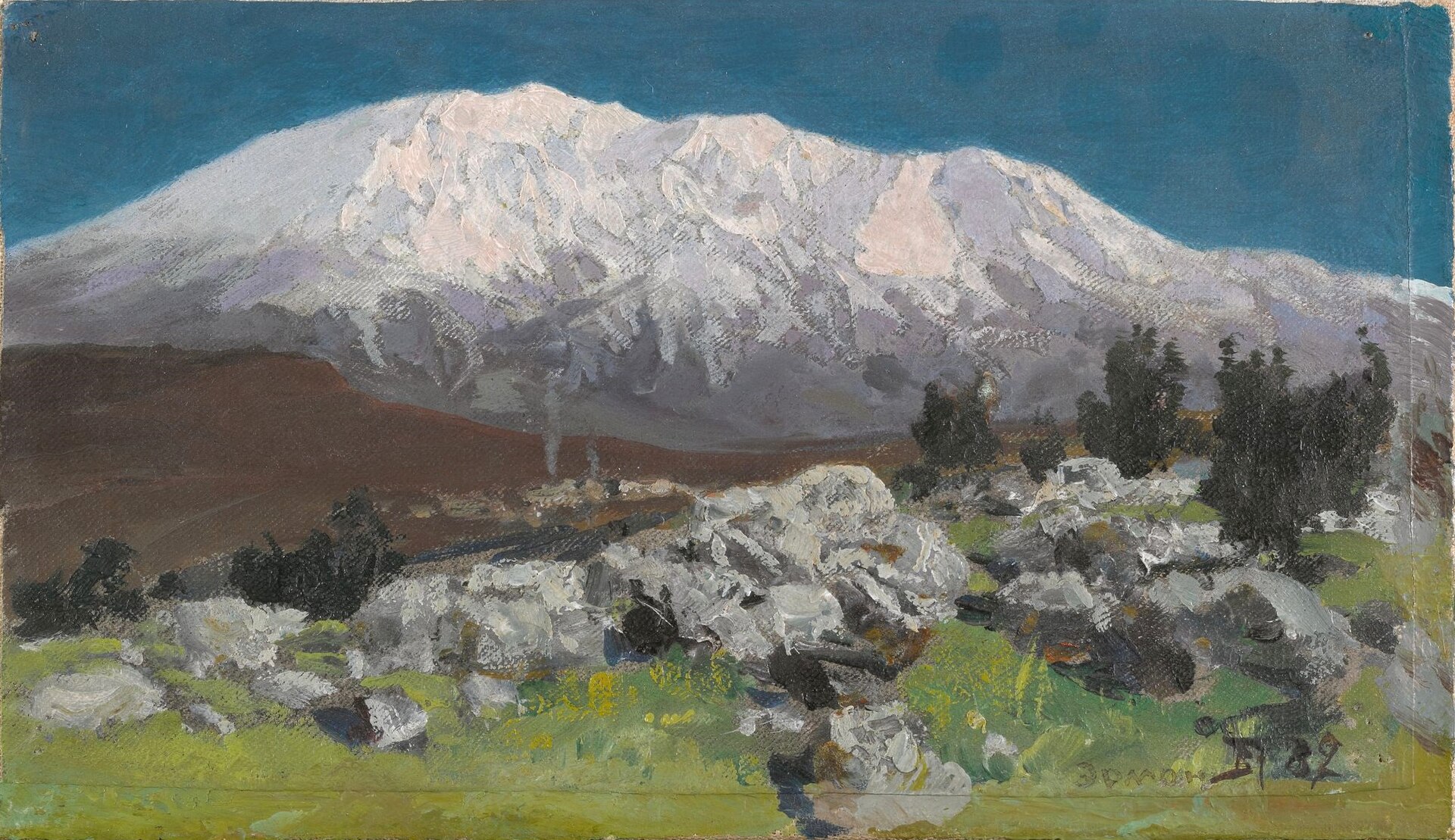
Hermon is the high snow peak of the far north, and its dew falling on the mountains of Zion is a blessing brought far south. Like the oil running down Aaron's beard, the dew comes down from above. There is Zion, the home the LORD chose at Psalm 132:13.
The record, by era
The Church Fathers1 voice
"As the dew of Hermon, which fell upon the hills of Sion" [Psalm 133:3]. He would have it understood, my brethren, that it is of God's grace that brethren dwell together in unity. ... But ye should know what Hermon is. It is a mountain far distant from Jerusalem, that is, from Sion. And so it is strange that he says thus: As the dew of Hermon, which fell upon the mountains of Sion, since mount Hermon is far distant from Jerusalem, for it is said to be over Jordan. Let us then seek out some interpretation of Hermon. The word is Hebrew, and we learn its meaning from them who know that language. Hermon is said to mean, a light set on a high place. For from Christ comes the dew. No light is set on a high place, save Christ. How is He set on high? First on the cross, afterwards in heaven. Set on high on the cross when He was humbled; humbled, but His humiliation could not but be high. The ministry of man grew less and less, as was signified in John; the ministry of God in our Lord Jesus Christ increased, as was shown at their birth. The former was born, as the tradition of the Church shows, on the 24th of June, when the days begin to shorten. The Lord was born on the 25th of December, when the days begin to lengthen. Here John himself confessing, "He must increase, but I must decrease." And the passion of each shows this. The Lord was exalted on the cross; John was diminished by beheading. Thus the light set on high is Christ, whence is the dew of Hermon. ...But if he have the dew of Hermon, which fell on the hill of Sion, he is quiet, peaceable, humble, submissive, pouring forth prayer in place of murmuring. For murmurers are admirably described in a certain passage of the Scriptures, "The heart of a fool is as the wheel of a cart." What is the meaning of "the heart of a fool is as the wheel of a cart"? It carries hay, and creaks. […]
The Puritans and the Awakening3 voices
As the dew of Hermon, and as the dew that descended upon the mountains of Zion,.... Hermon was a very high hill beyond Jordan; the Sidonians called it Sirion, and the Amorites Shenir, Deu 3:8; hence Shenir and Hermon are mentioned together, Son 4:8; and sometimes Sion or Seon, Deu 4:48; and is the Zion here intended; for the dew of Hermon could never descend on the mountain of Zion near Jerusalem, which was a hundred miles distant; besides Zion was but one mountain, these many.
); and then we are left to make the application, which we ought to do in singing it, provoking ourselves and one another to holy love. The contents of this psalm in our Bibles, are short, but very proper; it is "the benefit of the communion of saints." Brotherly Love.
quarantine:debris (2026-07-29) — leading-punctuation+unbalanced-parens
Zion - It is as desirable as the dew which falls upon mount Hermon, nay, as desirable as that heavenly dew of God's ordinances and graces which he hath commanded to fall upon the mountains of Zion and Moriah, and others which are round about Jerusalem.
The Nineteenth Century1 voice
As the dew of Hermon, and as the dew that descended upon the mountains of Zion. From the loftier mountains the moisture appears to be wafted to the lesser hills: the dews of Hermon fall on Zion. The Alpine Lebanon ministers to the minor elevation of the city of David; and so does brotherly love descend from the higher to the lower, refreshing and enlivening in its course. Holy concord is as dew, mysteriously blessed, full of life and growth for all plants of grace.
4 more voices on this verse
The Nineteenth Century3 voices
As the dew of Hermon, and as the dew that descended upon the mountains of Zion. From the loftier mountains the moisture appears to be wafted to the lesser hills: the dews of Hermon fall on Zion. The Alpine Lebanon ministers to the minor elevation of the city of David; and so does brotherly love descend from the higher to the lower, refreshing and enlivening in its course. Holy concord is as dew, mysteriously blessed, full of life and growth for all plants of grace. It brings with it so much benediction that it is as no common dew, but As that of Hermon which is specially copious, and far reaching. The proper rendering is, "As the dew of Hermon that descended upon the mountains of Zion", and this tallies with the figure which has been already used; and sets forth by a second simile the sweet descending diffusiveness of brotherly unity. For there the Lord commanded the blessing, even life for evermore. That is, in Zion, or better still, in the place where brotherly love abounds. Where love reigns God reigns. Where love wishes blessing, there God commands the blessing. God has but to command, and it is done. He is so pleased to see his dear children happy in one another that he fails not to make them happy in himself. He gives especially his best blessing of eternal life, for love is life; dwelling together in love we have begun the enjoyments of eternity, and these shall not be taken from us. Let us love for evermore, and we shall live for evermore. This makes Christian brotherhood so good and pleasant; it has Jehovah's blessing resting upon it, and it cannot be otherwise than sacred like "the precious ointment", and heavenly like "the dew of Hermon." O for more of this rare virtue!
As the dew of Hermon, and as the dew that descended upon the mountains of Zion - This was not Mount Zion, ציון tsiyon, in Jerusalem, but Sion, שיאן which is a part of Hermon, see Deu 4:48: “Mount Sion, which is Hermon.” On this mountain the dew is very copious. Mr. Maundrell says that “with this dew, even in dry weather, their tents were as wet as if it had rained the whole night.” This seems to show the strength of the comparison. For there - Where this unity is. The Lord commanded the blessing - That is, an everlasting life. There he pours out his blessings, and gives a long and happy life. For other particulars, see the commentators passim, and the following analysis.
A commentator
Albert Barnes1798–1870
Notes, Explanatory and Practical, on the Old and New Testaments (1832-1869)
proposed
As the dew of Hermon ... - On the situation of Mount Hermon, see the notes at Psa 89:12. The literal rendering of this passage would be, “Like the dew of Hermon which descends on the mountains of Zion.” According to our version two things are referred to: the dew of Hermon, and the dew on the mountains of Zion, But this is not in the original. There no dew is referred to but that which belongs to Hermon. It has, of course, been made a question how the dew of Hermon, a remote mountain, could be said to descend on the mountains of Zion, and our translators have sought to solve the difficulty by inserting the words “and as the dew.” Some have supposed that the proper interpretation is to refer the comparison in the passage to the dew of Hermon, and that all which follows is an application of the thought: “Like the dew of Hermon is the influence which comes down upon the mountains of Zion,” etc. The most probable and plausible interpretation, however, it seems to me, is, that the mind of the poet was turned to the dew of Hermon - to the gentleness, and the copiousness, and the vivifying nature of that dew - diffusing beauty and abundance all around - and that he thought of that dew, or dew like that, as descending on the mountains of Zion. Not that the dew of Hermon actually descended there; but when changing the comparison, in illustration of brotherly love, from oil to dew, he most naturally thought (perhaps from some former observation) of the dew of Hermon, and immediately thought of Zion as if that dew descended there: that is, love, unity, and concord there would be as if the dew of Hermon should descend on the barren hills of Zion or Jerusalem, there diffusing beauty, abundance, fertility. The comparison of the influence of brotherly love, or unity, with dew is not a forced or unnatural one. […]
Modern Voices1 voice
I've learned that broken covenants impact your spiritual authority because disunity diminishes the anointing (Ps. 133) and creates conditions for the curse.
The words behind it
15 Hebrew wordsEvery Hebrew word of this verse in the order it stands, with what it means and the door to its own study. The last column counts the times a word stands in the whole Bible: the rarer the word, the more the places it appears belong together.
| Hebrew | Sound | Meaning | Word study | In the Bible |
|---|---|---|---|---|
| כְּטַל־ | ketal- | like [the] dew of | H2919 → | |
| חֶרְמ֗וֹן | chermon | Hermon | H2768 → | |
| שֶׁיֹּרֵד֮ | sheiyored | that [is] running down | H3381 → | 381 times |
| עַל־ | ʾal- | on | H5921 → | 5755 times |
| הַרְרֵ֪י | harei | [the] mountains of | H2042 → | 12 times |
| צִ֫יּ֥וֹן | tziyon | Zion | H6726 → | 154 times |
| כִּ֤י | ki | for | H3588 → | 4482 times |
| שָׁ֨ם׀ | sham | there | H8033 → | 834 times |
| צִוָּ֣ה | tzivah | he has commanded | H6680 → | 494 times |
| יְ֭הוָה | yahweh | Yahweh | H3068 → | 6520 times |
| אֶת־ | ʾet- | <obj.> | H853 → | 10935 times |
| הַבְּרָכָ֑ה | haberakhah | the blessing | H1293 → | 69 times |
| חַ֝יִּ֗ים | chaiyim | life | H2416 → | 498 times |
| עַד־ | ʾad- | until | H5704 → | 1261 times |
| הָעוֹלָֽם׃ | haolam | <the> perpetuity | H5769 → | 438 times |
כְּטַל־like [the] dew of
ketal-H2919 →
חֶרְמ֗וֹןHermon
chermonH2768 →
שֶׁיֹּרֵד֮that [is] running down
sheiyoredH3381 →381 times
עַל־on
ʾal-H5921 →5755 times
הַרְרֵ֪י[the] mountains of
hareiH2042 →12 times
צִ֫יּ֥וֹןZion
tziyonH6726 →154 times
כִּ֤יfor
kiH3588 →4482 times
שָׁ֨ם׀there
shamH8033 →834 times
צִוָּ֣הhe has commanded
tzivahH6680 →494 times
יְ֭הוָהYahweh
yahwehH3068 →6520 times
אֶת־<obj.>
ʾet-H853 →10935 times
הַבְּרָכָ֑הthe blessing
haberakhahH1293 →69 times
חַ֝יִּ֗יםlife
chaiyimH2416 →498 times
עַד־until
ʾad-H5704 →1261 times
הָעוֹלָֽם׃<the> perpetuity
haolamH5769 →438 times
A shaded row is a word that stands 400 times or fewer in the Bible.
The walk
8 stopsEach card is a verse this one points to, and under it the verses that one points to in turn. Where several paths arrive at the same place, that place is listed first: the text keeps returning to it.
Through
1 John 5:11And this is that testimony: God has given us eternal life, and this life is in His Son.
it leads to
- Romans 6:23
For the wages of sin is death, but the gift of God is eternal life in Christ Jesus our Lord.
- 1 John 2:25
And this is the promise that He Himself made to us: eternal life.
- John 3:36
Whoever believes in the Son has eternal life. Whoever rejects the Son will not see life. Instead, the wrath of God remains on him.”
- 1 John 5:20
And we know that the Son of God has come and has given us understanding, so that we may know Him who is true; and we are in Him who is true—in His Son…
- John 1:4
In Him was life, and that life was the light of men.
- Romans 6:23
Through
Leviticus 25:21But I will send My blessing upon you in the sixth year, so that the land will yield a crop sufficient for three years.
it leads to
- Deuteronomy 28:8
The LORD will decree a blessing on your barns and on everything to which you put your hand; the LORD your God will bless you in the land He is giving you.
Reached by 2 separate paths from here.
- Deuteronomy 28:8
Through
Deuteronomy 28:8The LORD will decree a blessing on your barns and on everything to which you put your hand; the LORD your God will bless you in the land He is giving you.
it leads to
- Deuteronomy 15:10
Give generously to him, and do not let your heart be grieved when you do so. And because of this the LORD your God will bless you in all your work and in everything…
- Leviticus 26:10
You will still be eating the old supply of grain when you need to clear it out to make room for the new.
- Deuteronomy 15:10
Where this verse is studied
On this page
Studies1
About Psalms
Who and where
1 name in this verse with a page on the site.
This page draws on 11 works. Open the list of works
This page draws on Adam Clarke, Commentary on the Bible; Albert Barnes, Notes on the Book of Psalms; Albert Barnes, Notes, Explanatory and Practical, on the Old and New Testaments (1832-1869); Augustine of Hippo, Exposition on Psalm 133; Charles Spurgeon, The Treasury of David, Vol. 7; Franz Delitzsch, Biblical Commentary on the Psalms; Jennifer Eivaz, Unroll the Scroll (blog article, JenniferEivaz.com); Jerome, Homily 45, on Psalm 132; John Gill, Exposition of the Old Testament (1748-1763); John Wesley, Explanatory Notes upon the Old Testament and Matthew Henry, Commentary on the Whole Bible.