
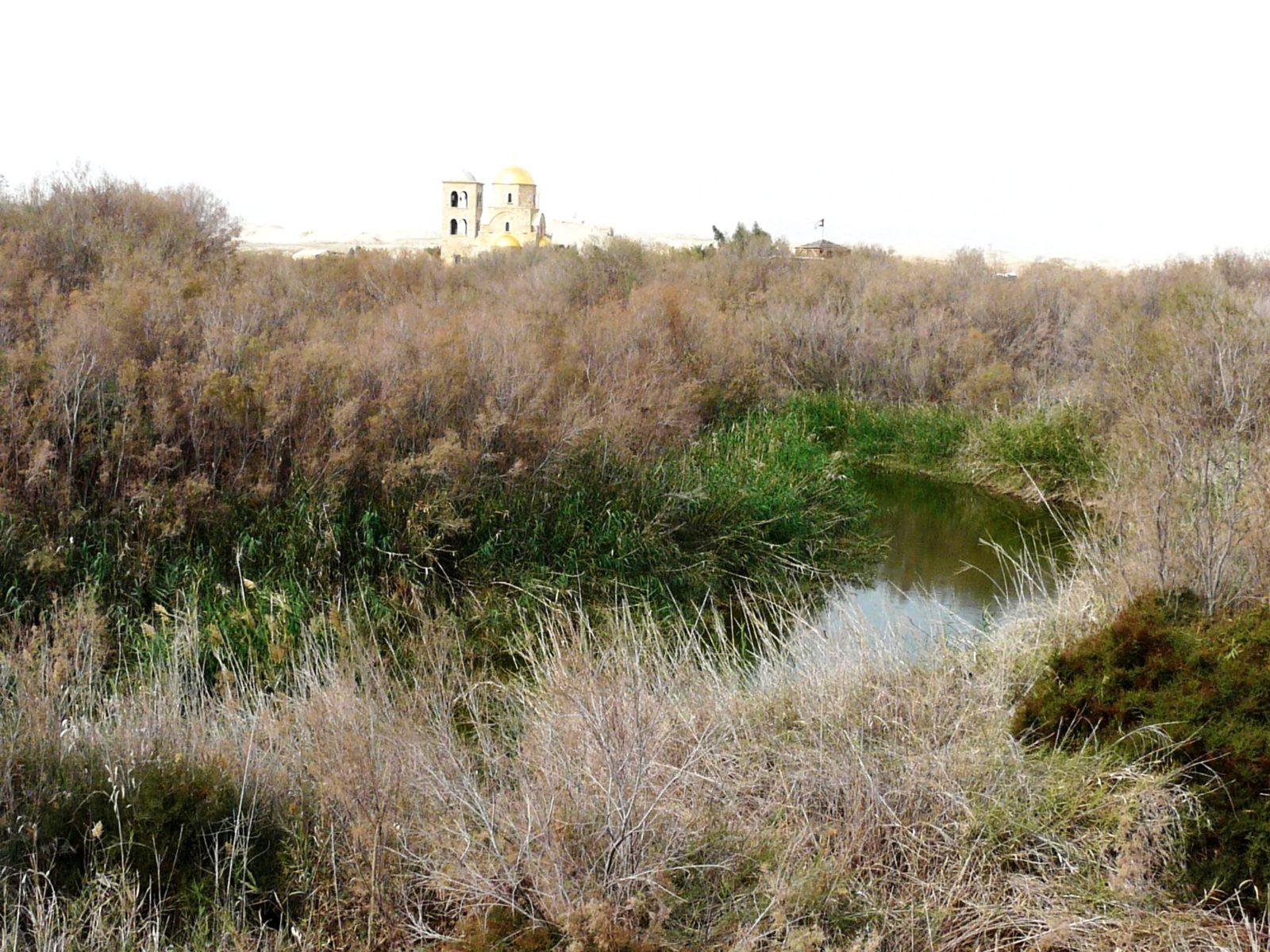
Yong Woo Park, The Jordan River in front of the plains of Moab opposite Jericho, 2007. Public domain.
Numbers 22:1 · Place · Featured Study
The Plains of Moab
Israel's last camp before the Jordan stretched along the river from Beth-jeshimoth to Abel-shittim (Numbers 33:49).
Then the Israelites traveled on and camped in the plains of Moab near the Jordan, across from Jericho.
- Region
- The Jordan valley north-east of the Dead Sea
- First named
- Numbers 22:1 “…on and camped in the plains of Moab…”
- Last named
- Joshua 13:32 “…had given them on the plains of Moab…”
Twelve verses of the Berean text name the plains of Moab.
Summary
The tribes set out from the mountains of Abarim and camped on the plains of Moab (Numbers 33:48).
- Israel grieved for Moses thirty days on these plains (Deuteronomy 34:8).
- Moses and Eleazar counted the people again here (Numbers 26:63).
- No one knows the place of Moses' grave (Deuteronomy 34:6).
The Last Camp
Two commentaries explain why the ground kept the name of Moab.
Why is the camp across from Jericho called the plains of Moab? Numbers 21:26 says Sihon king of the Amorites had fought against the former king of Moab and taken all his land as far as the Arnon. Deuteronomy 4:46 sets the camp in the valley across the Jordan facing Beth-peor, in the land of Sihon. Jamieson, Fausset and Brown, on Numbers 22:1, say the plains were so called from having formerly belonged to Moab, though wrested from it by Sihon. Albert Barnes, on Deuteronomy 1:5, says the district retained its name from the Moabites. The word rendered plains is the plural of arabah, which Barnes, on Numbers 22:1, says names the whole sunken tract along the Jordan and the Dead Sea.
The Plains on Fuller's Plate
On the plate Reuben the plain lies between the river and the hills of Abarim, and a man stands on the top of Pisgah.
Eight marks on Fuller's plate of Reuben, from Jericho to Mount Nebo.
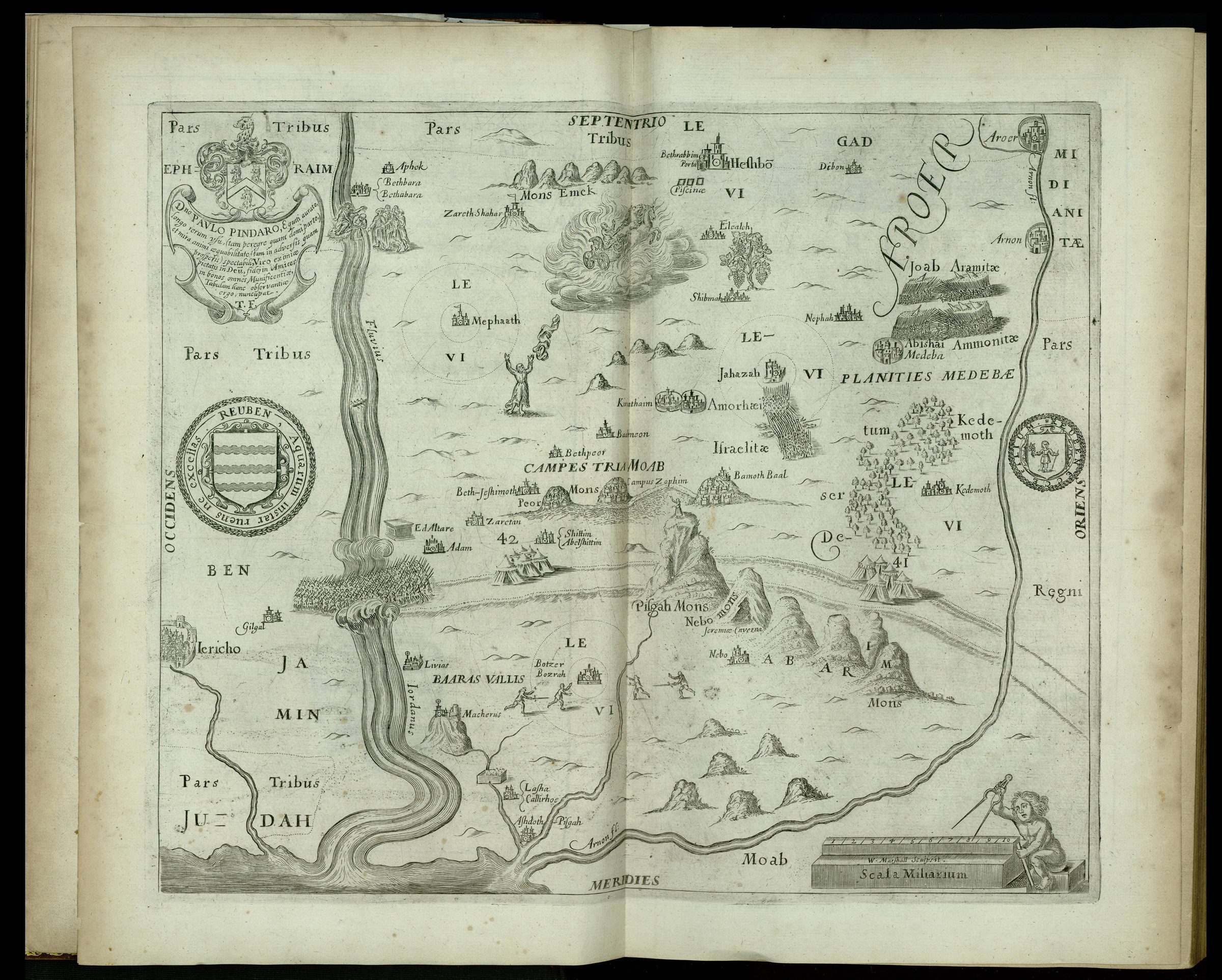
- Plains of MoabThe plate prints Campestria Moab, the fields of Moab, across the plain. OpenBible rates the identification known.Numbers 33:50
- Beth-jeshimothThe plate draws a walled town by this name on the plain north of Shittim, beside the hill Peor. OpenBible rates the identification probable.Numbers 33:49
- Abel-shittimThe plate writes Shittim and Abelshittim beside one town south of Beth-jeshimoth. OpenBible lists Abel-shittim as another name for Shittim and rates it probable.Numbers 33:49
- The campThe plate draws the tents by the river, south of Shittim, and numbers them 42. OpenBible rates the plains of Moab known.Numbers 33:48
- PisgahThe plate prints Pisgah Mons on the ridge east of the camp. OpenBible rates the identification proposed.Deuteronomy 34:1
- Mount NeboThe plate prints Nebo mons beside Pisgah. OpenBible rates the identification proposed.Deuteronomy 32:49
- Mountains of AbarimThe plate draws these mountains south-east of the camp. OpenBible rates the identification known.Numbers 33:48
- JerichoThe plate prints Iericho across the river from the camp. OpenBible rates the identification known.Numbers 26:3
Thomas Fuller, Reuben, A Pisgah-Sight of Palestine, 1650, engraved by W. Marshall. Public domain (PD-old-assumed); Eran Laor Cartographic Collection, National Library of Israel; Wikimedia Commons, File:Thomas_Fuller,_Reuben_(FL199985342_2368554).jpg.
Eight places are numbered where the plate prints them. The plate Reuben of Thomas Fuller's A Pisgah-Sight of Palestine, 1650, was engraved by W. Marshall. It is a seventeenth-century maker's drawing of the land, with scenes from several books. Each label gives what the plate shows and its verse. A place with its own entry in the OpenBible gazetteer also carries that entry's rating of its modern identification. North is at the top, and the plate is not to a modern scale.
The plate also draws Peor of Numbers 25 and Beth-peor, which faced the valley where Israel stayed (Deuteronomy 3:29). It draws the people crossing the Jordan where the water stood still as far upstream as Adam (Joshua 3:16).
What Happened at the Camp
No verse moves the camp between its arrival on the plains and Joshua 3:1.
Eight events from Numbers 22 to Joshua 3 fall in Israel's time on the plains.
- NumbersBalak king of Moab sends messengers to Balaam son of BeorNumbers 22:5
- NumbersWhile Israel is staying in Shittim, Israel joins in worshiping Baal of PeorNumbers 25:1 to 3
- NumbersThe captives, spoils and plunder of Midian are brought to the campNumbers 31:12
- NumbersMoses gives the kingdoms of Sihon and Og to Gad, Reuben and the half-tribe of ManassehNumbers 32:33
- NumbersThe LORD speaks to Moses of the towns of the Levites and the cities of refugeNumbers 35:1
- DeuteronomyMoses goes up from the plains to Mount NeboDeuteronomy 34:1
- JoshuaJoshua sends two spies from Shittim to JerichoJoshua 2:1
- JoshuaIsrael leaves Shittim for the JordanJoshua 3:1
Each row gives its verse in the Berean text.
Joshua
The Law Given in Moab
The last verse of Numbers and the fifth of Deuteronomy both set Moses' teaching of the law on this ground.
These are the commandments and ordinances that the LORD gave the Israelites through Moses on the plains of Moab by the Jordan across from Jericho.The verse closes Numbers by placing these commandments on the plains of Moab.
On the east side of the Jordan in the land of Moab, Moses began to explain this law, saying:Deuteronomy 1:1 names the Arabah, and this verse adds the land of Moab.
Deuteronomy 29:1 calls the words Moses spoke there a covenant made in the land of Moab, in addition to the covenant made at Horeb.
Beth-jeshimoth and Abel-shittim
Joshua 13:20 lists Beth-jeshimoth among the towns Moses gave to Reuben.
Adam Clarke, on Numbers 33:49, points to the same list in Joshua 13. He notes that Israel had now come to the edge of the Jordan, opposite Jericho, where it later crossed. Barnes, on Joshua 3:1, renders Shittim as the acacia groves and says they line the upper terraces of the valley on both sides of the river.
What Scripture Leaves Unsaid
Three things about the camp are left untold.
The Road Micah Remembers
In Micah 6:5 Shittim and Gilgal stand for the two ends of the crossing.
My people, remember what Balak king of Moab counseled and what Balaam son of Beor answered. Remember your journey from Shittim to Gilgal, so that you may acknowledge the righteousness of the LORD.’”The prophet makes the camp's story a reason to acknowledge the LORD's righteousness.
Albert Barnes on the Census
Barnes writes on the generation that died in the wilderness.
Albert Barnes (1798 to 1870)
Numbers 26:64 to 65 says no one counted at Sinai was counted here; Barnes adds when the last of them had died.
“It appears from Deu 2:14-15 that the generation numbered at the former census had perished before the host crossed the brook Zered.”
Albert Barnes · Notes, Explanatory and Practical, on the Old and New Testaments (1832-1869) · on Numbers 26:64Evangelical
The Word Is Near
But the word is very near you; it is in your mouth and in your heart, so that you may obey it.Moses gives this word on the plains, in his last speeches to Israel.
Paul quotes Deuteronomy 30:14 in Romans 10:8 and calls it the word of faith that he and his companions proclaim.
Sources
Scripture is the Berean Standard Bible.
- STEP Bible TBESH glosses (Tyndale House, CC BY 4.0), entry h6160 arabah.
- OpenBible.info, Bible Geocoding Data, ancient places (CC BY 4.0)
- Albert Barnes, Notes, Explanatory and Practical, on the Old and New Testaments, on Numbers 22:1.
- Albert Barnes, Notes, Explanatory and Practical, on the Old and New Testaments, on Deuteronomy 1:5.
- Albert Barnes, Notes, Explanatory and Practical, on the Old and New Testaments, on Joshua 3:1.
- Albert Barnes, Notes, Explanatory and Practical, on the Old and New Testaments, on Numbers 26:64.
- Jamieson, Fausset and Brown, Commentary Critical and Explanatory on the Whole Bible, on Numbers 22:1.
- Adam Clarke, Commentary on the Bible, on Numbers 33:49.
Keep Studying
Read it5
Studies6