
Hebrews 7:9
in Hebrews 7And so to speak, Levi, who collects the tenth, paid the tenth through Abraham.
BSB
The same verse in ASV and KJV ▾
ASV
And, so to say, through Abraham even Levi, who receiveth tithes, hath paid tithes;
KJV
And as I may so say, Levi also, who receiveth tithes, payed tithes in Abraham.
⋯
This verse in Hebrews 7
Commentary
15 notes on this verseA commentator
Albert Barnes1798–1870
Notes, Explanatory and Practical, on the Old and New Testaments (1832-1869)
And as I may so say - So to speak - ὡς ἔπος εἰπεῖν hōs epos eipein. For numerous examples in the classic writers of this expression, see Wetstein in loc.
This site's exposition
paid the tenth through Abraham
on Hebrews 7:9-10
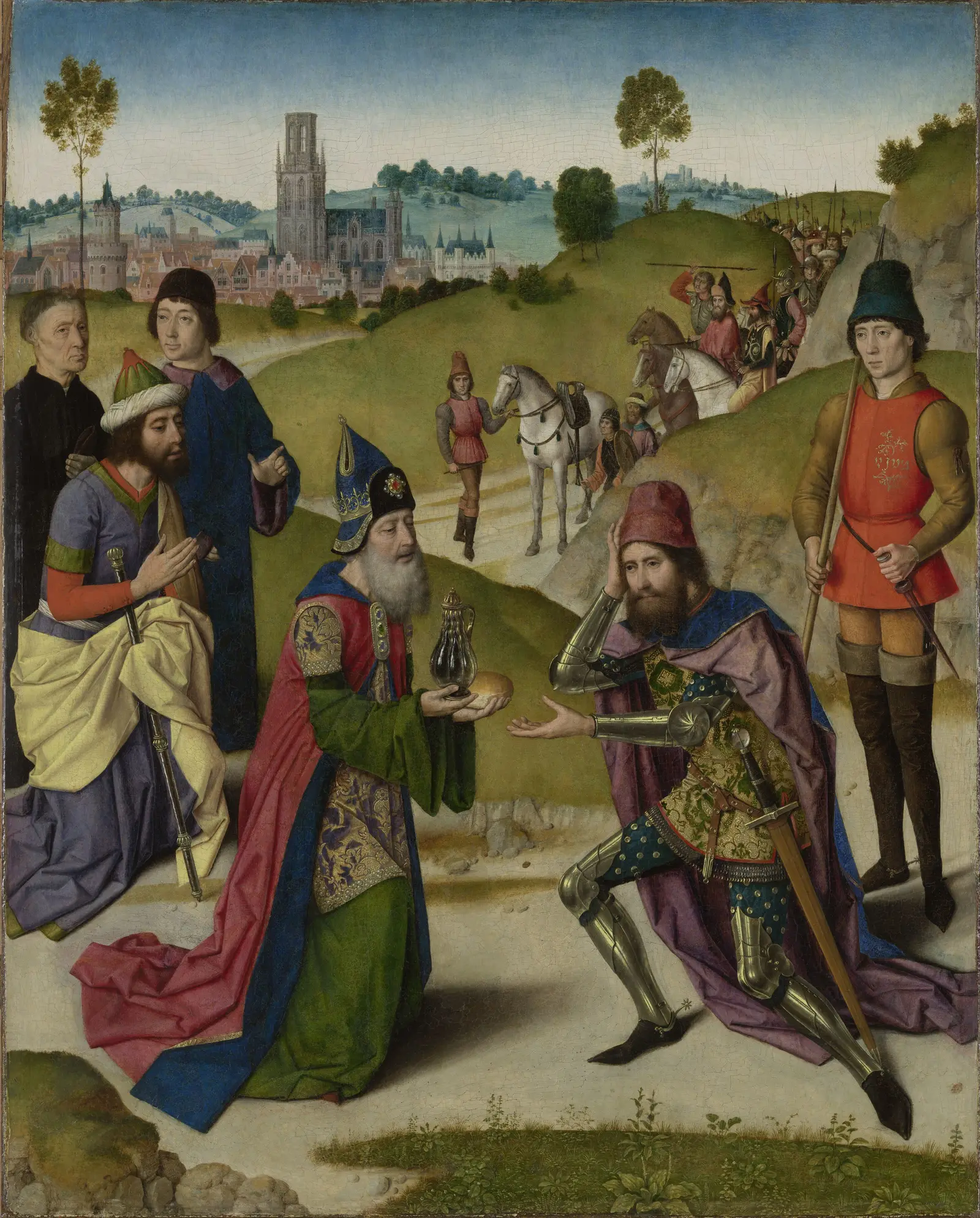
Levi, who collects the tenth, paid the tenth through Abraham, since he was still in the loin of his ancestor. The writer marks this with so to speak, treating the nation as present in its forefather. Levi's whole priesthood is then placed beneath Melchizedek's.
The record, by era
The Church Fathers5 voices
"and so to speak." So that they may not say, "And what," he says, "was also tithing through Abraham?" Yes, he says. For Levi was in Abraham when he gave the tithes, even though he was not yet born. If therefore Levi was in the …
A commentator
Augustine of HippoON THE LITERAL INTERPRETATION OF GENESIS 10.19.34-21.37 · Written in the 5th century.
proposed
Why is it that Scripture reports, for the sake of the tremendous difference between the priesthood of Christ and that of Levi, that Levi paid a tithe to Melchizedek when he was in the loins of Abraham, since Christ was also there, and so both Levi and Christ paid the tithe? Unless it is because we should understand that, in some other way, Christ was not there? But who would deny that Christ was there according to the flesh? Then he was not there according to the soul, for the soul of Christ did not originate through the transmission of the sin of Adam, or else he would have been there.…Levi was surely there in the loins of Abraham in accordance with the transmission of human seed by which he would enter into his mother; Christ was not there through that cause, although the flesh of Mary was. Thus, neither Levi nor Christ were present there according to the soul, but both of them were there according to the flesh. Levi was there according to fleshly desire, while Christ was there only according to his physical substance. For in a seed, there is both a visible physicality and an invisible principle. Both ran their course from Abraham, even from Adam himself, all the way to the body of Mary, since that too was conceived and born in the normal way. So Christ assumed the physical substance of flesh from the flesh of the virgin, but the reason for his conception did not come from a man's seed, but from a much different source—from above. So for this reason, the flesh which he assumed from his mother was also present in the loins of Abraham. So Levi paid a tithe in Abraham, who, although he was only there according to the flesh, was still there in the loins of Abraham, as Abraham also was once in the loins of his own father. […]
A commentator
Augustine of HippoON THE MERITS AND FORGIVENESS OF SINS AND ON INFANT BAPTISM 2.39 · Written in the 5th century.
proposed
We now advance in reply to such as argue that one who is born of a baptized man ought himself to be regarded as already baptized. "For why," they ask, "could he not have been baptized in the loins of his father, when, according to the Epistle to the Hebrews, Levi was able to pay tithes in the loins of Abraham?" They who propose this argument ought to observe that Levi did not on this account subsequently not pay tithes, because he had paid tithes already in the loins of Abraham, but because he was ordained to the office of the priesthood in order to receive tithes, not to pay them; otherwise neither would his brethren, who all contributed their tithes to him, have been tithed—because they too, whilst in the loins of Abraham, had already paid tithes to Melchisedec.
A commentator
Ephrem the SyrianCOMMENTARY ON THE EPISTLE TO THE HEBREWS · Written before 373.
proposed
Through Abraham, who gave him the tenth part, the house of Levi, which had to be generated by him, took the tenth part in him. The Levites, even though they took the tenth part, did not take it from strangers but received the tenth part …
How? "For he was yet in his loins when Melchisedec met him," i.e. Levi was in him, although he was not yet born. And he said not the Levites but Levi. Hast thou seen the superiority? Hast thou seen how great is the interval between Abraham and Melchisedec, who bears the type of our High Priest? And he shows that the superiority had been caused by authority, not necessity. For the one paid the tithe, which indicates the priest: the other gave the blessing, which indicates the superior. This superiority passes on also to the descendants. In a marvelous and triumphant way he cast out the Jewish system. On this account he said, "Ye are become dull," because he wished to lay these foundations, that they might not start away. Such is the wisdom of Paul, first preparing them well, he so leads them into what he wishes. For the human race is hard to persuade, and needs much attention, even more than plants. Since in that case there is only the nature of material bodies, and earth, which yields to the hands of the husbandmen: but in this there is will, which is liable to many alterations, and now prefers this, now that. For it quickly turns to evil.
8 more voices on this verse
The Church Fathers1 voice
Therefore, it is said that Abraham gave tithes, even Levi who receives tithes was himself tithed, that is, he gave tithes. Thus, concerning those words, "through Abraham," a distinction must be made so that the meaning becomes completely undeniable. For because of Abraham's tithing, in …
The Medieval Church3 voices
So that the priests of the law could not say: what relation does it have to us if Abraham gave a tithe? – he says that through the mediation of Abraham, Levi too, the forefather of our priesthood, "who receives tithes,... paid tithes." Thus, is …
A commentator
Photios I of ConstantinopleFRAGMENTS ON THE EPISTLE TO THE HEBREWS 7.9-10 · Written before 893.
proposed
He says, that because Abraham paid tithes, also Levi "who receives tithes himself was made to tithe," that is, he gave a tithe. We must underscore the phrase "through Abraham," so that the meaning does not suffer violence. For because Abraham was made to tithe, …
345. – Then when he says, and one might say that even Levi who received tithes, paid tithes through Abraham, he answers an objection. For someone might say: it is true that Melchizedek is greater than Abraham who gave him tithes; but Levi is greater …
The Puritans and the Awakening2 voices
We were in Adam's loins when he sinned, and the guilt and depravity contracted by the human nature when it was in our first parents are equitably imputed and derived to the same nature as it is in all other persons naturally descended from them. They justly adhere to the nature, and it must be by an act of grace if ever they be taken away.
And as l may so say,.... With truth, and with great propriety and pertinence: Levi also who receiveth tithes; or the Levites, who receive tithes according to the law of Moses from the people of Israel: paid tithes in Abraham; that is, to Melchizedek; and therefore Melchizedek must be greater than they, and his priesthood a more excellent one than theirs; since they who receive tithes from others gave tithes to him.
The Nineteenth Century2 voices
A commentator
Jamieson, Fausset & Brown1802–1910
Commentary Critical and Explanatory on the Whole Bible (1871)
proposed
as I may so say--to preclude what he is about to say being taken in the mere literal sense; I may say that, virtually, Levi, in the person of his father Abraham, acknowledged Melchisedec's superiority, and paid tithes to him. who receiveth tithes--(Compare Heb 7:5). in Abraham--Greek, "by means of (by the hand of) Abraham"; through Abraham.
quarantine:debris (2026-07-29) — starts-lowercase
And as I may so say - Και ὡς επος ειπειν· And so to speak a word. This form of speech, which is very frequent among the purest Greek writers, is generally used to soften some harsh expression, or to limit the meaning when the proposition might otherwise appear to be too general. It answers fully to our so to speak - as one would say - I had almost said - in a certain sense. Many examples of its use by Aristotle, Philo, Lucian, Josephus, Demosthenes, Aeschines, and Plutarch, may be seen in Raphelius and Kypke. Payed tithes in Abraham - The Levites, who were descendants of Abraham, paid tithes to Melchisedec δια through, Abraham, their progenitor and representative.
The words behind it
12 Greek wordsEvery Greek word of this verse in the order it stands, with what it means and the door to its own study. The last column counts the times a word stands in the whole Bible: the rarer the word, the more the places it appears belong together.
| Greek | Sound | Meaning | Word study | In the Bible |
|---|---|---|---|---|
| καὶ | kai | And | G2532 → | 9120 times |
| ὡς | hos | so | G5613 → | 500 times |
| ἔπος | epos | a word | G2031 → | |
| εἰπεῖν· | eipein | to speak; | G2036 → | 925 times |
| δι᾽ | di᾽ | through | G1223 → | 664 times |
| Ἀβραὰμ | abraam | Abraham | G11 → | 73 times |
| καὶ | kai | also | G2532 → | 9120 times |
| Λευὶ | leui | Levi | G3017 → | |
| ὁ | ho | the [one] | G3588 → | 19766 times |
| δεκάτας | dekatas | tithes | G1182 → | 7 times |
| λαμβάνων | lambanon | receiving | G2983 → | 257 times |
| δεδεκάτωται. | dedekatotai | has paid the tithe. | G1183 → |
καὶAnd
kaiG2532 →9120 times
ὡςso
hosG5613 →500 times
ἔποςa word
eposG2031 →
εἰπεῖν·to speak;
eipeinG2036 →925 times
δι᾽through
di᾽G1223 →664 times
ἈβραὰμAbraham
abraamG11 →73 times
καὶalso
kaiG2532 →9120 times
ΛευὶLevi
leuiG3017 →
ὁthe [one]
hoG3588 →19766 times
δεκάταςtithes
dekatasG1182 →7 times
λαμβάνωνreceiving
lambanonG2983 →257 times
δεδεκάτωται.has paid the tithe.
dedekatotaiG1183 →
A shaded row is a word that stands 400 times or fewer in the Bible.
The walk
8 stopsEach card is a verse this one points to, and under it the verses that one points to in turn. Where several paths arrive at the same place, that place is listed first: the text keeps returning to it.
Through
Romans 5:12Therefore, just as sin entered the world through one man, and death through sin, so also death was passed on to all men, because all sinned.
it leads to
- 1 Corinthians 15:21–22
For since death came through a man, the resurrection of the dead comes also through a man.
- Romans 5:19
For just as through the disobedience of the one man the many were made sinners, so also through the obedience of the one man the many will be made righteous.
- Romans 6:23
For the wages of sin is death, but the gift of God is eternal life in Christ Jesus our Lord.
- Romans 3:23
for all have sinned and fall short of the glory of God,
- James 1:15
Then after desire has conceived, it gives birth to sin; and sin, when it is full-grown, gives birth to death.
- 1 Corinthians 15:21–22
Through
Genesis 14:20and blessed be God Most High, who has delivered your enemies into your hand.” Then Abram gave Melchizedek a tenth of everything.
it leads to
- Genesis 28:22
And this stone I have set up as a pillar will be God’s house, and of all that You give me I will surely give You a tenth.”
- Hebrews 7:4–9
Consider how great Melchizedek was: Even the patriarch Abraham gave him a tenth of the plunder.
- Genesis 28:22
Through
Hebrews 7:4Consider how great Melchizedek was: Even the patriarch Abraham gave him a tenth of the plunder.
it leads to
- Genesis 14:20
and blessed be God Most High, who has delivered your enemies into your hand.” Then Abram gave Melchizedek a tenth of everything.
- Genesis 14:20
Where this verse is studied
On this page
Studies15
On this verse
On this chapter
About Hebrews
Who and where
1 name in this verse with a page on the site.
This page draws on 14 works. Open the list of works
This page draws on Adam Clarke, Commentary on the Bible; Albert Barnes, Notes, Explanatory and Practical, on the Old and New Testaments (1832-1869); Augustine of Hippo, ON THE LITERAL INTERPRETATION OF GENESIS 10.19.34-21.37; Augustine of Hippo, ON THE MERITS AND FORGIVENESS OF SINS AND ON INFANT BAPTISM 2.39; Ephrem the Syrian, COMMENTARY ON THE EPISTLE TO THE HEBREWS; Jamieson, Fausset & Brown, Commentary Critical and Explanatory on the Whole Bible; John Calvin, Commentary on Hebrews; John Chrysostom, Homily on Hebrews 12; John Gill, Exposition of the New Testament (1746-1748); Matthew Henry, Commentary on the Whole Bible; Oecumenius, The Pseudo-Oecumenian Catena on Hebrews; Photios I of Constantinople, FRAGMENTS ON THE EPISTLE TO THE HEBREWS 7.9-10; Theophylact of Ohrid, Commentary on Hebrews and Thomas Aquinas, Commentary on Hebrews.