
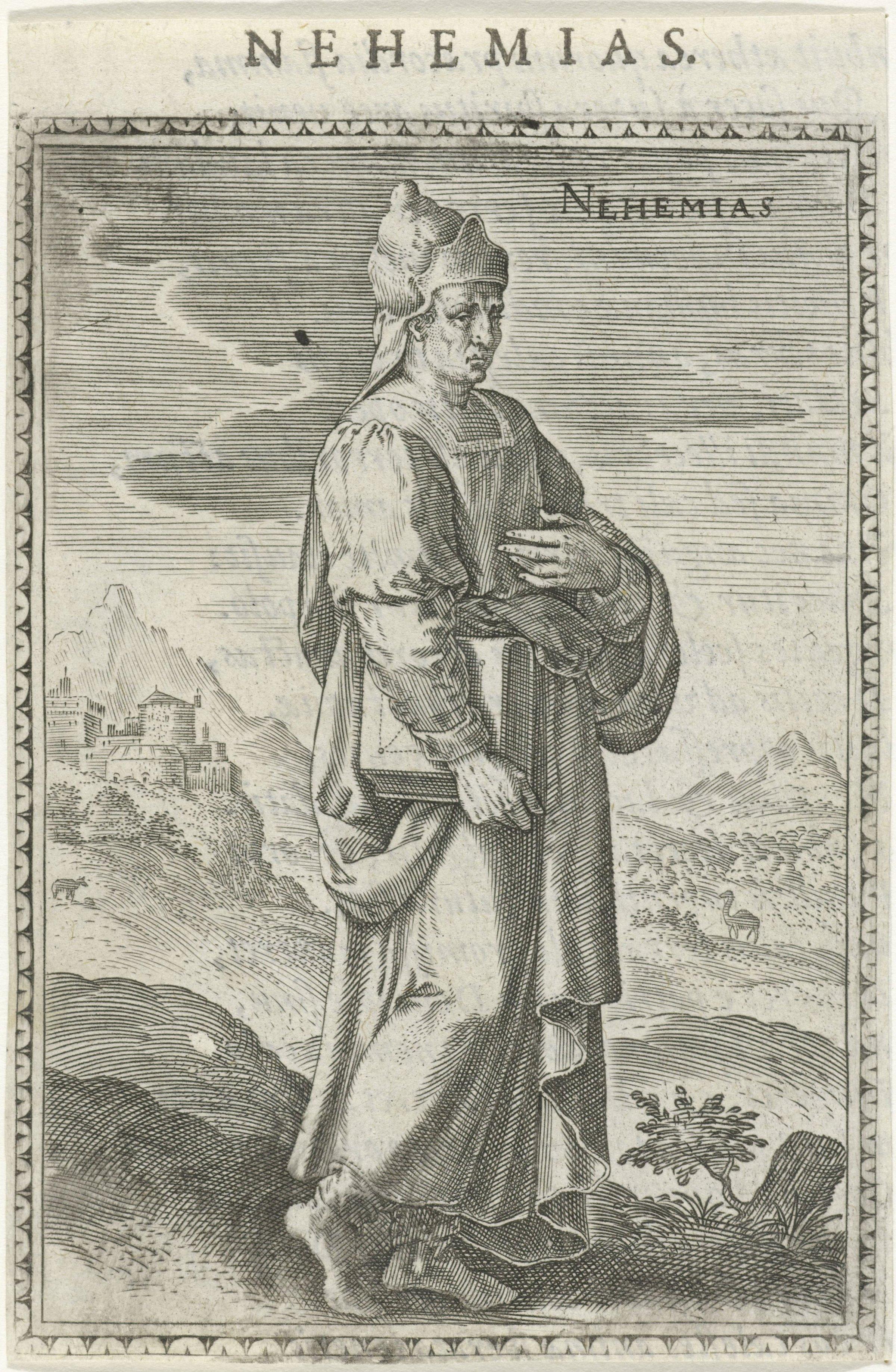
Johann Sadeler I after Crispijn van den Broeck, Nehemias, 1577. Public domain.
Nehemiah 10 and 13 · Doctrine · Featured Study
The Covenant of Nehemiah 10 and Its Undoing
In Nehemiah 10 the people of Judah sealed a written covenant to keep the Law, and Nehemiah 13 finds three of its promises broken.
The covenant's last promise was that the house of God would not be neglected, and Nehemiah's rebuke in chapter 13 asked why it had been.
hereby join with their noble brothers and commit themselves with a sworn oath to follow the Law of God given through His servant Moses and to carefully obey all the commandments, ordinances, and statutes of the LORD our Lord.
hereby join with their noble brothers and commit themselves with a sworn oath to follow the Law of God given through His servant Moses and to carefully obey all the commandments, ordinances, and statutes of the LORD our Lord.
- First taught
- Nehemiah 9:38 “In view of all this, we make a…”
- Fullest statement
- Nehemiah 10:28 to 39 “The rest of the people—the priests, Levites, gatekeepers,…”
Summary
The covenant answered the confession of Nehemiah 9. The leaders set their seals to it, and the rest of the people swore an oath.
- Its promises dealt with marriage, the Sabbath and the temple.
- Within a few years the marriages, the Sabbath and the Levites' pay had slipped.
- Readers differ on whether chapter 10 came before chapter 13 or after it.
A Covenant in Writing
The covenant answers the prayer of confession in Nehemiah 9.
This study asks what the people of Nehemiah 10 promised and how much of it held. It sets each measure beside chapter 13, follows the covenant renewals of Scripture and weighs when the chapter belongs.
In view of all this, we make a binding agreement, putting it in writing and sealing it with the names of our leaders, Levites, and priests.”It shows the covenant as the prayer's answer, made in writing so that it could be held to.
Now these were the ones who sealed the document: Nehemiah the governor, son of Hacaliah, and also Zedekiah,It shows the governor putting his own name first.
Chapters 8 and 9, which led to the covenant, are told on the page of the return.
amanah (Hebrew, H548)
2 uses in the canon
Strong's dictionary glosses the word of Nehemiah 9:38 as something fixed, a covenant, and also an allowance. Its other use is the king's ordinance for the singers.
Covenants Renewed in Scripture
Scripture records Israel binding itself to the LORD at Sinai and many times after.
Eight renewals of the covenant, and Jeremiah's promise of a new one.
- Text
- Exodus 24:7
- What the text adds
- The people answer the Book of the Covenant with a vow to obey
2Moab
- Text
- Deuteronomy 29:12
- What the text adds
- Moses brings the people into the covenant and its oath
- Text
- Joshua 24:25
- What the text adds
- Joshua makes a covenant for the people and sets a statute
4Asa
- Text
- 2 Chronicles 15:12
- What the text adds
- The people enter a covenant to seek the LORD with all their heart
- Text
- 2 Chronicles 29:10
- What the text adds
- The king resolves on a covenant to turn away the LORD's anger
- Text
- 2 Kings 23:3
- What the text adds
- The king binds the people to the words written in the book
7Ezra
- Text
- Ezra 10:3
- What the text adds
- Shecaniah proposes a covenant to send away the foreign wives
- Text
- Nehemiah 10:29
- What the text adds
- The people swear to keep the Law that came through Moses
- Text
- Jeremiah 31:33
- What the text adds
- The LORD promises to write His law on the heart
Nine texts in the order of the events, with Jeremiah's promise last.
Ezra, Nehemiah, The new covenant
The covenant at Shechem and Josiah's revival each have their own study.
The Seven Measures and Chapter 13
The table follows Batten's count of seven measures, and leaves out the firstborn of Nehemiah 10:36.
Each measure of the covenant stands beside its record in Nehemiah 13.
| Measure | The promise | In Nehemiah 13 |
|---|---|---|
| Marriages | No marriage with the peoples of the land, Nehemiah 10:30 | Broken, Nehemiah 13:23 |
| The Sabbath | No buying on the Sabbath, Nehemiah 10:31 | Broken, Nehemiah 13:15 |
| The seventh year | Fields fallow and debts cancelled every seventh year, Nehemiah 10:31 | Not mentioned |
| The temple tax | A third of a shekel a year, Nehemiah 10:32 | Not mentioned |
| The wood | Wood for the altar by lot, Nehemiah 10:34 | Nehemiah arranged for it, Nehemiah 13:31 |
| The firstfruits | The firstfruits each year, Nehemiah 10:35 | Nehemiah arranged for it, Nehemiah 13:31 |
| The tithes | A tenth for the Levites, Nehemiah 10:37 | Broken, Nehemiah 13:10 |
So I rebuked the officials and asked, “Why has the house of God been neglected?” Then I gathered the Levites and singers together and stationed them at their posts,It shows Nehemiah holding the officials to their own promise.
The study of the half shekel asks why the pledge was a third of a shekel, and the book page of Nehemiah sets out what Nehemiah did at each reform.
What the Text Leaves Unsaid
Ezra's name is missing from the covenant's list.
Ezra read the Law in Nehemiah 8, and his name is absent from the list of Nehemiah 10:1 to 27.
John Wesley offers a reason drawn from Ezra's later return to the story.
“It may seem strange that Ezra doth not appear among them. But that might be because he was prevented, by some sickness, or other extraordinary impediment. It is true, we meet with Ezra after this, at the dedication of the wall of Jerusalem, chap. xii, 36, and therefore he was then freed from this impediment, whatsoever it was.”
John Wesley · Explanatory Notes upon the Old Testament · on Nehemiah 10:1Evangelical
A Covenant Written on the Heart
Jeremiah promised a new covenant, and Paul says the Spirit writes it on human hearts.
It will not be like the covenant I made with their fathers when I took them by the hand to lead them out of the land of Egypt—a covenant they broke, though I was a husband to them,” declares the LORD.It shows that breaking a covenant was Israel's old pattern, before Nehemiah's day.
It is clear that you are a letter from Christ, the result of our ministry, written not with ink but with the Spirit of the living God, not on tablets of stone but on tablets of human hearts.It shows the new covenant's writing done in people rather than on a document.
Jeremiah had promised a covenant of another kind before the exile, long before Nehemiah's covenant was sealed.
Voices on the Covenant
Matthew Henry and Albert Barnes wrote on the sealing and its signers.
Matthew Henry (1662 to 1714)
Matthew Henry, on Nehemiah 10:32 to 39, sets the sealing beside the blood of Sinai.
“When Israel was first brought into covenant with God it was done by sacrifice and the sprinkling of blood, Exod. xxiv. But here it was done by the more natural and common way of sealing and subscribing the written articles of the covenant, which bound them to no more than was already their duty.”
Matthew Henry · Commentary on the Whole Bible · on Nehemiah 10:32 to 39Puritan
On Nehemiah 10:30 Henry says a covenant should name the sins most often committed.
“Many of them had been guilty of this, Ezra ix. In our covenants with God we should engage particularly against those sins that we have been most frequently overtaken in and damaged by.”
Matthew Henry · Commentary on the Whole Bible · on Nehemiah 10:30Puritan
Albert Barnes (1798 to 1870)
Albert Barnes, on Nehemiah 10:1, names the scribe who may have drawn up the document.
“The ‘Zidkijah’ of this passage is probably the same as ‘Zadok’ Neh 13:13. ‘Zadok’ is expressly called ‘the scribe,’ and it was probably as the scribe who drew up the document that ‘Zidkijah’ signed it immediately after Nehemiah.”
Albert Barnes · Notes, Explanatory and Practical, on the Old and New Testaments (1832-1869) · on Nehemiah 10:1Evangelical
When Chapter 10 Belongs
Readers differ on whether the covenant came before the abuses of chapter 13 or after them.
The covenant came first, and chapter 13 records a relapseC. F. Keil (1873)
Keil keeps the order of the book. He holds that the separation from foreigners could not be carried out at once, so that cases against the repeated resolutions of chapters 9 and 10 could be found again. He reads chapter 13 as the irregularities that broke out while Nehemiah was away.
The objection is Batten's: four of the covenant's measures are the very reforms of chapter 13, which reads as their source.
Chapter 10 is the sequel to chapter 13L. W. Batten (1913)
Batten lists the seven measures and finds four of them, the marriages, the Sabbath, the wood and the tithes, identical with the reforms of Nehemiah's second term. He places the chapter after chapter 13, as the people's pledge to keep Nehemiah's reforms.
Keil's answer is the order of the text: the sealing follows the prayer of chapter 9, and Nehemiah 13:6 says the abuses arose while Nehemiah was at the king's court.
Books to Read Next
Three commentaries on Nehemiah from 1710 to 1913, each free to read.
The Books of Ezra, Nehemiah, and Esther
C. F. Keil · 1873
Keil's commentary was translated into English by Sophia Taylor in 1873.
Read it at the Internet ArchiveA Critical and Exegetical Commentary on the Books of Ezra and Nehemiah
L. W. Batten · 1913
Batten wrote the volume of the International Critical Commentary on these books.
Read it at the Internet ArchiveCommentary on the Whole Bible
Matthew Henry · 1710
Henry reads the sealing as a lesson for every covenant a believer makes with God.
Read it at the Christian Classics Ethereal LibraryThe House of Our God
Nehemiah's last reforms put the storerooms of the house of God back in order.
For the Israelites and the Levites are to bring the contributions of grain, new wine, and oil to the storerooms where the articles of the sanctuary are kept and where the ministering priests, the gatekeepers, and the singers stay. Thus we will not neglect the house of our God.”The covenant ends with this pledge to the temple's upkeep.
Sources
Scripture is the Berean Standard Bible.
- James Strong, Exhaustive Concordance of the Bible (1890), Hebrew dictionary, entry 548.
- C. F. Keil, The Books of Ezra, Nehemiah, and Esther, translated by Sophia Taylor, Edinburgh, T. and T. Clark, 1873, pages 286 to 287.
- L. W. Batten, A Critical and Exegetical Commentary on the Books of Ezra and Nehemiah, International Critical Commentary, 1913, page 373.
- John Wesley, Explanatory Notes upon the Old Testament (1765), on Nehemiah 10:1.
- Matthew Henry, Commentary on the Whole Bible (1710), on Nehemiah 10:32 to 39.
- Matthew Henry, Commentary on the Whole Bible (1710), on Nehemiah 10:30.
- Albert Barnes, Notes, Explanatory and Practical, on the Old and New Testaments (1832 to 1869), on Nehemiah 10:1.
Keep Studying
People and groups3
Go further3