
Hebrews 7:6
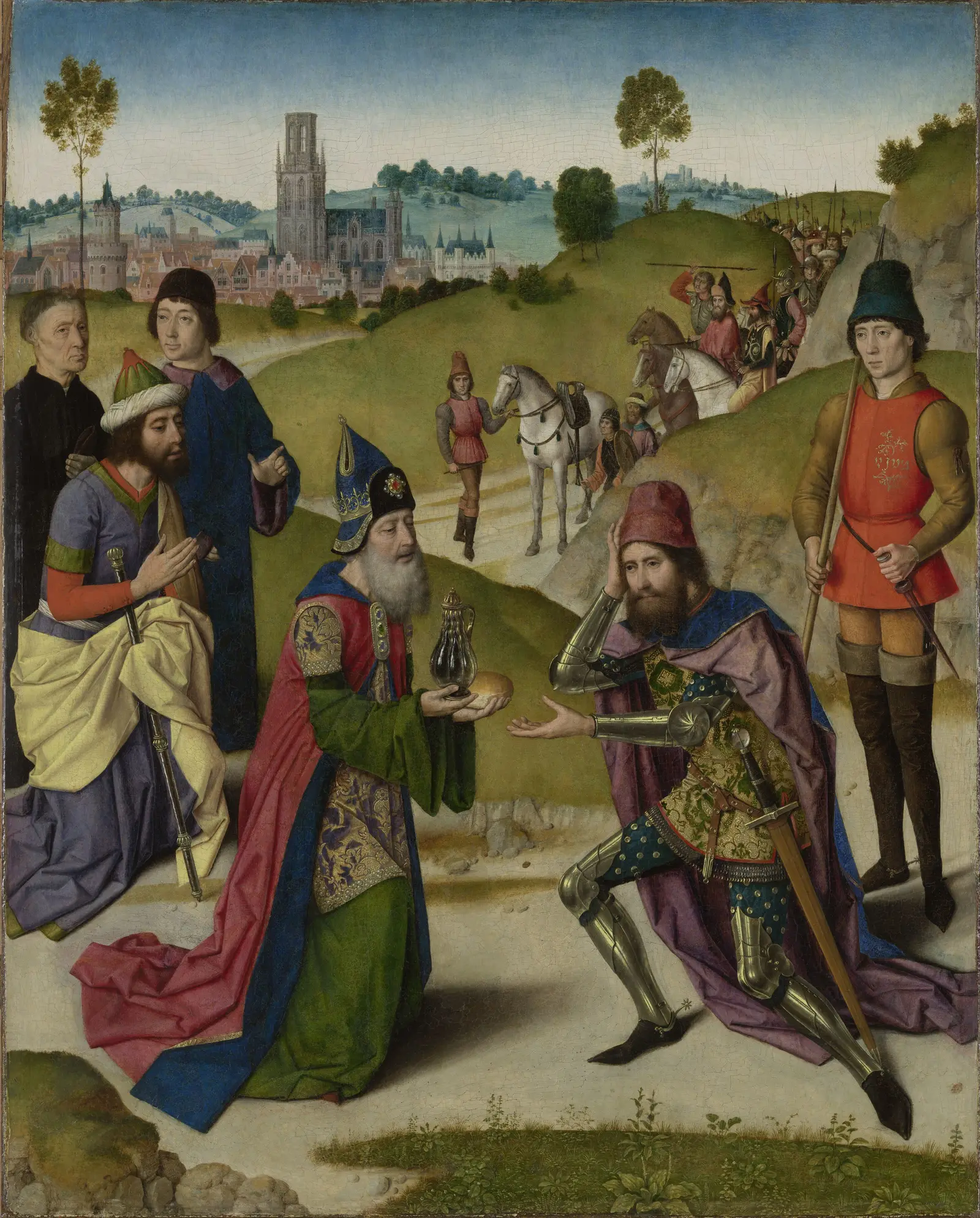
in Hebrews 7But Melchizedek, who did not trace his descent from Levi, collected a tenth from Abraham and blessed him who had the promises.
BSB
The same verse in ASV and KJV ▾
ASV
but he whose genealogy is not counted from them hath taken tithes of Abraham, and hath blessed him that hath the promises.
KJV
But he whose descent is not counted from them received tithes of Abraham, and blessed him that had the promises.
⋯
This verse in Hebrews 7
Commentary
13 notes on this verseBlessed him that had the promises - This is a continuation of the same argument, namely, to show the superiority of Melchisedec; and, in consequence, to prove the superiority of the priesthood of Christ beyond that of Aaron. As in the seed of Abraham all the nations of the earth were to be blessed, Abraham received a sacerdotal blessing from Melchisedec, who was the representative of the Messiah, the promised seed, to show that it was through him, as the high priest of the human race, that this blessing was to be derived on all mankind.
This site's exposition
sons of Levi who become priests
on Hebrews 7:5-6
The Levites collect a tenth from their brothers, and they too are descended from Abraham. Melchizedek, who did not trace his descent from Levi, took a tenth from Abraham himself and blessed him who had the promises. Rank here follows the tithe and the blessing.
This site's exposition
blessed him who had the promises
Both Greek verbs, collected and blessed, stand in the perfect tense, so the tithe and the blessing keep their force. The promises Abraham already held were of a great seed and of the land of Canaan.
The record, by era
The Church Fathers3 voices
"who have come out." This is what it says: Although in all other respects they were equal in condition and honor, yet from the fact that these indeed gave tithes, while those received them, great excellence is shown. If this is so, it is clear …
"But he whose descent is not counted from them, received tithes of Abraham." And after that he did not simply pass on, but added, "and blessed him that had the promises." Inasmuch as throughout, this was regarded with reverence, he shows that Melchisedec was to be reverenced more than Abraham, from the common judgment of all men.
A commentator
Ephrem the SyrianCOMMENTARY ON THE EPISTLE TO THE HEBREWS · Written before 373.
proposed
Through Abraham, who gave him the tenth part, the house of Levi, which had to be generated by him, took the tenth part in him. The Levites, even though they took the tenth part, did not take it from strangers but received the tenth part …
The Medieval Church2 voices
341. – Then when he says, But this man who has not the genealogy received tithes of Abraham, he shows how it was more fitting for Melchizedek to receive tithes, because he was not of the stock of Abraham; hence, he has not their genealogy, …
Hence Melchizedek too, who received a tithe from Abraham, and moreover not being of his lineage, for he was a foreigner, is superior and higher than he. For why would Abraham have given a tithe to a foreigner if great honor did not belong to …
5 more voices on this verse
The Puritans and the Awakening3 voices
He who is not from them - The Levites Blessed - Another proof of his superiority. Even him that had the promises - That was so highly favoured of God. When St. Paul speaks of Christ, he says, "the promise;" promises refer to other blessings also.
But he whose descent is not counted from them, &c.
He was one in covenant with God, to whom God had given exceedingly great and precious promises. That man is rich and happy indeed who has an estate in bills and bonds under God's own hand and seal. These promises are both of the life that now is and of that which is to come; this honour have all those who receive the Lord Jesus, in whom all the promises are yea and amen.
The Nineteenth Century2 voices
A commentator
Jamieson, Fausset & Brown1802–1910
Commentary Critical and Explanatory on the Whole Bible (1871)
Paul exalts Abraham in order still more to exalt Melchisedec. When Christ is the subject, the singular "promise" is used. "The promises" in the plural, refer to God's promise of greatness to himself and his seed, and of the possession of Canaan, twice repeated before the blessing of Melchisedec.
A commentator
Albert Barnes1798–1870
Notes, Explanatory and Practical, on the Old and New Testaments (1832-1869)
proposed
But he whose descent is not counted from them - Melchizedek. The word “descent” is “pedigree” in the margin. The meaning is, that he was not “in the same genealogy” - μὴ γενεαλογούμενος mē genealogoumenos - he was not of the order of Levitical priests. That Melchizedek is meant there can be no doubt; at the same time, also, the thought is presented with prominence on which Paul so much insists, that he was of a different order from the Levitical priesthood. And blessed him - Blessed him as a priest of God; blessed him in such a manner as to imply acknowledged superiority; see Heb 7:1. That had the promises - The promise that he should have a numerous posterity; that in him all the nations of the earth should be blessed; see Heb 6:12-16.
The words behind it
14 Greek wordsEvery Greek word of this verse in the order it stands, with what it means and the door to its own study. The last column counts the times a word stands in the whole Bible: the rarer the word, the more the places it appears belong together.
| Greek | Sound | Meaning | Word study | In the Bible |
|---|---|---|---|---|
| ὁ | ho | The [one] | G3588 → | 19766 times |
| δὲ | de | however | G1161 → | 2765 times |
| μὴ | me | not | G3361 → | 1066 times |
| γενεαλογούμενος | genealogoumenos | tracing his ancestry | G1075 → | |
| ἐξ | ex | from | G1537 → | 911 times |
| αὐτῶν | auton | them | G846 → | 5565 times |
| δεδεκάτωκεν | dedekatoken | he has collected a tenth | G1183 → | |
| Ἀβραάμ· | abraam | from Abraham; | G11 → | 73 times |
| καὶ | kai | and | G2532 → | 9120 times |
| τὸν | ton | the [one who] | G3588 → | 19766 times |
| ἔχοντα | echonta | is having | G2192 → | 707 times |
| τὰς | tas | the | G3588 → | 19766 times |
| ἐπαγγελίας | epangelias | promises | G1860 → | 52 times |
| εὐλόγηκεν. | eulogeken | He has blessed. | G2127 → | 41 times |
ὁThe [one]
hoG3588 →19766 times
δὲhowever
deG1161 →2765 times
μὴnot
meG3361 →1066 times
γενεαλογούμενοςtracing his ancestry
genealogoumenosG1075 →
ἐξfrom
exG1537 →911 times
αὐτῶνthem
autonG846 →5565 times
δεδεκάτωκενhe has collected a tenth
dedekatokenG1183 →
Ἀβραάμ·from Abraham;
abraamG11 →73 times
καὶand
kaiG2532 →9120 times
τὸνthe [one who]
tonG3588 →19766 times
ἔχονταis having
echontaG2192 →707 times
τὰςthe
tasG3588 →19766 times
ἐπαγγελίαςpromises
epangeliasG1860 →52 times
εὐλόγηκεν.He has blessed.
eulogekenG2127 →41 times
A shaded row is a word that stands 400 times or fewer in the Bible.
The walk
8 stopsEach card is a verse this one points to, and under it the verses that one points to in turn. Where several paths arrive at the same place, that place is listed first: the text keeps returning to it.
Through
Romans 4:13For the promise to Abraham and his offspring that he would be heir of the world was not given through the law, but through the righteousness that comes by faith.
it leads to
- Galatians 3:29
And if you belong to Christ, then you are Abraham’s seed and heirs according to the promise.
- Genesis 28:14
Your descendants will be like the dust of the earth, and you will spread out to the west and east and north and south. All the families of the earth will be blessed through…
- Romans 9:8
So it is not the children of the flesh who are God’s children, but it is the children of the promise who are regarded as offspring.
- Genesis 22:17–18
I will surely bless you, and I will multiply your descendants like the stars in the sky and the sand on the seashore. Your descendants will possess the gates of their enemies.
- Psalms 2:8
Ask Me, and I will make the nations Your inheritance, the ends of the earth Your possession.
- Galatians 3:29
Through
Hebrews 11:17By faith Abraham, when he was tested, offered up Isaac on the altar. He who had received the promises was ready to offer his one and only son,
it leads to
- Genesis 22:16
saying, “By Myself I have sworn, declares the LORD, that because you have done this and have not withheld your only son,
- James 2:21–24
Was not our father Abraham justified by what he did when he offered his son Isaac on the altar?
- Genesis 22:1–12
Some time later God tested Abraham and said to him, “Abraham!” “Here I am,” he answered.
- Genesis 22:16
Where this verse is studied
On this page
Studies15
On this verse
On this chapter
About Hebrews
Who and where
2 names in this verse with a page on the site.
- PersonPatriarchsMelchizedekKing of Salem and priest of the Most High God, without recorded genealogy, who brings out bread and wine — the type of Christ's et…
- PersonPatriarchsAbrahamCalled out of Ur, the father of all who believe, justified by faith, and the friend of God through whose seed all nations are bles…
This page draws on 14 works. Open the list of works
This page draws on Adam Clarke, Commentary on the Bible; Albert Barnes, Notes, Explanatory and Practical, on the Old and New Testaments (1832-1869); Ephrem the Syrian, COMMENTARY ON THE EPISTLE TO THE HEBREWS; Jamieson, Fausset & Brown, Commentary Critical and Explanatory; Jamieson, Fausset & Brown, Commentary Critical and Explanatory on the Whole Bible; John Calvin, Commentary on Hebrews; John Chrysostom, Homily on Hebrews 12; John Gill, Exposition of the New Testament (1746-1748); John Wesley, Explanatory Notes Upon the New Testament; John Wesley, Explanatory Notes upon the New Testament; Matthew Henry, Commentary on the Whole Bible; Oecumenius, The Pseudo-Oecumenian Catena on Hebrews; Theophylact of Ohrid, Commentary on Hebrews and Thomas Aquinas, Commentary on Hebrews.