
Hebrews 7:2
in Hebrews 7and Abraham apportioned to him a tenth of everything. First, his name means “king of righteousness.” Then also, “king of Salem” means “king of peace.”
BSB
The same verse in ASV and KJV ▾
ASV
to whom also Abraham divided a tenth part of all (being first, by interpretation, King of righteousness, and then also King of Salem, which is, King of peace;
KJV
To whom also Abraham gave a tenth part of all; first being by interpretation King of righteousness, and after that also King of Salem, which is, King of peace;
⋯
This verse in Hebrews 7
Commentary
21 notes on this verseUsing the principles of pastoral science, he gathers us into his heavenly fold. He is called "sheep," because he was sacrificed, a "Lamb," because he was without blemish. He is the "high priest" because he presented the offering. "Melchizedek," because on the transcendent level he had no mother, on the human level no father, and his high estate is without genealogy. "Who," it says, "can recount his generation?" He is "Melchizedek" too, as king of Salem or peace, as king of righteousness, and because he tithes the patriarchs who prevailed over evil powers.
This site's exposition
priest of God Most High
on Hebrews 7:1-2
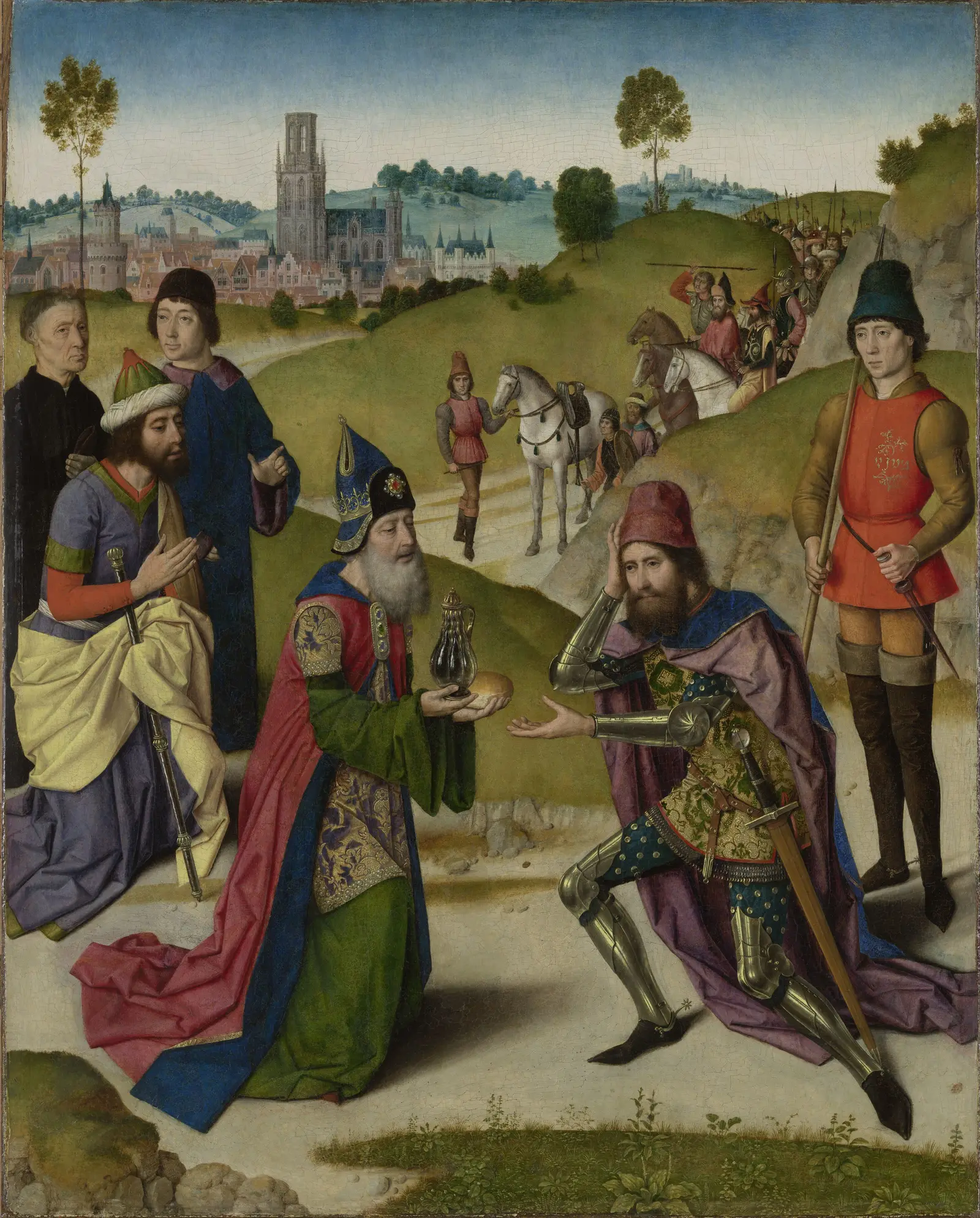
Genesis 14 has Melchizedek meet Abraham as king of Salem and priest of God Most High, two offices Israel never joined again until Christ. His name means king of righteousness, and Salem makes him king of peace. Abraham gave him a tenth of everything.
This site's exposition
apportioned to him a tenth of everything
The Greek verb behind apportioned means to assign as a portion. The priest who received the tenth had just blessed Abraham, so the gift went to God through the one who brought God's blessing. Tithe and priesthood belong together.
The record, by era
The Church Fathers5 voices
What need is there to say that He is the only High Priest, who alone possesses the knowledge of the worship of God? He is Melchizedek, "King of peace," the most fit of all to head the race of men. A legislator too, in as much as He gave the law by the mouth of the prophets, enjoining and teaching most distinctly what things are to be done, and what not.
For Salem is, by interpretation, peace; of which our Savior is enrolled King, as Moses says, Melchizedek king of Salem, priest of the Most High God, who gave bread and wine, furnishing consecrated food for a type of the Eucharist. And Melchizedek is interpreted "righteous king"; and the name is a synonym for righteousness and peace.
"gave a tenth." That is, to Melchizedek, Abraham gave a tenth, he says. "first being interpreted." Therefore, he wants to show how Melchizedek is a type of Christ, and first he does this from the name. For, he says, his name is interpreted, king of …
A commentator
Ephrem the SyrianCOMMENTARY ON THE EPISTLE TO THE HEBREWS · Written before 373.
proposed
Now the interpretation of the name Melchizedek is "king of justice" and "king of peace." The apostle indeed demonstrated that in this name the mystery of the grace and justice of the Son, Lord of Melchizedek, was inscribed.
Now, the comparison he had frequently gone to great trouble to develop he develops in the present case. Firstly, he recalls the story of Melchizedek. While he seems to conduct his treatment in narrative style, he is laying the groundwork for his thesis. The reason, …
13 more voices on this verse
The Church Fathers2 voices
And first from the name. "First" (he says) "being by interpretation King of righteousness": for Sedec means "righteousness"; and Melchi, "King": Melchisedec, "King of righteousness." Seest thou his exactness even in the names? But who is "King of righteousness," save our Lord Jesus Christ? "King of righteousness. And after that also King of Salem," from his city, "that is, King of Peace," which again is characteristic of Christ. For He has made us righteous, and has "made peace" for "things in Heaven and things on earth." What man is "King of Righteousness and of Peace"? None, save only our Lord Jesus Christ.
This is Melchisedek — that so great priest of God most high, who received tithes from the priests under the Mosaic law. This is the King of peace and righteousness, and at the same time a priest of God most high, who was made like …
The Medieval Church2 voices
330. – But it seems from Numbers (18:21) that the giving of tithes dated from the Law; therefore, there was none before the Law. I answer that the ceremonial precepts of the Old Testament are amplifications of the precepts of the natural law and of …
Here he shows in what sense Melchizedek is a prototype of Christ. And first of all, he says, learn the true meaning from the name itself. Namely: "Melchi" means king; "Sedek" means righteousness. Who else is the king of righteousness, if not our Lord Jesus …
The Puritans and the Awakening4 voices
He bore the image of God in his piety and authority, and stands upon record as an immortal high priest; the ancient type of him who is the eternal and only-begotten of the Father, who abideth a priest for ever. Let us now consider (as the apostle advises) how great this Melchisedec was, and how far his priesthood was above that of the order of Aaron (
quarantine:debris (2026-07-29) — unbalanced-parens
King of righteousness, then - According to the name of his city. King of peace - So in him, as in Christ, righteousness and peace were joined. And so they are in all that believe in him.
To whom also Abraham gave a tenth part of all,.... Or tithes, as in Gen 14:
(1.) Melchisedec was a king, and so is the Lord Jesus--a king of God's anointing; the government is laid upon his shoulders, and he rules over all for the good of his people. (2.) That he was king of righteousness: his name signifies the righteous king. Jesus Christ is a rightful and a righteous king--rightful in his title, righteous in his government.
The Nineteenth Century5 voices
Gave a tenth part of all - It was an ancient custom, among all the nations of the earth, to consecrate a part or tenth of the spoils taken in war to the objects of their worship. Many examples of this kind occur. This however was not according to any provision in law, but merely ad libitum, and as a eucharistic offering to those to whom they imagined they owed the victory. But neither Abraham’s decimation, nor theirs, had any thing to do, either with tithes as prescribed under the Mosaic dispensation, or as claimed under the Christian.
A commentator
Jamieson, Fausset & Brown1802–1910
Commentary Critical and Explanatory on the Whole Bible (1871)
Hebrew "Malchi" means king: "Tzedek," righteousness. King of Salem--not only his own name, but that of the city which he ruled, had a typical significance, namely, peace. Christ is the true Prince of peace.
WE will not enlarge upon the story of Melchisedec, nor discuss the question as to who he was. It is near enough for us to believe that he was one who worshipped God after the primitive fashion, a believer in God such as Job was in the land of Uz, one of the world's gray fathers who had kept faithful to the Most High God. He combined in his own person the kingship and the priesthood—a conjunction by no means unusual in the first ages.
WE will not enlarge upon the story of Melchisedec, nor discuss the question as to who he was. It is near enough for us to believe that he was one who worshipped God after the primitive fashion, a believer in God such as Job was in the land of Uz, one of the world's gray fathers who had kept faithful to the Most High God. He combined in his own person the kingship and the priesthood—a conjunction by no means unusual in the first ages. Of this man we know very little and it is partly because we know so little of him that he is all the better type of our Lord, of whom we may enquire, "Who shall declare His generation?" The very mystery which hangs about Melchisedec serves to set forth the mystery of the Person of our Divine Lord. "Without father, without mother, without descent, having neither beginning of days, nor end of life, but made like unto the Son of God, he abides a priest continually. Now consider how great this man was, unto whom even the Patriarch Abraham gave the tenth of the spoils." Melchisedec seems to have been, first by name, and then by place of office, doubly designated a king. First, his name is Melchisedec, which signifies by interpretation, "King of righteousness." His personal name is "King of righteousness." As a matter of fact, he was also the monarch of some town called Salem. It is not at all likely to have been Jerusalem, although that may have been the case. The interpretation of his official name is "King of peace." A teaching was intended by the Holy Spirit in the names—so the Apostle instructs us in the passage before us. I believe in the verbal Inspiration of Scripture and, therefore, I can see how there can be instruction for us even in the proper names of persons and of places. Those who reject verbal Inspiration must, in effect, condemn the great Apostle of the Gentiles, whose teaching is so frequently based upon a Word of God.
A commentator
Albert Barnes1798–1870
Notes, Explanatory and Practical, on the Old and New Testaments (1832-1869)
proposed
To whom also Abraham gave a tenth part of all - That is, a tenth part of all the spoils which he had taken Gen 14:20, thus acknowledging that in dignity of office Melchizedek was greatly his superior; Heb 7:4, Heb 7:6, Heb 7:8. This does not appear to have been on the part of Abraham so much designed as a present to Melchizedek personally, as an act of pious thankfulness to God. He doubtless recognized in Melchizedek one who was a minister of God, and to him as such he devoted the tenth of all which he had taken, as a proper acknowledgment of the goodness of God and of his claims. From this it is evident that the propriety of devoting a tenth part of what was possessed to God, was regarded as a duty before the appointment of the Levitical law. “Some” expression of this kind is obviously demanded, and piety seems early to have fixed on the “tenth” part as being no more than a proper proportion to consecrate to the service of religion. For the propriety of the use which the apostle makes of this fact, see the notes on Heb 7:4, Heb 7:6, Heb 7:8. First being - The “first” idea in the interpretation of his name and office, etc. First being mentioned as king of righteousness, and then as king of peace. King of righteousness - The literal translation of the name Melchizedek; see the notes on ver. 1. The “argument” implied in this by the remarks of the apostle is, that he bore a name which made him a proper emblem of the Messiah. There was a propriety that one in whose “order” the Messiah was to be found, should have such a name. It would be exactly descriptive of him, and it was “worthy of observation” that he of whose “order” it was said the Messiah would be, should have had such a name. […]
The words behind it
21 Greek wordsEvery Greek word of this verse in the order it stands, with what it means and the door to its own study. The last column counts the times a word stands in the whole Bible: the rarer the word, the more the places it appears belong together.
| Greek | Sound | Meaning | Word study | In the Bible |
|---|---|---|---|---|
| ᾧ | ho | to whom | G3739 → | 1405 times |
| καὶ | kai | also | G2532 → | 9120 times |
| δεκάτην | dekaten | a tenth | G1182 → | 7 times |
| ἀπὸ | apo | of | G575 → | 640 times |
| πάντων | panton | all | G3956 → | 1235 times |
| ἐμέρισεν | emerisen | apportioned | G3307 → | |
| Ἀβραάμ, | abraam | Abraham, | G11 → | 73 times |
| πρῶτον | proton | first | G4413 → | 152 times |
| μὲν | men | indeed | G3303 → | 176 times |
| ἑρμηνευόμενος | hermeneuomenos | being translated | G2059 → | |
| βασιλεὺς | basileus | king | G935 → | 114 times |
| δικαιοσύνης | dikaiosunes | of righteousness | G1343 → | 92 times |
| ἔπειτα | epeita | then | G1899 → | |
| δὲ | de | however | G1161 → | 2765 times |
| καὶ | kai | also | G2532 → | 9120 times |
| βασιλεὺς | basileus | king | G935 → | 114 times |
| Σαλήμ, | salem | of Salem, | G4532 → | |
| ὅ | ho | which | G3739 → | 1405 times |
| ἐστιν | estin | is | G1510 → | 2333 times |
| βασιλεὺς | basileus | king | G935 → | 114 times |
| εἰρήνης, | eirenes | of peace, | G1515 → | 91 times |
ᾧto whom
hoG3739 →1405 times
καὶalso
kaiG2532 →9120 times
δεκάτηνa tenth
dekatenG1182 →7 times
ἀπὸof
apoG575 →640 times
πάντωνall
pantonG3956 →1235 times
ἐμέρισενapportioned
emerisenG3307 →
Ἀβραάμ,Abraham,
abraamG11 →73 times
πρῶτονfirst
protonG4413 →152 times
μὲνindeed
menG3303 →176 times
ἑρμηνευόμενοςbeing translated
hermeneuomenosG2059 →
βασιλεὺςking
basileusG935 →114 times
δικαιοσύνηςof righteousness
dikaiosunesG1343 →92 times
ἔπειταthen
epeitaG1899 →
δὲhowever
deG1161 →2765 times
καὶalso
kaiG2532 →9120 times
βασιλεὺςking
basileusG935 →114 times
Σαλήμ,of Salem,
salemG4532 →
ὅwhich
hoG3739 →1405 times
ἐστινis
estinG1510 →2333 times
βασιλεὺςking
basileusG935 →114 times
εἰρήνης,of peace,
eirenesG1515 →91 times
A shaded row is a word that stands 400 times or fewer in the Bible.
The walk
8 stopsEach card is a verse this one points to, and under it the verses that one points to in turn. Where several paths arrive at the same place, that place is listed first: the text keeps returning to it.
Through
2 Samuel 23:3The God of Israel spoke; the Rock of Israel said to me, ‘He who rules the people with justice, who rules in the fear of God,
it leads to
- Psalms 72:2
May he judge Your people with righteousness and Your afflicted with justice.
Reached by 2 separate paths from here.
- Deuteronomy 32:4
He is the Rock, His work is perfect; all His ways are just. A God of faithfulness without injustice, righteous and upright is He.
- Exodus 18:21
Furthermore, select capable men from among the people—God-fearing, trustworthy men who are averse to dishonest gain. Appoint them over the people as leaders of thousands, of hundreds, of fifties, and of tens.
- 2 Samuel 22:32
For who is God besides the LORD? And who is the Rock except our God?
- Deuteronomy 16:18–20
You are to appoint judges and officials for your tribes in every town that the LORD your God is giving you. They are to judge the people with righteous judgment.
- Psalms 72:2
Through
2 Samuel 8:15Thus David reigned over all Israel and administered justice and righteousness for all his people:
it leads to
- Amos 5:15
Hate evil and love good; establish justice in the gate. Perhaps the LORD, the God of Hosts, will be gracious to the remnant of Joseph.”
- Psalms 89:14
Righteousness and justice are the foundation of Your throne; loving devotion and faithfulness go before You.
- Amos 5:15
Through
Numbers 18:21Behold, I have given to the Levites all the tithes in Israel as an inheritance in return for the work they do, the service of the Tent of Meeting.
it leads to
- Nehemiah 12:44
And on that same day men were appointed over the rooms that housed the supplies, contributions, firstfruits, and tithes. The portions specified by the Law for the priests and Levites were gathered into these…
- Nehemiah 12:44
Where this verse is studied
On this page
Studies15
On this chapter
About Hebrews
Who and where
1 name in this verse with a page on the site.
This page draws on 18 works. Open the list of works
This page draws on Adam Clarke, Commentary on the Bible; Albert Barnes, Notes, Explanatory and Practical, on the Old and New Testaments (1832-1869); Charles Spurgeon, The Metropolitan Tabernacle Pulpit, Sermon No. 1768: “First, King of Righteousness, and after That, King of Peace” (lightly modernized text, CCEL edition); Clement of Alexandria, The Stromata Book 2; Clement of Alexandria, The Stromata Book 4; Cosmas Indicopleustes, The Christian Topography, Book 5; Ephrem the Syrian, COMMENTARY ON THE EPISTLE TO THE HEBREWS; Gregory of Nazianzus, ON THE SON, THEOLOGICAL ORATION 4(30).21; Jamieson, Fausset & Brown, Commentary Critical and Explanatory; Jamieson, Fausset & Brown, Commentary Critical and Explanatory on the Whole Bible; John Chrysostom, Homily on Hebrews 12; John Gill, Exposition of the New Testament (1746-1748); John Wesley, Explanatory Notes upon the New Testament; Matthew Henry, Commentary on the Whole Bible; Oecumenius, The Pseudo-Oecumenian Catena on Hebrews; Theodoret of Cyrus, INTERPRETATION OF HEBREWS 7; Theophylact of Ohrid, Commentary on Hebrews and Thomas Aquinas, Commentary on Hebrews.