
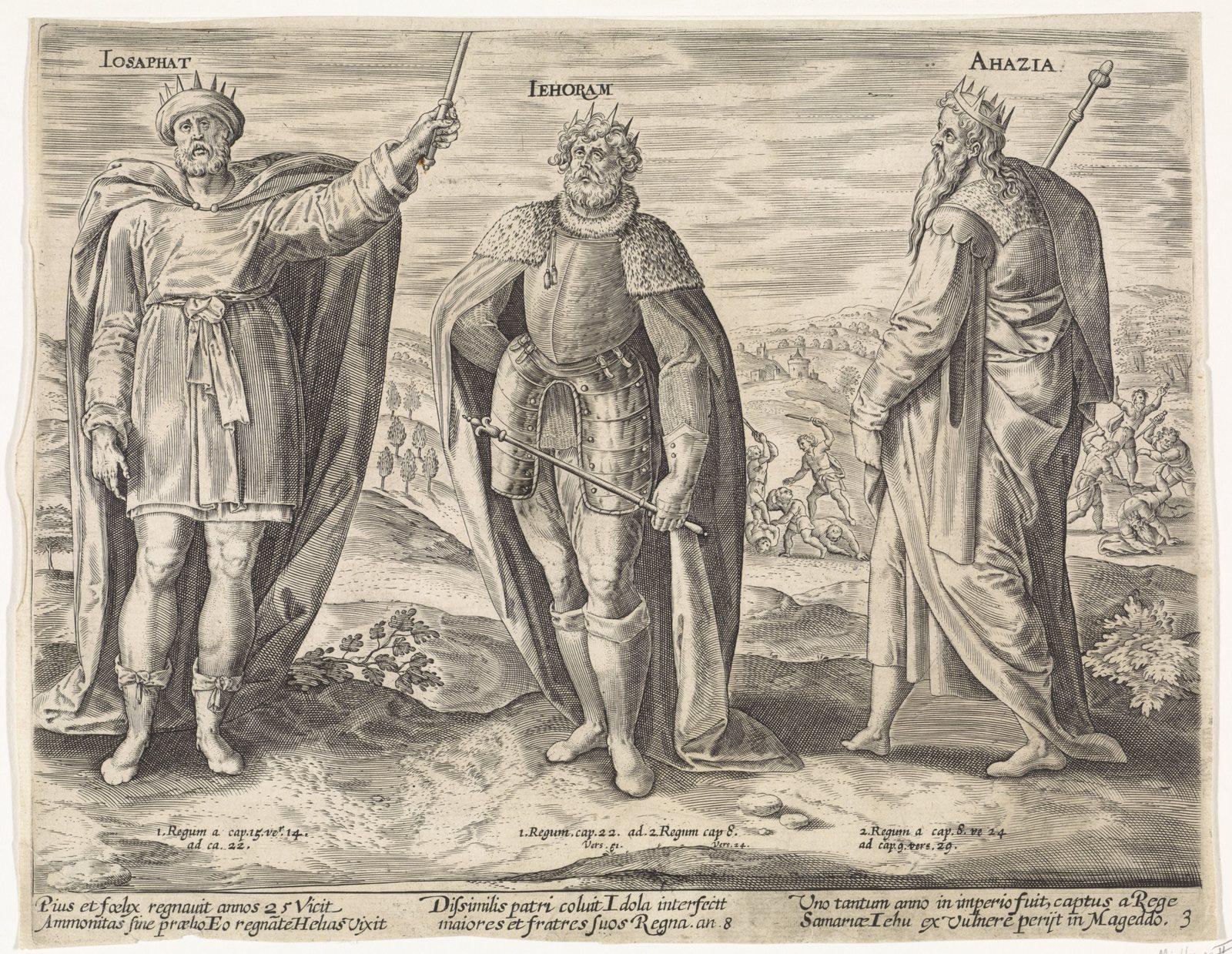
After Jan Snellinck the Elder, Jehoshaphat, Jehoram and Ahaziah, 1643. Public domain.
2 Chronicles 19 · Subject · Featured Study
Jehoshaphat's Courts
The reform of the courts of Judah under King Jehoshaphat is told in 2 Chronicles 19:5 to 11.
He appointed judges in the land, in each of the fortified cities of Judah.
- Book
- 2 Chronicles
- Hold in memory
- 2 Chronicles 19:6, 2 Chronicles 19:7
The king who ordered these courts bore a name that means the LORD is judge.
Summary
The reform had two levels: a bench in each walled town and one high court in the capital.
- Two men led the high court, one for the LORD's matters and one for the king's.
- The Talmud and Rashi read the king's words as a warning to all judges.
- Readers differ on what the two kinds of cases were.
- They also differ on whether the story comes from the king's day or from the Chronicler's.
The Charge to the Judges of the Cities
The king's charge to the town benches comes first in the reform.
Then he said to the judges, “Consider carefully what you do, for you are not judging for man, but for the LORD, who is with you when you render judgment.The king grounds the whole office in the One the bench answers to.
And now, may the fear of the LORD be upon you. Be careful what you do, for with the LORD our God there is no injustice or partiality or bribery.”The king names the safeguard against a crooked court.
Who Sat in Jehoshaphat's Courts
Each office of the courts stands with the verse that names it.
A bench sat in each walled town, and above them a high court of three orders sat at Jerusalem under two presidents.
| Office | Its holders | Its business |
|---|---|---|
| The town benches | Judges named by the king | The cases of each walled town |
| The high court at Jerusalem | Levites, priests and heads of Israelite families | The judgment of the LORD and disputes |
| President in the LORD's matters | Amariah | All that pertains to the LORD |
| President in the king's matters | Zebadiah son of Ishmael | All that pertains to the king |
The pattern in the Law of MosesDeuteronomy 16:18 and Deuteronomy 17:8 to 9
You are to appoint judges and officials for your tribes in every town that the LORD your God is giving you. They are to judge the people with righteous judgment.The town benches of 2 Chronicles 19 carry out this command of the Law.
If a case is too difficult for you to judge, whether the controversy within your gates is regarding bloodshed, lawsuits, or assaults, you must go up to the place the LORD your God will choose. You are to go to the Levitical priests and to the judge who presides at that time. Inquire of them, and they will give you a verdict in the case.The high court of priests and Levites carries out this second command.
How the Rabbis Read the Charge
Three rabbinic works take rules for later courts from this charge.
God presides in the divine assembly; He renders judgment among the gods:This verse is the first proof the Talmud gives for the judge's duty.
The Babylonian Talmud, at Sanhedrin 6b, says that judges should know before whom they judge, and it cites this psalm and the king's charge together. From the words He is with you it rules that a judge answers only for what his own eyes see.
The Sifrei on Deuteronomy cites the charge under the command to fear no man in judgment. The Jerusalem Talmud, at Sanhedrin 1:1, asks how flesh and blood can judge its Creator.
Rashi, on the same verse, says a judge who convicts the innocent takes from his Creator's property. He tells every judge to rule as though the Holy One stood before him in the case.
The Courts in Other Records
David's officers came before the reform, and Josephus tells the reform again.
“Of these,” said David, “24,000 are to oversee the work of the house of the LORD, 6,000 are to be officers and judges,Levites already held this office under David, the pattern the king followed at Jerusalem.
Josephus, in his Antiquities of the Jews, gives the same high court. He makes its members the priests, the Levites and the principal persons of the people.
The Words of the Courts
Four Hebrew words of the chapter stand on the cards, and the bars count the king's name by book.
Yehoshaphat (Hebrew, H3092)
The king's name, which the STEP lexicon gives as the name of six Israelites and of a valley near Jerusalem.
shaphat (Hebrew, H8199)
To pronounce sentence for or against; by extension, to govern.
riv (Hebrew, H7379)
A contest, personal or legal; 2 Chronicles uses it only in 2 Chronicles 19:8 and 2 Chronicles 19:10.
shoter (Hebrew, H7860)
An officer or overseer, the office the Levites held before the high court.
The lexicon in full1 figure
The name Jehoshaphat stands 41 times in 2 Chronicles and 25 times in 1 Kings.
The six counts as a table
| Book | Uses |
|---|---|
| 2 Chronicles | 41 |
| 1 Kings | 25 |
| 2 Kings | 12 |
| 2 Samuel | 2 |
| 1 Chronicles | 2 |
| Joel | 2 |
A bar chart of the Hebrew name Yehoshaphat by book, from the TAHOT word index of Tyndale House.
What the Text Leaves Unsaid
The chapter leaves these matters open.
It gives no number of judges and names none of the judges of the towns.
It gives no list of the walled towns that received a bench.
It leaves unsaid who sent a case from a town to Jerusalem and on what grounds.
What the Courts Teach
One charge was laid on the high court and the town benches alike.
He commanded them, saying, “You must serve faithfully and wholeheartedly in the fear of the LORD.The capital court is held to the charge the town benches received, so no court stood above it.
In Jehoshaphat's ordering a verdict was an act done in the sight of God before it was an act of the crown.
Two Voices on the Courts
Two commentators of the eighteenth and nineteenth centuries weigh the high court.
Matthew Henry (1662 to 1714)
Matthew Henry, in his Commentary on the Whole Bible of 1710, compares the court's two presidents with the gifts of the church.
“Thus there are diversities of gifts and operations, but all from the same Spirit, and for the good of the body. Some best understand the matters of the Lord, others the king's matters; neither can say to the other, I have no need of thee, for God's Israel has need of both; and, as every one has received the gift, so let him minister the same.”
Matthew Henry · Commentary on the Whole Bible · on 2 Chronicles 19:11Puritan
Albert Barnes (1798 to 1870)
Albert Barnes, in his Notes on the Old Testament, explains how a case reached the high court.
“The Jews who ‘dwelt in the cities,’ if dissatisfied with the decision given by the provincial judges, might therefore remove the cause to Jerusalem, as to a court of appeal.”
Albert Barnes · Notes, Explanatory and Practical, on the Old and New Testaments (1832-1869) · on 2 Chronicles 19:10Evangelical
Where Readers of the Courts Differ
Readers differ on the two kinds of business and on the account's date, and each reading has its holders and an objection.
The two kinds of matters were religious and civilJohn Wesley; Keil and Delitzsch · Protestant commentary
Wesley reads the matters of the LORD as the laws and worship of God, and the disputes as cases between man and man. Keil and Delitzsch call Amariah the spiritual president and Zebadiah the civil president.
The objection is Rashi's, who finds in the same two words of 2 Chronicles 19:8 a division by the kind of case.
The two kinds of matters were money cases and cases of bloodRashi · Jewish commentary
Rashi, on 2 Chronicles 19:8, takes judgment to mean cases of money and disputes to mean capital cases and bodily injuries. On 2 Chronicles 19:10 he reads between blood and blood as the line between a killing by accident and a killing on purpose.
The objection is that 2 Chronicles 19:11 divides the court's business between the matters of the LORD and the matters of the king.
The Chronicler carried his own day's courts back to JehoshaphatJulius Wellhausen; the Encyclopaedia Judaica · historical criticism
Wellhausen, in his Prolegomena to the History of Israel, holds that the Chronicler set the courts of his own day in Jehoshaphat's reign. He says the king was chosen for the story because of his name. The Encyclopaedia Judaica's article on Jehoshaphat says the whole account may be a midrash on the name.
The objection is the Law itself. It had already set judges in the towns and a court at the chosen place (Deuteronomy 16:18 and Deuteronomy 17:8 to 9).
Jehoshaphat ordered the courts in his own reignJamieson, Fausset and Brown · Protestant commentary
Jamieson, Fausset and Brown say courts had stood from an early time. Jehoshaphat, they say, was the first king to fit them to the smaller kingdom of Judah.
The objection is Wellhausen's, that the king's name alone explains why the story was told of him.
Books to Read Next
These works on 2 Chronicles 19 are each free to read.
Commentary on the Whole Bible
Matthew Henry · 1710
Henry draws lessons for magistrates from the king's charge.
Read it at Bible HubBiblical Commentary on the Old Testament
Keil and Delitzsch · 1857 to 1878
The volume on Chronicles reads 2 Chronicles 19 verse by verse with the Hebrew.
Read it at Bible HubProlegomena to the History of Israel
Julius Wellhausen, translated by J. Sutherland Black and Allan Menzies · 1878
Its chapter on Chronicles weighs each story Chronicles adds against Kings.
Read it at Project GutenbergThe Judge Beside the Judges
A court in Judah answered to the LORD before it answered to the king.
Whoever must decide between others today stands under the same charge to fear God and take no bribe.
Sources
Scripture is the Berean Standard Bible.
- STEP Bible TBESH lexicon and TAHOT word index, Tyndale House, CC BY 4.0.
- Babylonian Talmud, Sanhedrin 6b:14, William Davidson Edition, CC BY-NC.
- Jerusalem Talmud, Sanhedrin 1:1:29, translated by Heinrich Guggenheimer, CC BY.
- Sifrei Devarim 17:6, translated by Marty Jaffee, CC BY-NC.
- Rashi on II Chronicles 19, The Judaica Press complete Tanach with Rashi, translated by A. J. Rosenberg, CC BY.
- Flavius Josephus, Antiquities of the Jews 9.1.1, translated by William Whiston.
- Julius Wellhausen, Prolegomena to the History of Israel, first published 1878, translated by J. Sutherland Black and Allan Menzies, chapter 6.
- Encyclopaedia Judaica, Jehoshaphat, at the Jewish Virtual Library.
- C. F. Keil and F. Delitzsch, Biblical Commentary on the Old Testament, 1857 to 1878, on 2 Chronicles 19:11.
- Matthew Henry, Commentary on the Whole Bible, 1710, on 2 Chronicles 19.
- Albert Barnes, Notes on the Old Testament, 1832 to 1869, on 2 Chronicles 19:10.
- John Wesley, Explanatory Notes upon the Old Testament, 1765, on 2 Chronicles 19:8.
- Jamieson, Fausset and Brown, Commentary Critical and Explanatory on the Whole Bible, 1871, on 2 Chronicles 19:5 to 7.
Keep Studying
Doctrines1
People and groups4
Places1
Symbols1