
Judges 2:4
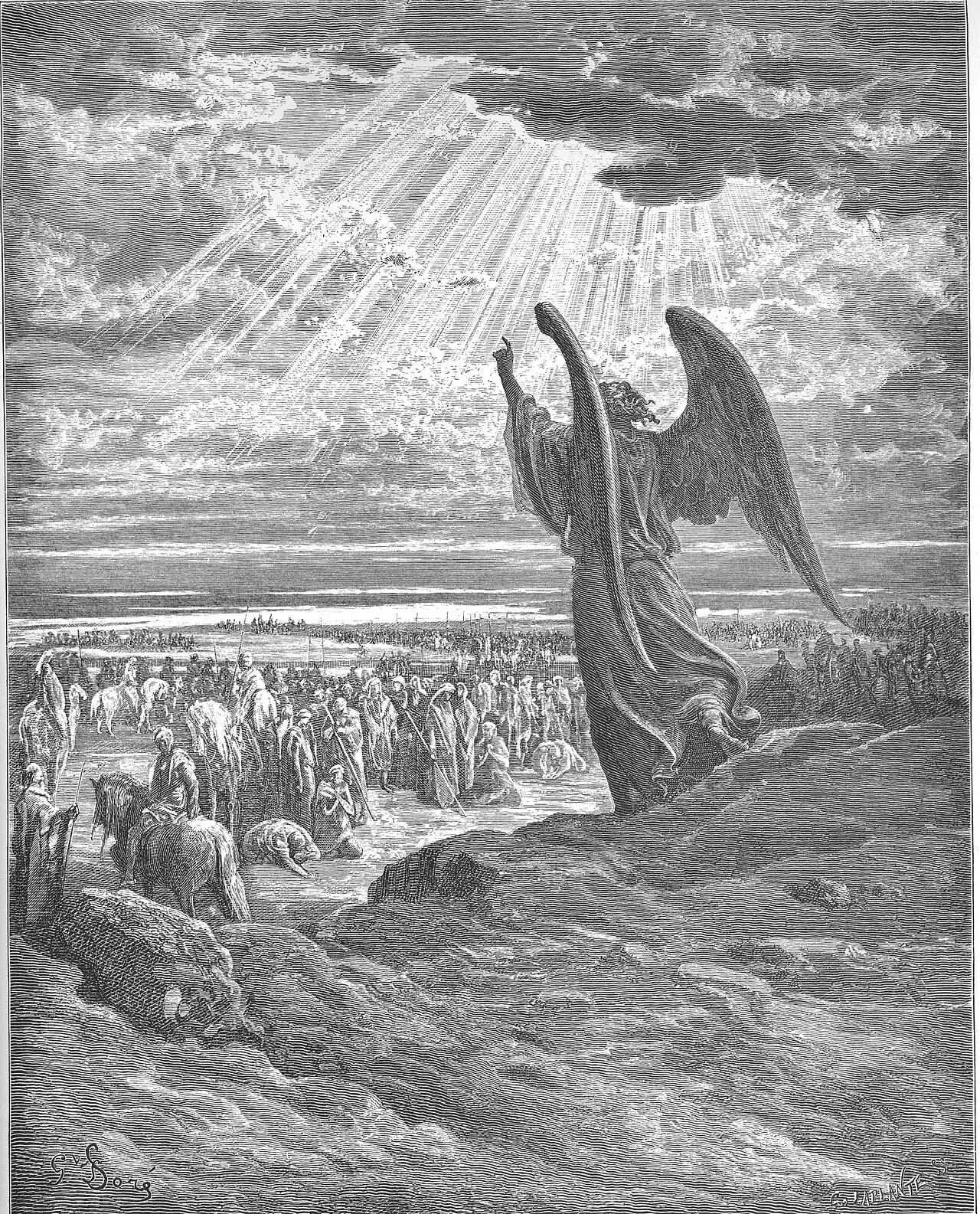
in Judges 2When the angel of the LORD had spoken these words to all the Israelites, the people lifted up their voices and wept.
BSB
The same verse in ASV and KJV ▾
ASV
And it came to pass, when the angel of Jehovah spake these words unto all the children of Israel, that the people lifted up their voice, and wept.
KJV
And it came to pass, when the angel of the Lord spake these words unto all the children of Israel, that the people lifted up their voice, and wept.
⋯
This verse in Judges 2
Commentary
7 notes on this verseLet us consider where he has set his ascent: "In the valley of tears, in the place that he has appointed." We have read in the book of Judges that when the angel came and preached repentance to the people, saying, "You have abandoned the Lord, and the Lord shall abandon you," the Israelites wept aloud when they heard the threat; and that place was called the valley of tears. We have called attention to ancient history in order to avoid heresy.
This site's exposition
When the angel of the LORD had spoken these words
on Judges 2:4-5
They weep and they sacrifice, and the place is named Bochim, which means weepers. Nothing is said about throwing down an altar or breaking a league, which is what verse 2 charged them with failing to do. The book's first recorded response to God is grief without amendment, and chapter 3 begins the cycle anyway.
The record, by era
The Puritans and the Awakening3 voices
And it came to pass, when the angel of the Lord spake these words unto all the children of Israel,....
A great congregation for a great preacher! They were assembled either for war, each tribe sending in its forces for some great expedition, or rather for worship, and then the place of their meeting must be Shiloh, where the tabernacle was, at which they were all to come together three times a year.
This was good, and a sign that the word they heard made an impression upon them: it is a wonder sinners can ever read their Bible with dry eyes. But this was not enough; they wept, but we do not find that they reformed, that they went home and destroyed all the remains of idolatry and idolaters among them.
The Nineteenth Century2 voices
LET me give an outline of the chapter, that we may put the text into its proper setting. God had brought His people out of Egypt and divided Jordan that they might march through, dry-shod, into the land which He had promised to their fathers. He charged them to drive out the Canaanites, a race that had become so loathsome in God's sight that He decreed their destruction and appointed the tribes of Israel to be their executioners.
LET me give an outline of the chapter, that we may put the text into its proper setting. God had brought His people out of Egypt and divided Jordan that they might march through, dry-shod, into the land which He had promised to their fathers. He charged them to drive out the Canaanites, a race that had become so loathsome in God's sight that He decreed their destruction and appointed the tribes of Israel to be their executioners. It was for the good of the universal world that this pest-house should be broken up and that the filthy races should be destroyed—and God gave His people that charge to carry out. Those who quarrel with this arrangement should remember that this is not the only instance of aboriginal tribes being driven out by a superior race. Our Anglo-Saxon nation drove out the original inhabitants of this island, who survived only in the mountains of Wales and Cornwall and in the highlands of Scotland. It certainly will not be wise, on our part, as Anglo-Saxons, to condemn Israel for doing, under Divine command, what our forefathers did for their own aggrandizement. Alas, in more modern times, lands have been seized and nations extirpated by the white man without Divine warrant or reasonable excuse. We do not justify all this, but if any complain of Israel for obeying the sentence of God, let them first raise their voices against the driving out of ancient races by colonists of our own race! The order to slay the Canaanites had a second objective, namely, that Israel might dwell, alone, in the land and might keep themselves to themselves—the great nonconformists of the universe—separated from all the rest of mankind, both by residence and by manners, not following the customs of the nations round about them, or falling into their sins. That they might be sanctified they were to be separated.
The words behind it
16 Hebrew wordsEvery Hebrew word of this verse in the order it stands, with what it means and the door to its own study. The last column counts the times a word stands in the whole Bible: the rarer the word, the more the places it appears belong together.
| Hebrew | Sound | Meaning | Word study | In the Bible |
|---|---|---|---|---|
| וַיְהִ֗י | vayhi | and it was | H1961 → | 3559 times |
| כְּדַבֵּ֞ר | kedaber | when spoke | H1696 → | 1141 times |
| מַלְאַ֤ךְ | malakh | [the] angel of | H4397 → | 213 times |
| יְהוָה֙ | yahweh | Yahweh | H3068 → | 6520 times |
| אֶת־ | ʾet- | <obj.> | H853 → | 10935 times |
| הַדְּבָרִ֣ים | hadevarim | the words | H1697 → | 1440 times |
| הָאֵ֔לֶּה | haeleh | <the> these | H428 → | 746 times |
| אֶֽל־ | ʾel- | to | H413 → | 5510 times |
| כָּל־ | kol- | all | H3605 → | 5413 times |
| בְּנֵ֖י | benei | [the] people of | H1121 → | 4930 times |
| יִשְׂרָאֵ֑ל | yisrael | Israel | H3478 → | 2507 times |
| וַיִּשְׂא֥וּ | vaiyisu | and they lifted up | H5375 → | 656 times |
| הָעָ֛ם | haam | the people | H5971 → | 1873 times |
| אֶת־ | ʾet- | <obj.> | H853 → | 10935 times |
| קוֹלָ֖ם | kolam | voice their | H6963 → | 506 times |
| וַיִּבְכּֽוּ׃ | vaiyivku | and they wept | H1058 → | 114 times |
וַיְהִ֗יand it was
vayhiH1961 →3559 times
כְּדַבֵּ֞רwhen spoke
kedaberH1696 →1141 times
מַלְאַ֤ךְ[the] angel of
malakhH4397 →213 times
יְהוָה֙Yahweh
yahwehH3068 →6520 times
אֶת־<obj.>
ʾet-H853 →10935 times
הַדְּבָרִ֣יםthe words
hadevarimH1697 →1440 times
הָאֵ֔לֶּה<the> these
haelehH428 →746 times
אֶֽל־to
ʾel-H413 →5510 times
כָּל־all
kol-H3605 →5413 times
בְּנֵ֖י[the] people of
beneiH1121 →4930 times
יִשְׂרָאֵ֑לIsrael
yisraelH3478 →2507 times
וַיִּשְׂא֥וּand they lifted up
vaiyisuH5375 →656 times
הָעָ֛םthe people
haamH5971 →1873 times
אֶת־<obj.>
ʾet-H853 →10935 times
קוֹלָ֖םvoice their
kolamH6963 →506 times
וַיִּבְכּֽוּ׃and they wept
vaiyivkuH1058 →114 times
A shaded row is a word that stands 400 times or fewer in the Bible.
The walk
8 stopsEach card is a verse this one points to, and under it the verses that one points to in turn. Where several paths arrive at the same place, that place is listed first: the text keeps returning to it.
Through
Zechariah 12:10Then I will pour out on the house of David and on the people of Jerusalem a spirit of grace and prayer, and they will look on Me, the One they have pierced. They…
it leads to
- Revelation 1:7
Behold, He is coming with the clouds, and every eye will see Him—even those who pierced Him. And all the tribes of the earth will mourn because of Him. So shall it be! Amen.
- Ezekiel 39:29
And I will no longer hide My face from them, for I will pour out My Spirit on the house of Israel, declares the Lord GOD.”
- Revelation 1:7
Through
2 Corinthians 7:10Godly sorrow brings repentance that leads to salvation without regret, but worldly sorrow brings death.
it leads to
- Acts 3:19
Repent, then, and turn back, so that your sins may be wiped away,
- Acts 11:18
When they heard this, their objections were put to rest, and they glorified God, saying, “So then, God has granted even the Gentiles repentance unto life.”
- 2 Timothy 2:25–26
He must gently reprove those who oppose him, in the hope that God may grant them repentance leading to a knowledge of the truth.
- 2 Samuel 12:13
Then David said to Nathan, “I have sinned against the LORD.” “The LORD has taken away your sin,” Nathan replied. “You will not die.
- Luke 18:13
But the tax collector stood at a distance, unwilling even to lift up his eyes to heaven. Instead, he beat his breast and said, ‘God, have mercy on me, a sinner!’
- Acts 3:19
Through
James 4:9Grieve, mourn, and weep. Turn your laughter to mourning, and your joy to gloom.
it leads to
- Matthew 5:4
Blessed are those who mourn, for they will be comforted.
- Matthew 5:4
Where this verse is studied
On this page
About Judges
This page draws on Charles Spurgeon, The Metropolitan Tabernacle Pulpit, Sermon No. 1680: “Bochim—Or, the Weepers” (lightly modernized text, CCEL edition); Jerome, HOMILIES ON THE PSALMS, ALTERNATE SERIES 63 (Ps 83); John Gill, Exposition of the Old Testament; John Gill, Exposition of the Old Testament (1748-1763) and Matthew Henry, Commentary on the Whole Bible.