
Skip to content
mannafest.faith

What we believe · 4 of 10

The Holy Spirit

Who is the Holy Spirit, and what does he do now?

Most people meet the Holy Spirit last. God the Father is easy to picture. Jesus has a face, a village, a cross. The Spirit gets described as wind, fire, water, oil, a dove, and a person can walk away thinking he is God's energy rather than God himself.

Scripture will not allow that. The Spirit says things. He can be lied to, grieved, resisted, and insulted. He decides which gift goes to which person. He prays for you when you have run out of words. Those are not things a force does. They are things a someone does.

This locus takes up who he is, what he does, and then the question that divides sincere Christians more sharply than almost any other: whether the gifts described in the New Testament are still given today. MannaFest says yes, and says why. It also gives the other side its best case, because the people on the other side are not fools and are not enemies.

Theologians have a name for this subject: pneumatology. You don’t need the word — but now you’ll know it when you see it.

The shape of it

What the Spirit does

Not a sequence anyone schedules: but this is the order the New Testament describes, and each link has its own passage.

CONVICTSJohn 16:8NEW BIRTHJohn 3:5-8INDWELLS1 Cor 6:19SEALSEph 1:13FILLSActs 2:4GIFTS1 Cor 12:7FRUITGal 5:22
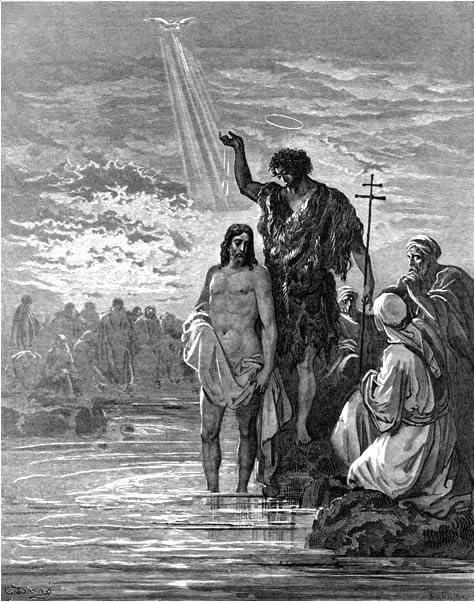
John baptizes Jesus in the Jordan as light descends from an opened heaven, engraving by Gustave Doré.

Notable art

The Baptism of Jesus

John 1:32 · I saw the Spirit descending from heaven like a dove, and it abode upon him.

Gustave Doré, 1866. Public domain.

6 statements, each with its passages

What we hold

  1. 01What we hold

    The Holy Spirit is a person, not a force.

    A force does not speak. The Spirit does: in Antioch he said, out loud enough to be obeyed, "Separate me Barnabas and Saul for the work whereunto I have called them." That is a sentence with a speaker behind it.

    A force cannot be hurt. Paul tells the Ephesians not to grieve the Holy Spirit, you cannot grieve electricity. A force does not choose. Paul says the Spirit distributes spiritual gifts "severally as he will," which is a decision, made by someone with a will. And when you do not know what to pray, the Spirit himself intercedes for you.

    This matters practically. If the Spirit is a power, the question becomes how to get more of it, and the Christian life turns into a hunt for a substance. If the Spirit is a person, the question becomes how to walk with him: how not to grieve him, how to listen, how to obey. One of those produces technique. The other produces friendship.

  2. 02What we hold

    The Holy Spirit is fully God.

    Peter's words to Ananias make this unavoidable. He says, "Why hath Satan filled thine heart to lie to the Holy Ghost?" — and one breath later, "thou hast not lied unto men, but unto God." Lying to the Spirit is lying to God, because the Spirit is God.

    The church put this in writing at Constantinople in 381, in the line most churches still recite: the Holy Spirit is "the Lord and Giver of life, who with the Father and the Son together is worshipped and glorified." Worship is reserved for God alone. The creed hands it to the Spirit without apology.

    So the Spirit is not God's junior partner or God's tool. He is the third person of the one God: equal in nature, distinct in person, at work in the world right now.

  3. 03What we hold

    He was there at creation, and he gave us the Scriptures.

    The second sentence of the Bible has the Spirit of God moving over the face of the waters. Job says the Spirit of God made him. The Psalms say that when God sends forth his Spirit, things are created. He is not a latecomer who arrives in Acts 2; he has been present and active since the first page.

    He is also the reason you have a Bible. Peter says prophecy never came by human will; holy men spoke as they were carried along by the Holy Spirit. Paul says all Scripture is God-breathed. Human authors wrote in their own styles, with their own vocabularies and personalities fully intact, and what came out was God's word, because the Spirit carried them.

  4. 04What we hold

    He convicts, gives new birth, moves in, and seals.

    Four works, in the order a person usually experiences them.

    Conviction: Jesus said the Spirit would convict the world of sin, of righteousness, and of judgment. That uncomfortable clarity about your own life is not your conscience working overtime. It is God being kind enough to tell you the truth.

    New birth: Jesus told Nicodemus a person must be born of the Spirit. Not improved. Born. Regeneration is the Spirit making alive what was dead, and it is his work, not the product of a decision technique or a stirring meeting.

    Indwelling: Paul asks the Corinthians, of all people, whether they know that their body is a temple of the Holy Spirit. Not the building. The person. Every believer is indwelt; this is not a reward for the advanced.

    Sealing: a seal in the ancient world meant ownership and protection. Paul says believers were sealed with the Holy Spirit of promise, who is the down payment on everything still coming. God has put his mark on you, and left a deposit as proof he intends to finish.

  5. 05What we hold

    He grows fruit: character that looks like Jesus.

    Paul lists it: love, joy, peace, longsuffering, gentleness, goodness, faith, meekness, temperance. Note the grammar: fruit, singular. It is one crop with nine flavors, not a menu where you pick the three that suit your temperament.

    Fruit is grown, not installed. Nobody gets patience by asking once. The Spirit produces this over years, usually through exactly the circumstances a person would not have chosen. That is slow, and it is supposed to be.

    This is also the honest measuring stick. A person can be gifted and unkind. Nobody can bear this fruit and stay unchanged. When MannaFest says a gift is never proof of maturity, this is the passage standing behind it.

  6. 06What we hold

    He gives gifts: to ordinary people, for everyone else's good.

    There are three main lists and they do not match, which is itself a clue that none of them is meant to be exhaustive. First Corinthians 12 gives wisdom, knowledge, faith, healing, miracles, prophecy, discernment, tongues, interpretation. Romans 12 adds prophecy, serving, teaching, encouraging, giving, leading, mercy. Ephesians 4 lists people rather than abilities: apostles, prophets, evangelists, pastors and teachers, given to equip the saints for the work of the ministry.

    Two rules run through all of them. The gifts are distributed by the Spirit's decision, not earned by the recipient's merit, so nobody may boast and nobody may despair. And they are given "to profit withal," for the common good. A gift used to build a reputation is being misused no matter how genuine it is.

    That second rule is the whole argument of 1 Corinthians 14. Paul does not tell the Corinthians their gifts are fake. He tells them to arrange their meetings so that people are actually built up. "Let all things be done unto edifying" is the standard, and it is a standard a church can be measured by.

Quoted, with the work named

How the church has said it

Aldersgate: the assurance this locus calls the witness of the Spirit, in the moment it landed.

I felt my heart strangely warmed. I felt I did trust in Christ, Christ alone, for salvation; and an assurance was given me that He had taken away my sins, even mine, and saved me from the law of sin and death.

John Wesley· Journal, 24 May 1738Evangelical

Read the work →

The definition the Wesleyan stream still works from.

The testimony of the Spirit is an inward impression on the soul, whereby the Spirit of God directly witnesses to my spirit that I am a child of God.

John Wesley· sermon 10, The Witness of the Spirit, IEvangelical

Read the work →

Even the tradition most cautious about the gifts makes the Spirit the whole connection.

The Holy Spirit is the bond by which Christ effectually unites us to himself.

John Calvin· Institutes of the Christian Religion III.i.1 (Beveridge translation)Reformed

Read the work →

The house answer in gold, every alternative at full strength

Where Christians divide

  • The claimthis site's tradition
  • The objectionanother reading, at full strength
  • The answerwhat that reading costs
  • Scripturequoted plain, never slanted toward any side

Do the gifts of the Spirit still happen today?

The claim · this site's tradition

Yes. This site's tradition, Wesleyan-Pentecostal, holds that the gifts described in the New Testament, including prophecy, healing, miracles, and tongues, were never withdrawn, and are given by the Spirit to the church today, along with everything that costs.

The New Testament never announces an expiration. This is the argument that carries the most weight, and it is an argument from absence in a place where absence is loud. The apostles gave the church careful instructions on a hundred practical matters: food, lawsuits, head coverings, widows, elders, meeting order. Paul devotes three entire chapters to regulating the use of these gifts. If the gifts were about to stop within a generation, that regulation was wasted ink, and the silence about their ending is very strange.

The one text that is supposed to announce it does not. First Corinthians 13:8-12 says prophecy will be done away and tongues will cease "when that which is perfect is come." What is the perfect? Paul answers in the same breath: "now we see through a glass, darkly; but then face to face: now I know in part; but then shall I know even as also I am known." Face to face. Knowing as I am known. No Christian has ever claimed that a finished New Testament gave them face-to-face sight of God or exhaustive knowledge. That is the return of Christ. On the most natural reading, Paul's stopping point for the gifts is the second coming, not the last page of Revelation.

Peter's Pentecost sermon sets the timeframe, and it is long. He quotes Joel and says this outpouring, sons and daughters prophesying, visions, dreams, is what happens "in the last days." The last days in the New Testament run from Pentecost to the return of Christ. Hebrews says God has spoken to us in these last days by his Son. If we are still in the last days, we are still in the era Joel describes.

The record after the apostles is not empty. Justin Martyr in the mid-second century told Trypho that prophetic gifts were present among Christians in his own day. Irenaeus wrote of believers who prophesied, saw visions, and, he says plainly, of the dead being raised. Tertullian described charismatic phenomena in the assemblies. Augustine, who had earlier written that miracles had ceased, walked that back in Book 22 of *The City of God* and catalogued healings he had personally investigated in his own diocese. Later you have the Moravians, the early Methodists, the Welsh revival, and a global Pentecostal movement now numbering in the hundreds of millions. One may judge any of these claims false. One cannot say the record is empty.

And the plain instruction still stands unrepealed. "Despise not prophesyings. Prove all things; hold fast that which is good." That is not the language of a gift about to be withdrawn. It is the language of a gift the church will need to keep handling carefully.

Where others land: 2 positions, each with what it costs

  1. THE OBJECTION01Open but cautiousThere is no convincing biblical case that the gifts have ceased, so we should not say they have. But there is also no biblical warrant for expecting them as a regular feature of ordinary church life, and much modern charismatic practice does not resemble what the New Testament describes. God may do anything; we should neither forbid nor engineer it.Its case, in fullIt refuses to prove a negative that Scripture never states. On the exegesis of 1 Corinthians 13, this position often sides with the continuationist, "the perfect" is the return of Christ, while still declining to build a church culture around the gifts.It distinguishes between what God may do and what we may promise. Much charismatic damage comes not from believing God heals but from guaranteeing that he will in a given case. This position keeps the possibility and drops the guarantee.It takes seriously that the New Testament's own regulation of the gifts is overwhelmingly restrictive in tone: two or three at most, in turn, with interpretation, and if no interpreter, silence.D. A. Carson, *Showing the Spirit*; Wayne Grudem, *Systematic Theology* (Grudem is more firmly continuationist but pioneered the framing); a large share of contemporary evangelicals in practice.

    THE ANSWER

    The honest difficulty. It can become a theoretical openness that never changes what any meeting actually looks like. If the gifts are genuinely given for the common good, a church that never seeks them is missing something real, not merely declining an optional extra.

  2. THE OBJECTION02The sacramental / third-wave and Catholic-charismatic readingsThe gifts continue, but they are ordinary equipment for ordinary Christians rather than the marker of a separate spiritual class. On the Catholic side, the fullness of the Spirit is tied to baptism and confirmation, with charismatic renewal understood as a release of what was already given rather than a second reception.Its case, in fullIt preserves the continuation of the gifts while removing the two-tier Christianity that has caused so much pain: the sense that there are Spirit-filled believers and then everyone else.It reads 1 Corinthians 12:7 straight: the manifestation of the Spirit is given "to every man," not to a qualified elite.It has been the least divisive form of renewal historically, because it does not require a congregation to split over an experience.The Catholic Charismatic Renewal, which began at Duquesne in 1967 and was welcomed by Paul VI in 1975; John Wimber and the Vineyard movement; many Anglicans, including the late J. I. Packer's sympathetic treatment in *Keep in Step with the Spirit*.

    THE ANSWER

    The honest difficulty. It can under-read the narrative pattern of Acts, where the coming of the Spirit is repeatedly a datable, noticeable event and not merely a formal possession. And in Catholic form it ties the Spirit's giving to sacraments in a way Protestants find hard to locate in Acts.

Is being filled with the Spirit something separate from becoming a Christian?

The claim · this site's tradition

This site's tradition holds the Pentecostal position: baptism in the Holy Spirit is a distinct work, available to every believer, that may come at conversion or later, and that empowers a Christian for witness and service. It is not a second salvation and it does not make anyone a better class of Christian; every believer already has the Spirit. It is more power for the same life.

Acts keeps telling the story that way. The Samaritans in Acts 8 believed and were baptized, and only afterward did Peter and John come down and pray that they might receive the Holy Spirit. The Ephesian disciples in Acts 19 are asked directly, "Have ye received the Holy Ghost since ye believed?" — a question that assumes the two can be separated. Paul himself believed on the Damascus road and was filled three days later under Ananias's hands.

The stated purpose is power for mission, not the beginning of spiritual life. Jesus' own framing in Acts 1:8 is "ye shall receive power, after that the Holy Ghost is come upon you; and ye shall be witnesses unto me." The result named is witness.

Even Cornelius's household, where the Spirit falls during the sermon with no interval at all, fits: the point is not that a delay is required, but that the filling is a real, recognizable event. Sometimes it is simultaneous with conversion. Sometimes it is not.

Paul's command in Ephesians 5:18 is in the present continuous: keep on being filled. Whatever happens once, the filling is meant to be repeated. Acts 4:31 has the same people filled again who were filled in Acts 2.

Where others land: 2 positions, each with what it costs

  1. THE OBJECTION01It is conversion: every Christian is baptized in the Spirit alreadySpirit baptism is what happens when a person is saved. There is no second reception to seek. Believers are commanded to be filled with the Spirit, repeatedly, and more than they usually are, but that is a different word and a different thing from baptism.Its case, in fullThe one text that defines the term directly is 1 Corinthians 12:13: "For by one Spirit are we all baptized into one body." All. Not the advanced ones. If Paul can say every member of the fractious Corinthian church has been baptized in the Spirit, the term cannot describe a subsequent experience some believers lack.Romans 8:9 draws the line hard: "if any man have not the Spirit of Christ, he is none of his." There is no category of Christian without the Spirit, so there is no waiting room.Acts is narrative, and narrative describes what happened rather than prescribing what must happen. The book covers a genuine hinge of history, the gospel crossing from Jews to Samaritans to Gentiles, and Luke marks each crossing with a visible outpouring so the church could not deny that the outsiders were truly in. Read that way, the Samaritan delay in Acts 8 is about apostolic verification of a boundary crossing, not a normal two-stage pattern.The Ephesians of Acts 19 turn out to be disciples of John the Baptist who had not heard of the Holy Spirit and were re-baptized in Jesus' name. They were not Christians waiting for an upgrade; they were pre-Christian and were brought all the way in at once.Pastorally, this view spares believers a spiritual second-class status and the exhausting pursuit of an experience that may never arrive on demand.Martyn Lloyd-Jones is a partial exception, but the standard case is John Stott, *Baptism and Fullness*; James D. G. Dunn, *Baptism in the Holy Spirit*; the broad Reformed and evangelical consensus.

    THE ANSWER

    The honest difficulty. It must flatten the Acts 8 sequence, where Luke says the Spirit "was fallen upon none of them" though they had believed and been baptized, a sentence that is hard to fit if reception is automatic at faith. And it has to explain why Paul asks the Ephesians a question about timing at all, if no gap is ever possible.

  2. THE OBJECTION02The sacramental viewThe Spirit is given in baptism and sealed in confirmation or chrismation. What Pentecostals seek in a later crisis experience the church has always given in the sacraments; the appropriate later development is a deeper living-out of what was already received.Its case, in fullIt has continuity: the laying on of hands after baptism in Acts 8 and 19 is exactly what confirmation formalizes, and the church was doing it by the second century.It grounds assurance in something objective (a promise attached to an act of the church) rather than in the intensity of a personal experience, which fluctuates.It resists the tiering of Christians as firmly as the Reformed view does.Roman Catholic and Eastern Orthodox teaching; classical Anglican and Lutheran confirmation practice.

    THE ANSWER

    The honest difficulty. It can turn a living reception into a completed formality, and it does not easily account for the datable, unmistakable, sometimes disruptive character of the outpourings Luke describes.

Is speaking in tongues the sign that someone has been filled?

The claim · this site's tradition

This one is an argument inside the house, and MannaFest says so rather than pretending otherwise. Classical Pentecostalism teaches that tongues is the initial physical evidence of Spirit baptism. Much of the broader charismatic and Third Wave stream holds that tongues is one gift among several and no believer should be told their filling is invalid without it. MannaFest stands in the Pentecostal stream and honors its testimony, and it will not make tongues a test of anyone's standing with God.

The classical Pentecostal case is a pattern argument from Acts, and it is a real pattern: tongues accompany the outpouring at Pentecost in Acts 2, at Cornelius's house in Acts 10 (where it is the very evidence that convinces the Jewish believers the Gentiles are in) and at Ephesus in Acts 19. Three named instances, and in Acts 8 something visible clearly happened, since Simon saw it and wanted to buy it.

The counterweight is Paul's own question in 1 Corinthians 12:30: "do all speak with tongues?" — framed in Greek to expect the answer no. Classical Pentecostals answer that Paul is asking about the public gift of tongues for the congregation, which requires interpretation, not about private prayer language. That distinction is coherent and long-standing. It is also, honestly, contested.

Where MannaFest lands practically: seek the fullness of the Spirit, expect God to give what he chooses to give, and never let a believer be told that God has withheld himself because a particular manifestation has not come. The fruit of the Spirit, not any single gift, is the settled evidence Scripture gives for measuring a life.

Where others land: 2 positions, each with what it costs

  1. THE OBJECTION01Initial evidence: the classical Pentecostal positionTongues is the initial physical evidence that a believer has been baptized in the Holy Spirit. It is distinct from the ongoing gift of tongues for ministry, which not everyone has.Its case, in fullIt reads the Acts pattern consistently rather than selectively, and it explains why Peter in Acts 10:46 treats tongues as sufficient proof that Cornelius's household had received the same gift.It gives an ordinary believer something concrete to expect rather than an undefined feeling.The distinction between evidential tongues and the congregational gift is not an ad hoc rescue; Paul himself distinguishes private tongues that edify the speaker from public tongues requiring interpretation in 1 Corinthians 14:2-5, 18-19.The Assemblies of God Statement of Fundamental Truths; the Church of God (Cleveland); the Foursquare Church; the Azusa Street tradition from 1906.

    THE ANSWER

    The honest difficulty. No New Testament text states the doctrine directly; it is inferred from narrative. And it can leave sincere believers who have sought the filling for years feeling that God has passed them over, a pastoral cost the position must own and its best teachers do.

  2. THE OBJECTION02Tongues is one gift among manyThe Spirit distributes gifts as he wills, tongues included. A person may be genuinely and powerfully filled and never speak in tongues. Requiring it as evidence adds a condition Scripture does not state.Its case, in full1 Corinthians 12:11 and 12:30 both point the same direction: the distribution is the Spirit's choice, and not everyone gets the same gift.Acts describes the outpourings in different terms in different places: tongues in some, prophecy, boldness, and praise in others.It removes a test that has, in practice, produced imitation and quiet shame in people who did not want to be left out.Most of the charismatic renewal; the Vineyard; Gordon Fee, *God's Empowering Presence* — himself a lifelong Pentecostal who argued against making tongues a required evidence.

    THE ANSWER

    The honest difficulty. It can soften into expecting nothing in particular, which is not what Acts describes either. If the filling is real, something should be different.

How should we handle someone who says 'God told me'?

The claim · this site's tradition

With both halves of Paul's sentence, and never only one. "Despise not prophesyings" is the first half, do not sneer, do not shut it down reflexively. "Prove all things; hold fast that which is good" is the second: test it, every time, without apology. A church that only does the first gets used. A church that only does the second goes deaf.

Testing is a New Testament command, not a modern suspicion. Paul tells the Corinthians that when prophets speak, "let the other judge." John tells believers to test the spirits, because many false prophets have gone out. The gift comes with a built-in weighing process, and the weighing is the congregation's job.

The tests are concrete. Does it agree with Scripture? Scripture is the fixed point; anything contradicting it is rejected regardless of how it arrived. Does it exalt Jesus? The Spirit's stated work is to glorify Christ, not the messenger. Does it build up, encourage, and comfort (Paul's own definition of what prophecy is for)? Does it come true? Deuteronomy 18 is blunt about that. And what is the messenger's life like: is there fruit, and is the person correctable?

New Testament prophecy is not treated as inerrant Scripture. That is why it gets judged rather than simply obeyed. Agabus predicts a famine and it happens; and when Agabus foretells Paul's arrest, Paul weighs the counsel and goes to Jerusalem anyway. Whether Agabus's wording was precise is itself disputed: Wayne Grudem argues it was close but not exact, while Richard Gaffin and others read it as an accurate summary of what happened, and that disagreement is live. Either way, prophecy informs; it does not override.

One practical rule that spares a great deal of grief: a word that fits Scripture and confirms what God is already doing can be received with thanks. A word that directs a major life decision (marriage, money, a move) should never be acted on by itself. Confirm it in the ordinary ways, through Scripture, wise counsel, and time.

Where others land: 1 position, each with what it costs

  1. THE OBJECTION01Prophecy today is a lesser, fallible gift than ScriptureOld Testament prophets spoke God's words directly and were to be stoned if wrong. New Testament congregational prophecy is a Spirit-prompted impression reported in human words, which can be partly right and must be judged. It never carries the authority of Scripture.Its case, in fullIt explains why Paul commands the church to weigh prophecies at all: you do not weigh the words of God.It preserves the sufficiency and uniqueness of Scripture while leaving room for the gift.It fits 1 Corinthians 13:9, "we prophesy in part" — partial by nature, not merely partial in delivery.Wayne Grudem, *The Gift of Prophecy in the New Testament and Today*; widely held across the charismatic and Third Wave stream.

    THE ANSWER

    The honest difficulty. Critics argue this creates a category the Bible does not have, and that a prophecy which may be wrong is not what the word "prophecy" meant to any first-century reader.

Named, and linked where the text is free

The works this page stands on

In copyright: named, not reproduced

We cite these at fifty words or fewer and send you to the book itself.

  • A. W. Tozer, The Pursuit of God
  • Chuck Missler, Learn the Bible in 24 Hours, session on Acts
  • D. A. Carson, Showing the Spirit: A Theological Exposition of 1 Corinthians 12–14
  • Gordon Fee, God's Empowering Presence
  • Wayne Grudem, The Gift of Prophecy in the New Testament and Today
  • John Stott, Baptism and Fullness
  • Assemblies of God, Statement of Fundamental Truths, articles 7–8as the classical Pentecostal position