MANNAFEST

Historical Books · Ruth

Hesed in the Barley Field

Ruth is the Bible's small, quiet proof that the LORD's hesed reaches past the boundary stones of the covenant people to a Moabite widow — and that the kinsman he raises up for her, Boaz, is himself a rehearsal of the greater Kinsman who is near enough, willing enough, and able enough to redeem us.

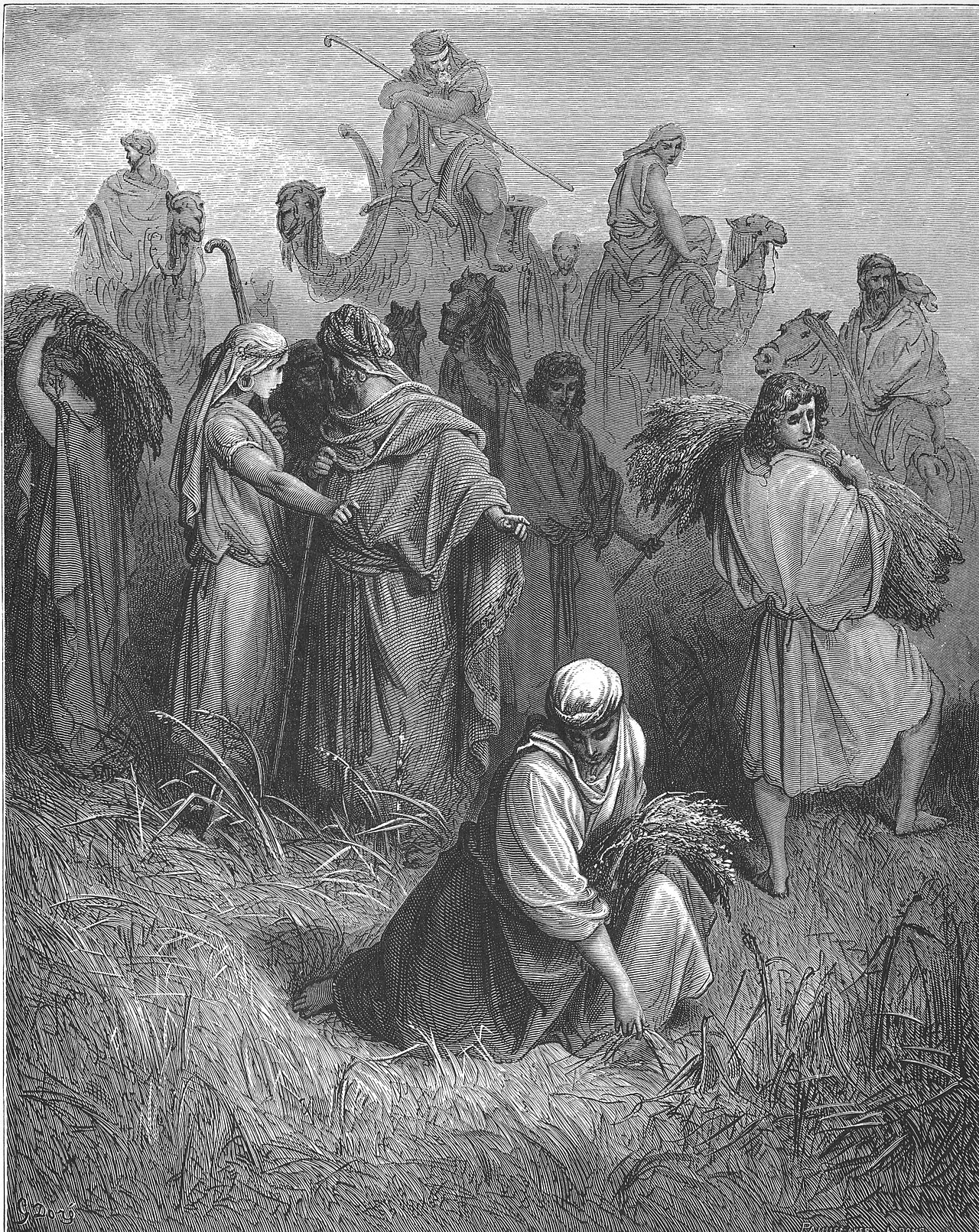
Ruth and Boaz — Gustave Doré
Ruth gleaning in the field of Boaz — hesed reaching a Moabite widow at harvest — Gustave Doré, Doré’s English Bible (1866), public domain · Ruth 2:8-12

The Arc

four chapters, one shape — full, to empty, to full again

Ruth's own design is an inclusio: the book opens on famine and three deaths and closes on harvest, a birth, and a genealogy running to the king. At its center sit two paired tests of Boaz's hesed — the field by day, the threshing floor by night — each resolved by a blessing. Naomi's own words frame the shape: “I went out full, and Jehovah hath brought me home again empty” (1:21) — answered by the women's blessing over Obed (4:14–17).

Ruth 1:1–5

Elimelech, Naomi, and their two sons leave Bethlehem — “the house of bread” — for Moab, because the house of bread has none.

Ruth 1:20–21

Husband and both sons dead in Moab. Naomi renames herself “bitter”: “I went out full, and Jehovah hath brought me home again empty.”

Ruth 2:3, 12

“Her hap was to light on” Boaz's field — miqreh, “chance,” the narrator's one deliberately ironic word for what the whole book means as providence. Boaz blesses her: “under whose wings thou art come to take refuge.”

Ruth 3:9

Ruth asks Boaz to “spread thy skirt” over his handmaid — kanaph, the same word as his own blessing in 2:12. A bold, legally-loaded request, not a scandal (see Contested Points).

Ruth 4:14–17

The women of Bethlehem tell Naomi her daughter-in-law “is better to thee than seven sons.” She nurses Obed in her lap — bitterness answered not by explanation, but by a child.

The line does not stop at 4:17. The closing genealogy (4:18–22) carries it past the book's own edge — Perez to David, and from David to the Christ (Matt 1:5). See The Genealogy of Jesus for where the line runs next.

  1. I
    Famine, loss, and returnRuth 1:1–22

    Elimelech's family in Moab; three deaths; Naomi releases her daughters-in-law; Ruth's clinging vow (“thy people shall be my people, and thy God my God,” 1:16); the return to Bethlehem at the start of barley harvest.

  2. II
    The field — gleaning, hesed, and providenceRuth 2:1–23

    Ruth gleans, and “her hap was to light on” Boaz's field. Boaz's kindness and blessing; Naomi identifies him — “one of our near kinsmen.”

  3. III
    The threshing floor — Ruth's bold appealRuth 3:1–18

    Naomi's plan; Ruth uncovers Boaz's feet by night and asks him to spread his skirt over her — “thou art a near kinsman.” Boaz's response, and the complication of a nearer kinsman.

  4. IV
    The gate — legal redemption and the genealogyRuth 4:1–22

    Boaz redeems the land and marries Ruth after the nearer kinsman declines; the birth of Obed; the elders' blessing invoking Rachel, Leah, Tamar, and Perez; the closing genealogy, Perez to David.

The Argument

the whole book in three sentences
Author
Anonymous — Jewish tradition names Samuel
Date
MannaFest's flag: early / Davidic-era
Genre
Historical narrative — a short story saturated with legal formulas
Shape
4 chapters · 2 paired tests · 1 closing genealogy
  1. 1

    Famine drives Elimelech's family from Bethlehem to Moab, where he and both sons die, leaving Naomi bereft with two Moabite daughters-in-law; one, Ruth, refuses to leave her and returns with her to Bethlehem in poverty, confessing Naomi's people and Naomi's God as her own.

  2. 2

    Ruth gleans in the field of Boaz, a kinsman of Elimelech, whose hesed toward her culminates at the threshing floor and the city gate in a legal act of redemption — goel-ship — that makes her his wife.

  3. 3

    Their son Obed becomes the grandfather of David, so a Moabite widow's loyalty and a Bethlehemite's righteousness together become a hinge in the line that leads, four generations later in genealogy and forty in Matthew's count, to Christ.

Christ in Ruth

the threefold qualification of a goel — rehearsed by Boaz, fulfilled in Christ
Near of kinLev 25:25; Ruth 3:12–13 → Heb 2:14

The law required a redeemer to be family — “there is a kinsman nearer than I,” Ruth is told, before Boaz can act. Christ's incarnation makes Him our kinsman by blood: “the children are sharers in flesh and blood… he also himself in like manner partook of the same,” so that He could redeem.

WillingRuth 3:11 → John 10:18

Boaz volunteers before Ruth finishes asking — “I will do to thee all that thou sayest.” Christ lays down His life of His own will: “No one taketh it away from me, but I lay it down of myself.”

AbleRuth 2:1; 4:6 → Rom 8:3

Boaz is “a mighty man of wealth”; the nearer kinsman, offered first refusal, lacks the will to risk his own inheritance and steps aside. Christ's redemption is of infinite sufficiency, unlike the Law, which “was weak through the flesh” and could not redeem.

The seeded typology candidate reads it plainly: Ruth 4:9's redemption of Boaz → Ephesians 1:7's redemption in Christ, “in whom we have our redemption through his blood.” The full three-fold case — near, willing, able — is worked out on its own page.

The Kinsman-Redeemer study →

Themes

five load-bearing lines through the book
01

Hesed — the book's engine

Ruth 1:8; 2:20; 3:10

Covenant loyalty, three times, each a hinge: Naomi blesses her daughters-in-law for it; Naomi blesses Boaz for it toward the dead and the living; Boaz commends Ruth for showing more of it in the end than at the beginning.

02

Providence under an ordinary surface

Ruth 2:3

God never speaks or acts directly in Ruth — no theophany, no miracle. The narrator's one aside, “her hap was to light on the portion of the field belonging unto Boaz,” is Scripture's paradigm case of God governing history through gleaning laws and kindness, not the miraculous.

03

The goel and redemption

Ruth chs. 3–4

Ga'al, “to redeem, act as kinsman,” governs the legal core: the duty to redeem land sold in poverty (Lev 25:25) and to raise up a name for a dead kinsman (Deut 25:5–10), blended in Boaz's single act at the gate.

04

Gentile inclusion

Ruth 1:16; Deut 23:3

Ruth is a Moabite, a people under a standing exclusion — yet received into Israel by personal confession and made an ancestress of David and of Christ. The Old Testament's clearest narrative enactment of grace toward an outsider who turns to Israel's God.

05

Emptiness to fullness

Ruth 1:21; 4:15–16

Naomi's own words frame the book: “I went out full, and Jehovah hath brought me home again empty” — answered not by explanation but by a grandson in her lap and a name in the line of the king.

“She knew not whose field it was, nor had she any reason for going to that more than any other, and therefore it is said to be her hap; but Providence directed her steps to this field. Note, God wisely orders small events; and those that seem altogether contingent serve his own glory and the good of his people.”

Matthew Henry, Commentary on the Whole Bible (1710), on Ruth 2:3 — public domain

The Approved Voices on Ruth

the roster applied — the specific work named where one is confirmed
Matthew Henrypublic domain

An Exposition of the Old and New Testament, on Ruth

Devotional-practical exposition, strong on Ruth's “happening” on Boaz's field as providence, and on Boaz's kindness as a model of righteous character.

Jamieson, Fausset & Brownpublic domain

A Commentary, Critical and Explanatory, on the Whole Bible, on Ruth

Concise critical-devotional notes, strongest on the legal background of the levirate and redemption customs behind chapter 4.

Keil & Delitzschpublic domain

Commentary on the Old Testament (Joshua–Judges–Ruth volume)

The most textually careful public-domain treatment available — the source to open for the ga'al / ge'ullah legal-technical material.

John Wesleypublic domain

Explanatory Notes upon the Old Testament, on Ruth

Brief, warm, practical notes on hesed and on Boaz's character as a model of Christian charity toward the poor and the stranger.

Charles Spurgeonpublic domain

sermon citation ⚠verify

Preached repeatedly from Ruth — the “under his wings” refuge image (2:12) and Ruth's confession (1:16) both sit squarely in his cross-centered preaching. No specific sermon title is confirmed for this pass.

Chuck Misslercite-only ≤50w

no confirmed Ruth-specific work

Marcus Brown's formative teacher. What is confidently applicable without a specific-work citation is his general typological method — Christ in every text, the goel-as-Christ pattern — which structures the Kinsman-Redeemer study.

R. C. Sproulcite-only ≤50w

no confirmed Ruth-specific work

His broader teaching on God's meticulous, ordinary-means providence is directly on-theme for 2:3's “hap,” though no Ruth-specific title is confirmed for this pass.

One honest absence, worth naming: Calvin's Old Testament commentary corpus covers the Pentateuch, Joshua, Psalms, Isaiah, the Gospel harmony, Acts, and the Epistles — not Judges through Kings. A Ruth page that cites him has invented it. Ruth also has a thinner confirmed-citation trail than Genesis or the Gospels in this research pass; the wider roster's fit on grace-to-the-outsider and hearing God's voice is strong in emphasis but lacks a confirmed Ruth-specific title for this session. Marcus Brown's own commentary leads above all; within a tier, all voices are equal.

Contested Points

presented at full strength, then MannaFest's flag

The date of composition

The early / Davidic-era reading

The book reads naturally as close to its own setting; its Hebrew shows no linguistic marker all scholars agree is late; the genealogy's interest in David as still-notable fits a monarchy-era audience; Jewish tradition ascribes it to Samuel's era.

The post-exilic / anti-Ezra-Nehemiah reading

A substantial line of scholarship dates Ruth after the exile and reads it as a deliberate counter-argument to Ezra and Nehemiah's dissolving of marriages to foreign wives (Ezra 9–10; Neh 13:23–27) — a faithful Moabite becoming David's great-grandmother makes the returnees' ethnic-purity anxiety look shortsighted.

MannaFest flag — MannaFest holds the traditional early date. The book's theology of hesed, providence, and redemption does not require a polemical occasion to make sense — though the parallel to Ezra-Nehemiah's crisis is genuinely illuminating background even under an early date.

The threshing-floor scene (3:6–15)

The innocent / legal reading

“Uncovering the feet” and lying down until Boaz wakes is a customary, legally-loaded gesture requesting a near kinsman's protection, conducted at night for privacy and safety — threshing floors were normally guarded by sleeping workers during harvest. The narrative itself calls Ruth “a virtuous woman” (3:11), and the scene resolves in a public, legally proper marriage.

The more suggestive reading

Some scholars argue “feet” functions elsewhere as a euphemism, and that the night setting, the wine, and the instruction to wait until Boaz is “in a good mood” carry deliberate sexual tension the narrator wants felt, even if nothing improper occurs.

MannaFest flag — MannaFest holds the innocent / legal reading, which the text's own moral commentary (3:11) and its public resolution at the gate (ch. 4) support — while granting the more suggestive reading's observation that the scene is dramatically bold, not a safe one.

Ruth's Moabite ethnicity and Deuteronomy 23:3

The tension read at full strength

Deut 23:3 bars Moabites “even to the tenth generation… for ever” from the assembly of the LORD — yet Ruth the Moabitess is not only received but becomes ancestress of David and, through him, of Christ. A genuine tension some read as the book deliberately testing the exclusion.

The consistency reading

The statute is aimed at the political-cultic corruption of Moabite and Ammonite men (who hired Balaam and seduced Israel at Baal-peor, Num 22–25) rather than a blanket bar on any individual convert of any era. Ruth's personal covenant confession, “thy God my God” (1:16), fits inside the statute rather than overturning it.

MannaFest flag — MannaFest reads Ruth as the Old Testament's own demonstration that the door was never closed to genuine faith — exactly the pattern Gentile inclusion in Christ later fulfills at full scale (Eph 2:11–13).

The Cast

eight people and two places — the whole world of the book
Naomi / MaraThe book's emotional center — from full, to empty, to full again in Obed's grandmother.RuthThe Moabitess who clings to Naomi and Naomi's God — “thy people shall be my people” (1:16).Boaz“A mighty man of wealth” (2:1), Elimelech's kinsman, the willing, able, near redeemer.
ElimelechNaomi's husband — dies in Moab (1:3), traditionally glossed “my God is king.”
Mahlon and ChilionNaomi's sons — die in Moab without children (1:5).
OrpahThe daughter-in-law who kisses Naomi and turns back to Moab (1:14–15).
The unnamed kinsman“Such a one” (4:1) — nearer than Boaz, but unwilling to redeem “lest I mar mine own inheritance” (4:6).
ObedRuth and Boaz's son — grandfather of David (4:17).

The two places

Keep studying

— more from Israel's Story

Drafted from MannaFest's research brief on Ruth — public-domain commentators (Henry, JFB, Keil & Delitzsch, Wesley) paraphrased, with ledger-confirmed verbatim excerpts, cited by specific work, moderns cite-only per the founder's approved-voices roster. Scripture ASV. Every cited work — the sources registry →