
Job 2:12
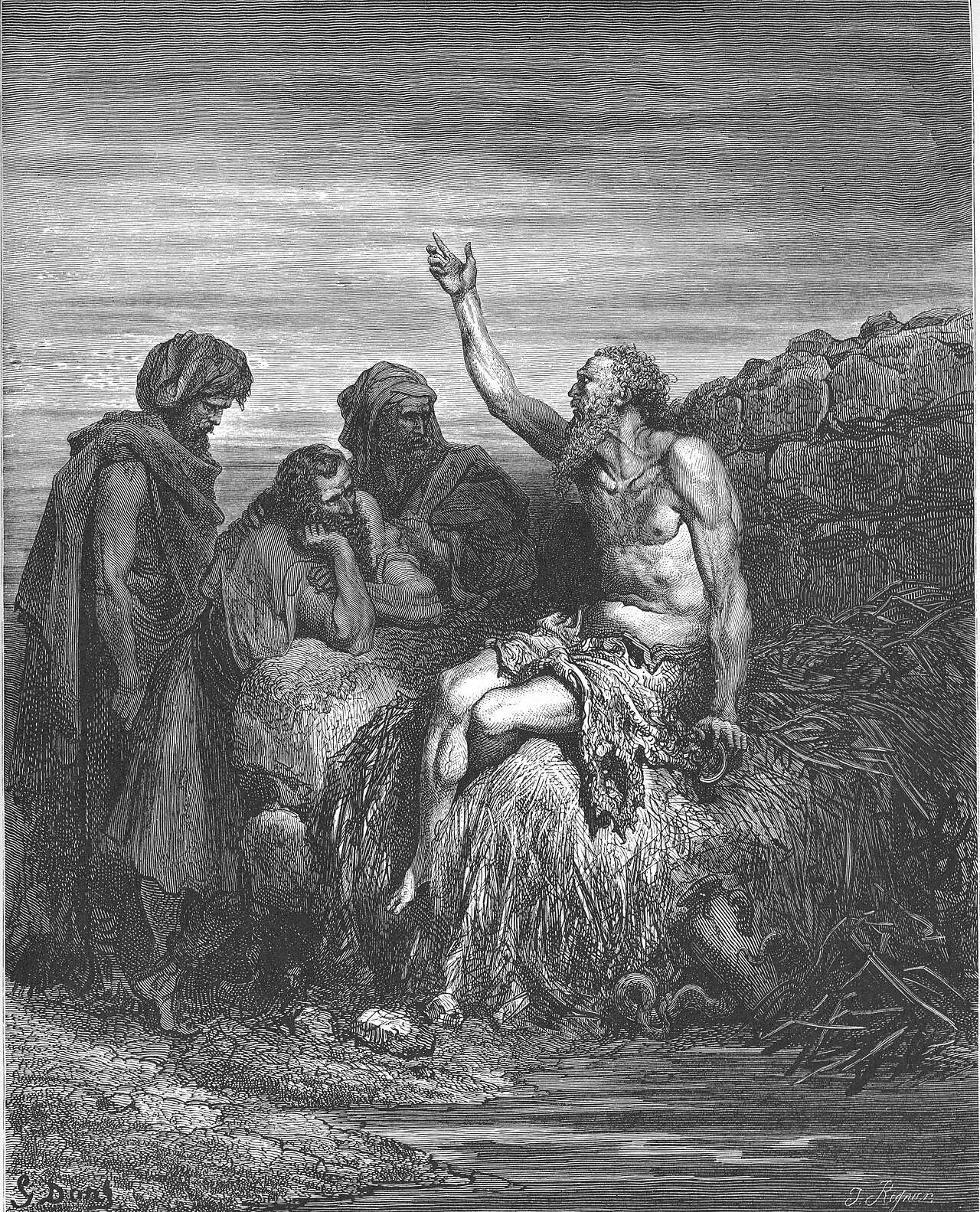
in Job 2When they lifted up their eyes from afar, they could barely recognize Job. They began to weep aloud, and each man tore his robe and threw dust in the air over his head.
BSB
The same verse in ASV and KJV ▾
ASV
And when they lifted up their eyes afar off, and knew him not, they lifted up their voice, and wept; and they rent every one his robe, and sprinkled dust upon their heads toward heaven.
KJV
And when they lifted up their eyes afar off, and knew him not, they lifted up their voice, and wept; and they rent every one his mantle, and sprinkled dust upon their heads toward heaven.
⋯
This verse in Job 2
Commentary
11 notes on this verseThey rent every one his mantle - I have already had frequent occasions to point out and illustrate, by quotations from the ancients, the actions that were used in order to express profound grief; such as wrapping themselves in sackcloth, covering the face, strewing dust or ashes upon the head, sitting upon the bare ground, etc., etc.; significant actions which were in use among all nations.
This site's exposition
heard about all this adversity
on Job 2:11-13
Eliphaz the Temanite, Bildad the Shuhite and Zophar the Naamathite arrive, and Eliphaz bears a town name from Edom, where the opening verse placed Job. They tear their robes and sit on the ground and "no one spoke a word to him because they saw how intense his suffering was".
This site's exposition
they could barely recognize Job
Disease had so changed Job that his friends could barely recognize him from afar, as Barnes reads it. Thomas Aquinas adds the loss of his fine clothing. The torn robe and the dust thrown over the head are the old signs of deep grief that Clarke gathers from the ancients.
The record, by era
The Medieval Church4 voices
MORAL INTERPRETATION. And when they lifted up their eyes afar off, and knew him not, they lifted up their voice, and wept. For the vices do not know us in our afflictions, in that so soon as they have knocked at the dejected heart, being reproved they start back, and they, which as it were knew us in our joy, because they made their way in, cannot know us in our sadness, in that they break their edge on our very rigidity itself. But our old enemy, the more he sees that he is himself caught out in them, and that with a good courage, cloaks them with so much the deeper disguise under the image of virtues; and hence it is added, They lifted up their voice, and wept; and they rent every one his mantle, and sprinkled dust upon their heads toward heaven. For by the weeping pity is betokened, discretion by the cutting of the garments, the affecting of good works by the dust upon the head, humility by the sitting. For sometimes the enemy in plotting against us feigns somewhat that is full of pity, that he may bring us down to an end of cruelty. As is the case, when he prevents a fault being corrected by chastisement, that that, which is not suppressed in this life, may be stricken with the fire of hell. Sometimes he presents the form of discretion to the eyes, and draws us on to snares of indiscretion, which happens, when at his instigation we as it were from prudence allow ourselves too much nourishment on account of our weakness, while we are imprudently raising against ourselves assaults of the flesh. Sometimes he counterfeits the affecting of good works, yet hereby entails upon us restlessness in labours, as it happens, when a man cannot remain quiet, and, as it were, fears to be judged for idleness. […]
What provoked these signs of compassion is now introduced. "When they saw him from afar, they did not recognize him," for his face was changed by sores, his clothing and his refinement gone because of the loss of his possessions. The term "from afar" should …
HISTORICAL INTERPRETATION. And when they lifted up their eyes afar off, and knew him not, they lifted up their voice, and wept; and they rent everyone his mantle, and sprinkled dust upon their heads toward heaven. Because the scourge had altered the appearance of the stricken man, his friends 'lift up their voice and weep,' 'rend their garments,' 'sprinkle dust upon their heads;' that seeing him altered to whom they had come, their voluntary grief might likewise alter the very appearance even of the comforters also.
ALLEGORICAL INTERPRETATION. And when they lifted up their eyes afar off, and knew him not, they lifted up their voice, and wept. All heretics, in contemplating the deeds of Holy Church, lift up their eyes, in that they are themselves down below, and when they look at her works, the objects, which they are gazing at, are set high above them. Yet they do not know her in her sorrow, for she herself covets to 'receive evil things' here, that so being purified she may attain to the reward of an eternal recompence, and for the most part she dreads prosperity, and joys in the hard lessons of her training. Therefore heretics, who aim at present things as something great, know her not amidst her wounds. For that, which they see in her, they recognise not in the reading of their own hearts. While she then is gaining ground even by her adversities, they themselves stick fast in their stupefaction, because they know not by experiment the things they see. And they rent everyone his mantle, and sprinkled dust upon their heads toward heaven. Like as we take the garments of the Church for the whole number of the faithful; (and it is hence that the Prophet saith, Thou shalt clothe thee with them all as with an ornament;) so the garments of heretics are all they that attaching themselves with one accord to them are implicated in their errors. But heretics have this point proper to themselves, that they cannot remain stationary for long in that stage wherein they leave the Church, but they are day by day precipitated into further extremes, and by hatching worse opinions they split into manifold divisions, and are in most cases parted the wider from one another by their contention and disorderment. […]
The Puritans and the Awakening1 voice
They said nothing to that purport to which afterwards they said much--nothing to grieve him ( ch. iv. 2 ), because they saw his grief was very great already, and they were loth at first to add affliction to the afflicted. There is a time to keep silence, when either the wicked is before us, and by speaking we may harden them ( Ps. xxxix.
quarantine:debris (2026-07-29) — unbalanced-parens
3 more voices on this verse
The Puritans and the Awakening2 voices
And when they lifted up their eyes afar off,....
One would have thought that he had enough of his former attempt upon Job, in which he was so shamefully baffled and disappointed; but malice is restless: the devil and his instruments are so.
The Nineteenth Century1 voice
A commentator
Albert Barnes1798–1870
Notes, Explanatory and Practical, on the Old and New Testaments (1832-1869)
proposed
And when they lifted up their eyes afar off - “When they saw him at the distance at which they could formerly recognize him without difficulty, disease had so altered his appearance that at first sight they knew him not” - Noyes. They lifted up their voice - This is a common expression in the Scriptures, to denote grief; Gen 27:38; Gen 29:11; Jdg 2:4; Rth 1:9; 1Sa 24:16, “et soepe al.” We learn to suppress the expressions of grief. The ancients gave vent to their sorrows aloud. - They even hired persons to aid them in their lamentations; and it became a professional business of women to devote themselves to the office of making an outcry on occasions of mourning. The same thing prevails in the East at present. Friends sit around the grave of the dead, or go there at different times, and give a long and doleful shriek or howl, as expressive of their grief. And they rent every one his mantle - See the notes at Job 1:20. And sprinkled dust upon their heads toward heaven - Another expression of sorrow; compare Lam 2:10; Neh 9:1; 1Sa 4:12; Jos 7:6; Eze 27:30. Thc indications of grief here referred to, were such as were common in ancient times. They resemble, in a remarkable manner, the mode in which Achilles gave utterance to his sorrow, when informed of the death of Patroclus. Iliad xviii. 21-27. A sudden horror shot through all the chief, And wrapp’d his senses in the cloud of grief; Cast on the ground, with furious hands he spread The scorching ashes o’er his graceful head, His purple garments, and his golden hairs, Those he deforms with dust, and these he tears: On the hard soil his groaning breast he threw, And roll’d and grovell’d as to earth he grew. Pope Thus far the feelings of the three friends were entirely kind, and all that they did was expressive of sympathy for the sufferer.
How the passage was read
What the Jewish commentators add
but they did not recognize him because his face had changed as a result of the agonies.
This section is reception history: how the passage was read and kept in the Jewish tradition. Where a reading parts from an essential of the Christian faith, the section says so at that point.
Texts and citation data: Sefaria; each excerpt follows its version’s licence. 5 further sources are cited on this chapter that carry no English text this site may quote or only restate the verse.
The words behind it
17 Hebrew wordsEvery Hebrew word of this verse in the order it stands, with what it means and the door to its own study. The last column counts the times a word stands in the whole Bible: the rarer the word, the more the places it appears belong together.
| Hebrew | Sound | Meaning | Word study | In the Bible |
|---|---|---|---|---|
| וַיִּשְׂא֨וּ | vaiyisu | and they lifted up | H5375 → | 656 times |
| אֶת־ | ʾet- | <obj.> | H853 → | 10935 times |
| עֵינֵיהֶ֤ם | ʾeineihem | eyes their | H5869 → | 887 times |
| מֵרָחוֹק֙ | merachok | from a distance | H7350 → | 84 times |
| וְלֹ֣א | velo' | and not | H3808 → | 5168 times |
| הִכִּירֻ֔הוּ | hikiruhu | they recognized him | H5234 → | 49 times |
| וַיִּשְׂא֥וּ | vaiyisu | and they lifted up | H5375 → | 656 times |
| קוֹלָ֖ם | kolam | voice their | H6963 → | 506 times |
| וַיִּבְכּ֑וּ | vaiyivku | and they wept | H1058 → | 114 times |
| וַֽיִּקְרְעוּ֙ | vaiyikreu | and they tore | H7167 → | |
| אִ֣ישׁ | ʾish | each one | H376 → | 1663 times |
| מְעִל֔וֹ | meilo | robe his | H4598 → | 28 times |
| וַיִּזְרְק֥וּ | vaiyizreku | and they sprinkled | H2236 → | |
| עָפָ֛ר | ʾafar | dust | H6083 → | 110 times |
| עַל־ | ʾal- | on | H5921 → | 5755 times |
| רָאשֵׁיהֶ֖ם | rasheihem | heads their | H7218 → | 599 times |
| הַשָּׁמָֽיְמָה׃ | hashamayemah | the heavens towards | H8064 → | 421 times |
וַיִּשְׂא֨וּand they lifted up
vaiyisuH5375 →656 times
אֶת־<obj.>
ʾet-H853 →10935 times
עֵינֵיהֶ֤םeyes their
ʾeineihemH5869 →887 times
מֵרָחוֹק֙from a distance
merachokH7350 →84 times
וְלֹ֣אand not
velo'H3808 →5168 times
הִכִּירֻ֔הוּthey recognized him
hikiruhuH5234 →49 times
וַיִּשְׂא֥וּand they lifted up
vaiyisuH5375 →656 times
קוֹלָ֖םvoice their
kolamH6963 →506 times
וַיִּבְכּ֑וּand they wept
vaiyivkuH1058 →114 times
וַֽיִּקְרְעוּ֙and they tore
vaiyikreuH7167 →
אִ֣ישׁeach one
ʾishH376 →1663 times
מְעִל֔וֹrobe his
meiloH4598 →28 times
וַיִּזְרְק֥וּand they sprinkled
vaiyizrekuH2236 →
עָפָ֛רdust
ʾafarH6083 →110 times
עַל־on
ʾal-H5921 →5755 times
רָאשֵׁיהֶ֖םheads their
rasheihemH7218 →599 times
הַשָּׁמָֽיְמָה׃the heavens towards
hashamayemahH8064 →421 times
A shaded row is a word that stands 400 times or fewer in the Bible.
The walk
8 stopsEach card is a verse this one points to, and under it the verses that one points to in turn. Where several paths arrive at the same place, that place is listed first: the text keeps returning to it.
Through
Joshua 7:6Then Joshua tore his clothes and fell facedown before the ark of the LORD until evening, as did the elders of Israel; and they all sprinkled dust on their heads.
it leads to
- Genesis 37:29
When Reuben returned to the pit and saw that Joseph was not there, he tore his clothes,
Reached by 2 separate paths from here.
- Lamentations 2:10
The elders of the Daughter of Zion sit on the ground in silence. They have thrown dust on their heads and put on sackcloth. The young women of Jerusalem have bowed their heads to…
Reached by 2 separate paths from here.
- Genesis 37:29
Through
Job 1:20Then Job stood up, tore his robe, and shaved his head. He fell to the ground and worshiped,
it leads to
- Genesis 37:34
Then Jacob tore his clothes, put sackcloth around his waist, and mourned for his son many days.
Reached by 2 separate paths from here.
- 1 Peter 5:6
Humble yourselves, therefore, under God’s mighty hand, so that in due time He may exalt you.
- 2 Samuel 12:16–20
David pleaded with God for the boy. He fasted and went into his house and spent the night lying in sackcloth on the ground.
- Genesis 37:34
Through
Nehemiah 9:1On the twenty-fourth day of the same month, the Israelites gathered together, fasting and wearing sackcloth, with dust on their heads.
it leads to
- Acts 13:2–3
While they were worshiping the Lord and fasting, the Holy Spirit said, “Set apart for Me Barnabas and Saul for the work to which I have called them.”
- Ezra 8:23
So we fasted and petitioned our God about this, and He granted our request.
- Acts 13:2–3
Through
Ezekiel 27:30They will raise their voices for you and cry out bitterly. They will throw dust on their heads and roll in ashes.
it leads to
- Jeremiah 6:26
O daughter of my people, dress yourselves in sackcloth and roll in ashes. Mourn with bitter wailing, as you would for an only son, for suddenly the destroyer will come upon us.
- Jeremiah 6:26
Where this verse is studied
On this page
About Job
Who and where
1 name in this verse with a page on the site.
This page draws on Adam Clarke, Commentary on the Bible; Albert Barnes, Notes, Explanatory and Practical, on the Old and New Testaments; Albert Barnes, Notes, Explanatory and Practical, on the Old and New Testaments (1832-1869); Gregory the Dialogist, Morals on the Book of Job, Book III; John Gill, Exposition of the Old Testament (1748-1763); Matthew Henry, Commentary on the Whole Bible and Thomas Aquinas, Commentary on Job.