
Genesis 23:4
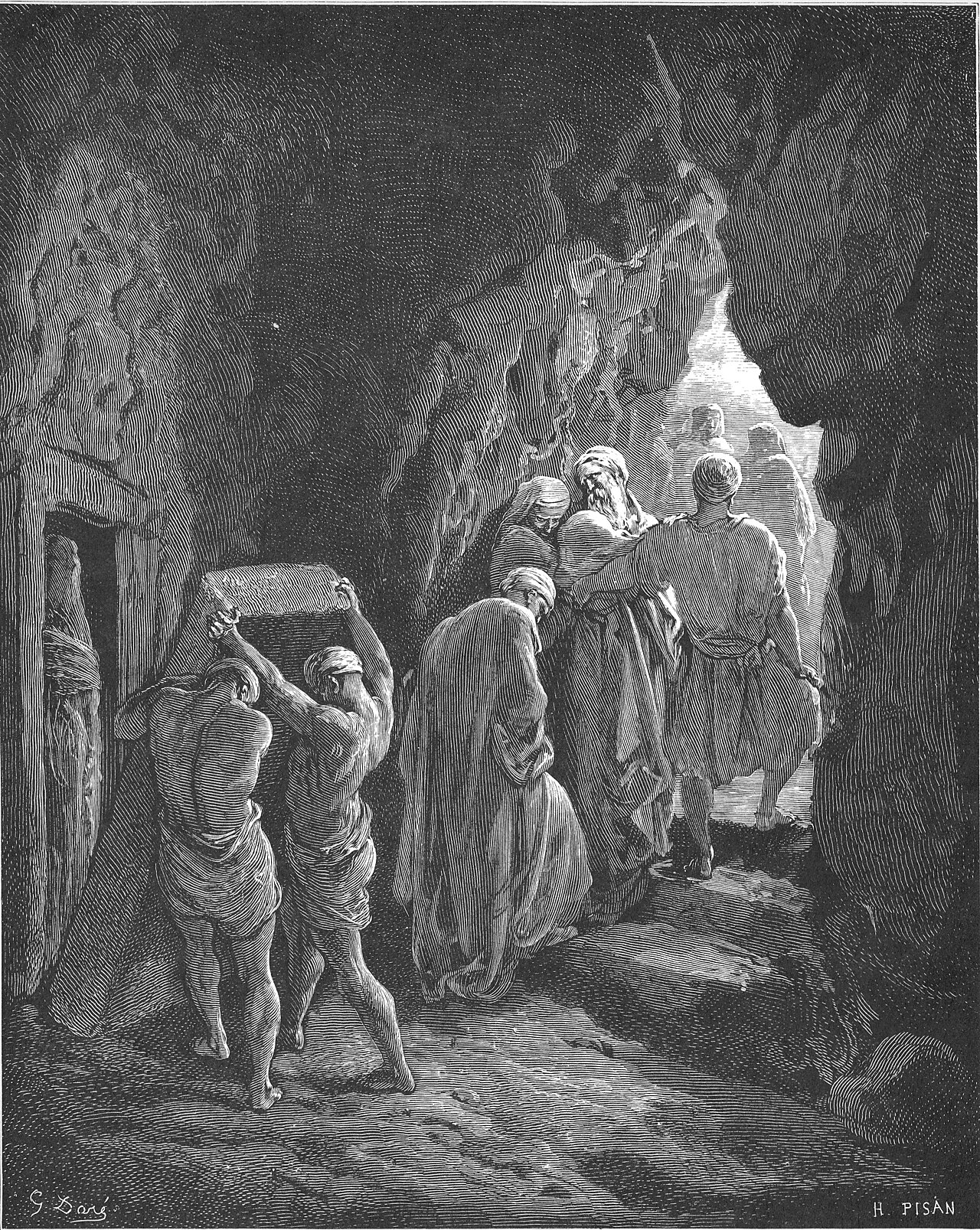
in Genesis 23“I am a foreigner and an outsider among you. Give me a burial site among you so that I can bury my dead.”
BSB
The same verse in ASV and KJV ▾
ASV
I am a stranger and a sojourner with you: give me a possession of a burying-place with you, that I may bury my dead out of my sight.
KJV
I am a stranger and a sojourner with you: give me a possession of a buryingplace with you, that I may bury my dead out of my sight.
⋯
This verse in Genesis 23
Commentary
7 notes on this verseI am a stranger and a sojourner with you,.... Not a native of the place, only dwelt as a sojourner among them for a time; but had not so much as a foot of ground he could call his own, and consequently had no place to inter his dead: give me a possession of a buryingplace with you; not that he desired it as a free gift, but that he might be allowed to make a purchase of a piece of ground to bury his dead in; so the Targum of Jonathan,"sell me a possession,'' &c.
This site's exposition
I am a foreigner and an outsider among you
The man promised the whole country calls himself a foreigner and an outsider in it. Hebrews 11:13 takes the words up for all the patriarchs, who died in faith as strangers and exiles on the earth. Leviticus 25:23 puts the same phrase in God's mouth about Israel, that the land is His and they are foreigners and residents with Him. He asks for a burial site to bury his dead.
The record, by era
The Puritans and the Awakening4 voices
I am a stranger and a sojourner with you - Therefore I am unprovided, and must become a suiter to you for a burying-place. This was one occasion which Abraham took to confess that he was a stranger and a pilgrim upon earth. The death of our relations should effectually mind us that we are not at home in this world.
I am a stranger and a sojourner with you - Therefore I am unprovided, and must become a suiter to you for a burying-place. This was one occasion which Abraham took to confess that he was a stranger and a pilgrim upon earth. The death of our relations should effectually mind us that we are not at home in this world.
I am a stranger and a sojourner with you,.... Not a native of the place, only dwelt as a sojourner among them for a time; but had not so much as a foot of ground he could call his own, and consequently had no place to inter his dead: give me a possession of a buryingplace with you; not that he desired it as a free gift, but that he might be allowed to make a purchase of a piece of ground to bury his dead in; so the Targum of Jonathan,"sell me a possession,'' &c.
The argument he used with the children of Heth, which was this: " I am a stranger and a sojourner with you, therefore I am unprovided, and must become a humble suitor to you for a burying-place." This was one occasion which Abraham took to confess that he was a stranger and a pilgrim upon earth; he was not ashamed to own it thus publicly, Heb. xi.
The Nineteenth Century1 voice
I am a stranger and a sojourner - It appears from Heb 11:13-16; 1Pe 2:11, that these words refer more to the state of his mind than of his body. He felt that he had no certain dwelling place, and was seeking by faith a city that had foundations.
The words behind it
12 Hebrew wordsEvery Hebrew word of this verse in the order it stands, with what it means and the door to its own study. The last column counts the times a word stands in the whole Bible: the rarer the word, the more the places it appears belong together.
| Hebrew | Sound | Meaning | Word study | In the Bible |
|---|---|---|---|---|
| גֵּר־ | ger- | [am] a sojourner | H1616 → | |
| וְתוֹשָׁ֥ב | vetoshav | and a resident alien | H8453 → | |
| אָנֹכִ֖י | ʾanokhi | I | H595 → | 359 times |
| עִמָּכֶ֑ם | ʾimakhem | with you | H5973 → | 1050 times |
| תְּנ֨וּ | tenu | give | H5414 → | 2011 times |
| לִ֤י | li | to <the> me | ||
| אֲחֻזַּת־ | ʾachuzat- | a possession of | H272 → | 66 times |
| קֶ֙בֶר֙ | kever | a burial site | H6913 → | 67 times |
| עִמָּכֶ֔ם | ʾimakhem | with you | H5973 → | 1050 times |
| וְאֶקְבְּרָ֥ה | veekberah | so let me bury | H6912 → | 133 times |
| מֵתִ֖י | meti | dead my | H4191 → | 839 times |
| מִלְּפָנָֽי׃ | milefanai | from to before me | H6440 → | 2123 times |
גֵּר־[am] a sojourner
ger-H1616 →
וְתוֹשָׁ֥בand a resident alien
vetoshavH8453 →
אָנֹכִ֖יI
ʾanokhiH595 →359 times
עִמָּכֶ֑םwith you
ʾimakhemH5973 →1050 times
תְּנ֨וּgive
tenuH5414 →2011 times
לִ֤יto <the> me
li
אֲחֻזַּת־a possession of
ʾachuzat-H272 →66 times
קֶ֙בֶר֙a burial site
keverH6913 →67 times
עִמָּכֶ֔םwith you
ʾimakhemH5973 →1050 times
וְאֶקְבְּרָ֥הso let me bury
veekberahH6912 →133 times
מֵתִ֖יdead my
metiH4191 →839 times
מִלְּפָנָֽי׃from to before me
milefanaiH6440 →2123 times
A shaded row is a word that stands 400 times or fewer in the Bible.
The walk
8 stopsEach card is a verse this one points to, and under it the verses that one points to in turn. Where several paths arrive at the same place, that place is listed first: the text keeps returning to it.
Through
Psalms 119:19I am a stranger on the earth; do not hide Your commandments from me.
it leads to
- 1 Chronicles 29:15
For we are foreigners and strangers in Your presence, as were all our forefathers. Our days on earth are like a shadow, without hope.
- Psalms 39:12
Hear my prayer, O LORD, and give ear to my cry for help; do not be deaf to my weeping. For I am a foreigner dwelling with You, a stranger like all my fathers.
- Hebrews 11:13–16
All these people died in faith, without having received the things they were promised. However, they saw them and welcomed them from afar. And they acknowledged that they were strangers and exiles on the…
- 1 Chronicles 29:15
Through
Genesis 17:8And to you and your descendants I will give the land where you are residing—all the land of Canaan—as an eternal possession; and I will be their God.”
it leads to
- Leviticus 26:12
I will walk among you and be your God, and you will be My people.
- Psalms 105:11
“I will give you the land of Canaan as the portion of your inheritance.”
- Genesis 12:7
Then the LORD appeared to Abram and said, “I will give this land to your offspring.” So Abram built an altar there to the LORD, who had appeared to him.
- Exodus 6:7
I will take you as My own people, and I will be your God. Then you will know that I am the LORD your God, who brought you out from under the yoke of…
- Leviticus 26:12
Through
Hebrews 11:9By faith he dwelt in the promised land as a stranger in a foreign country. He lived in tents, as did Isaac and Jacob, who were heirs with him of the same promise.
it leads to
- Genesis 12:8
From there Abram moved on to the hill country east of Bethel and pitched his tent, with Bethel to the west and Ai to the east. There he built an altar to the LORD,…
- Genesis 12:8
Where this verse is studied
On this page
About Genesis
This page draws on Adam Clarke, Commentary on the Bible; John Gill, Exposition of the Old Testament (1748-1763); John Gill, Exposition of the Old Testament; John Wesley, Explanatory Notes upon the Old Testament and Matthew Henry, Commentary on the Whole Bible.