
Revelation 22:9
in Revelation 22But he said to me, “Do not do that! I am a fellow servant with you and your brothers the prophets, and with those who keep the words of this book. Worship God!”
BSB
The same verse in ASV and KJV ▾
ASV
And he saith unto me, See thou do it not: I am a fellow-servant with thee and with thy brethren the prophets, and with them that keep the words of this book: worship God.
KJV
Then saith he unto me, See thou do it not: for I am thy fellowservant, and of thy brethren the prophets, and of them which keep the sayings of this book: worship God.
⋯
This verse in Revelation 22
Commentary
11 notes on this verseA commentator
Athanasius of Alexandria296–373
Discourses Against the Arians 2.23 · Written before 373.
The Father shows [the Son] to be his own proper and only Son, saying, "You are my Son," and "This is my beloved Son, in whom I am well pleased." Accordingly the angels ministered to him, as being one beyond themselves; and they worship him, not as being greater in glory but as being some one beyond all the creatures, and beyond themselves, and alone the Father's proper Son according to essence. For if he was worshiped as excelling them in glory, each of the things subservient ought to worship what excels itself.
This site's exposition
I fell down to worship
on Revelation 22:8-9
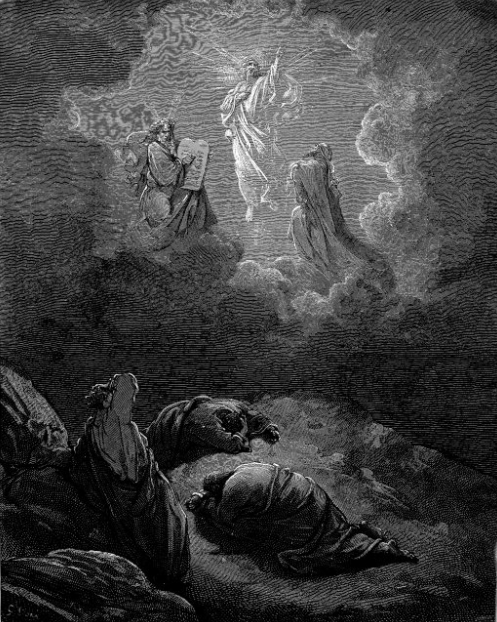
John, who has seen more of heaven than any other man alive, still falls down to worship before the angel's feet, and the angel refuses him exactly as another angel refused him at 19:10, the same words in both places, worship God. The angel names himself thy fellowservant, and of thy brethren the prophets, placing himself in the same rank as John rather than above him, the book's own teaching against creature worship and angel veneration stated twice for emphasis. No prayer, veneration, or worship belongs to any angel or any saint; it belongs to God alone.
The record, by era
The Church Fathers3 voices
Since there is no pride in the servant nor any vanity in the saints, [the angel] immediately exhorts him [not to worship him].… The angel proclaims that nothing is equal to the Creator, and he declares that nothing can be offered to another that is …
And when he says I heard and saw, I fell down to worship before the feet of the angel. These things are interpreted in those that have arrived, when we also have demonstrated that the doctrines of the atheistic Greeks about their national leaders have …
This is the Judge and the Avenger, beloved brothers, that we are to await who, when he revenges himself, is destined to revenge us, the people of his church, and the number of all the just from the beginning of the world. Let him who hastens and hurries too much to his own revenge consider that he alone who avenges has not yet avenged himself.… In the Apocalypse, when John wishes to adore him, the angel resists him and says, "You must not do this because I am a fellow servant of you and of your brothers. Adore Jesus the Lord." How wonderful then is Jesus our Lord, and what great patience this is that he who is adored in heaven is not yet avenged on earth! Let us think of his patience, beloved brothers, in our persecutions and sufferings. Let us show the full obedience that is inspired by our expectation of his coming, and let us not hasten with the impious and shameless haste of a servant to defend ourselves before the Lord. Let us rather persevere and let us labor, and [let us] be watchful with all our heart and steadfast even to total resignation; let us guard the precepts of the Lord, so that when the day of wrath and vengeance comes, we may not be punished with the impious and sinners but may be honored with the just and those who fear God.
The Medieval Church2 voices
He shows the piety of the angel who has described and interpreted the vision, indicating that [the angel] would not allow himself to be worshiped by a fellow servant. Rather, with a good conscience we are to give homage to [our] common Lord.
I am a fellow servant, etc. Note how often he names both John the prophet and this book as prophecy; for there is much agreement with the prophets, not only in the senses but also in the words. For how many verses from Isaiah, how …
4 more voices on this verse
The Medieval Church1 voice
This is why Lot and Joshua worshipped angels and were not forbidden to worship; but John in his Apocalypse wished to worship an angel, yet that same angel restrained him from worshipping him, saying: See that you do not do this, for I am your fellow servant and of your brethren. Why is it that before the Redeemer's coming angels are worshipped by men and remain silent, but afterward they refuse to be worshipped, unless it is that our nature, which they had previously despised, they now fear to see prostrate before them after they behold it assumed above themselves? Nor do they now dare to scorn as weak what is beneath them, since they venerate it above themselves in the King of heaven. Nor do they disdain to have man as a companion, since they adore man as God above themselves.
The Puritans and the Awakening1 voice
Then saith he unto me,....
The Nineteenth Century2 voices
A commentator
Albert Barnes1798–1870
Notes, Explanatory and Practical, on the Old and New Testaments (1832-1869)
Then saith he unto me, See thou do it not - See the notes on Rev 19:10. For I am thy fellow-servant - notes on Rev 19:10. And of thy brethren the prophets - In Rev 19:10, it is “of thy brethren that have the testimony of Jesus.” Here the angel says that, in the capacity in which he appeared to John, he belonged to the general rank of the prophets, and was no more entitled to worship than any of the prophets had been.
A commentator
Jamieson, Fausset & Brown1802–1910
Commentary Critical and Explanatory on the Whole Bible (1871)
Contrast the fallen angel's temptation to Jesus, "Fall down and worship me" (Mt 4:9). for--A, B, Vulgate, Syriac, Coptic, ANDREAS, and CYPRIAN omit "for"; which accords with the abrupt earnestness of the angel's prohibition of an act derogatory to God. and of--"and (the fellow servant) of thy brethren."
The words behind it
25 Greek wordsEvery Greek word of this verse in the order it stands, with what it means and the door to its own study. The last column counts the times a word stands in the whole Bible: the rarer the word, the more the places it appears belong together.
| Greek | Sound | Meaning | Word study | In the Bible |
|---|---|---|---|---|
| καὶ | kai | And | G2532 → | 9120 times |
| λέγει | legei | he says | G3004 → | 1325 times |
| μοι· | moi | to me; | G3165 → | 1936 times |
| ὅρα | hora | do see that you | G3708 → | |
| μή, | me | [do] not, | G3361 → | 1066 times |
| σύνδουλός | sundoulos | Fellow servant | G4889 → | 10 times |
| σού | sou | of you | G4771 → | 2973 times |
| εἰμι | eimi | I am | G1510 → | 2333 times |
| καὶ | kai | and | G2532 → | 9120 times |
| τῶν | ton | with the | G3588 → | 19766 times |
| ἀδελφῶν | adelphon | brothers | G80 → | 343 times |
| σου | sou | of you | G4771 → | 2973 times |
| τῶν | ton | the | G3588 → | 19766 times |
| προφητῶν | propheton | prophets | G4396 → | 144 times |
| καὶ | kai | and | G2532 → | 9120 times |
| τῶν | ton | with those | G3588 → | 19766 times |
| τηρούντων | terounton | keeping | G5083 → | 70 times |
| τοὺς | tous | the | G3588 → | 19766 times |
| λόγους | logous | words | G3056 → | 329 times |
| τοῦ | tou | of the | G3588 → | 19766 times |
| βιβλίου | bibliou | book | G975 → | 34 times |
| τούτου· | toutou | this; | G3778 → | 1381 times |
| τῷ | to | <the> | G3588 → | 19766 times |
| θεῷ | theo | God | G2316 → | 1312 times |
| προσκύνησον.¶ | proskuneson | do worship. | G4352 → | 60 times |
καὶAnd
kaiG2532 →9120 times
λέγειhe says
legeiG3004 →1325 times
μοι·to me;
moiG3165 →1936 times
ὅραdo see that you
horaG3708 →
μή,[do] not,
meG3361 →1066 times
σύνδουλόςFellow servant
sundoulosG4889 →10 times
σούof you
souG4771 →2973 times
εἰμιI am
eimiG1510 →2333 times
καὶand
kaiG2532 →9120 times
τῶνwith the
tonG3588 →19766 times
ἀδελφῶνbrothers
adelphonG80 →343 times
σουof you
souG4771 →2973 times
τῶνthe
tonG3588 →19766 times
προφητῶνprophets
prophetonG4396 →144 times
καὶand
kaiG2532 →9120 times
τῶνwith those
tonG3588 →19766 times
τηρούντωνkeeping
terountonG5083 →70 times
τοὺςthe
tousG3588 →19766 times
λόγουςwords
logousG3056 →329 times
τοῦof the
touG3588 →19766 times
βιβλίουbook
bibliouG975 →34 times
τούτου·this;
toutouG3778 →1381 times
τῷ<the>
toG3588 →19766 times
θεῷGod
theoG2316 →1312 times
προσκύνησον.¶do worship.
proskunesonG4352 →60 times
A shaded row is a word that stands 400 times or fewer in the Bible.
The walk
8 stopsEach card is a verse this one points to, and under it the verses that one points to in turn. Where several paths arrive at the same place, that place is listed first: the text keeps returning to it.
Through
1 John 5:20And we know that the Son of God has come and has given us understanding, so that we may know Him who is true; and we are in Him who is true—in His Son…
it leads to
- John 17:3
Now this is eternal life, that they may know You, the only true God, and Jesus Christ, whom You have sent.
- Luke 24:45
Then He opened their minds to understand the Scriptures.
- John 14:9
Jesus replied, “Philip, I have been with you all this time, and still you do not know Me? Anyone who has seen Me has seen the Father. How can you say, ‘Show us the…
- 1 Timothy 3:16
By common confession, the mystery of godliness is great: He appeared in the flesh, was vindicated by the Spirit, was seen by angels, was proclaimed among the nations, was believed in throughout the world,…
- John 17:3
Through
Revelation 14:7And he said in a loud voice, “Fear God and give Him glory, because the hour of His judgment has come. Worship the One who made the heavens and the earth and the sea…
it leads to
- Exodus 20:11
For in six days the LORD made the heavens and the earth and the sea and all that is in them, but on the seventh day He rested. Therefore the LORD blessed the Sabbath…
- Exodus 20:11
Through
Revelation 19:10So I fell at his feet to worship him. But he told me, “Do not do that! I am a fellow servant with you and your brothers who rely on the testimony of Jesus.…
it leads to
- Revelation 22:8–9
And I am John, who heard and saw these things. And when I had heard and seen them, I fell down to worship at the feet of the angel who had shown me these…
- Acts 10:25–26
As Peter was about to enter, Cornelius met him and fell at his feet to worship him.
- Revelation 22:8–9
Through
Revelation 4:10the twenty-four elders fall down before the One seated on the throne, and they worship Him who lives forever and ever. They cast their crowns before the throne, saying:
it leads to
- Revelation 5:8
When He had taken the scroll, the four living creatures and the twenty-four elders fell down before the Lamb. Each one had a harp, and they were holding golden bowls full of incense, which…
- Revelation 5:8
Where this verse is studied
On this page
Studies17
By subject
Worship35 verses
About Revelation
This page draws on 12 works. Open the list of works
This page draws on Albert Barnes, Notes on the New Testament; Albert Barnes, Notes, Explanatory and Practical, on the Old and New Testaments (1832-1869); Andreas of Caesarea, COMMENTARY ON THE APOCALYPSE 22:8-9; Apringius of Beja, TRACTATE ON THE APOCALYPSE 22:9; Athanasius of Alexandria, Discourses Against the Arians 2.23; Bede, Commentary on Revelation; Cyprian, Treatise IX. On the Advantage of Patience 24; Gregory the Dialogist, Forty Gospel Homilies, Homily 8; Jamieson, Fausset & Brown, Commentary Critical and Explanatory on the Whole Bible; John Gill, Exposition of the New Testament (1746-1748); Matthew Henry, Commentary on the Whole Bible and Oecumenius, Commentary on Revelation.