
Joshua 6:16
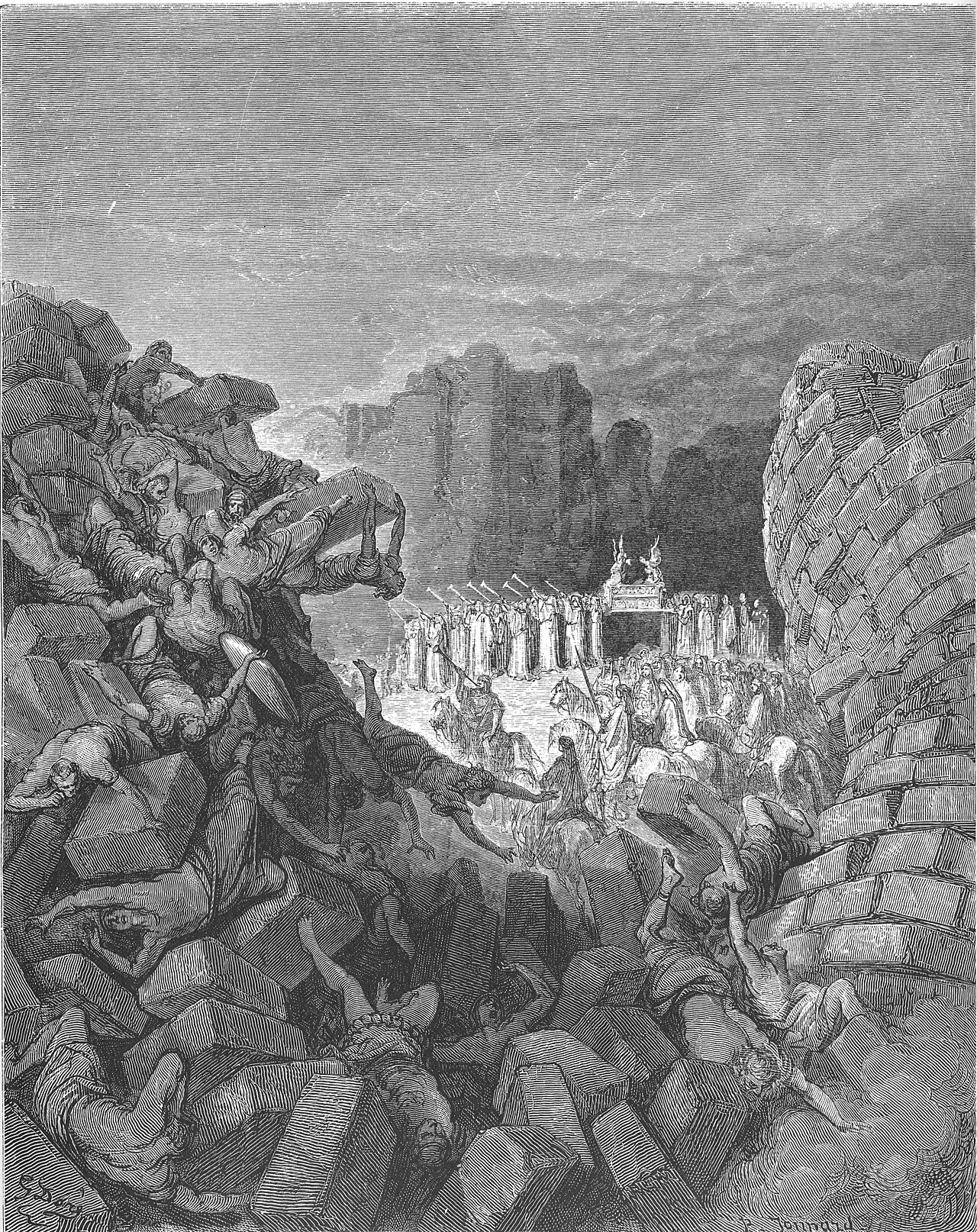
in Joshua 6After the seventh time around, the priests blew the horns, and Joshua commanded the people, “Shout! For the LORD has given you the city!
BSB
The same verse in ASV and KJV ▾
ASV
And it came to pass at the seventh time, when the priests blew the trumpets, Joshua said unto the people, Shout; for Jehovah hath given you the city.
KJV
And it came to pass at the seventh time, when the priests blew with the trumpets, Joshua said unto the people, Shout; for the Lord hath given you the city.
⋯
This verse in Joshua 6
Commentary
10 notes on this verseThis site's exposition
they got up at dawn
on Joshua 6:15-16
The seventh day begins at dawn and runs seven circuits, seven times the cost of each day before. Joshua’s order to shout because “the LORD has given you the city” uses the tense God used at verse 2, spoken with the wall still up. The shout falls at the end of the thirteenth circuit, after days of silence.
This site's exposition
After the seventh time around
Wesley gives three purposes for the shout: to declare faith in the promise, to encourage Israel, and to strike terror into the city. Henry calls it a shout of prayer answering the trumpets. Numbers 10:9 says the trumpet blown in battle brings Israel to the Lord's remembrance, and Henry reads the horns that way.
The record, by era
The Church Fathers1 voice
But what was done then to the city of Jericho, as we have said, was done in symbol, since now this very thing happens in reality. For we read that at that time the priests circled the aforementioned city continuously for seven days and that, …
The Puritans and the Awakening4 voices
Shout - To testify your faith in God's promise, and thankfulness for this glorious mercy; to encourage yourselves and brethren, and to strike a terror into your enemies. Given you the city - It is given to them, to be devoted to God, as the first, and perhaps the worst of all the cities of Canaan.
And it came to pass at the seventh time,....
It is given to them to be devoted to God, as the first and perhaps the worst of all the cities of Canaan. The city must be burnt, and all the lives in it sacrificed without mercy to the justice of God. All this they knew was included in those words,
This was a shout of faith; they believed that the walls of Jericho would fall, and by this faith the walls were thrown down. It was a shot of prayer, an echo to the sound of the trumpets which proclaimed the promise that God would remember them; with one accord, as one man, they cry to heaven for help, and help comes in.
3 more voices on this verse
The Nineteenth Century3 voices
A commentator
Jamieson, Fausset & Brown1802–1910
Commentary Critical and Explanatory on the Whole Bible (1871)
proposed
it came to pass at the seventh time, . . . Joshua said unto the people, Shout; for the Lord hath given you the city--This delay brought out their faith and obedience in so remarkable a manner, that it is celebrated by the apostle (Heb 11:30).
quarantine:debris (2026-07-29) — starts-lowercase
The Lord divided the Jordan that His people might pass through dry-shod. This miracle greatly dispirited the Canaanites, and so prepared the way for an easy triumph for the invading Israelites. You would have naturally expected that the Lord would have bid His people avail themselves immediately of this terror to strike a heavy blow at once, and press on with might and main before the enemy could take a breath and so sweep the land clear of the adversaries in a single campaign. But it was not so.
The Lord divided the Jordan that His people might pass through dry-shod. This miracle greatly dispirited the Canaanites, and so prepared the way for an easy triumph for the invading Israelites. You would have naturally expected that the Lord would have bid His people avail themselves immediately of this terror to strike a heavy blow at once, and press on with might and main before the enemy could take a breath and so sweep the land clear of the adversaries in a single campaign. But it was not so. Instead of immediate activity, the children of Israel pitched their tents at Gilgal and there tarried for a considerable season. For God is in no hurry. His purposes can be accomplished without haste, and though He would have us redeem the time because our days are evil, yet in His eternity He can afford to wait and by His wisdom He so orders His delays that they prove to be far better than our hurries. Why were the people to delay? That they might be obedient to commands which had been forgotten. In the desert, for many reasons, circumcision and the Passover had been neglected. They were not visited with any chastisement on account of this neglect, for the Lord considered their position and condition, and winked at their error. But before He would use them He would have them fully obedient to His will. It cannot be expected that God should tolerate disobedient servants, and therefore they must stay awhile, till they had been attentive to the two great precepts of the Mosaic Covenant. Dear Friends, let us pause and ask ourselves, as Believers, whether we have been in all respects conscientiously attentive to our Master's commands. If not, we may not expect Him to send a blessing to the Church or to the world through us, until first of all we have yielded our willing obedience to that which He has prescribed for us.
How the passage was read
What the Jewish commentators add
On the verses either side of this one
On the seventh day. This was on the Shabbos. 2 They were permitted to wage war and to kill on Shabbos by the Divine command, that instructed them to lay siege to the city according to the word of God, as told to Yehoshua. See verses 2-5, this chapter.
1 more on this passage, in their own words ▾
And the city shall be consecrated. It shall be sacred, for that day was the holy Shabbos, 3 See Rashi to verse.
This section is reception history: how the passage was read and kept in the Jewish tradition. Where a reading parts from an essential of the Christian faith, the section says so at that point.
Texts and citation data: Sefaria; each excerpt follows its version’s licence. 4 further sources are cited on this chapter that carry no English text this site may quote or only restate the verse.
The words behind it
17 Hebrew wordsEvery Hebrew word of this verse in the order it stands, with what it means and the door to its own study. The last column counts the times a word stands in the whole Bible: the rarer the word, the more the places it appears belong together.
| Hebrew | Sound | Meaning | Word study | In the Bible |
|---|---|---|---|---|
| וַיְהִי֙ | vayhi | and it was | H1961 → | 3559 times |
| בַּפַּ֣עַם | bapaam | at the time | H6471 → | 118 times |
| הַשְּׁבִיעִ֔ית | hasheviit | <the> seventh | H7637 → | 98 times |
| תָּקְע֥וּ | takeu | they gave a blast | H8628 → | 69 times |
| הַכֹּהֲנִ֖ים | hakohanim | the priests | H3548 → | 750 times |
| בַּשּׁוֹפָר֑וֹת | bashofarot | on the trumpets | H7782 → | 72 times |
| וַיֹּ֨אמֶר | vaiyomer | and he said | H559 → | 5305 times |
| יְהוֹשֻׁ֤עַ | yehoshua' | Joshua | H3091 → | 218 times |
| אֶל־ | ʾel- | to | H413 → | 5510 times |
| הָעָם֙ | haam | the people | H5971 → | 1873 times |
| הָרִ֔יעוּ | hariu | shout | H7321 → | 44 times |
| כִּֽי־ | ki- | for | H3588 → | 4482 times |
| נָתַ֧ן | natan | he has given | H5414 → | 2011 times |
| יְהוָ֛ה | yahweh | Yahweh | H3068 → | 6520 times |
| לָכֶ֖ם | lakhem | to <the> you | ||
| אֶת־ | ʾet- | <obj.> | H853 → | 10935 times |
| הָעִֽיר׃ | hair | the city | H5892 → | 1090 times |
וַיְהִי֙and it was
vayhiH1961 →3559 times
בַּפַּ֣עַםat the time
bapaamH6471 →118 times
הַשְּׁבִיעִ֔ית<the> seventh
hasheviitH7637 →98 times
תָּקְע֥וּthey gave a blast
takeuH8628 →69 times
הַכֹּהֲנִ֖יםthe priests
hakohanimH3548 →750 times
בַּשּׁוֹפָר֑וֹתon the trumpets
bashofarotH7782 →72 times
וַיֹּ֨אמֶרand he said
vaiyomerH559 →5305 times
יְהוֹשֻׁ֤עַJoshua
yehoshua'H3091 →218 times
אֶל־to
ʾel-H413 →5510 times
הָעָם֙the people
haamH5971 →1873 times
הָרִ֔יעוּshout
hariuH7321 →44 times
כִּֽי־for
ki-H3588 →4482 times
נָתַ֧ןhe has given
natanH5414 →2011 times
יְהוָ֛הYahweh
yahwehH3068 →6520 times
לָכֶ֖םto <the> you
lakhem
אֶת־<obj.>
ʾet-H853 →10935 times
הָעִֽיר׃the city
hairH5892 →1090 times
A shaded row is a word that stands 400 times or fewer in the Bible.
The walk
8 stopsEach card is a verse this one points to, and under it the verses that one points to in turn. Where several paths arrive at the same place, that place is listed first: the text keeps returning to it.
Through
Joshua 6:5And when there is a long blast of the ram’s horn and you hear its sound, have all the people give a mighty shout. Then the wall of the city will collapse and all…
it leads to
- 2 Corinthians 10:4–5
The weapons of our warfare are not the weapons of the world. Instead, they have divine power to demolish strongholds.
- Hebrews 11:30
By faith the walls of Jericho fell, after the people had marched around them for seven days.
- Exodus 19:19
And as the sound of the ram’s horn grew louder and louder, Moses spoke and God answered him in the thunder.
- 1 Samuel 4:5
When the ark of the covenant of the LORD entered the camp, all the Israelites raised such a great shout that it shook the ground.
- 2 Chronicles 13:14–15
When Judah turned and discovered that the battle was both before and behind them, they cried out to the LORD. Then the priests blew the trumpets,
- 2 Corinthians 10:4–5
Through
2 Chronicles 13:15and the men of Judah raised the battle cry. And when they raised the cry, God routed Jeroboam and all Israel before Abijah and Judah.
it leads to
- 2 Chronicles 14:12
So the LORD struck down the Cushites before Asa and Judah, and the Cushites fled.
- Numbers 32:4
which the LORD conquered before the congregation of Israel, are suitable for livestock—and your servants have livestock.”
- Psalms 47:1
Clap your hands, all you peoples; shout unto God with a voice of triumph.
- 2 Chronicles 14:12
Where this verse is studied
On this page
Studies5
About Joshua
Who and where
1 name in this verse with a page on the site.
This page draws on Charles Spurgeon, The Metropolitan Tabernacle Pulpit, Sermon No. 795: “Joshua's Vision” (lightly modernized text, CCEL edition); Jamieson, Fausset & Brown, Commentary Critical and Explanatory on the Whole Bible; John Gill, Exposition of the Old Testament (1748-1763); John Wesley, Explanatory Notes upon the Old Testament; Keil and Delitzsch, Biblical Commentary on the Old Testament: Joshua, Judges, Ruth; Matthew Henry, Commentary on the Whole Bible and Maximus of Turin, SERMON 94.2.