
On this page, 7 sections
The one drawing
Across the canon
12 passages
Where Scripture speaks
The passages this subject stands on, in canon order.
Then Caleb quieted the people before Moses and said, “We must go up and take possession of the land, for we can certainly conquer it!”and when the LORD your God has delivered them over to you to defeat them, then you must devote them to complete destruction. Make no treaty with them and show them no mercy.Have I not commanded you to be strong and courageous? Do not be afraid; do not be discouraged, for the LORD your God is with you wherever you go.”Then Joshua son of Nun secretly sent two spies from Shittim, saying, “Go, inspect the land, especially Jericho.” So they went and entered the house of a prostitute named Rahab and stayed there.The priests carrying the ark of the covenant of the LORD stood firm on dry ground in the middle of the Jordan, while all Israel crossed over the dry ground, until the entire nation had crossed the Jordan.“Neither,” He replied. “I have now come as Commander of the LORD’s army.” Then Joshua fell facedown in reverence and asked Him, “What does my Lord have to say to His servant?”So when the rams’ horns sounded, the people shouted. When they heard the blast of the horn, the people gave a great shout, and the wall collapsed. Then all the people charged straight into the city and captured it.The Israelites, however, acted unfaithfully regarding the things devoted to destruction. Achan son of Carmi, the son of Zabdi, the son of Zerah, of the tribe of Judah, took some of what was set apart. So the anger of the LORD burned against the Israelites.So the sun stood still and the moon stopped until the nation took vengeance upon its enemies. Is this not written in the Book of Jashar? “So the sun stopped in the middle of the sky and delayed going down about a full day.”So Joshua took the entire land, in keeping with all that the LORD had spoken to Moses. And Joshua gave it as an inheritance to Israel according to the allotments to their tribes. Then the land had rest from war.Not one of all the LORD’s good promises to the house of Israel had failed; everything was fulfilled.After the death of Joshua, the Israelites inquired of the LORD, “Who will be the first to go up and fight for us against the Canaanites?”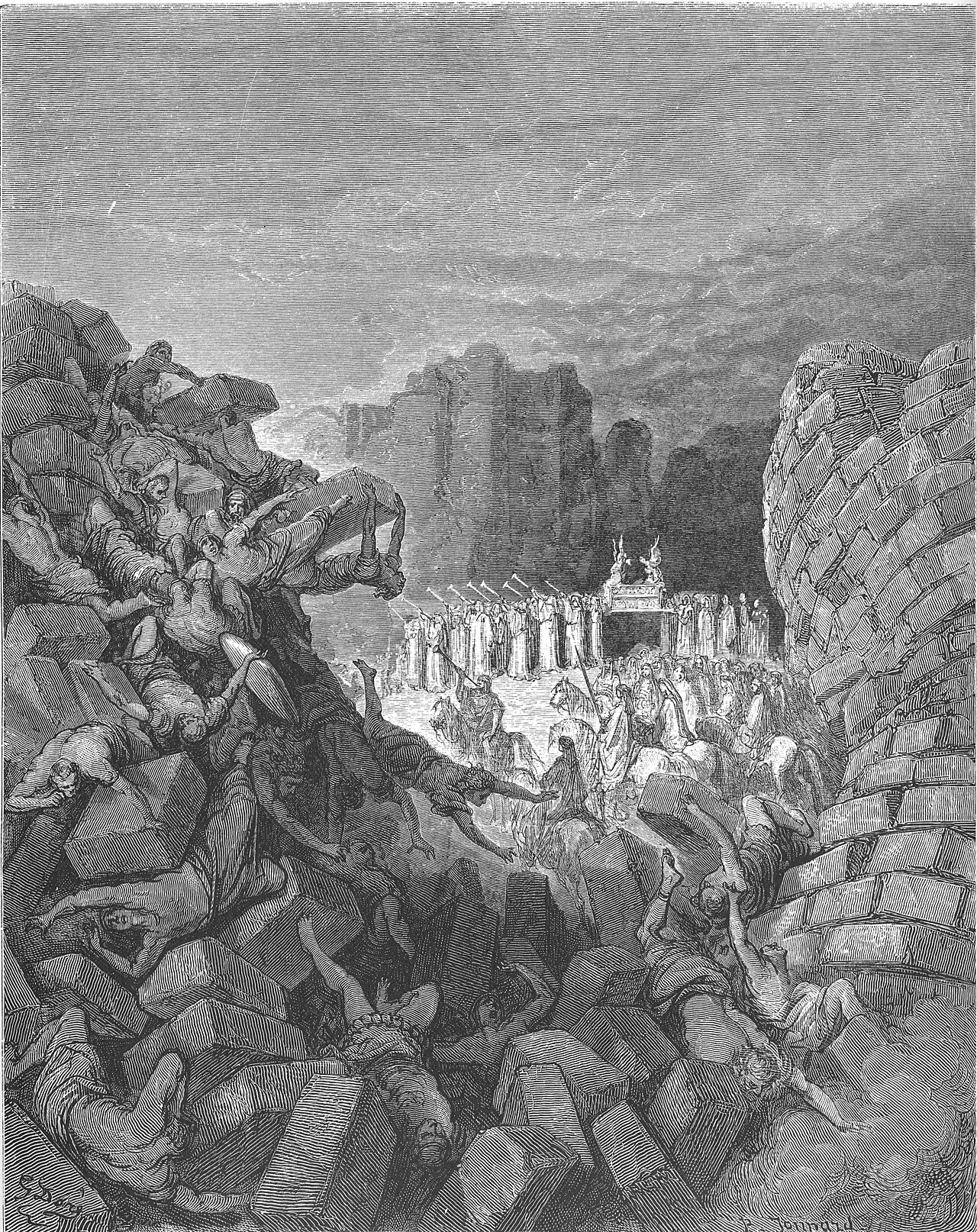
The conquest in Scripture, in full
The conquest is the story of Israel entering and taking the land God promised centuries earlier to Abraham. It happens in one dramatic phase under Joshua, right after forty years of wandering in the wilderness.
Before it starts, God warns Israel plainly what they're walking into: "When the LORD thy God shall bring thee into the land whither thou goest to possess it... thou shalt smite them, and utterly destroy them" (Deuteronomy 7:1-2). Scripture doesn't soften it. But it isn't presented as conquest for its own sake. Centuries earlier, God had told Abraham that his descendants wouldn't possess the land right away, "for the iniquity of the Amorites is not yet full" (Genesis 15:16). The conquest happens when that measure of wickedness has run its course: judgment, not mere land-grabbing.
Right before crossing into the land, God gives Joshua his marching orders, and they're less about strategy than about courage: "Be strong and of a good courage; be not afraid, neither be thou dismayed: for the LORD thy God is with thee whithersoever thou goest" (Joshua 1:9). That promise (God's presence), is really the engine behind everything that follows.
Joshua sends two spies into Jericho first, and they find an unlikely ally: Rahab, a Canaanite woman who hides them and puts her trust in Israel's God (Joshua 2:1-14). She becomes one of the clearest pictures in the whole conquest that this was never really about ethnicity; anyone who turned to God, even from inside the enemy city, found mercy.
Israel crosses the Jordan on dry ground, the water piling up just as it had at the Red Sea a generation earlier (Joshua 3:17). Then, right outside Jericho, Joshua meets someone unexpected: "the captain of the host of the LORD," a heavenly figure so holy that Joshua removes his sandals (Joshua 5:14-15). The message is clear before the first battle is even fought: this conquest belongs to God, and Joshua is under command, not in it.
Jericho falls not by siege engines but by obedience; Israel marches around the city for seven days, and on the last day the walls collapse at a shout (Joshua 6:20). It's a strange way to win a war, and that's the point. The victory can't be credited to Israel's military skill.
The conquest isn't without failure. After Jericho, a man named Achan secretly keeps plunder God had forbidden, and Israel suffers a humiliating defeat at Ai as a result (Joshua 7:1-5). Sin in the camp, the story shows, can stall the whole mission; this was never a guaranteed march, but one that depended on Israel's own faithfulness too.
The most famous single moment of the conquest happens at Gibeon, where Joshua asks God to make the sun stand still so Israel can finish a battle in daylight, and it does (Joshua 10:12-13). Few moments in the Old Testament show God bending nature itself to fight for his people so visibly.
By the end, the land is largely subdued: "So Joshua took the whole land, according to all that the LORD said unto Moses... And the land rested from war" (Joshua 11:23). The book of Joshua closes with a sweeping statement of faithfulness: "There failed not ought of any good thing which the LORD had spoken unto the house of Israel; all came to pass" (Joshua 21:45).
The conquest was never really the story of Israel's strength. It's the story of a promise made to Abraham centuries before, kept in full: one city, one battle, one act of obedience at a time.
4 voices
What teachers have said
When the city of Jericho fell at the sound of the priests' trumpets and Joshua the son of Nun gained the victory, he knew that the valor of the people was weakened through love of money and desire for gold.
Ambrose of Milan · On the Duties of the Clergy 2.26.129
Written before 397.
Jericho, that collapsed in seven days, is a type of this world, and as such is determined to kill the secret agents. Because, therefore, Jericho is bent upon killing the spies, Rahab, the harlot, alone received them, lodged them not on the ground floor but in the upper story of the roof—or, in other words, in the sublimity of her faith.
Jerome · HOMILIES ON THE PSALMS 18 (Ps 86)
Written before 420.
I myself think it is better that the Israelite wars be understood in this way, and it is better that Jesus [Joshua] is thought to fight in this way and to destroy cities and overthrow kingdoms.
Origen of Alexandria · Homilies on Joshua 13.3
Written before 253.
there stood a man over against him with his sword drawn--It is evident from the strain of the context that this was not a mere vision, but an actual appearance; the suddenness of which surprised, but did not daunt, the intrepid leader.
Jamieson, Fausset & Brown · Commentary Critical and Explanatory on the Whole Bible, 1871
Where it leads
Everything the site holds on the conquest
On this page
Studies1
The words underneath
Each card is one Hebrew or Greek word behind the conquest. It gives the sense, the count across the canon, and the number in Strong's 1890 concordance.
Yehoshua: Joshua
Hebrew · H3091Strong's entry: Jehoshua (i.e. Joshua), the Jewish leader
the general who led the conquest
218 times in the Old Testament · Yehoshua, in full →
nikos: victory
Greek · G3534Strong's entry: a conquest (concretely), i.e. (by implication) triumph
the New Testament word for triumph over death
4 times in the New Testament · nikos, in full →
yerushshah: possession
Hebrew · H3425Strong's entry: something occupied; a conquest; also a patrimony
the conquest itself, land taken and held
14 times in the Old Testament · yerushshah, in full →
Yericho: Jericho
Hebrew · H3405Strong's entry: Jericho or Jerecho, a place in Palestine
the fortified city whose fall opened the land
57 times in the Old Testament · Yericho, in full →
Where in the story
The subjects beside it
On this page