
Joshua 6:3
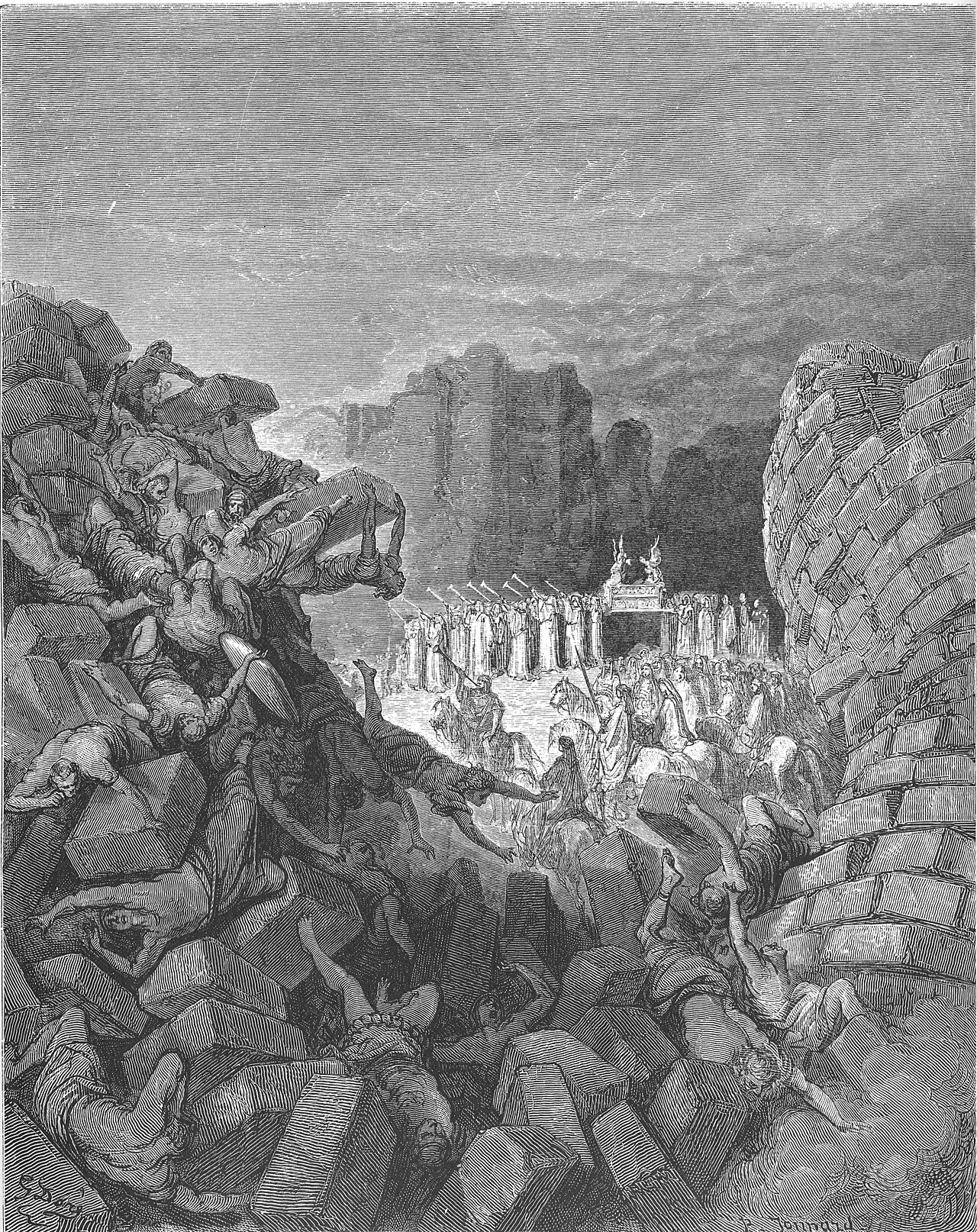
in Joshua 6March around the city with all the men of war, circling the city one time. Do this for six days.
BSB
The same verse in ASV and KJV ▾
ASV
And ye shall compass the city, all the men of war, going about the city once. Thus shalt thou do six days.
KJV
And ye shall compass the city, all ye men of war, and go round about the city once. Thus shalt thou do six days.
⋯
This verse in Joshua 6
Commentary
11 notes on this verseThis site's exposition
with all the men of war
on Joshua 6:3-5
Seven governs the whole instruction: seven priests, seven trumpets, six days and then seven circuits on the seventh. The horns are rams' horns, the yobel horn that Leviticus 25:9 sounds to open the jubilee, the year land returns to the family that held it, and Keil and Delitzsch make that the reason for the instrument chosen. No ramp, no siege engine and no assault order is given, and the only weapon named in the plan is a shout.
The record, by era
The Church Fathers3 voices
But the Jews are sure to say that ever since this precept was given through Moses, the observance has been binding. But it is clear according to the text that the precept was not eternal or spiritual but temporary, which would one day cease.
Though we appear unarmed in body, we nonetheless are bearing arms with which even in time of sunny peace we grapple in spirit against the unsubstantial foe. Now we need God to help us, and him only we must fear; without him our armor falls …
A commentator
Philoxenus of Mabbug13 Ascetic Discourses, Discourse 4 -- On Faith: First Discourse on Simplicity · Written before 523.
proposed
For when they had passed over the Jordan, Joshua commanded them to go round Jericho seven days, each day once, and on the seventh day to go round seven times, and he and the priests were to go before them carrying horns and the ark …
The Puritans and the Awakening2 voices
And ye shall compass the city, all ye men of war,.... Joshua their chief commander under the Lord, and all that were able to make war, even all above twenty years of age; these were to compass the city, not in the form of a siege, but by a procession around it: and go round about the city once; or one time, for the first once in a day, and no more: thus shall thou do six days; one after another; that is, go round it, once every day, for such a time.
This was all they were to do. He assures them that on the seventh day before night they should, without fail, be masters of the town. Up on a signal given, they must all shout, and immediately the wall should fall down, which would not only expose the inhabitants, but so dispirit them that they would not be able to make any resistance,
5 more voices on this verse
The Nineteenth Century5 voices
A commentator
Jamieson, Fausset & Brown1802–1910
Commentary Critical and Explanatory on the Whole Bible (1871)
proposed
ye shall compass the city, all ye men of war. . . . Thus shalt thou do six days, &c.--Directions are here given as to the mode of procedure. Hebrew, "horns of jubilee"; that is, the bent or crooked trumpets with which the jubilee was proclaimed.
quarantine:debris (2026-07-29) — starts-lowercase
I SEE many ministering Brothers here. I think I shall follow the example of Martin Luther who observes that he frequently saw in the church at Wittenberg sundry learned doctors and there usually sat Dr. Justus Jonas and others of whom he said were infinitely greater and more wise than himself. "But," said Martin, "I do not, therefore, alter my style of preaching—I do not preach to them—I preach to those peasants who come in from the country and to the citizens of Wittenberg. For then I am quite certain that if they can understand me, Dr. Justus Jonas and the learned divines can understand me, too, if they like." I shall, moreover, adopt what is said to have been Mr. Wesley's exhortation to his preachers, namely, aim low. "There is more likelihood," he says, "of hitting the men than when you fire high." I may also frankly confess I am reduced to that precept by necessity since I have no capabilities of firing high and must therefore shoot low. We shall take our text now and try, if we can, to get something out of it which may be applicable to the present position of our Society and see if we cannot draw some words and thoughts from it which may strengthen, encourage and nerve us for future action in this good work of God. The Irish Society has to do with one of the citadels of Romanism and it strikes me that there is a very evident parallel between our efforts and the work which Israel had to do against this city of Jericho. Jericho was a strongly defended city and shut up so that none went in or came out. And Romanism seems to have accomplished this admirably. It shuts up its disciples so that they are scarcely accessible and converts from it are few and far between. None, I was about to say, go in—very few, indeed, from us—and there are very few who ever come out again. Jericho was the frontier city.
I SEE many ministering Brothers here. I think I shall follow the example of Martin Luther who observes that he frequently saw in the church at Wittenberg sundry learned doctors and there usually sat Dr. Justus Jonas and others of whom he said were infinitely greater and more wise than himself. "But," said Martin, "I do not, therefore, alter my style of preaching—I do not preach to them—I preach to those peasants who come in from the country and to the citizens of Wittenberg. For then I am quite certain that if they can understand me, Dr.
Ye shall compass the city - In what order the people marched round the city does not exactly appear from the text. Some think they observed the same order as in their ordinary marches in the desert; (see the note on Num 10:14, and see the plans, Num 2:2 (note)); others think that the soldiers marched first, then the priests who blew the trumpets, then those who carried the ark, and lastly the people.
A commentator
Albert Barnes1798–1870
Notes, Explanatory and Practical, on the Old and New Testaments (1832-1869)
proposed
The command of the Lord as to the mode in which the fall of Jericho should be brought about is given in these verses in a condensed form. Further details (see Jos 6:8-10, Jos 6:16-17, etc.), were, no doubt, among the commands given to Joshua by the Angel. Jos 6:4 Trumpets of ram’s horns - Render rather here and in Jos 6:5-6, Jos 6:8, etc., “trumpets of jubilee” (compare Lev 25:10 note). The instrument is more correctly rendered “cornet” (see Lev 25:9, note).
The words behind it
15 Hebrew wordsEvery Hebrew word of this verse in the order it stands, with what it means and the door to its own study. The last column counts the times a word stands in the whole Bible: the rarer the word, the more the places it appears belong together.
| Hebrew | Sound | Meaning | Word study | In the Bible |
|---|---|---|---|---|
| וְסַבֹּתֶ֣ם | vesabotem | and you will go around | H5437 → | 161 times |
| אֶת־ | ʾet- | <obj.> | H853 → | 10935 times |
| הָעִ֗יר | hair | the city | H5892 → | 1090 times |
| כֹּ֚ל | kol | all | H3605 → | 5413 times |
| אַנְשֵׁ֣י | ʾanshei | [the] men of | H582 → | 566 times |
| הַמִּלְחָמָ֔ה | hamilchamah | <the> war | H4421 → | 320 times |
| הַקֵּ֥יף | hakeif | you will encircle | H5362 → | |
| אֶת־ | ʾet- | <obj.> | H853 → | 10935 times |
| הָעִ֖יר | hair | the city | H5892 → | 1090 times |
| פַּ֣עַם | paam | a time | H6471 → | 118 times |
| אֶחָ֑ת | ʾechat | one | H259 → | 971 times |
| כֹּ֥ה | koh | thus | H3541 → | 577 times |
| תַעֲשֶׂ֖ה | taaseh | you will do | H6213 → | 2628 times |
| שֵׁ֥שֶׁת | sheshet | six | H8337 → | 216 times |
| יָמִֽים׃ | yamim | days | H3117 → | 2304 times |
וְסַבֹּתֶ֣םand you will go around
vesabotemH5437 →161 times
אֶת־<obj.>
ʾet-H853 →10935 times
הָעִ֗ירthe city
hairH5892 →1090 times
כֹּ֚לall
kolH3605 →5413 times
אַנְשֵׁ֣י[the] men of
ʾansheiH582 →566 times
הַמִּלְחָמָ֔ה<the> war
hamilchamahH4421 →320 times
הַקֵּ֥יףyou will encircle
hakeifH5362 →
אֶת־<obj.>
ʾet-H853 →10935 times
הָעִ֖ירthe city
hairH5892 →1090 times
פַּ֣עַםa time
paamH6471 →118 times
אֶחָ֑תone
ʾechatH259 →971 times
כֹּ֥הthus
kohH3541 →577 times
תַעֲשֶׂ֖הyou will do
taasehH6213 →2628 times
שֵׁ֥שֶׁתsix
sheshetH8337 →216 times
יָמִֽים׃days
yamimH3117 →2304 times
A shaded row is a word that stands 400 times or fewer in the Bible.
The walk
8 stopsEach card is a verse this one points to, and under it the verses that one points to in turn. Where several paths arrive at the same place, that place is listed first: the text keeps returning to it.
Through
2 Corinthians 4:7Now we have this treasure in jars of clay to show that this surpassingly great power is from God and not from us.
it leads to
- 2 Corinthians 3:5–6
Not that we are competent in ourselves to claim that anything comes from us, but our competence comes from God.
- 2 Corinthians 5:1
Now we know that if the earthly tent we live in is dismantled, we have a building from God, an eternal house in heaven, not built by human hands.
- Ephesians 2:8–9
For it is by grace you have been saved through faith, and this not from yourselves; it is the gift of God,
- 1 Corinthians 1:28
He chose the lowly and despised things of the world, and the things that are not, to nullify the things that are,
- Colossians 2:3
in whom are hidden all the treasures of wisdom and knowledge.
- 2 Corinthians 3:5–6
Through
Numbers 14:9Only do not rebel against the LORD, and do not be afraid of the people of the land, for they will be like bread for us. Their protection has been removed, and the LORD…
it leads to
- Deuteronomy 7:18
But do not be afraid of them. Be sure to remember what the LORD your God did to Pharaoh and all Egypt:
- Deuteronomy 31:6
Be strong and courageous; do not be afraid or terrified of them, for it is the LORD your God who goes with you; He will never leave you nor forsake you.”
- Romans 8:31
What then shall we say in response to these things? If God is for us, who can be against us?
- Deuteronomy 7:18
Where this verse is studied
On this page
Studies5
About Joshua
This page draws on 10 works. Open the list of works
This page draws on Adam Clarke, Commentary on the Bible; Albert Barnes, Notes, Explanatory and Practical, on the Old and New Testaments (1832-1869); Charles Spurgeon, The Metropolitan Tabernacle Pulpit, Sermon No. 629: “Jericho Captured” (lightly modernized text, CCEL edition); Jamieson, Fausset & Brown, Commentary Critical and Explanatory on the Whole Bible; John Gill, Exposition of the Old Testament (1748-1763); Keil and Delitzsch, Biblical Commentary on the Old Testament: Joshua, Judges, Ruth; Matthew Henry, Commentary on the Whole Bible; Paulinus of Nola, POEM 26.99-114; Philoxenus of Mabbug, 13 Ascetic Discourses, Discourse 4 -- On Faith: First Discourse on Simplicity and Tertullian, AN ANSWER TO THE JEWS 4.