
Joshua 6:11
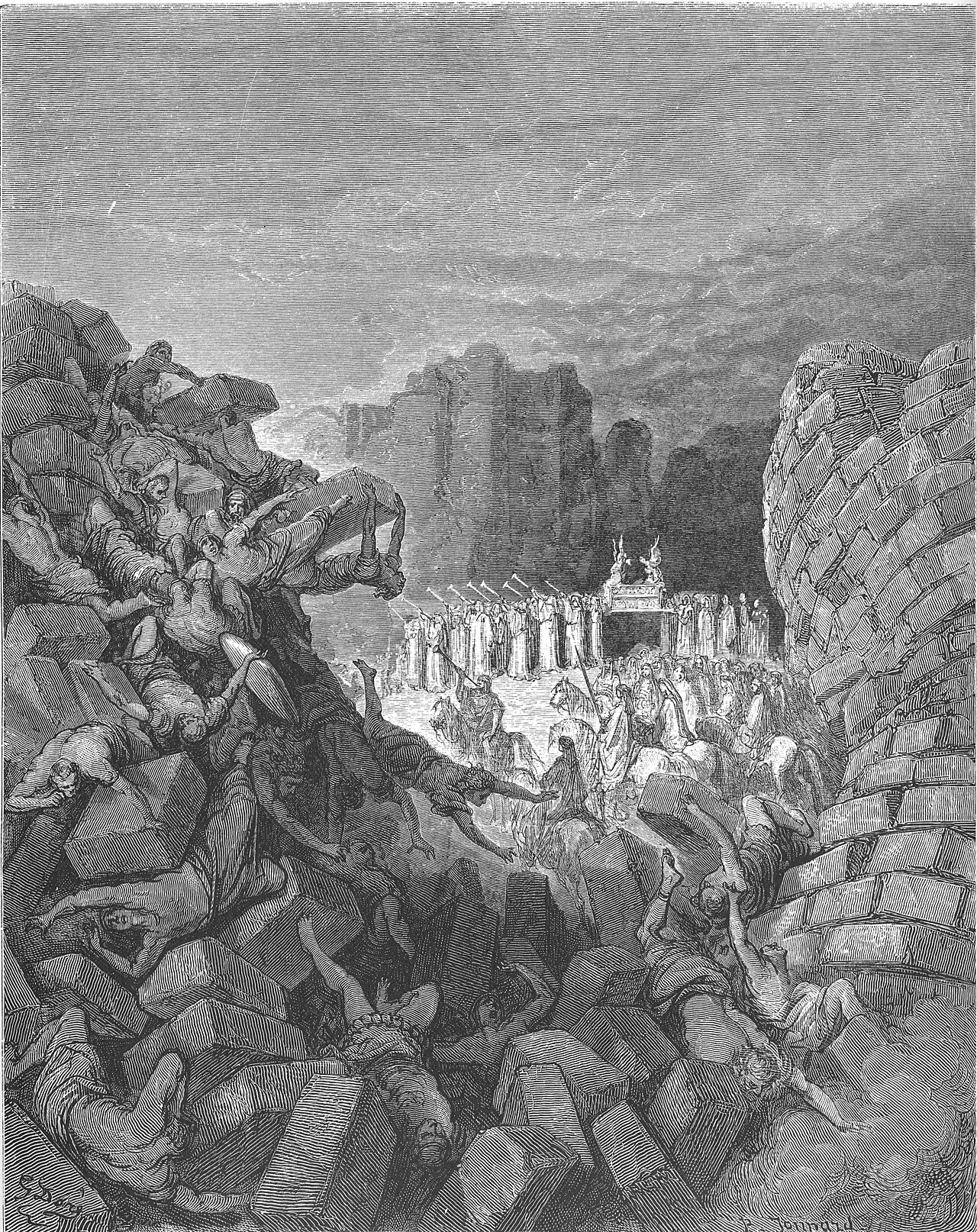
in Joshua 6So he had the ark of the LORD carried around the city, circling it once. And the people returned to the camp and spent the night there.
BSB
The same verse in ASV and KJV ▾
ASV
So he caused the ark of Jehovah to compass the city, going about it once: and they came into the camp, and lodged in the camp.
KJV
So the ark of the Lord compassed the city, going about it once: and they came into the camp, and lodged in the camp.
⋯
This verse in Joshua 6
Commentary
7 notes on this verseThis site's exposition
Joshua had commanded the people
on Joshua 6:10-11
The silence is ordered in three clauses covering shouting, noise and any word at all, which is heavier than a march order requires. What ends it is a shout released on command at a moment Joshua names, so the sound that takes the city is obedience rather than a cry the men work themselves into. Then the circuit is made once, the people lodge in the camp, and that is the whole of day one.
This site's exposition
the people returned to the camp and spent the night there
Gill places the camp at Gilgal, so each circuit began and ended there. Henry imagines the watchers on the wall asking whether this was the army they had feared, and quotes Bishop Hall that the wicked think God is jesting while he prepares their judgment. The first day ends without a blow struck.
The record, by era
The Puritans and the Awakening2 voices
Is this the people we thought so formidable? Are these their methods of attack?" Thus they cried peace and safety, that the destruction might be the more terrible when it came. Wicked men (says bishop Hall) think God in jest when he is preparing for their judgment; but they will be convinced of their mistake when it is too late.
quarantine:debris (2026-07-29) — odd-straight-quotes
So the ark of the Lord compassed the city,....
The Nineteenth Century3 voices
A commentator
Jamieson, Fausset & Brown1802–1910
Commentary Critical and Explanatory on the Whole Bible (1871)
proposed
the seven priests bearing the seven trumpets . . . passed on before the Lord--before the ark, called "the ark of the covenant," for it contained the tables on which the covenant was inscribed.
quarantine:debris,scripture (2026-07-29) — starts-lowercase; scripture-overlap:81%@v6-8
The Lord divided the Jordan that His people might pass through dry-shod. This miracle greatly dispirited the Canaanites, and so prepared the way for an easy triumph for the invading Israelites. You would have naturally expected that the Lord would have bid His people avail themselves immediately of this terror to strike a heavy blow at once, and press on with might and main before the enemy could take a breath and so sweep the land clear of the adversaries in a single campaign. But it was not so.
The Lord divided the Jordan that His people might pass through dry-shod. This miracle greatly dispirited the Canaanites, and so prepared the way for an easy triumph for the invading Israelites. You would have naturally expected that the Lord would have bid His people avail themselves immediately of this terror to strike a heavy blow at once, and press on with might and main before the enemy could take a breath and so sweep the land clear of the adversaries in a single campaign. But it was not so. Instead of immediate activity, the children of Israel pitched their tents at Gilgal and there tarried for a considerable season. For God is in no hurry. His purposes can be accomplished without haste, and though He would have us redeem the time because our days are evil, yet in His eternity He can afford to wait and by His wisdom He so orders His delays that they prove to be far better than our hurries. Why were the people to delay? That they might be obedient to commands which had been forgotten. In the desert, for many reasons, circumcision and the Passover had been neglected. They were not visited with any chastisement on account of this neglect, for the Lord considered their position and condition, and winked at their error. But before He would use them He would have them fully obedient to His will. It cannot be expected that God should tolerate disobedient servants, and therefore they must stay awhile, till they had been attentive to the two great precepts of the Mosaic Covenant. Dear Friends, let us pause and ask ourselves, as Believers, whether we have been in all respects conscientiously attentive to our Master's commands. If not, we may not expect Him to send a blessing to the Church or to the world through us, until first of all we have yielded our willing obedience to that which He has prescribed for us.
The words behind it
12 Hebrew wordsEvery Hebrew word of this verse in the order it stands, with what it means and the door to its own study. The last column counts the times a word stands in the whole Bible: the rarer the word, the more the places it appears belong together.
| Hebrew | Sound | Meaning | Word study | In the Bible |
|---|---|---|---|---|
| וַיַּסֵּ֤ב | vaiyasev | and he caused to go around | H5437 → | 161 times |
| אֲרוֹן־ | ʾaron- | [the] ark of | H727 → | 202 times |
| יְהוָה֙ | yahweh | Yahweh | H3068 → | 6520 times |
| אֶת־ | ʾet- | <obj.> | H853 → | 10935 times |
| הָעִ֔יר | hair | the city | H5892 → | 1090 times |
| הַקֵּ֖ף | hakef | it encircled [it] | H5362 → | |
| פַּ֣עַם | paam | a time | H6471 → | 118 times |
| אֶחָ֑ת | ʾechat | one | H259 → | 971 times |
| וַיָּבֹ֙אוּ֙ | vaiyavou | and they went | H935 → | 2568 times |
| הַֽמַּחֲנֶ֔ה | hamachaneh | the camp | H4264 → | 215 times |
| וַיָּלִ֖ינוּ | vaiyalinu | and they stayed | H3885 → | 84 times |
| בַּֽמַּחֲנֶֽה׃ פ | bamachaneh | in the camp | H4264 → | 215 times |
וַיַּסֵּ֤בand he caused to go around
vaiyasevH5437 →161 times
אֲרוֹן־[the] ark of
ʾaron-H727 →202 times
יְהוָה֙Yahweh
yahwehH3068 →6520 times
אֶת־<obj.>
ʾet-H853 →10935 times
הָעִ֔ירthe city
hairH5892 →1090 times
הַקֵּ֖ףit encircled [it]
hakefH5362 →
פַּ֣עַםa time
paamH6471 →118 times
אֶחָ֑תone
ʾechatH259 →971 times
וַיָּבֹ֙אוּ֙and they went
vaiyavouH935 →2568 times
הַֽמַּחֲנֶ֔הthe camp
hamachanehH4264 →215 times
וַיָּלִ֖ינוּand they stayed
vaiyalinuH3885 →84 times
בַּֽמַּחֲנֶֽה׃ פin the camp
bamachanehH4264 →215 times
A shaded row is a word that stands 400 times or fewer in the Bible.
Where this verse is studied
On this page
Studies5
About Joshua
This page draws on Adam Clarke, Commentary on the Bible; Charles Spurgeon, The Metropolitan Tabernacle Pulpit, Sermon No. 795: “Joshua's Vision” (lightly modernized text, CCEL edition); Jamieson, Fausset & Brown, Commentary Critical and Explanatory on the Whole Bible; John Gill, Exposition of the Old Testament; John Gill, Exposition of the Old Testament (1748-1763) and Matthew Henry, Commentary on the Whole Bible.