
On this page, 7 sections
The one drawing
Across the canon
Old Testament
New Testament
The other 55 books of the canon carry none.
12 passages
Where Scripture speaks
The passages this subject stands on, in canon order.
For this reason a man will leave his father and mother and be united to his wife, and they will become one flesh.So Boaz took Ruth, and she became his wife. And when he had relations with her, the LORD enabled her to conceive, and she gave birth to a son.He who finds a wife finds a good thing and obtains favor from the LORD.A wife of noble character, who can find? She is far more precious than rubies.Set me as a seal over your heart, as a seal upon your arm. For love is as strong as death, its jealousy as unrelenting as Sheol. Its sparks are fiery flames, the fiercest blaze of all.“For I hate divorce,” says the LORD, the God of Israel. “He who divorces his wife covers his garment with violence,” says the LORD of Hosts. So guard yourselves in your spirit and do not break faith.So they are no longer two, but one flesh. Therefore what God has joined together, let man not separate.”On the third day a wedding took place at Cana in Galilee. Jesus’ mother was there,But because there is so much sexual immorality, each man should have his own wife, and each woman her own husband.Husbands, love your wives, just as Christ loved the church and gave Himself up for her“For this reason a man will leave his father and mother and be united to his wife, and the two will become one flesh.”Marriage should be honored by all and the marriage bed kept undefiled, for God will judge the sexually immoral and adulterers.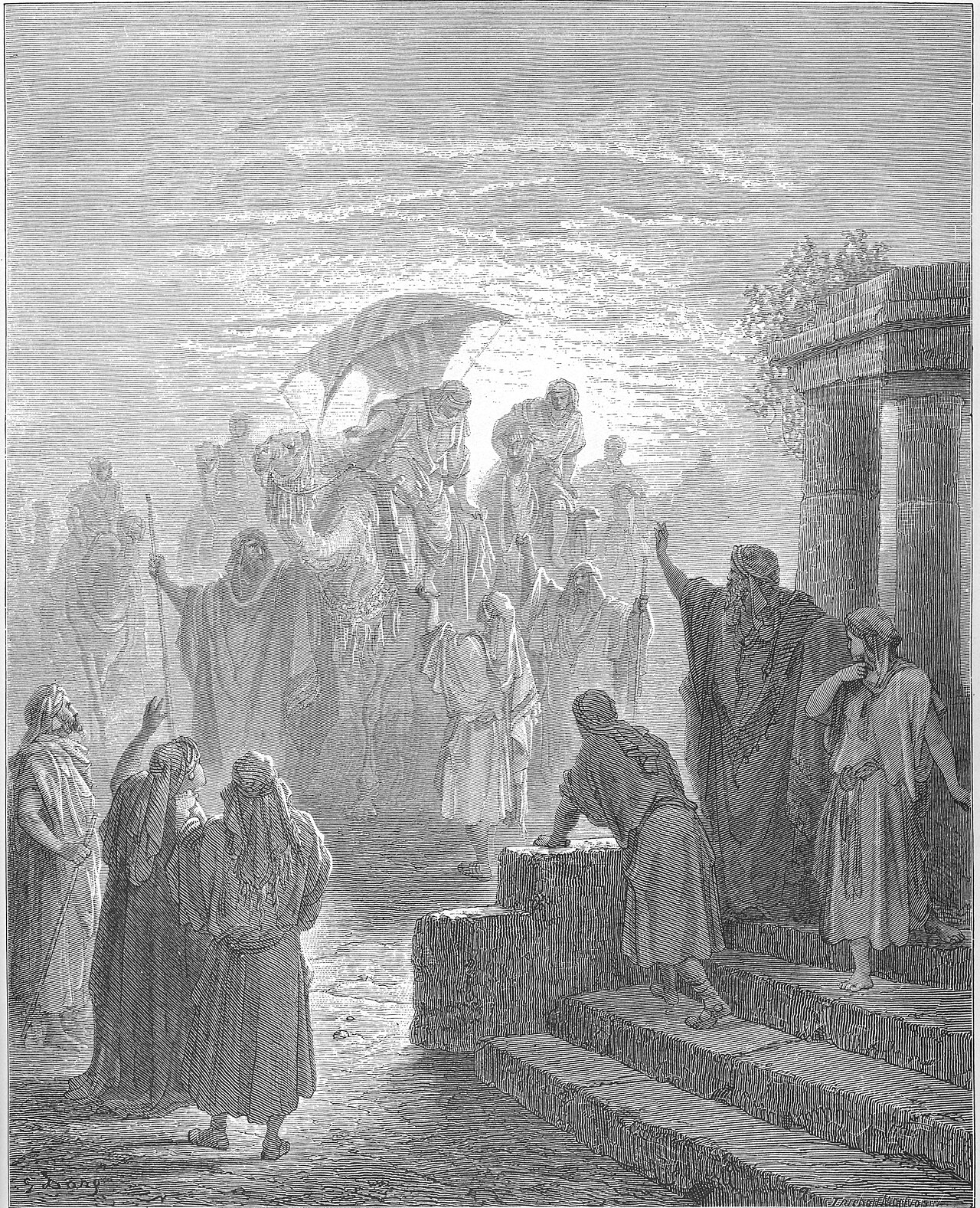
Marriage in Scripture, in full
Marriage begins in a garden, not a law code. When God made the first man, he said it was not good for him to be alone, and he built a wife for him from his own side (Genesis 2:18-22). Adam's response was joy; this one, at last, was like him, part of him. The passage that follows became the pattern for every marriage after: a man leaves his father and mother, joins himself to his wife, and the two become one flesh (Genesis 2:24).
One flesh is not a metaphor for feelings. It described a real, God-made union: two people bound together as if they were one body, undoing the aloneness the very first chapter of the Bible calls not good. Marriage was there before sin entered the world. It is part of the original design, not a fallback plan.
Scripture never hides how hard marriage can be. Jacob loved one wife and was tricked into another (Genesis 29:21-30). Hosea married a woman who broke her vows, and God used that marriage to picture how Israel had broken its vows to him (Hosea 1:2-3). Proverbs weighs both sides plainly, warning of a quarrelsome wife in one place and praising a good one as a gift from the Lord in another (Proverbs 21:9; 18:22). The Bible is honest about marriage rather than sentimental about it.
Even so, one whole book of the Bible is a love song. The Song of Solomon lingers over the delight two people can take in each other, without embarrassment, as something God made and blessed. Later readers have also heard in it an echo of a larger love: the love between God and his people.
That echo becomes explicit in the prophets. God speaks of himself as a husband to Israel, wounded by her unfaithfulness but still pursuing her (Isaiah 54:5; Jeremiah 3:14). Marriage, in other words, was never only about two people. From early on it was also a picture: the closest human relationship standing in for the closest thing to it, the bond between God and his own.
Jesus deepens rather than loosens that picture. Asked about marriage, he goes back past the law of Moses to the beginning, grounding it in Genesis and forbidding anyone from tearing apart what God has joined (Matthew 19:4-6). His first recorded miracle takes place at a wedding, where he keeps the celebration going rather than let it run dry (John 2:1-11): a small but telling sign of how he regards the occasion.
Paul takes the picture furthest of all. Writing to husbands and wives, he tells husbands to love their wives the way Christ loved the church and gave himself for her (Ephesians 5:25). Then he goes further still, applying the one-flesh language of Genesis directly to Christ and his people, calling it a great mystery (Ephesians 5:31-32).
By the end of the Bible the picture has become the main event. The last book does not close with an ordinary ending but with a wedding, the marriage of the Lamb to his bride at last made ready (Revelation 19:6-9). Every earthly marriage, at its best and even in its struggles, has been pointing toward this the whole time: the day Christ is joined to his people forever, and the two, at last, become one.
4 voices
What teachers have said
This book seems to me to be an epithalamium, that is, a marriage song, written by Solomon in the style of a drama, which he sang like a bride who is getting married and burning with a heavenly love toward her husband, which is the Word of God.
Origen of Alexandria · Commentary on the Song of Songs, Prologue
Written before 253.
The marriage is the putting on of immortality, and the joining together corruption and incorruption in a new union
Hilary of Poitiers · Catena Aurea by Aquinas
Written before 367.
He kept no concubine, no mistress, but was inviolably faithful to the marriage bed, though his wife was none of the wisest, best, or kindest.
Matthew Henry · Commentary on the Whole Bible, 1710
In the Song of Songs it is said, "I am wounded with love"; that is, of being in love, of being inflamed with passion, of sighing for the bridegroom, from whom she received the arrow of the Word.
Augustine of Hippo · Explanations of the Psalms 45:14
Written before 430.
The words underneath
Each card is one Hebrew or Greek word behind marriage. It gives the sense, the count across the canon, and the number in Strong's 1890 concordance.
baal: master
Hebrew · H1167Strong's entry: a master; hence, a husband, or (figuratively) owner (often used with another noun in modifications of this latter sense)
used of a husband as the one to whom a wife is bound
84 times in the Old Testament · baal, in full →
kallah: daughter-in-law: bride
Hebrew · H3618Strong's entry: a bride (as if perfect); hence, a son's wife
also used for a son's wife, daughter-in-law
34 times in the Old Testament · kallah, in full →
chathan: relative
Hebrew · H2859Strong's entry: to give (a daughter) away in marriage; hence (generally) to contract affinity by marriage
the root of Hebrew's word for kin by marriage
33 times in the Old Testament · chathan, in full →
ishshah: woman
Hebrew · H802Strong's entry: a woman
the term Genesis uses when God brings her to the man
781 times in the Old Testament · ishshah, in full →
1 verses
The complete list
This subject carries 13 curated verses. 12 of them are quoted above, and the other 1 stand here, book by book. Open a book to read the references with a clause of each verse.
Life questions