
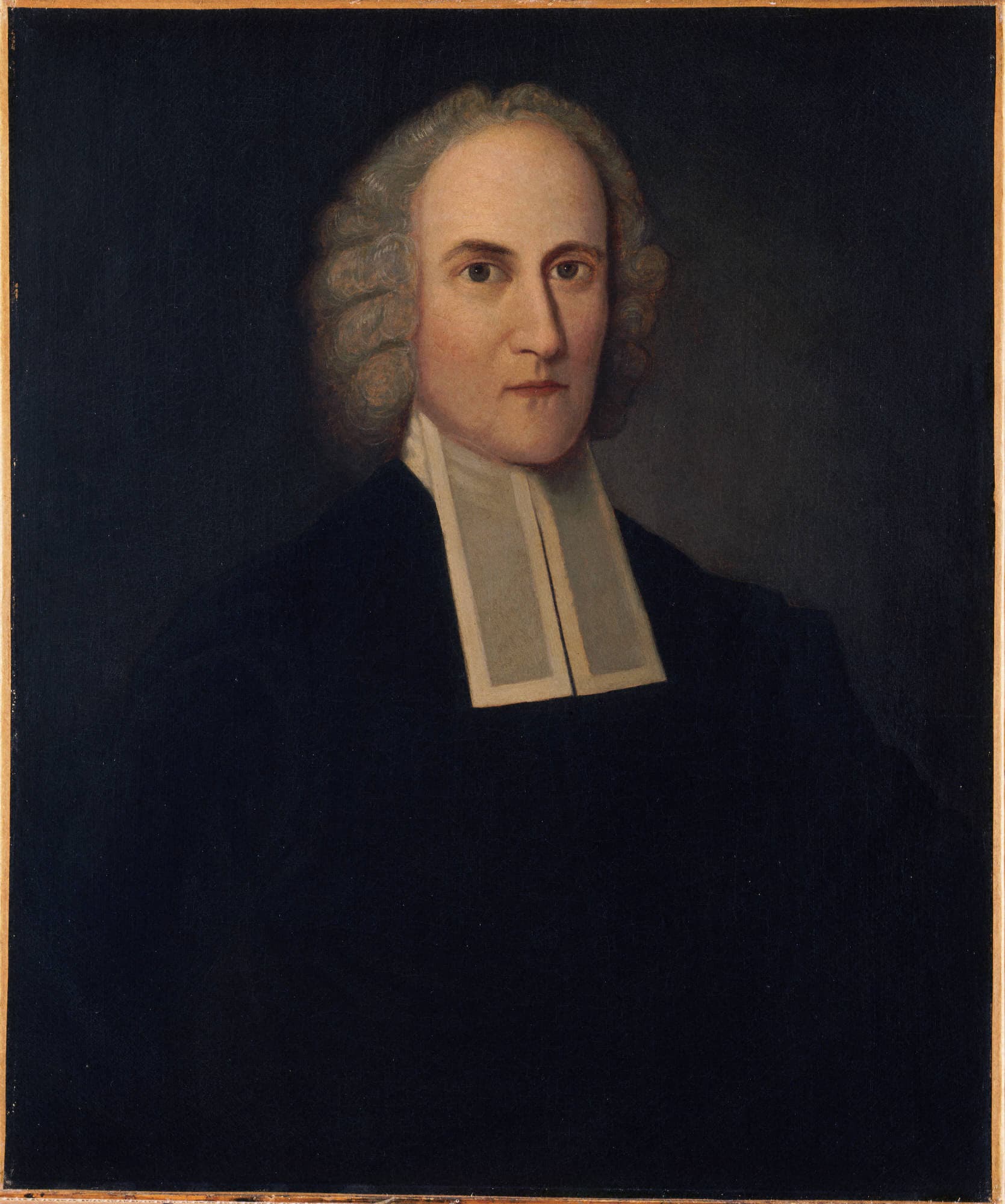
New Haven, 1727 · Story · Marriage in Its Trials
An Uncommon Union
A pastor and his wife in colonial New England stayed united through more than thirty years of revival and loss.
When Edwards died at Princeton in 1758, his wife was at their home in Stockbridge, more than 150 miles away.
but from the inner disposition of your heart, the unfading beauty of a gentle and quiet spirit, which is precious in God’s sight.
- When
- 28 July 1727
Summary
Jonathan Edwards, the minister of Northampton in Massachusetts, married Sarah Pierrepont of New Haven in 1727, when she was seventeen. They raised a large family and shared his work for more than thirty years. On his deathbed he sent her word that their union had been spiritual and would therefore last for ever. In her answer to his death she wrote to their daughter that her God lived and had her heart.
- Edwards wrote of Sarah's devotion to God in 1723, four years before they married.
- The preacher George Whitefield stayed in their house in October 1740 and wrote warmly of them as husband and wife.
- Edwards's church dismissed him in 1750, and the family moved to the Indian mission at Stockbridge in 1751.
A Young Lady in New Haven
The memoir prints Edwards's picture of a young woman wholly given to God.
An Uncommon Union tells the story of the marriage of Edwards and Sarah Pierrepont. It belongs to the trial of marriage because their marriage bore loss of income and home, the death of a daughter, and a separation at the end.
Its question is what held their marriage through those trials. It gives the dated events from his first words about her to her death, the household a famous visitor saw, the troubles they bore together, and the words each left when he died.
Sereno Dwight's memoir prints a passage that Edwards wrote on a blank leaf when Sarah was thirteen. It begins, “They say there is a young lady in [New-Haven] who is loved of that Great Being, who made and rules the world”.
He wrote that “She has a strange sweetness in her mind, and singular purity in her affections”.
He ended, “She loves to be alone, walking in the fields and groves, and seems to have some one invisible always conversing with her.”
From Windsor to Princeton
Edwards was born at Windsor in 1703, and Sarah died at Philadelphia in 1758.
The marriage of July 1727 ended with Edwards's death in March 1758, and Sarah died the same year.
- 5 October 1703Jonathan Edwards is born at Windsor, ConnecticutThe monument at Princeton, in Dwight's memoir
- 9 January 1710Sarah Pierrepont is bornDwight's memoir
- 1723His first written words about herDwight's memoir
- 15 February 1727Edwards is ordained at NorthamptonDwight's memoir
- 28 July 1727They are married at New HavenDwight's memoir
- 16 to 20 October 1740George Whitefield stays at NorthamptonDwight's memoir; Whitefield's journal
- 22 June 1750He loses his pulpit at NorthamptonEdwards's letter, in Dwight's memoir
- 8 August 1751He is installed at StockbridgeDwight's memoir
- 13 February 1758He is given the inoculation at the collegeDwight's memoir
- 22 March 1758He dies at PrincetonDwight's memoir
- 3 April 1758Sarah writes to their daughter Esther BurrDwight's memoir
- 7 April 1758Esther Burr diesDwight's memoir
- 2 October 1758Sarah dies at Philadelphia; the edition misprints the year as 1738Dwight's memoir
A timeline of thirteen dated events from 1703 to 1758, each with its date and the account it comes from.
22 June 1750, 8 August 1751, 13 February 1758, 22 March 1758, 3 April 1758, 7 April 1758, 2 October 1758
The Household at Northampton
The household grew to eleven children, and in 1740 it received George Whitefield.
Sarah was in the eighteenth year of her age when they married, and Dwight records that she came to a station “of great delicacy, as well as responsibility”.
George Whitefield came to Northampton in October 1740 to see Edwards and to ask about the revival of 1735. In his journal for Sunday, 19 October, he called Edwards a son of Abraham with a daughter of Abraham for his wife, and he wrote, “A sweeter Couple I have not yet seen.”
Of Sarah he wrote, “She is a Woman adorn'd with a meek and quiet Spirit”. She so impressed him that he renewed his own prayers for a wife.
Their second daughter, Jerusha, died on 14 February 1748, in the eighteenth year of her age. Edwards's friendship with the missionary David Brainerd, whom Jerusha nursed, is told in Brainerd and Edwards.
Troubles Borne Together
In eight years Edwards lost his pulpit, moved his family to the frontier and was called away to Princeton.
After a long dispute with his church over the “qualifications for full communion”, a council of churches was called to decide whether pastor and people should part. Edwards wrote that his “pastoral relation to my people was dissolved, on June 22nd”, and that the vote “was carried in the council by a majority of one voice”.
Dwight writes that Edwards then had “a numerous and chargeable family, and little or no income, exclusive of his salary”. In August 1751 Edwards took his household to Stockbridge, where he was installed as minister of the congregation and missionary to the Indians.
When his son-in-law Aaron Burr, president of the college at Princeton, died in September 1757, the trustees chose Edwards to succeed him. Edwards went ahead to Princeton in January 1758 and left his family at Stockbridge until the spring.
The Uncommon Union
Edwards's message to Sarah was written down by their daughter Lucy at his bedside.
Smallpox was spreading at Princeton, and Edwards had never had it, so with the physician's advice he was inoculated. A secondary fever followed, and pustules in his throat kept him from taking the medicines that might have checked it.
Knowing that he would not recover, he called Lucy and sent his wife “my kindest love”. He asked Lucy to tell her “that the uncommon union, which has so long subsisted between us, has been of such a nature, as I trust is spiritual, and therefore will continue for ever”.
He added the hope that Sarah would “be supported under so great a trial, and submit cheerfully to the will of God”.
Near the end, those at his bedside lamented his death as a loss to the college and to the church. By Dwight's record his last words told them to trust in God and they would have no need to fear.
My God Lives
Sarah outlived her husband by a little more than six months.
On 3 April 1758 Sarah wrote from Stockbridge to Esther Burr, “My very dear child, What shall I say? A holy and good God has covered us with a dark cloud.”
She wrote that God had made her adore His goodness “that we had him so long”, and she added, “But my God lives”.
Esther died four days later. In September Sarah set out for Philadelphia to take in Esther's two orphaned children, fell ill there, and died. Her body was carried to Princeton and laid with her husband's, and Dwight wrote of the two, “Thus they who were in their lives remarkably lovely and pleasant, in their death were not much divided.”
Saul and Jonathan, beloved and delightful in life, were not divided in death. They were swifter than eagles, they were stronger than lions.David's lament for Saul and his son gave the memoir the words it used of the couple at their burial.
Sources
Scripture is the Berean Standard Bible.
- Sereno E. Dwight, Memoirs of Jonathan Edwards, in The Works of Jonathan Edwards, vol. 1, revised and corrected by Edward Hickman (first published 1834; Banner of Truth reprint), chapters VI, IX, XV, XVII, XVIII, XIX and XXIV.
- Jonathan Edwards, letter of 1750 on his dismissal, printed in Dwight's memoir, chapter XVII.
- George Whitefield, A Continuation of the Reverend Mr. Whitefield's Journal ... The Seventh Journal, second edition (London: W. Strahan), page 48, entry for Sunday, 19 October 1740.
Keep Studying
Read it1
Studies1