
John 2:1
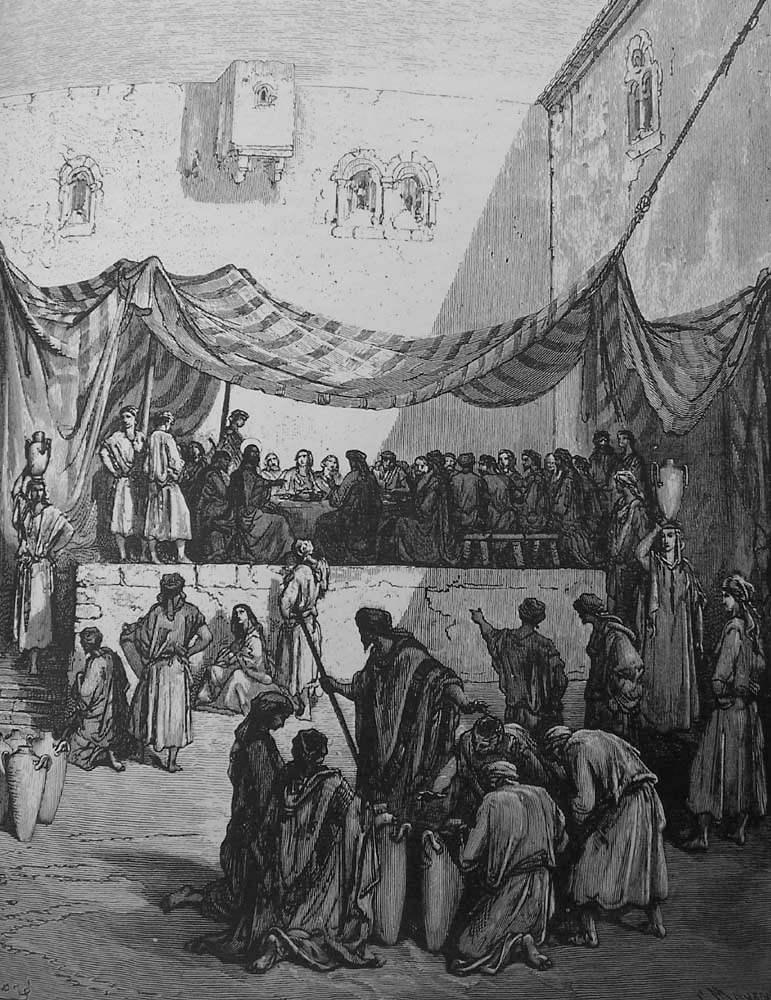
in John 2On the third day a wedding took place at Cana in Galilee. Jesus’ mother was there,
BSB
The same verse in ASV and KJV ▾
ASV
And the third day there was a marriage in Cana of Galilee; and the mother of Jesus was there:
KJV
And the third day there was a marriage in Cana of Galilee; and the mother of Jesus was there:
⋯
This verse in John 2
Commentary
28 notes on this verseGalilee. Let him that loves learning again note well: for not in Jerusalem is the gathering, but without Judaea is the feast celebrated, as it were in the country of the Gentiles. For it is Galilee of the gentiles, as the prophet saith. It is I suppose altogether plain, that the synagogue of the Jews rejected the Bridegroom from Heaven, and that the church of the Gentiles received Him, and that very gladly.
This site's exposition
a wedding took place at Cana
on John 2:1-2
On the third day counts forward from the day sequence John has kept since 1:29, and it closes an opening week. Jesus, His disciples and His mother are at a village wedding, and a Galilean wedding feast ran several days, with the wine standing as the host's honor before the whole village. The signs of this Gospel begin here.
The record, by era
The Church Fathers5 voices
The miracle indeed of our Lord Jesus Christ, whereby He made the water into wine, is not marvellous to those who know that it was God's doing. For He who made wine on that day at the marriage feast, in those six water-pots, which He commanded to be filled with water, the self-same does this every year in vines. For even as that which the servants put into the water-pots was turned into wine by the doing of the Lord, so in like manner also is what the clouds pour forth changed into wine by the doing of the same Lord. But we do not wonder at the latter, because it happens every year: it has lost its marvellousness by its constant recurrence. And yet it suggests a greater consideration than that which was done in the water-pots. For who is there that considers the works of God, whereby this whole world is governed and regulated, who is not amazed and overwhelmed with miracles? If he considers the vigorous power of a single grain of any seed whatever, it is a mighty thing, it inspires him with awe. But since men, intent on a different matter, have lost the consideration of the works of God, by which they should daily praise Him as the Creator, God has, as it were, reserved to Himself the doing of certain extraordinary actions, that, by striking them with wonder, He might rouse men as from sleep to worship Him. A dead man has risen again; men marvel: so many are born daily, and none marvels. If we reflect more considerately, it is a matter of greater wonder for one to be who was not before, than for one who was to come to life again.
The Lord, on being invited, came to the marriage. What wonder if He came to that house to a marriage, having come into this world to a marriage? For, indeed, if He came not to a marriage, He has not here a bride. But what says the apostle? "I have espoused you to one husband, to present you a chaste virgin to Christ." Why does he fear lest the virginity of Christ's bride should be corrupted by the subtilty of the devil? "I fear," saith he, "lest as the serpent beguiled Eve by his subtilty, so also your minds should be corrupted from the simplicity and chastity which is in Christ." Thus has He here a bride whom He has redeemed by His blood, and to whom He has given the Holy Spirit as a pledge. He has freed her from the bondage of the devil: He died for her sins, and is risen again for her justification. Who will make such offerings to his bride? Men may offer to a bride every sort of earthly ornament,-gold, silver, precious stones, houses, slaves, estates, farms,-but will any give his own blood? For if one should give his own blood to his bride, he would not live to take her for his wife. But the Lord, dying without fear, gave His own blood for her, whom rising again He was to have, whom He had already united to Himself in the Virgin's womb. For the Word was the Bridegroom, and human flesh the bride; and both one, the Son of God, the same also being Son of man. The womb of the Virgin Mary, in which He became head of the Church, was His bridal chamber: thence He came forth, as a bridegroom from his chamber, as the Scripture foretold, "And rejoiced as a giant to run his way." From His chamber He came forth as a bridegroom; and being invited, came to the marriage.
(In Verb. Dom. Serm. xli) Let the proud man blush to see the humility of God. Lo, among other things, the Son of the Virgin comes to a marriage; He who, when He was with the Father, instituted marriage. (Tr. viii. c. 4) What marvel, if He went to that house to a marriage, Who came into this world to a marriage. For here He has His spouse whom He redeemed with His own blood, to whom He gave the pledge of the Spirit, and whom He united to Himself in the womb of the Virgin. For the Word is the Bridegroom, and human flesh the bride, and both together arc one Son of God and Son of man. That womb of the Virgin Mary is His chamber, from which he went forth as a bridegroom. (Ps. 19:5)
When we see, therefore, such deeds wrought by Jesus God, why should we wonder at water being turned into wine by the man Jesus? For He was not made man in such manner that He lost His being God. Man was added to Him, God not lost to Him. This miracle was wrought by the same who made all those things. Let us not therefore wonder that God did it, but love Him because He did it in our midst, and for the purpose of our restoration. For He gives us certain intimations by the very circumstances of the case. I suppose that it was not without cause He came to the marriage. The miracle apart, there lies something mysterious and sacramental in the very fact. Let us knock, that He may open to us, and fill us with the invisible wine: for we were water, and He made us wine, made us wise; for He gave us the wisdom of His faith, whilst before we were foolish. And it appertains, it may be, to this wisdom, together with the honor of God, and with the praise of His majesty, and with the charity of His most powerful mercy, to understand what was done in this miracle.
In the ancient times there was prophecy, and no times were left without the dispensation of prophecy. But the prophecy, since Christ was not understood therein, was water. For in water wine is in some manner latent. The apostle tells us what we are to understand by this water: "Even unto this day," saith he, "whilst Moses is read, that same veil is upon their heart; that it is not unveiled because it is done away in Christ. And when thou shalt have passed over," saith he, "to the Lord, the veil shall be taken away." By the veil he means the covering over of prophecy, so that it was not understood. When thou hast passed over to the Lord, the veil is taken away; so likewise is tastelessness taken away when thou hast passed over to the Lord; and what was water now becomes wine to thee. Read all the prophetic books; and if Christ be not understood therein, what canst thou find so insipid and silly? Understand Christ in them, and what thou readest not only has a taste, but even inebriates thee; transporting the mind from the body, so that forgetting the things that are past, thou reachest forth to the things that are before. Wherefore, prophecy from ancient times, even from the time when the series of human births began to run onwards, was not silent concerning Christ; but the import of the prophecy was concealed therein, for as yet it was water. When these words of the Gospel are understood, and they are certainly clear, all the mysteries which are latent in this miracle of the Lord will be laid open. Observe what He says, that it behoved the things to be fulfilled in Christ that were written of Him. Where were they written? "In the law," saith He, "and in the prophets, and in the Psalms." He omitted no part of the Old Scriptures. These were water; and hence the disciples were called irrational by the Lord, because as yet they tasted to them as water, not as wine. […]
21 more voices on this verse
The Church Fathers8 voices
It is evident that this third day should be calculated as the third day after the baptism. He said that the first day was that in which Andrew and his companion followed him and then passed the night with him. The second day relates the …
Consider whether this first miracle of our Savior that took place in Cana of Galilee, where he changed water into wine, is not foretold in the beginning of this prophecy where it says, "Drink this first. Act quickly, land of Zebulun and Naphtali, Galilee of the Gentiles." And this miracle was a sign of the mystic wine—that wine of the faith of the new covenant that is transformed from bodily joy to a joy of mind and spirit.
According to the theoria [of this passage], the Word of God descended from heaven in order that the bridegroom, having made the punishment of the human nature his own, might persuade [his bride] to become pregnant with the spiritual seed of wisdom. He convened the …
The third day is the mystery of the Trinity, while the miracles of the nuptials are the mysteries of heavenly joys. It was both a nuptial day and a feast for this reason, because the church after the redemption was joined to the spouse who …
He was truly both seen and heard upon the mount; true and real was the draught of that wine at the marriage of (Cana in) Galilee; true and real also was the touch of the then believing Thomas.
How mighty is the grace of water, in the sight of God and His Christ, for the confirmation of baptism! Never is Christ without water: if, that is, He is Himself baptized in water; inaugurates in water the first rudimentary displays of His power, when invited to the nuptials; invites the thirsty, when He makes a discourse, to His own sempiternal water; approves, when teaching concerning love, among works of charity, the cup of water offered to a poor (child); recruits His strength at a well; walks over the water; willingly crosses the sea; ministers water to His disciples.
But further, if Christ reproves the scribes and Pharisees, sitting in the official chair of Moses, but not doing what they taught, what kind of (supposition). is it that He Himself withal should set upon His own official chair men who were mindful rather to enjoin-(but) not likewise to practise-sanctity of the flesh, which (sanctity) He had in all ways recommended to their teaching and practising?-first by His own example, then by all other arguments; while He tells (them) that "the kingdom of heavens" is "children's; " while He associates with these (children) others who, after marriage, remained (or became)virgins; " while He calls (them) to (copy) the simplicity of the dove, a bird not merely innocuous, but modest too, and whereof one male knows one female; while He denies the Samaritan woman's (partner to be) a husband, that He may show that manifold husbandry is adultery; while, in the revelation of His own glory, He prefers, from among so many saints and prophets, to have with him Moses and Elias -the one a monogamist, the other a voluntary celibate (for Elias was nothing else than John, who came "in the power and spirit of Elias" ); while that "man gluttonous and toping," the "frequenter of luncheons and suppers, in the company of publicans and sinners," sups once for all at a single marriage, though, of course, many were marrying (around Him); for He willed to attend (marriages) only so often as (He willed) them to be.
I said before that He was best known in Galilee; therefore they invite Him to the marriage, and He comes; for He looked not to His own honor, but to our benefit. He who disdained not to "take upon Him the form of a servant" (Phil. ii. 7), would much less disdain to be present at the marriage of servants; He who sat down "with publicans and sinners" (Matt. ix. 13), would much less refuse to sit down with those present at the marriage. Assuredly they who invited Him had not formed a proper judgment of Him, nor did they invite Him as some great one, but merely as an ordinary acquaintance; and this the Evangelist has hinted at, when he says, "The mother of Jesus was there, and His brethren." Just as they invited her and His brethren, they invited Jesus.
The Medieval Church6 voices
Galilee is a province; Cana a village in it.
(in v. 1) At the time of our Lord's appearing in the flesh, the sweet vinous taste of the law had been weakened by the carnal interpretations of the Pharisees.
(Hom. 2d Sund. after Epiph.) His condescension in coming to the marriage, and the miracle He wrought there, are, even considering them in the letter only, a strong confirmation of the faith. Therein too are condemned the errors of Tatian, Marcion, and others who detract from the honour of marriage. For if the undefiled bed, and the marriage celebrated with due chastity, partook at all of sin, our Lord would never have come to one. Whereas now, conjugal chastity being good, the continence of widows better, the perfection of the virgin state best, to sanction all these degrees, but distinguish the merit of each, He deigned to be born of the pure womb of the Virgin; was blessed after birth by the prophetic voice of the widow Anna; and now invited in manhood to attend the celebration of a marriage, honours that also by the presence of His goodness. (in loc.) Nor is it without some mysterious allusion, that the marriage is related as taking-place on the third day. The first age of the world, before the giving of the Law, was enlightened by the example of the Patriarchs; the second, under the Law, by the writings of the Prophets; the third, under grace, by the preaching of the Evangelists, as if by the light of the third day; for our Lord had now appeared in the flesh. The name of the place too where the marriage was held, Cana of Galilee, which means, desire of migrating, has a typical signification, viz. that those are most worthy of Christ, who burn with devotional desires, and have known the passage from vice to virtue, from earthly to eternal things.
Above, the Evangelist showed the dignity of the incarnate Word and gave various evidence for it. Now he begins to relate the effects and actions by which the divinity of the incarnate Word was made known to the world. First, he tells the things Christ …
And on the third day a marriage etc. After the calling of the disciples has been described, there is here described the manifestation made through the Word and concerning the incarnate Word: whence the Gloss says that after the showings made through John, the Lord …
Allegorically: There is a threefold day according to a threefold time, namely of nature, of the Law, and of grace. In this third, the wedding was celebrated between Christ and the Church in the assumption of flesh, concerning which Matthew 22: The kingdom of heaven …
The Puritans and the Awakening1 voice
And the third day there was a marriage,.... Either from the second testimony bore by John the Baptist concerning Christ, and from the call of Simon Peter, which seem to be of the same date; see Joh 1:35, or from Christ's coming into Galilee; or from the conversation he had with Nathanael; from either of which the date is taken, it matters not; the first is as agreeable and plain, as any.
The Nineteenth Century5 voices
A commentator
Albert Barnes1798–1870
Notes, Explanatory and Practical, on the Old and New Testaments (1832-1869)
And the third day - On the third day after his conversation with Nathanael. Cana - This was a small town about 15 miles northwest of Tiberias and 6 miles northeast of Nazareth. It is now called Kerr Kenna, is under the government of a Turkish officer, and contains perhaps 300 inhabitants, chiefly Catholics.
A commentator
Jamieson, Fausset & Brown1802–1910
Commentary Critical and Explanatory on the Whole Bible (1871)
proposed
third day--He would take two days to reach Galilee, and this was the third. mother there--it being probably some relative's marriage. John never names her [BENGEL].
quarantine:debris (2026-07-29) — starts-lowercase
A commentator
J.C. Ryle1816–1900
Expository Thoughts on the Gospels: John (lightly modernized text, Grace Gems edition) (1869)
proposed
These verses describe a miracle which should always possess a special interest in the eyes of a true Christian. It is the first, in order of time, of the many mighty works which Jesus did, when He was upon earth. We are distinctly told, "This beginning of miracles did Jesus in Cana of Galilee." Like every other miracle which John was inspired to record, it is related with great minuteness and particularity. And, like every other miracle in John's Gospel, it is rich in spiritual lessons.
A commentator
J.C. Ryle1816–1900
Expository Thoughts on the Gospels: John (lightly modernized text, Grace Gems edition) (1869)
proposed
These verses describe a miracle which should always possess a special interest in the eyes of a true Christian. It is the first, in order of time, of the many mighty works which Jesus did, when He was upon earth. We are distinctly told, "This beginning of miracles did Jesus in Cana of Galilee." Like every other miracle which John was inspired to record, it is related with great minuteness and particularity. And, like every other miracle in John's Gospel, it is rich in spiritual lessons. We learn, firstly, from these verses, how honorable in the sight of Christ is the estate of matrimony . To be present at a "marriage" was almost the first public act of our Lord's earthly ministry. Marriage is not a sacrament, as the Church of Rome asserts. It is simply a state of life ordained by God for man's benefit. But it is a state which ought never to be spoken of with levity, or regarded with disrespect. The Prayerbook service has well described it, as "an honorable estate, instituted of God in the time of man's innocency, and signifying unto us the mystical union that is between Christ and his Church." Society is never in a healthy condition, and true religion never flourishes in that land where the marriage tie is lightly esteemed. They who lightly esteem it have not the mind of Christ. He who "beautified and adorned the estate of matrimony by His presence and first miracle that He wrought in Cana of Galilee," is One who is always of one mind. "Marriage," says the Holy Spirit by Paul, "is honorable in all." (Heb. 13:4.) One thing, however, ought not to be forgotten. Marriage is a step which so seriously affects the temporal happiness and spiritual welfare of two immortal souls, that it ought never to be taken in hand "unadvisedly, lightly, wantonly, and without due consideration."
Cana of Galilee - This was a small city in the tribe of Asher, Jos 19:28, and by saying this was Cana of Galilee, the evangelist distinguishes it from another Cana, which was in the tribe of Ephraim, in the Samaritan country. See Jos 16:8; Jos 17:9. Some suppose that the third day, mentioned here, refers to the third day of the marriage feast: such feasts lasting among the Jews seven days. See Jdg 14:12, Jdg 14:17, Jdg 14:18, and Bishop Pearce. The mother of Jesus was there - Some of the ancients have thought that this was the marriage of John the evangelist, who is supposed to have been a near relative of our Lord. See the sketch of his life prefixed to these notes.
Modern Voices1 voice
A commentator
GK ChestertonThe Superstition of Divorce, Ch. 8: The Vista of Divorce (1920) (1920)
proposed
The primary laws of man are to be found in the permanent life of man; in those things that have been common to it in every time and land, though in the highest civilisation they have reached an enrichment like that of the divine romance …
The words behind it
18 Greek wordsEvery Greek word of this verse in the order it stands, with what it means and the door to its own study. The last column counts the times a word stands in the whole Bible: the rarer the word, the more the places it appears belong together.
| Greek | Sound | Meaning | Word study | In the Bible |
|---|---|---|---|---|
| Καὶ | kai | And | G2532 → | 9120 times |
| τῇ | tea | on the | G3588 → | 19766 times |
| ἡμέρᾳ | hemera | day | G2250 → | 389 times |
| τῇ | tea | <the> | G3588 → | 19766 times |
| τρίτῃ | trite | third | G5154 → | 56 times |
| γάμος | gamos | a wedding | G1062 → | |
| ἐγένετο | egeneto | took place | G1096 → | 667 times |
| ἐν | en | in | G1722 → | 2738 times |
| Κανὰ | kana | Cana | G2580 → | 4 times |
| τῆς | tes | <the> | G3588 → | 19766 times |
| Γαλιλαίας, | galilaias | of Galilee, | G1056 → | 61 times |
| καὶ | kai | and | G2532 → | 9120 times |
| ἦν | en | was | G1510 → | 2333 times |
| ἡ | he | the | G3588 → | 19766 times |
| μήτηρ | meter | mother | G3384 → | 83 times |
| τοῦ | tou | <the> | G3588 → | 19766 times |
| Ἰησοῦ | iesou | of Jesus | G2424 → | 908 times |
| ἐκεῖ· | ekei | there; | G1563 → | 105 times |
ΚαὶAnd
kaiG2532 →9120 times
τῇon the
teaG3588 →19766 times
ἡμέρᾳday
hemeraG2250 →389 times
τῇ<the>
teaG3588 →19766 times
τρίτῃthird
triteG5154 →56 times
γάμοςa wedding
gamosG1062 →
ἐγένετοtook place
egenetoG1096 →667 times
ἐνin
enG1722 →2738 times
ΚανὰCana
kanaG2580 →4 times
τῆς<the>
tesG3588 →19766 times
Γαλιλαίας,of Galilee,
galilaiasG1056 →61 times
καὶand
kaiG2532 →9120 times
ἦνwas
enG1510 →2333 times
ἡthe
heG3588 →19766 times
μήτηρmother
meterG3384 →83 times
τοῦ<the>
touG3588 →19766 times
Ἰησοῦof Jesus
iesouG2424 →908 times
ἐκεῖ·there;
ekeiG1563 →105 times
A shaded row is a word that stands 400 times or fewer in the Bible.
The walk
8 stopsEach card is a verse this one points to, and under it the verses that one points to in turn. Where several paths arrive at the same place, that place is listed first: the text keeps returning to it.
Through
Matthew 12:46While Jesus was still speaking to the crowds, His mother and brothers stood outside, wanting to speak to Him.
it leads to
- Matthew 13:55
“Isn’t this the carpenter’s son? Isn’t His mother’s name Mary, and aren’t His brothers James, Joseph, Simon, and Judas?
- John 2:12
After this, He went down to Capernaum with His mother and brothers and His disciples, and they stayed there a few days.
- John 7:3
So Jesus’ brothers said to Him, “Leave here and go to Judea, so that Your disciples there may see the works You are doing.
- Mark 3:31–35
Then Jesus’ mother and brothers came and stood outside. They sent someone in to summon Him,
- John 7:5
For even His own brothers did not believe in Him.
- Matthew 13:55
Through
John 1:43The next day Jesus decided to set out for Galilee. Finding Philip, He told him, “Follow Me.”
it leads to
- John 14:8
Philip said to Him, “Lord, show us the Father, and that will be enough for us.”
- Isaiah 65:1
“I revealed Myself to those who did not ask for Me; I was found by those who did not seek Me. To a nation that did not call My name, I said, ‘Here I…
- Matthew 9:9
As Jesus went on from there, He saw a man named Matthew sitting at the tax booth. “Follow Me,” He told him, and Matthew got up and followed Him.
- John 14:8
Where this verse is studied
About John
This page draws on 24 works. Open the list of works
This page draws on Adam Clarke, Commentary on the Bible; Albert Barnes, Notes, Explanatory and Practical, on the Old and New Testaments (1832-1869); Alcuin of York, Catena Aurea by Aquinas; Augustine of Hippo, Tractates on John 8; Augustine of Hippo, Catena Aurea by Aquinas; Augustine of Hippo, Tractates on John 9; Bede, Catena Aurea by Aquinas; Bonaventure, Commentary on John, Chapter 2; Caesarius of Arles, SERMON 167.1; Cyril of Alexandria, Commentary on the Gospel of John, Book 2; Eusebius of Caesarea, PROOF OF THE GOSPEL 9.8.8; GK Chesterton, The Superstition of Divorce, Ch. 8: The Vista of Divorce (1920); J. C. Ryle, Expository Thoughts on the Gospels, John; J.C. Ryle, Expository Thoughts on the Gospels: John (lightly modernized text, Grace Gems edition); Jamieson, Fausset & Brown, Commentary Critical and Explanatory on the Whole Bible; John Chrysostom, Homily on the Gospel of John 21; John Gill, Exposition of the New Testament (1746-1748); Matthew Henry, Commentary on the Whole Bible; Tertullian, A Treatise on the Soul; Tertullian, On Baptism; Tertullian, On Monogamy; Theodore of Heraclea, FRAGMENTS ON JOHN 12; Theodore of Mopsuestia, COMMENTARY ON JOHN 1.2.1 and Thomas Aquinas, Commentary on John.