
Joshuachapter 8
35 verses · BSBJoshua book hub →
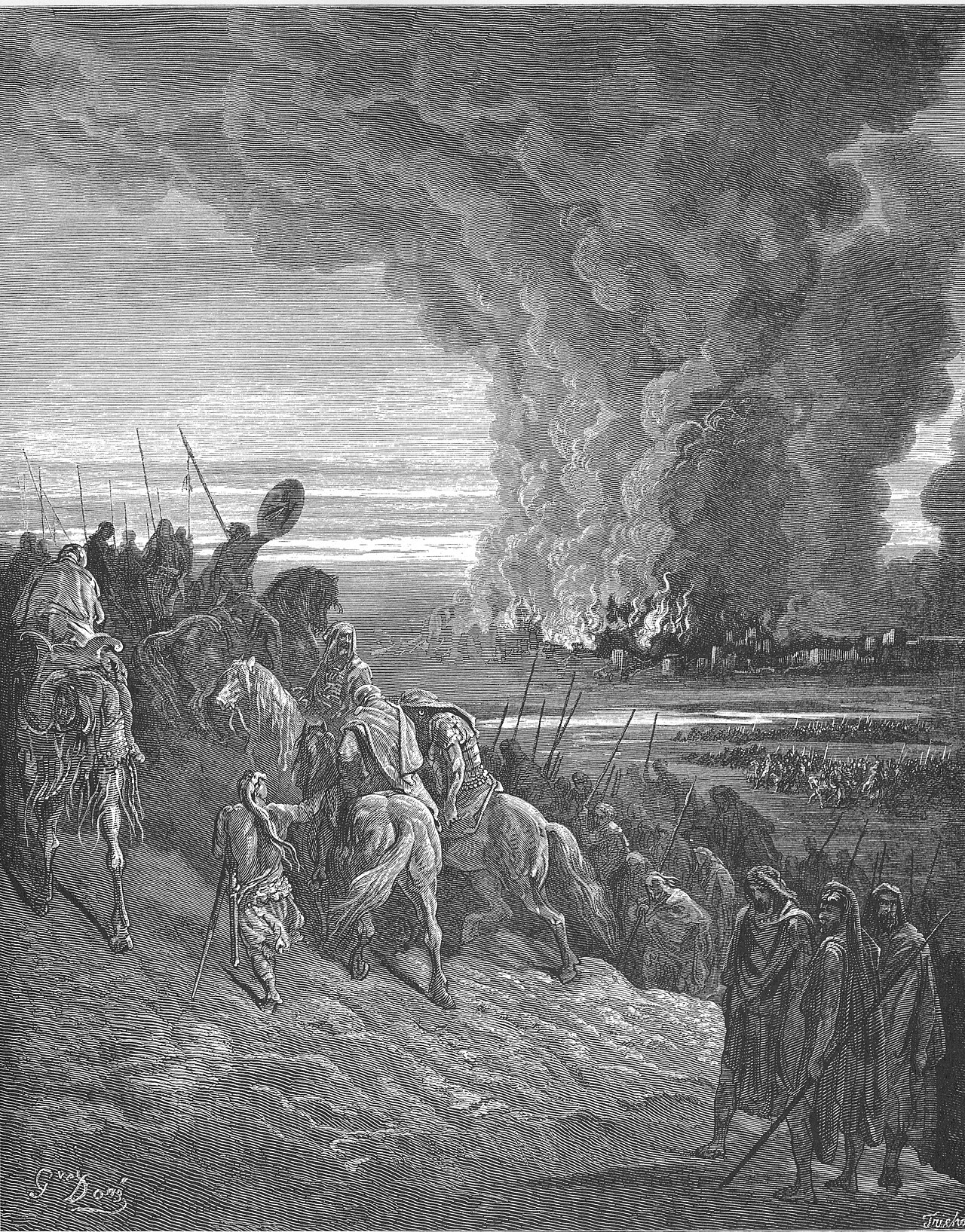
Joshua Burns the Town of Ai, Gustave Doré, Doré's English Bible (1866), public domain
Key verse
Then the LORD said to Joshua, “Do not be afraid or discouraged. Take the whole army with you, and go up and attack Ai. See, I have delivered into your hand the king of Ai, his people, his city, and his land.
It stands in An ambush set behind the city, verses 1 to 13.
The chapter
Chapter summary
Ai is taken the second time by ambush. Jehovah gives the city and its king into Joshua's hand, an ambush lies westward, the main force feigns flight as before, and Joshua holds out his javelin toward the city until every inhabitant is destroyed; the king is hanged on a tree and taken down at sunset, buried under a heap of stones. Then the army climbs north to do what Deuteronomy 27 commanded: an altar of unhewn stones on Mount Ebal, a copy of the law written on the stones, and all Israel (sojourner and homeborn alike, half toward Gerizim and half toward Ebal), hearing every word of blessing and curse read aloud.
Context
History · Joshua · Joshua overview
Where the chapter sits
Joshua 8 falls in Conquest campaigns (chapters 6–12). Jericho and Ai (central); Gibeonite alliance; five-king coalition at Beth-horon (southern); Hazor and the northern kings.
Before it: Entry into the Land, chapters 1–5. After it: Tribal allotments, chapters 13–22.
The whole shape of Joshua→The world behind this chapter
Joshua 8The history
The plan is a standard ambush, described in enough detail to follow on a map. A force is set behind the city to the west, the main body appears in front, and the defenders, encouraged by the earlier victory, chase them out. The city is left open, the ambush takes it and sets it on fire, and the smoke is the signal for the fleeing force to turn around.
The rest of the history, and what it meant to them
This time the plunder and livestock were Israel's to keep, by God's own instruction. The contrast with Jericho was deliberate: the first city was firstfruits, devoted entirely; after that, normal spoil rules applied. Achan died for taking early what the nation was given later.
The king of Ai was hanged on a tree and his body taken down at sunset, exactly as the law in Deuteronomy required. The narrative is showing the commander operating by the book he had just been handed.
Then the whole nation walks about thirty miles north to Shechem to do what Moses commanded: an altar of uncut stones on Mount Ebal, a copy of the law written on the stones, half the people on one mountain and half on the other, and the blessings and curses read aloud with foreigners standing among them. A stone structure on Mount Ebal excavated in the 1980s has been argued to be this altar; the identification is disputed and the site's purpose is still debated.
What it meant to them
The sequence would have struck first hearers hard. Defeat, then confession, then victory, then a covenant ceremony in the middle of enemy territory before the country was anywhere near conquered.
Joshua read every word of the law, the blessing and the curse, to the whole assembly including the women, the children, and the foreigners among them. The land was being claimed by a public reading before it was claimed by an army.
Sources cited
- K. A. Kitchen, On the Reliability of the Old Testament
- John H. Walton, Victor H. Matthews & Mark W. Chavalas, The IVP Bible Background Commentary: Old Testament
The structure of this chapter
The heads below are this chapter's scenes. The numbered points under each are its verses.
A. An ambush set behind the city
1. (vv. 1-2)
Joshua 8:1
“God rouses Joshua from his dejection Jos 7:6, and bids him lmarch against Ai with the main body.”
Read the whole quotation
Though Ai was but a small city (compare Jos 8:25 and Jos 7:3), yet the discouragement of the people rendered it inexpedient to send a second time a mere detachment against it; and the people of Ai had, as appears from Jos 8:17, help from Bethel, and possibly from other places also. It was fitting too that all the people should witness with their own eyes the happy consequences of having faithfully put away the sin which had separated them from God.
Albert Barnes· Notes, Explanatory and Practical, on the Old and New Testaments (1832-1869)· Joshua 8:1evangelical
Joshua 8:1, 1 more voiceWhat preachers and commentators have said about this verse, in their own words.
Joshua 8:1
“The first place, however, is due to the promise, Fear not, for I have delivered it into thy hands: for although it is verbally directed to Joshua, it belongs in common to the whole people, as it was most necessary that all to a man should be freed from anxiety and furnished with new confidence.”
John Calvin· Commentaries (1554)· Joshua 8:1reformed
Joshua 8:2
“And thou shalt do to Ai and her king as thou didst to Jericho and her king,....”
Read the whole quotation
Burn the one and slay the other: only the spoil thereof, and the cattle thereof, shall ye take for a prey unto yourselves; which they were not allowed to do at Jericho: lay thee an ambush for the city behind it; at the west side of it: some have called in question the lawfulness of the ambush, but, as this was appointed by the Lord, there is no room for it.
John Gill· Exposition of the Old Testament (1748-1763)· Joshua 8:2reformed
a.The words God gives Joshua after the defeat are the words he had already given him before anything went wrong, be not afraid, neither be thou dismayed, at 1:9. The ambush in verse 2 is God's own instruction, so the tactic that takes the city comes from him, where the plan that failed was the one the spies proposed at 7:3. The spoil and the cattle are granted outright to the people here, and they are the same kind of goods Achan was stoned for taking out of Jericho one chapter earlier.
2. (vv. 3-4)
Joshua 8:3
“Thirty thousand men - comparing Jos 8:3 and Jos 8:12 (“five thousand men”), there is probably a mistake in the numbers of this verse, where an early copyist may have written the sign for 30,000 instead of that for 5,000.”
Read the whole quotation
Sent them away by night - The selected 5,000 would accordingly post themselves in the main ravine between Ai and Bethel in the night and early morning.
Albert Barnes· Notes, Explanatory and Practical, on the Old and New Testaments (1832-1869)· Joshua 8:3evangelical
Joshua 8:3, 1 more voice
Joshua 8:3
“Out of this number a detachment of five thousand was sent forward to conceal themselves in the immediate precincts of the town, in order to seize the first opportunity of throwing themselves into it [Jos 8:12].”
Jamieson, Fausset & Brown· Commentary Critical and Explanatory on the Whole Bible (1871)· Joshua 8:3reformed
Joshua 8:4
“And he commanded them, saying,....”
Read the whole quotation
At the time he sent them away: behold, ye shall lie in wait against the city, even behind the city; that is, on the west side of it, Jos 8:9, go not very far from the city, but be ye all ready; to enter into it, as soon as the forces are drawn out eastward to meet the army of Israel.
John Gill· Exposition of the Old Testament (1748-1763)· Joshua 8:4reformed
a.Verse 3 sends thirty thousand men and verse 12 sets five thousand in the same place on the same night, and the difference is read three ways. Barnes suspects an early copyist wrote the sign for thirty thousand where five thousand stood. Henry takes verse 12 as the account doubling back on a single ambush of five thousand, and others read two bodies, a main force with the smaller detachment drawn out of it. The chapter records both figures and offers no reconciliation of its own.
3. (vv. 5-8)
Joshua 8:5
“And I and all the people that are with me will approach unto the city,....”
John Gill· Exposition of the Old Testament (1748-1763)· Joshua 8:5reformed
Joshua 8:6
“God had made use of them only for the rebuking of Israel, with a purpose, when the correction was over, to throw the rod itself into the fire; howbeit, they meant not so, but it was in their heart to destroy and cut off, Isa. x.”
Matthew Henry· Commentary on the Whole Bible (1707-1721)· Joshua 8:6puritan
Joshua 8:7
“Then ye shall rise up from the ambush,....”
Read the whole quotation
When they should see a signal made, that in Jos 8:18; and when their watch, they might set in a proper place, should see Israel flee, and the men of Ai at a distance from their city, pursuing, and give notice of it to the ambush: and seize upon the city; enter into it, and take possession of it, its fortresses, and secure its passes: for the Lord your God will deliver it into your hand; Joshua expresses himself with great confidence, having the promise of God, and relying on it.
John Gill· Exposition of the Old Testament (1748-1763)· Joshua 8:7reformed
Joshua 8:8
“Ye shall set the city on fire - Probably this means no more than that they should kindle a fire in the city, the smoke of which should be an indication that they had taken it.”
Read the whole quotation
For as the spoils of the city were to be divided among the people, had they at this time set fire to the city itself, all the property must have been consumed, for the five thousand men did not wait to save any thing, as they immediately issued out to attack the men of Ai in the rear.
Adam Clarke· Commentary on the Bible (1810-1826)· Joshua 8:8evangelical
a.Joshua tells the men what will happen before it happens, and the phrase as at the first falls twice in two verses. The thirty and six men who died at 7:5 are what makes the feint work, because the men of Ai have a real victory behind them and will believe a second flight. Verse 8 puts the whole of it under the commandment of the LORD, which is Joshua standing on the ground he was given in verse 2 rather than on his own judgment.
4. (vv. 9-11)
Joshua 8:9
“Joshua therefore sent them forth,.... The thirty thousand chosen men: and they went to lie in ambush; as they were ordered, Jos 8:2, and abode between Bethel and Ai, on the west side of Ai; for as Ai was on the east of Bethel, Jos 7:”
John Gill· Exposition of the Old Testament (1748-1763)· Joshua 8:9reformed
Joshua 8:10
“Numbered the people - ויפקד את העם vaiyiphkod eth haam, he visited the people - inspected their ranks to see whether every thing was in perfect readiness, that in case they should be needed they might be led on to the attack.”
Adam Clarke· Commentary on the Bible (1810-1826)· Joshua 8:10evangelical
Joshua 8:11
“And all the people, even the people of war that were with him, and went up, and drew nigh,....”
John Gill· Exposition of the Old Testament (1748-1763)· Joshua 8:11reformed
a.The whole force goes up this time, where the spies at 7:3 had said two or three thousand would be enough. Joshua lodges that night among the people rather than behind them, and musters them at first light; the word at verse 10 is the one for visiting or inspecting a rank, which Clarke marks. The valley named at the end of verse 11 lies between the camp and the town, and it is what Joshua goes down into in the dark at verse 13.
5. (vv. 12-13)
Joshua 8:12
“That we - I and the twenty five thousand with me. Sent them - The same party. Among the people - Hebrew. that people, the people of war as they are called, ver. 11, that is, the main body of the host consisting of thirty thousand.”
John Wesley· Explanatory Notes upon the Old Testament (1765)· Joshua 8:12evangelical
Joshua 8:12, 1 more voice
Joshua 8:12
“If we admit such a seeming disturbance in the order of the narrative (of which, perhaps, similar instances might be cited from the other scripture histories), it seems most probable that there was but one ambushment, which consisted only of 5000, enough for such a purpose.”
Matthew Henry· Commentary on the Whole Bible (1707-1721)· Joshua 8:12puritan
Joshua 8:13
“Joshua went down by night into the valley where He would be seen at daylight by the men of Ai, and was accompanied no doubt by a picked body of troops.”
Read the whole quotation
The king of Ai, in the morning, would see neither the ambush in his rear, nor the whole of the great host of Israel among the hills away to the north on his left; but supposing, as it appears, that the Israelites before him were a body detached as on the former occasion to assail his city, he sallied out promptly to attack them.
Albert Barnes· Notes, Explanatory and Practical, on the Old and New Testaments (1832-1869)· Joshua 8:13evangelical
Joshua 8:13, 1 more voice
Joshua 8:13
“Joshua himself took up his position on the north side of "the ravine"--the deep chasm of the wady El-Murogede; "that night"--means, while it was dark, probably after midnight, or very early in the morning (Joh 20:1).”
Jamieson, Fausset & Brown· Commentary Critical and Explanatory on the Whole Bible (1871)· Joshua 8:13reformed
a.about five thousand men: Joshua puts himself in the valley while it is still night, so what the king of Ai sees at daylight is a body of men in front of him and neither the ambush behind his city nor the host on the high ground to his north. Barnes reads the king's mistake out of that, that he took the men in the valley for a detachment like the one he had beaten before. Jamieson, Fausset and Brown identify the ravine with the wady running below the tell.
B. Ai burned, its king hanged on a tree
1. (vv. 14-15)
Joshua 8:14
“At a time appointed - Rather, “at the place appointed,” i. e. some spot suitable for the drawing up of his men, which had been assigned beforehand. This was “before the plain,” i. e.”
Read the whole quotation
it was at the entrance of the depressed tract of land which runs down to the Jordan valley, up which lay the route of the Israelites from Gilgal to Ai.
Albert Barnes· Notes, Explanatory and Practical, on the Old and New Testaments (1832-1869)· Joshua 8:14evangelical
Joshua 8:15
“And Joshua and all Israel made as if they were beaten before them,....”
Read the whole quotation
Or smitten, as some of them might be in the pursuit: and fled by the way of the wilderness; not a barren desert, but, according to Kimchi and Ben Melech, a place for the pasture of cattle; though perhaps it is the same with the wilderness of Bethaven, Jos 18:12. Epiphanius (w) makes mention of the wilderness of Bethel and Ephraim as near Jericho. (w) Contr. Haeres. l. 1. tom. 2.
John Gill· Exposition of the Old Testament (1748-1763)· Joshua 8:15reformed
a.the king of Ai saw: The king moves fast and moves early, and the verse says so twice over, that they hasted and rose up early. At a time appointed is read by Barnes as a place appointed, ground fixed beforehand for drawing up men, which suits a king who had fought on that field once already. Then the clause the chapter turns on, but he wist not that there were liers in ambush against him behind the city, which is the one thing in the whole account he does not know.
2. (vv. 16-17)
Joshua 8:16
“All the people - Namely, all that were able to bear arms, for old men and children were unfit for the pursuit or fight; and that they were yet left, may seem from ver. 24, 25.”
John Wesley· Explanatory Notes upon the Old Testament (1765)· Joshua 8:16evangelical
Joshua 8:16, 1 more voice
Joshua 8:16
“And all the people that were in Ai were called together to pursue after them,....”
John Gill· Exposition of the Old Testament (1748-1763)· Joshua 8:16reformed
Joshua 8:17
“There was not a man left in Ai or Beth-el - It is very likely that the principal strength of Beth-el had been previously brought into Ai, as the strongest place to make a stand in; Beth-el being but about three miles distant from Ai, and probably not greatly fortified.”
Read the whole quotation
Therefore Ai contained on this occasion all the men of Beth-el - all the warriors of that city, as well as its own troops and inhabitants.
Adam Clarke· Commentary on the Bible (1810-1826)· Joshua 8:17evangelical
Joshua 8:17, 1 more voice
Joshua 8:17
“It may be remarked, however, that the words, "or Beth-el," are not in the Septuagint, and are rejected by some eminent scholars, as an interpolation not found in the most ancient manuscripts.”
Jamieson, Fausset & Brown· Commentary Critical and Explanatory on the Whole Bible (1871)· Joshua 8:17reformed
a.Bethel empties itself into the field alongside Ai, and the two towns stand about three miles apart. Clarke takes it that the fighting strength of Bethel had already been moved into Ai as the stronger place to hold. This chapter never records Bethel being taken; its king is listed among the defeated at 12:16, and Judges 1:22-25 tells of the house of Joseph taking the town later after a man showed them the way in.
3. (vv. 18-19)
Joshua 8:18
“Stretch out the spear - It is very probable that Joshua had a flag or ensign at the end of his spear, which might be easily seen at a considerable distance; and that the unfurling or waving of this was the sign agreed on between him and the ambush.”
Read the whole quotation
(see Jos 8:13, and the preceding observations on Jos 8:1 (note), observation 6); and on seeing this flag or ensign unfurled, the men who lay in ambush arose and entered the city, making the fire previously agreed on. See Jos 8:8.
Adam Clarke· Commentary on the Bible (1810-1826)· Joshua 8:18evangelical
Joshua 8:18, 1 more voice
Joshua 8:18
“Stretch out the spear - This was, either, 1. for a sign to his host present with him, to stop their flight, and make head against the pursuers: or, 2. for a signal to the liers in wait, or, 3. as a token of God's presence and assistance with them, and of their victory.”
John Wesley· Explanatory Notes upon the Old Testament (1765)· Joshua 8:18evangelical
Joshua 8:19
“Set the city on fire - See on Jos 8:8 (note).”
Adam Clarke· Commentary on the Bible (1810-1826)· Joshua 8:19evangelical
Joshua 8:19, 1 more voice
Joshua 8:19
“And the ambush arose quickly out of their place,....”
John Gill· Exposition of the Old Testament (1748-1763)· Joshua 8:19reformed
a.The gesture is commanded before it is made, and the promise is attached to it, for I will give it into thine hand. Clarke takes the spear for a standard carrying a flag, which is what would make it readable to men lying a mile off behind a town. Behind it stands Exodus 17:11, where Israel prevailed while Moses held up his hand, and the man fighting in the valley on that day was Joshua.
4. (vv. 20-22)
Joshua 8:20
“They had no power to flee this way or that way - They were in utter consternation; they saw that the city was taken, they found themselves in the midst of their foes; that their wives, children, and property, had fallen a prey to their enemies…”
Read the whole quotation
in consequence of which they were so utterly panic-struck as to be incapable of making any resistance.
Adam Clarke· Commentary on the Bible (1810-1826)· Joshua 8:20evangelical
Joshua 8:20, 1 more voice
Joshua 8:20
“And when the men of Ai looked behind them,....”
John Gill· Exposition of the Old Testament (1748-1763)· Joshua 8:20reformed
Joshua 8:21
“And when Joshua,....”
Read the whole quotation
Or "for Joshua" (z): and all Israel saw that the ambush had taken the city; which they knew by the smoke, as follows: and that the smoke of the city ascended; in large columns, which sufficiently indicated that the whole city was taken and fired by the ambush: then, or, "and": they turned again and slew the men of Ai; great numbers of them. (z) ויהושע "et enim Josua", Junius & Tremellius, Piscator; so Masius.
John Gill· Exposition of the Old Testament (1748-1763)· Joshua 8:21reformed
Joshua 8:22
“And the other issued out of the city against them,....”
Read the whole quotation
That is, the ambush, or at least a part of them: so that they were in the midst of Israel, some on this side, and some on that side; or, as we commonly say, they were between two fires, the ambush on one side, the army of Israel on the other: and they smote them, so that they let none of them remain or escape; not one was saved alive, excepting their king, as in Jos 8:23; no quarter was given them, nor any suffered to make their escape.
John Gill· Exposition of the Old Testament (1748-1763)· Joshua 8:22reformed
Joshua 8:22, 2 more voices
Joshua 8:22
“You will read in the Holy Scriptures about the battles of the just ones, about the slaughter and carnage of murderers, and that the saints spare none of their deeply rooted enemies. If they do spare them, they are even charged with sin, just as Saul was charged because he had preserved the life of Agag king of Amalek.”
Read the whole quotation
You should understand the wars of the just by the method I set forth above, that these wars are waged by them against sin. But how will the just ones endure if they reserve even a little bit of sin? Therefore, this is said of them: "They did not leave behind even one who might be saved or might escape."Do you perhaps not believe me that the battle is joined against our sin? Then believe Paul as he says, "Not yet to the shedding of blood have you resisted against sin." Do you see that the fight proposed for you is against sin and that you must complete the battle even to the shedding of blood? Is it not evident that the divine Scripture indicates these things, even as it habitually says, "Sanctify war," and, "You will fight the battle of the Lord"?
Origen of Alexandria· written before 253· HOMILIES ON JOSHUA 8.7· Joshua 8:22patristic
Joshua 8:22
“When the Jews read these things, they become cruel and thirst after human blood, thinking that even holy persons so struck those who were living in Ai that not one of them was left "who might be saved or who might escape."”
Read the whole quotation
They do not understand that mysteries are dimly shadowed in these words and that they more truly indicate to us that we ought not to leave any of those demons deeply within, whose dwelling place is chaos and who rule in the abyss, but to destroy them all. We slay demons, but we do not annihilate their essence.
Origen of Alexandria· written before 253· HOMILIES ON JOSHUA 8.7· Joshua 8:22patristic
a.Israel runs this same tactic against its own tribe at Gibeah, and the words come back with it: liers in wait set round the town, a feigned flight, an appointed sign of smoke, and at Judges 20:40 the Benjamites looked behind them and the flame of the city ascended up to heaven. What God prescribes here against a Canaanite city is turned on Benjamin two books later. The men of Ai are caught between the ambush and the army, and verse 20 says they had no power to flee this way or that way.
5. (vv. 23-25)
Joshua 8:23
“And the king of Ai they took alive,.... They spared him, and reserved him for a more shameful death: and brought him to Joshua; their general; delivering him into his hands as his prisoner, to do will, him as seemed good in his sight.”
John Gill· Exposition of the Old Testament (1748-1763)· Joshua 8:23reformed
Joshua 8:23, 1 more voice
Joshua 8:23
“It was a federal transaction: the covenant was now renewed between God and Israel upon their taking possession of the land of promise, that they might be encouraged in the conquest of it, and might know upon what terms they held it, and come under fresh obligations to obedience. In token of the covenant, I.”
Read the whole quotation
They built an altar, and offered sacrifice to God (
Matthew Henry· Commentary on the Whole Bible (1707-1721)· Joshua 8:23puritan
Joshua 8:24
“Returned unto Ai, and smote it with the edge of the sword. - This must refer to the women, children, and old persons, left behind; for it is likely that all the effective men had sallied out when they imagined the Israelites had fled. See Jos 8:16.”
Adam Clarke· Commentary on the Bible (1810-1826)· Joshua 8:24evangelical
Joshua 8:25
“And so it was, that all that fell that day,....”
Read the whole quotation
Partly in the city, and partly in the field, both by the ambush and the army: both of men and women: were twelve thousand, even all the men of Ai; so that the city was not a very large one, and the numbers of inhabitants were comparatively but few, as in Jos 7:3.
John Gill· Exposition of the Old Testament (1748-1763)· Joshua 8:25reformed
a.Twelve thousand is the whole population, men and women counted together, so the spies at 7:3 were right that the town was small. What they had wrong was what the size of a town had to do with the outcome, since the defeat came from the accursed thing named at 7:11. Clarke reads verse 24 of those left inside, the women and children and old men, since the fighting strength had gone out after Israel.
6. (vv. 26-27)
Joshua 8:26
“For Joshua drew not his hand back wherewith he stretched out his spear,.... But continued it, and that stretched out: until he had utterly destroyed all the inhabitants of Ai; just as the hand of Moses was held up, and kept held up until Amalek was discomfited by Joshua, Exo 17:12.”
John Gill· Exposition of the Old Testament (1748-1763)· Joshua 8:26reformed
Joshua 8:26, 1 more voice
Joshua 8:26
“Joshua drew not his hand back - He was not only the general, but the standard-bearer or ensign of his own army, and continued in this employment during the whole of the battle. See on Jos 8:18 (note).”
Read the whole quotation
Some commentators understand this and Jos 8:18 figuratively, as if they implied that Joshua continued in prayer to God for the success of his troops; nor did he cease till the armies of Ai were annihilated, and the city taken and destroyed.
Adam Clarke· Commentary on the Bible (1810-1826)· Joshua 8:26evangelical
Joshua 8:27
“Only the cattle and the spoil - In the case of Jericho these were all consigned to destruction, and therefore it was criminal to take any thing pertaining to the city, as we have already seen; but in the case before us the cattle and spoils were expressly given to the conquerors by the order of God. See Jos 8:2.”
Adam Clarke· Commentary on the Bible (1810-1826)· Joshua 8:27evangelical
a.Joshua holds the spear out until the work is done, and Gill sets it beside Exodus 17:12, where Moses' hands were steady until the going down of the sun while Joshua fought Amalek below. The younger man now holds the posture that was once held over him. Verse 27 records the spoil taken according unto the word of the LORD, and the clause is there because a man had taken spoil without that word one chapter earlier.
7. (v. 28)
Joshua 8:28
“Joshua burnt Ai, and made it an heap for ever--"For ever" often signifies "a long time" (Ge 6:3). One of the remarkable things with regard to the tell we have identified with Ai is its name--the tell of the heap of stones--a name which to this day remains [VAN DE VELDE].”
Jamieson, Fausset & Brown· Commentary Critical and Explanatory on the Whole Bible (1871)· Joshua 8:28reformed
Joshua 8:28, 1 more voice
Joshua 8:28
“And, though there was no curse entailed upon him that should rebuild it, yet, it seems, it was not rebuilt unless it be the same with Aijah, which we read of, long after, Neh. xi.”
Read the whole quotation
Some think it was not rebuilt because Israel had received a defeat before it, the remembrance of which should be buried in the ruins of the city.
Matthew Henry· Commentary on the Whole Bible (1707-1721)· Joshua 8:28puritan
a.The Hebrew name of the town means a ruin or a heap, so the sentence in this verse leaves the place as the thing its name already called it. Where Ai stood is disputed: et-Tell is the long standing identification and the difficulty pressed against it is the absence of a Late Bronze town there, while Bryant Wood and the excavators of Khirbet el-Maqatir nearby have argued for that site instead. Jamieson, Fausset and Brown record that the local name of the tell in their own day was the heap of stones.
8. (v. 29)
Joshua 8:29
“The king of Ai he hanged on a tree - He had gone out at the head of his men, and had been taken prisoner, Jos 8:23; and the battle being over, he was ordered to be hanged, probably after having been strangled, or in some way deprived of life, as in the case mentioned Jos 10:26…”
Read the whole quotation
for in those times it was not customary to hang people alive. As soon as the sun was down - It was not lawful to let the bodies remain all night upon the tree. See the note on Deu 21:
Adam Clarke· Commentary on the Bible (1810-1826)· Joshua 8:29evangelical
Joshua 8:29, 1 more voice
Joshua 8:29
“An immense cairn was raised over his grave--an ancient usage, still existing in the East, whereby is marked the sepulchre of persons whose memory is infamous.”
Jamieson, Fausset & Brown· Commentary Critical and Explanatory on the Whole Bible (1871)· Joshua 8:29reformed
a.The body comes down at sundown because Deuteronomy 21:22-23 requires it, and Joshua does the same with five kings at 10:26-27. The heap of stones raised over him at the gate is the second such heap in the book, after the one piled over Achan at 7:26, and a third goes up at the cave mouth in chapter 10. Paul quotes that law at Galatians 3:13, cursed is every one that hangeth on a tree, and reads it of the cross.
C. The law read aloud between Ebal and Gerizim
1. (vv. 30-31)
Joshua 8:30
“The account of this solemnity is very brief. An acquaintance with Deut. 27 is evidently presupposed; and the three several acts of which the solemnity consisted are only so far distinctly named as is necessary to show that the commands of Moses there given were fully carried out by Joshua.”
Read the whole quotation
It is difficult to escape the conviction that these verses are here out of their proper and original place.
Albert Barnes· Notes, Explanatory and Practical, on the Old and New Testaments (1832-1869)· Joshua 8:30evangelical
Joshua 8:31
“I myself think that perhaps the holy apostles are able to be such whole and undefiled stones, making one altar all together on account of their unanimity and concord. For thus "praying unanimously" and opening their mouths all together, they are reported to have said, "You, Lord, you who know the hearts of all."”
Read the whole quotation
Therefore, those of one mind who were able to pray with one voice and one spirit, they are perhaps the worthy ones who all together ought to build one altar, upon which Jesus may offer sacrifices to the Father.
Origen of Alexandria· written before 253· HOMILIES ON JOSHUA 9.2· Joshua 8:31patristic
Joshua 8:31, 1 more voice
Joshua 8:31
“As Moses the servant of the Lord commanded the children of Israel, as it is written in the book of the law of Moses,....”
Read the whole quotation
Deu 27:5, an altar of whole stones, on which no man hath lift up any iron; See Gill on Exo 20:25; see Gill on Deu 27:5, and; see Gill on Deu 27:6, and they offered thereon burnt offerings unto the Lord, and sacrificed peace offerings; by way of thanksgiving for the good land they were introduced into, and this was what they were ordered to do by Moses, Deu 27:6.
John Gill· Exposition of the Old Testament (1748-1763)· Joshua 8:31reformed
a.Ebal stands at Shechem, about twenty miles north of Ai through country Israel had not taken, and the text gives no account of the march or of anyone opposing it. The altar answers Deuteronomy 27:4-6 to the letter, whole stones with no iron lifted on them, which is the law of the altar in Exodus 20:25. The Samaritan Pentateuch reads Gerizim instead of Ebal at Deuteronomy 27:4, and that variant is the ground of the Samaritan claim for their own mountain which the woman raises at John 4:20.
2. (v. 32)
Joshua 8:32
“A copy of the law of Moses - משנה תורת mishneh torath, the repetition of the law; that is, a copy of the blessings and curses, as commanded by Moses; not a copy of the Decalogue, as some imagine, nor of the book of Deuteronomy, as others think; much less of the whole Pentateuch…”
Read the whole quotation
but merely of that part which contained the blessings and curses, and which was to be read on this solemn occasion. See the note on Deu 27:3.
Adam Clarke· Commentary on the Bible (1810-1826)· Joshua 8:32evangelical
Joshua 8:32, 1 more voice
Joshua 8:32
“Upon the stones - Not upon the stones of the altar, which were to be rough and unpolished, ver. 31, but upon other stones, smooth and plaistered, as is manifest from Deut. xxvii, 2.”
John Wesley· Explanatory Notes upon the Old Testament (1765)· Joshua 8:32evangelical
a.a copy of the law: How much was written on the stones is read differently: the ten commandments, the blessings and cursings of Deuteronomy 27 and 28, or the book of the law entire, and the verse settles none of it. Deuteronomy 27:2 and 27:4 had the stones plaistered first, and writing on a plaistered face is the Egyptian method the generation out of Egypt knew. The word rendered copy here is the same word used at Deuteronomy 17:18 of the book a king was to write out for himself.
3. (v. 33)
Joshua 8:33
“All Israel - That is, the whole congregation, old and young, male and female. That side - Some on one side of it, and some on the other. Mount Gerizim - These two places were in the tribe of Ephraim, not far from Shechem, as appears both from scripture, and from other authors.”
John Wesley· Explanatory Notes upon the Old Testament (1765)· Joshua 8:33evangelical
a.The tribes stand as Deuteronomy 27:12-13 assigned them, six against Gerizim and six against Ebal, with the ark and the priests the Levites between the two halves. The stranger stands in the assembly beside the man born in Israel, which is the rule of Exodus 12:49 kept in the first covenant act inside the land. The ground is Shechem, where Abram built his first altar at Genesis 12:6-7, where Jacob bought his field at Genesis 33:18-20, and where Joseph's bones are buried at 24:32.
4. (vv. 34-35)
Joshua 8:34
“Afterward - After the altar was built, and the stones plaistered and writ upon. He read - That is, he commanded the priests or Levites to read, Deut. xxvii, 14.”
John Wesley· Explanatory Notes upon the Old Testament (1765)· Joshua 8:34evangelical
Joshua 8:35
“Read not - Therefore he read not the blessings and curses only, as some think, but the whole law, as the manner was when all Israel, men and women, were assembled together, or the ten commandments.”
John Wesley· Explanatory Notes upon the Old Testament (1765)· Joshua 8:35evangelical
a.Deuteronomy 11:29 and 27:11-26 set this ceremony up, and these two verses are the one place in Scripture that records it carried out. Verse 35 lists who heard it, the women and the little ones and the strangers that were conversant among them, which is exactly the assembly Deuteronomy 31:12 named for the reading of the law. The passage sits in different places in the different witnesses, after 9:2 in the Greek and earlier still in one of the Qumran scrolls of Joshua, and what differs is where the account stands in the book rather than what it reports.
This page carries no textual note on Joshua 8. Where this site has examined a place the manuscripts differ, the examination is in the manuscripts room. Every place this site examines →
This page draws on 9 works. Open the list of works
This page draws on Adam Clarke; Albert Barnes; Jamieson, Fausset & Brown; John Calvin, Commentaries (1554); John Gill; John Wesley, Explanatory Notes upon the Old Testament (1765); Keil and Delitzsch, Biblical Commentary on the Old Testament: Joshua, Judges, Ruth; Matthew Henry and Origen of Alexandria.