
Johnchapter 5
47 verses · John, by tradition · AD 85 to 95 · The Gospels
If you had believed Moses, you would believe Me, because he wrote about Me.
Introduction
John, by tradition, The Gospels, John Overview.
John wrote this chapter for readers who faced the charge that honouring Jesus dishonoured God. It opens with a healing and turns into a trial, as the authorities question the man and then Jesus Himself. Most of the chapter is a single speech. Listen for the Son and the Father, since the speech defines each by the other. Notice also the witnesses Jesus calls, one after another, as a defendant would in court. Read it as the first open conflict in the Gospel.
Context
- Who
- Readers who knew how a legal case was built from witnesses
- What
- The healing of a disabled man at the pool of Bethesda on a Sabbath, and Jesus' discourse on His authority as the Son and the witnesses to it.
- Where
- The pool of Bethesda near the Sheep Gate in Jerusalem, and then the temple.
- When
- An unnamed feast of the Jews in Jerusalem, about AD 28 to 29.
- Why
- To answer the charge of breaking the Sabbath and making Himself equal with God by showing the Son's unity with the Father.
Historical context
The pool John describes with five covered colonnades was long treated as a symbolic invention until it was excavated near the Church of St. Anne in Jerusalem: two large reservoirs side by side, with porticoes on the four outer sides and one on the dividing partition between them, five. It is one of the details that convinced many readers this author knew the pre-70 city firsthand.
Show the rest of the historical context, 3 more paragraphs
The sick gathered there because the water was believed to be healing when it stirred. Whatever caused the stirring, the crowd's behaviour is well attested for healing pools across the Roman world, and the man's complaint that he has nobody to put him in when it moves describes a scramble, not a queue.
The offence taken is not about the healing but about the mat. Carrying an object from one domain to another was one of the thirty-nine categories of work the teachers had defined as forbidden on the Sabbath, and telling a man to pick up his bed put Jesus in the position of instructing someone to break it.
The answer he gives steps into an existing debate. Jewish teachers had long discussed how God can be said to rest on the Sabbath while still sustaining the world, giving life and judging; the usual answer was that God is exempt. Jesus says, my Father is working until now, and I am working, and John notes precisely why that escalated the case.
Significance
The rest of the chapter is a legal defence built the way Jewish law required, since a claim needed the support of two or three witnesses. Jesus calls four: John the Baptist, the works themselves, the Father, and the Scriptures.
Show the rest of the significance, 1 more paragraph
The closing charge would have cut readers who prized their study: you search the Scriptures because you think that in them you have eternal life, and it is they that bear witness about me, yet you refuse to come to me. Moses himself is named as the accuser. This was written for people who had been told they were the ones abandoning Moses.
The heads below are this chapter's scenes. The numbered points under each are its verses.
Thirty-Eight Years Beside the Pool of Bethesda
John 5:1-2
a feast of the Jews: John names the feast only as a feast of the Jews, and Jesus goes up to Jerusalem for it. The pool stood near the Sheep Gate and carried a Hebrew name, Bethesda, read as house of mercy or house of outpouring.
John 5:1
“There was a feast of the Jews. Though the Evangelist does not expressly state what feast this was, yet the probable conjecture is that he means Pentecost, at least if what is here related took place immediately after that Christ came into Galilee.”
John Calvin · Commentaries (1554)reformed
2 more voices on this verseWhat preachers and commentators have said about this verse, in their own words.
John 5:1
“A feast - Probably the Passover, though it is not certain. There were two other feasts - the Pentecost and the Feast of Tabernacles - at which all the males were required to be present, and it might have been one of them. It is of no consequence, however, which of them is intended.”
John 5:1
“In our judgment the evidence is in favor of its being a Passover, but the reasons cannot be stated here. 2, 3. sheep market--The supplement should be (as in Margin) "sheep [gate]," mentioned in Ne 3:1, 32. Bethesda--that is, "house (place) of mercy," from the cures wrought there. five porches--for shelter to the patients.”
Jamieson, Fausset & Brown · Commentary Critical and Explanatory on the Whole Bible (1871)reformed
near the Sheep Gate: John Gill places the pool by the Sheep Gate of Nehemiah 3:1, where sheep entered the city for the temple. Some take the present tense, there is, as proof that John wrote before Jerusalem fell. Adam Clarke holds that the pool could have outlasted the city.
John 5:2
“Now there is at Jerusalem by the sheep market,.... The word "market" is not in the text, and of such a market, no account is given in the Scripture, nor in the Jewish writings; and besides, in our Lord's time, sheep and oxen were sold in the temple; rather therefore this signifies, the sheep gate, of which mention is made, in Neh 3:1, through which the sheep were brought into the city, to the temple. A pool.”
2 more voices on this verse
John 5:2
“There was in Jerusalem, at the sheep-market, a pool. The circumstance of the place is added, from which we learn that the miracle was not concealed or known to a few persons only; for the five porches show that the place was celebrated for the great number of persons who resorted to it, and this was also implied in its vicinity to the temple.”
John Calvin · Commentaries (1554)reformed
John 5:2
“How it was called: It was a pool (a pond or bath), which is called in Hebrew, Bethesda--the house of mercy; for therein appeared much of the mercy of God to the sick and diseased. In a world of so much misery as this is, it is well that there are some Bethesdas--houses of mercy (remedies against those maladies), that the scene is not all melancholy.”
Matthew Henry · Commentary on the Whole Bible (1707-1721)puritan
a great number of the sick: The walkways held the blind, the lame and people paralyzed for years, all waiting on the water. Verse 4, which explains an angel stirring the pool, stands in later manuscripts only, and modern versions bracket it or drop it. The invalid's answer in verse 7 takes the belief for granted.
John 5:3
“Lastly, many kinds of impotent folk lay near the pool: the blind, i. e. those who are without the light of knowledge; the lame, i. e. those who have not strength to do what they are commanded; the withered, i. e. those who have not the marrow of heavenly love.”
Bede · written before 735 · Catena Aurea by Aquinaspatristic
2 more voices on this verse
John 5:3
“It is possible that diseased persons lay in the porches to ask alms when the people were passing there who were going into the temple to worship; and there, too, it was customary to purchase the beasts which were to be offered in sacrifice. Yet at each feast God cured a certain number, that, in this way, he might recommend the worship prescribed in the Law and the holiness of the temple.”
John Calvin · Commentaries (1554)reformed
John 5:3
“The evangelist specifies three sorts of diseased people that lay here, blind, halt, and withered or sinew--shrunk, either in one particular part, as the man with the withered hand, or all over paralytic. These are mentioned because, being least able to help themselves into the water, they lay longest waiting in the porches.”
Matthew Henry · Commentary on the Whole Bible (1707-1721)puritan
Note on the text · John 5:4
The explanation that an angel stirred the pool and healed the first one in is missing from the earliest manuscripts of John, and looks like a note explaining local belief that a copyist folded into the text.
The witnesses, and what each reads here
- The earliest papyrus copies of John (P66, P75) · about AD 200-3rd centuryNo angel, no troubling of the water, the explanation is simply absent.
- Codex Sinaiticus, Codex Vaticanus, and Codex Bezae · 4th, 5th centuriesAlso without the explanation.
- Later Greek manuscripts and the Byzantine majority · 5th, 15th centuriesCarry the explanation, with noticeable variation in wording, and a substantial number mark it with critical symbols indicating doubt.
- The sick man's own words in verse 7, in every manuscript · All periods"I have no man, when the water is troubled, to put me into the pool", the belief about the stirring water is preserved by the story itself, whether or not verse 4 is present.
John 5:4
“What did the angel declare in this type but the descent of the Holy Spirit, which was to come to pass in our day and should consecrate the waters when invoked by the prayers of the priest? That angel, then, was a herald of the Holy Spirit, inasmuch as by means of the grace of the Spirit medicine was to be applied to our infirmities of soul and mind. The Spirit, then, has the same ministers as God the Father and Christ.”
Ambrose of Milan · written before 397 · On the Holy Spirit 1.8.88patristic
4 more voices on this verse
John 5:4
“Angel - “Of the Lord,” is added by AKL, about 20 others, the Ethiopic, Armenian, Slavonic, Vulgate, Anglo-Saxon, and six copies of the Itala: Cyril and Ambrose have also this reading. If this reading be genuine, and the authorities which support it are both ancient and respectable, it destroys Dr. Hammond’s conjecture, that, by the angel, a messenger only, sent from the Sanhedrin, is meant, and that these cures were all performed in a natural way.”
Adam Clarke · Commentary on the Bible (1810-1826)evangelical
John 5:4
“An angel - Yet many undoubtedly thought the whole thing to be purely natural. At certain times - Perhaps at a certain hour of the day, during this paschal week, went down - The Greek word implies that he had ceased going down, before the time of St. John's writing this.”
John Wesley · Explanatory Notes upon the New Testament (1755)evangelical
John 5:4
“We have heard of many waters having a medicinal virtue; but what water was ever known to cure instantaneously a single disease? And who ever heard of any water curing all, even the most diverse diseases--"blind, halt, withered"--alike?”
Jamieson, Fausset & Brown · Commentary Critical and Explanatory on the Whole Bible (1871)reformed
John 5:4
“Secondly, It was a type of the Messiah, who is the fountain opened; and was intended to raise people's expectations of him who is the Sun of righteousness, that arises with healing under his wings.”
Matthew Henry · Commentary on the Whole Bible (1707-1721)puritan
John 5:5-7
an invalid for thirty-eight years: Thirty-eight years is longer than most men in that porch had been alive, and Jesus picks him out of the crowd. His answer names his trouble, that no one carries him into the pool when the water stirs. A friendless man lay in a crowd of the friendless.
John 5:5
“Moreover, there was also a certain other person healed by the Lord, after he had suffered for eight-and-thirty years: they ought therefore to affirm that the Aeon who occupies the thirty-eighth place suffered. For if they assert that the things which were done by the Lord were types of what took place in the Pleroma, the type ought to be preserved throughout. But they can neither adapt to their fictitious system the case of her who was cured after eighteen years, nor of him who was cured after thirty-eight years.”
Irenaeus · written before 202 · Against Heresies Book IIpatristic
1 more voice on this verse
John 5:5
“An infirmity - A weakness. We know not what his disease was. We know only that it disabled him from walking, and that it was of very long standing. It was doubtless regarded as incurable.”
Cyril of Alexandria and Adam Clarke read Do you want to get well as a question asked to stir desire and hope. The answer was plain to all who saw him lying there. Jamieson, Fausset and Brown add that it made the man feel his condition and his helplessness.
John 5:6
“Wilt thou be made whole? - Christ, by asking this question, designed to excite in this person faith, hope, and a greater desire of being healed. He wished him to reflect on his miserable state, that he might be the better prepared to receive a cure, and to value it when it came. Addresses of this kind are always proper from the preachers of the Gospel, that the hearts, as well of hardened as of desponding sinners, may be stirred up to desire and expect salvation. Do you wish to be healed?”
Adam Clarke · Commentary on the Bible (1810-1826)evangelical
2 more voices on this verse
John 5:6
“An evident proof of the extreme goodness of Christ, that He doth not wait for entreaties from the sick, but forecometh their request by His Loving Kindness. For He runneth, as you see, to him as he lieth, and compassionateth him that was sick without comfort. But the enquiry whether he would like to be relieved from his infirmity was not that of one asking out of ignorance a thing manifest and evident to all, but of one stirring up to more earnest desire, and inciting to most diligent entreaty.”
Cyril of Alexandria · written before 444 · Commentary on the Gospel of John, Book 2patristic
John 5:6
“There was a great multitude of poor cripples here at Bethesda, but Christ fastened his eye upon this one, and singled him out from the rest, because he was senior of the house, and in a more deplorable condition than any of the rest; and Christ delights to help the helpless, and hath mercy on whom he will have mercy.”
Matthew Henry · Commentary on the Whole Bible (1707-1721)puritan
Albert Barnes hears a yes in the reply, together with a further grief, that the man had no friend. No one gave up a turn for him, Matthew Henry notes. Cyril of Alexandria describes the belief behind the complaint, that only the first into the stirred water was healed.
John 5:7
“About the day of the holy Pentecost, Angels coming down from heaven used to trouble the water of the pool, then they would make the plash therefrom the herald of their presence. And the water would be sanctified by the holy spirits, and whoever was beforehand of the multitude of sick people in getting down, he would come up again disburdened of the suffering that troubled him,, yet to one alone, him who first seized it, was the might of healing meted out.”
Cyril of Alexandria · written before 444 · Commentary on the Gospel of John, Book 2patristic
4 more voices on this verse
John 5:7
“The impotent man answered him, Sir,.... Which was a common and courteous way of speaking, much in use with the Jews, especially to strangers.”
John 5:7
“Sir, I have no man ... - The answer of the man implied that he did wish it, but, in addition to all his other trials, he had no “friend” to aid him. This is an additional circumstance that heightened his affliction.”
John 5:7
“None had the charity to say, "Your case is worse than mine, do you go in now, and I will stay till the next time;" for there is no getting over the old maxim, Every one for himself. Having been so often disappointed, he begins to despair, and now is Christ's time to come to his relief; he delights to help in desperate cases.”
Matthew Henry · Commentary on the Whole Bible (1707-1721)puritan
John 5:7
“Wait therefore he will, wait he does, and when Christ comes to heal him, lo! he is waiting his turn. What an attitude for a sinner at Mercy's gate! The man's hopes seemed low enough ere Christ came to him.”
Jamieson, Fausset & Brown · Commentary Critical and Explanatory on the Whole Bible (1871)reformed
John 5:8-9
Jesus answers a complaint about the pool with a command that passes the pool by. The man is well at once and carries the mat he had lain on for thirty-eight years. John adds that this happened on the Sabbath.
John 5:8
“Jesus saith to him, rise,.... From thy bed, or couch, on which he lay in one of the porches: and take up thy bed and walk; these words were spoken by the same power, as those to Lazarus, which called him out of his grave; as appears from the effect they had upon the man, who was in himself impotent, weak, and helpless.”
4 more voices on this verse
John 5:8
“Rise, take up thy bed, and walk - Jesus speaks here as God. He speaks in no name but his own, and with an authority which belongs to God alone. And what is the consequence? The man became whole immediately; and this sudden restoration to health and strength was an incontestable proof of the omnipotence of Christ. It has been remarked, that our Lord, after having performed a miracle, was accustomed to connect some circumstance with it, which attested its truth.”
Adam Clarke · Commentary on the Bible (1810-1826)evangelical
John 5:8
“God-befitting the injunction, and possessing clearest evidence of power and authority above man. For He prays not for the loosing of his sickness for the patient, lest He too should seem to be as one of the holy Prophets, but as the Lord of Powers He commandeth with authority that it be so, telling him to go home rejoicing, to take his bed on his shoulders, to be a memento to the beholders of the might of Him That had healed him.”
Cyril of Alexandria · written before 444 · Commentary on the Gospel of John, Book 2patristic
John 5:8
“The conversion of a sinner is the cure of a chronic disease; this is ordinarily done by the word, a word of command: Arise, and walk; turn, and live; make ye a new heart; which no more supposes a power in us to do it, without the grace of God, distinguishing grace, than this supposed such a power in the impotent man.”
Matthew Henry · Commentary on the Whole Bible (1707-1721)puritan
John 5:8
“Rise, take up thy bed, &c.--"Immediately" he did so. "He spake and it was done." The slinging of his portable couch over his shoulders was designed to show the perfection of the cure.”
Jamieson, Fausset & Brown · Commentary Critical and Explanatory on the Whole Bible (1871)reformed
this happened on the Sabbath day: The last clause turns a healing into a Sabbath dispute. Albert Barnes cites Jeremiah 17:21 and Nehemiah 13:15 against carrying burdens on that day. He holds that the Son of Man was Lord of the Sabbath and could tell a man to carry his mat.
John 5:9
“On the Sabbath day doth Christ heal the man, when healed He immediately enjoins him to break through the custom of the law, inducing him to walk on the Sabbath and this laden with his bed, although God clearly cries aloud by one of the holy Prophets, Neither carry forth a burthen out of your house on the Sabbath day.”
Cyril of Alexandria · written before 444 · Commentary on the Gospel of John, Book 2patristic
2 more voices on this verse
John 5:9
“The Sabbath - To carry burdens on the Sabbath was forbidden in the Old Testament, Jer 17:21; Neh 13:15; Exo 20:8-10. If it be asked, then, why Jesus commanded a man to do on the Sabbath what was understood to be a violation of the day, it may be answered, 1. That the Son of man was Lord of the Sabbath, and had a right to declare what might be done, and even to dispense with a positive law of the Jews, Mat 12:8; Joh 5:17. 2. This was a poor man, and Jesus directed him to secure his property.”
John 5:9
“OUR Divine Master healed men every day of the week. From the first day even to the close of the seventh day, He went about doing good and healing all manner of diseases. The healing virtue did not flow from Him occasionally, but perpetually. It was not like that famous pool which was only now and then touched with the angel's wing and so made salutary to the sick folk lying around—but whoever stepped into the pool of Christ's mercy found healing at any hour of the day or night!”
Charles Spurgeon · written before 1892 · The Metropolitan Tabernacle Pulpit, Sermon No. 2568: “Sabbath-work” (lightly modernized text, CCEL edition)Particular Baptist
A Sabbath Healing Stirs the Rulers
John 5:10-13
The Jews here are the Judean authorities, and the rabbinic Sabbath code counted carrying a burden among the forbidden labors. The healed man points them to the one who made him well, and Jesus had already slipped into the crowd. He has no name to give them.
John 5:10
“The Jews--that is, those in authority. (See on Joh 1:19.) it is not lawful to carry thy bed--a glorious testimony to the cure, as instantaneous and complete, from the lips of the most prejudiced!”
Jamieson, Fausset & Brown · Commentary Critical and Explanatory on the Whole Bible (1871)reformed
2 more voices on this verse
John 5:10
“It does not appear whether they were magistrates, who had power to punish him, or common people, who could only inform against him; but thus far was commendable, that, while they knew not by what authority he did it, they were jealous for the honour of the sabbath, and could not unconcernedly see it profaned; like Nehemiah.”
Matthew Henry · Commentary on the Whole Bible (1707-1721)puritan
John 5:10
“Not lawful - It was forbidden, they supposed, in the Old Testament. The Jews were very strenuous in the observation of the external duties of religion.”
Albert Barnes says the man reasoned correctly. One with power to heal him so had the right to explain the law, and a favor that great called for obedience. Barnes draws from it that mercy received binds the one who receives it to obey God.
John 5:11
“He that made me whole - The man reasoned correctly. If Jesus had power to work so signal a miracle, he had a right to explain the law. If he had conferred so great a favor on him, he had a right to expect obedience; and we may learn that the mercy of God in pardoning our sins, or in bestowing any signal blessing, imposes the obligation to obey him.”
The officials asked who told him to pick up his mat and walk, and passed over the man who made him well. Matthew Henry says they wanted the healed man as a witness against his physician. Albert Barnes calls this perverseness.
John 5:12
“What man is he ... - In this verse there is a remarkable instance of the “perverseness” of men, of their want of candor, and of the manner in which they often look at a subject. Instead of looking at the miracle, and at the man’s statement of the manner in which he was healed, they look only at what they thought to be a violation of the law.”
1 more voice on this verse
John 5:12
“They enquire not, no, not for curiosity, "Who is it that made thee whole? " While they industriously caught at that which might be a ground of reflection upon Christ ( What man is it who said unto thee, Take up thy bed? ) they would fain subpoena the patient to be witness against his physician, and to be his betrayer.”
Matthew Henry · Commentary on the Whole Bible (1707-1721)puritan
Jesus had slipped away: Albert Barnes says Jesus was lost in the crowd, and the man was so glad of his cure that he never asked the name. Matthew Henry sees a purpose: Christ left the miracle to speak for itself. He kept out of reach of both praise and blame.
John 5:13
“Wist not - Knew not. Had conveyed himself away - Was lost in the crowd. He had silently mingled with the multitude, or had passed on with the crowd unobserved, and the man had been so rejoiced at his cure that he had not even asked for the name of his benefactor.”
1 more voice on this verse
John 5:13
“Those that are active for God in their generation must expect to pass through evil report and good report; and it is wisdom as much as may be to keep out of the hearing of both; lest by the one we be exalted, and by the other depressed, above measure. Christ left the miracle to commend itself, and the man on whom it was wrought to justify it.”
Matthew Henry · Commentary on the Whole Bible (1707-1721)puritan
Stop sinning, or something worse may happen: Jesus finds the man at the temple and leaves him with a warning. Stop sinning ties the man's future to how he now lives, and something worse than thirty-eight years of sickness is in view. The healing came with a word about his life.
John 5:14
“Jesus findeth him in the temple - The man being conscious that it was through the mercy of God that he was restored, (though he did not as yet know distinctly who Christ was), went to the temple to return thanks to God for his cure.”
Adam Clarke · Commentary on the Bible (1810-1826)evangelical
2 more voices on this verse
John 5:14
“Sin no more - It seems his former illness was the effect or punishment of sin.”
John Wesley · Explanatory Notes upon the New Testament (1755)evangelical
John 5:14
“Jesus, there Himself for His own ends, "findeth him there"--not all accidentally, be assured. sin no more, &c.--a glimpse this of the reckless life he had probably led before his thirty-eight years' infirmity had come upon him, and which not improbably had brought on, in the just judgment of God, his chronic complaint.”
Jamieson, Fausset & Brown · Commentary Critical and Explanatory on the Whole Bible (1871)reformed
John 5:15-16
told the Jews that it was Jesus: The man goes back and tells the Jews it was Jesus who made him well. The Jews begin to persecute Jesus for doing these things on the Sabbath. A healing has become evidence in a case.
John 5:15
“The man departed, and told the Jews - He did not say it was Jesus who had ordered him to carry his bed, but it was Jesus who had cured him; and he left them to draw the inference, viz. That this Jesus must be the miraculous power of God.”
Adam Clarke · Commentary on the Bible (1810-1826)evangelical
3 more voices on this verse
John 5:15
“He makes Jesus known to the Jews, not that they by daring to do anything against Him should be found to be blasphemers, but in order that, if they too should be willing to be healed by Him, they might know the wondrous Physician. For observe how this was his aim. For he does not come like one of the faultfinders, and say that it was Jesus Who had bidden him walk on the Sabbath day, but Which had made him whole. But this was the part of one doing nought save only making known his Physician.”
Cyril of Alexandria · written before 444 · Commentary on the Gospel of John, Book 2patristic
John 5:15
“Let us not wonder then, if our good be evil spoken of: if even candour, benevolence, and usefulness, do not disarm the enmity of those who have been taught to prefer sacrifice to mercy; and who, disrelishing the genuine Gospel, naturally seek to slander and persecute the professors, but especially the defenders of it.”
John Wesley · Explanatory Notes upon the New Testament (1755)evangelical
John 5:15
“The man departed, and told, &c.--little thinking how unwelcome his grateful and eager testimony would be. "The darkness received not the light which was pouring its rays upon it" (Joh 1:5, 11) [OLSHAUSEN].”
Jamieson, Fausset & Brown · Commentary Critical and Explanatory on the Whole Bible (1871)reformed
the Jews began to persecute Him: Some manuscripts add that they sought to kill Him, and Adam Clarke keeps the clause though Griesbach left it out. Clarke asks what the cause was, and answers that a man ill for thirty-eight years was healed and carried home his mat.
John 5:16
“And sought to slay him - This clause is omitted by BCDL, some others, and several ancient versions. Griesbach has left it out of the text; and Professor White says, certissime delenda: but it does not appear to me that it should be omitted. However, it was true of the Jews, whether the words were originally in the evangelist or not. For what cause did these persons seek to destroy our Lord? Because he had healed a poor man, who had been diseased thirty-eight years, and ordered him to carry home the couch on which he lay!”
Adam Clarke · Commentary on the Bible (1810-1826)evangelical
1 more voice on this verse
John 5:16
“The Son of man is Lord even of the sabbath day; but he here enlarges on it. He pleads that he was the Son of God, plainly intimated in his calling God his Father; and, if so, his holiness was unquestionable and his sovereignty incontestable; and he might make what alterations he pleased of the divine law.”
Matthew Henry · Commentary on the Whole Bible (1707-1721)puritan
My Father is at His work: Jewish teaching already held that God sustains the world and judges the living and the dead on the Sabbath as on any day. Jesus puts His own work in that class, beside the Father's. The hearers took it as a claim about who He is.
John 5:17
“My Father - God. Worketh hitherto - Worketh “until now,” or until this time. God has not ceased to work on the Sabbath. He makes the sun to rise; He rolls the stars; He causes the grass, the tree, the flower to grow. He has not suspended His operations on the Sabbath, and the obligation to “rest” on the Sabbath does not extend to Him. He created the world in six days, and ceased the work of creation; but He has not ceased to govern it, and to carry forward, by His providence, His great plans on the Sabbath.”
1 more voice on this verse
John 5:17
“The word still shows [the Son's] eternal existence in the Father as the Word.”
Athanasius of Alexandria · written before 373 · Discourses Against the Arians 2.16.20-22patristic
making Himself equal with God: John states the charge in his own narration, that Jesus broke the Sabbath and called God His own Father. The wording Jesus used claimed a relation of nature, beyond the covenant sonship any Israelite could claim. The Jews set out to kill Him.
John 5:18
“Making himself equal with God - This the Jews understood from the preceding verse: nor did they take a wrong meaning out of our Lord’s words; for he plainly stated that, whatever was the Father’s work, his was the same; thus showing that He and the Father were One. They had now found out two pretenses to take away his life: one was that he had broken the Sabbath - ελυε, dissolved, as they pretended, the obligation of keeping it holy.”
Adam Clarke · Commentary on the Bible (1810-1826)evangelical
3 more voices on this verse
John 5:18
The Evangelist testifies that in calling himself God's own Son, Jesus made himself equal to God. For the Jews are not presented as saying, "For this cause we sought to kill him." Rather, the Evangelist, speaking for himself, says, "For this reason the Jews were seeking all the more to kill him."
Ambrose of Milan · written before 397 · Exposition of the Christian Faith 2.8.68patristic
John 5:18
“His own Father - The Greek word means his own Father in such a sense as no creature can speak. Making himself equal with God - It is evident all the hearers so understood him, and that our Lord never contradicted, but confirmed it.”
John Wesley · Explanatory Notes upon the New Testament (1755)evangelical
John 5:18
“And as, instead of instantly disclaiming any such meaning--as He must have done if it was false--He positively sets His seal to it in the following verses, merely explaining how consistent such claim was with the prerogatives of His Father, it is beyond all doubt that we have here an assumption of peculiar personal Sonship, or participation in the Father's essential nature.”
Jamieson, Fausset & Brown · Commentary Critical and Explanatory on the Whole Bible (1871)reformed
The Son Does What He Sees the Father Doing
John 5:19-20
the Son can do nothing by Himself: The Son does what He sees the Father doing, and whatever the Father does the Son does. The claim of equality stands inside a union of will, the Father loving the Son and showing Him everything He does. Greater works than Bethesda are coming.
John 5:19
“Let unbelievers meditate on the fact that, both by nature and sovereignty, the Son is one with the Father and that his power at work is not at cross-purposes with the Father, inasmuch as "whatever the Father does, the Son does as well." For no one can do in the same way the same work that another had done unless he shares in the unity of the same nature, but at the same time also is not inferior in the method of working.”
Ambrose of Milan · written before 397 · Exposition of the Christian Faith 4.5.60patristic
4 more voices on this verse
John 5:19
“The Son can do nothing of himself - Jesus, having stated the extent of his authority, proceeds here to show its “source and nature,” and to prove to them that what he had said was true. The first explanation which he gives is in these words: “The Son” - whom he had just impliedly affirmed to be equal with God - did nothing “of himself;” that is, nothing without the appointment of the Father; nothing contrary to the Father, as he immediately explains it.”
John 5:19
“The Son can do nothing of himself - This is not his imperfection, but his glory, resulting from his eternal, intimate, indissoluble unity with the Father.”
John Wesley · Explanatory Notes upon the New Testament (1755)evangelical
John 5:19
“Jesus, who was entirely God, modeled life with the limitations of a man. His life was an illustration of what one man could do who had no sin and was entirely empowered by the Holy Spirit.”
John 5:19
“It was the copy of that great original; it was Christ's faithfulness, as it was Moses's, that he did all according to the pattern shown him in the mount.”
Matthew Henry · Commentary on the Whole Bible (1707-1721)puritan
shows Him all He does: Basil of Caesarea reads the showing as instant. He likens it to a mirror's reflection, the will passing from Father to Son at once and whole, with no time between. Adam Clarke names the greater works as raising the dead and judging the world, in verses 21 and 22.
John 5:20
“Many are brought to marvel at Christ's works, whereby he has the honour of them, who are not brought to believe, by which they would have the benefit of them. He proves his equality with the Father, by specifying some of those works which he does that are the peculiar works of God.”
Matthew Henry · Commentary on the Whole Bible (1707-1721)puritan
2 more voices on this verse
John 5:20
“Let us rather, in a sense befitting the Godhead, perceive a transmission of will, like the reflexion of an object in a mirror, passing without note of time from Father to Son. "For the Father loveth the Son and sheweth him all things," so that "all things that the Father hath" belong to the Son, not gradual accruing to Him little by little, but with Him all together and at once.”
Basil of Caesarea · written before 379 · On the Spirit 8.20patristic
John 5:20
“Greater works than these - Two of these he immediately mentions: Raising the dead, Joh 5:21. And judging the world, Joh 5:22. That ye may marvel - Or, So as to make you wonder. Our Lord sometimes speaks of himself as God, and sometimes as the ambassador of God. As he had a human and Divine nature, this distinction was essentially necessary. Many errors have originated from want of attention to this circumstance.”
Adam Clarke · Commentary on the Bible (1810-1826)evangelical
the Father raises the dead and gives them life: Raising the dead was confessed in the synagogue prayer as God's own act, held by no creature. Jesus claims that same act for the Son and adds a choice, life given to whom the Son wishes. The equality of verse 18 becomes an act.
John 5:21
“For as the Father raiseth the dead and quickeneth them, so the Son too quickeneth whom He will. See again in these words clear proof of His Equality. For He That worketh equally in respect of the reviving of the dead, how can He have inferiority in ought? or how shall He be of another nature and alien to the Father Who is radiant with the Same Properties? For the Power of quickening, which is in the Father alike and the Son, is a Property of the Divine Essence.”
Cyril of Alexandria · written before 444 · Commentary on the Gospel of John, Book 2patristic
3 more voices on this verse
John 5:21
“As the Father raiseth up the dead - God has power to raise the dead. By his power it had been done in at least two instances - by the prophet Elijah, in the case of the son of the widow of Sarepta 1Ki 17:22, and by the prophet Elisha, in the case of the Shunamite’s son, 2Ki 4:32-35. The Jews did not doubt that God had power to raise the dead. Jesus here expressly affirms it, and says he has the same power.”
John 5:21
“It was therefore ridiculed at Athens as an absurd thing, Acts xvii. It is purely the work of a divine power, and the knowledge of it purely by divine revelation. Secondly, The Mediator is invested with this prerogative: He quickens whom he will; raises to life whom he pleases, and when he pleases.”
Matthew Henry · Commentary on the Whole Bible (1707-1721)puritan
John 5:21
“This statement is of immense importance in relation to the miracles of Christ, distinguishing them from similar miracles of prophets and apostles, who as human instruments were employed to perform supernatural actions, while Christ did all as the Father's commissioned Servant indeed, but in the exercise of His own absolute right of action.”
Jamieson, Fausset & Brown · Commentary Critical and Explanatory on the Whole Bible (1871)reformed
John 5:22-23
has assigned all judgment to the Son: The Father hands all judgment to the Son, and the honor due the Son matches the honor due the Father. Just as sets the two honors at one weight. Honor withheld from the Son is honor withheld from the Father.
John 5:22
“But there is fear that the judge may be more severe. Consider who the judge is. Indeed, the Father has given all judgment to Christ. Therefore, can that very one condemn you, whom he redeemed from death, for whom he offered himself, and whose life he knows to be the reward of his own death?”
Ambrose of Milan · written before 397 · On Jacob and the Blessed Life 1.6.26patristic
1 more voice on this verse
John 5:22
“The Father judgeth no man - This confirms what he had said before, Joh 5:17, Joh 5:19, that the Father acts not without the Son, nor the Son without the Father; their acts are common, their power equal.”
Adam Clarke · Commentary on the Bible (1810-1826)evangelical
honor the Son just as: John Gill argues that equal honor requires equal standing, since in Isaiah 42 God gives His glory to no other. Cyril of Alexandria reads it the same way. John Wesley adds that all will honor the Son, some willingly by faith and others unwillingly when they meet Him as Judge.
John 5:23
“That all men should honour ... - To honor is to esteem, reverence, praise, do homage to. We honor one when we ascribe to him in our hearts, and words, and actions the praise and obedience which are due to him. We honor God when we obey him and worship him aright. We honor the Son when we esteem him to be as he is; when we have right views and feelings toward him.”
1 more voice on this verse
John 5:23
“That all men may honour the Son, even as they honour the Father - Either willingly, and so escaping condemnation, by faith: or unwillingly, when feeling the wrath of the Judge.”
John Wesley · Explanatory Notes upon the New Testament (1755)evangelical
has crossed over from death to life: Hearing the word and believing the Father who sent Jesus brings eternal life at once. The crossing from death to life is stated as finished work, already behind the one who believes. Eternal life is held now.
John 5:24
“He that heareth my word - My doctrine - and believeth on him that sent me - he who credits my Divine mission, that I am come to give light and life to the world by my doctrine and death - hath eternal life - the seed of this life is sown in his heart the moment he believes - and shall not come into condemnation, εις κρισιν, into judgment - that which will speedily come on this unbelieving race; and that which shall overwhelm the wicked in the great day.”
Adam Clarke · Commentary on the Bible (1810-1826)evangelical
3 more voices on this verse
John 5:24
“Having now proved sufficiently by the foregoing, that the miserable Jews sin not against the Son only, by daring to find fault with the things which He says or does among them in His teaching, but do also ignorantly transgress against the Father Himself, and having as far as pertains to the force of what has been said, wrapped about their over-confidence with fear, and persuaded them to live more religiously in hope of things to come, He at length snares them to obedience. And not unskilfully again did He frame His speech to this end.”
Cyril of Alexandria · written before 444 · Commentary on the Gospel of John, Book 2patristic
John 5:24
The passage before us is singularly rich in weighty truths. To the minds of Jews, who were familiar with the writings of Moses and Daniel, it would come home with peculiar power. In the words of our Lord they would not fail to see fresh assertions of His claim to be received as the promised Messiah. We see in these verses that the salvation of our soul depends on hearing Christ. It is the man, we are told, who "hears Christ's word," and believes that God the Father sent Him to save sinners, who "has everlasting life."
John 5:24
THE words "Verily, verily," as they were solemnly used by our Divine Lord, indicate an utterance of special importance. If Jesus says, "Verily, verily," there is something coming to which we should attend with all our hearts! The subject which He thus introduces is our possession of eternal life and our being delivered from condemnation by faith in Himself. Can any theme be more important? Many questions may be asked, but they can all afford to wait till we get the answer to that first enquiry, "What must I do to be saved?"
the hour is coming and has now come: The hour is both coming and now here, a future event joined to one already begun. The dead here are the spiritually dead, hearing the Son of God speak and living by it. Verse 28 will speak of the graves.
John 5:25
“Here He rises from the calmer phrase "hearing his word" (Joh 5:24), to the grander expression, "hearing the voice of the Son of God," to signify that as it finds men in a dead condition, so it carries with it a resurrection-power. shall live--in the sense of Joh 5:24.”
Jamieson, Fausset & Brown · Commentary Critical and Explanatory on the Whole Bible (1871)reformed
1 more voice on this verse
John 5:25
“The hour - The time. Is coming - Under the preaching of the gospel, as well as in the resurrection of the dead. Now is - It is now taking place. Sinners were converted under his ministry and brought to spiritual life. The dead - Either the dead in sins, or those that are in their graves. The words of the Saviour will apply to either. Language, in the Scriptures, is often so used as to describe two similar events.”
John 5:26-27
the Father has life in Himself: Life in Himself is life that comes from no source outside, and the Father has granted the Son the same. Authority to judge is tied to the title Son of Man, Daniel's figure given dominion at Daniel 7:13 and 14. The judge of men shares their nature.
John 5:26
“Secondly, It is as certain that he has given to the Son to have life in himself. As the Father is the original of all natural life and good, being the great Creator, so the Son, as Redeemer, is the original of all spiritual life and good; is that to the church which the Father is to the world; see 1 Cor. viii.”
Matthew Henry · Commentary on the Whole Bible (1707-1721)puritan
3 more voices on this verse
John 5:26
“Hath he given to the Son to have life, etc. - Here our Lord speaks of himself in his character of Messiah, or envoy of God.”
Adam Clarke · Commentary on the Bible (1810-1826)evangelical
John 5:26
“Observe again the economy in these words, that thou mayest marvel at the form of expression and not, by falling into offence thereat from ignorance, bring upon thyself perdition. For the Only-Begotten, being Man in respect of the nature of His Body, and seen as one of us while yet upon the earth with flesh, manifoldly instructing the Jews in matters pertaining to salvation, clothed Himself with the glory of two God-befitting things. For He clearly affirmed, that He would both raise the dead, and set them at His Judgement-seat to be judged.”
Cyril of Alexandria · written before 444 · Commentary on the Gospel of John, Book 2patristic
John 5:26
“But as all that Christ says of His essential relation to the Father is intended to explain and exalt His mediatorial functions, so the one seems in our Lord's own mind and language mainly the starting-point of the other.”
Jamieson, Fausset & Brown · Commentary Critical and Explanatory on the Whole Bible (1871)reformed
because He is the Son of Man: Albert Barnes reads authority here as both the power to raise the dead and the right to judge. It is given by the Father's appointment, as at Acts 17:31.
John 5:27
“Hath given him authority - Hath appointed him to do this. Has made him to be judge of all. This is represented as being the appointment of the Father, Act 17:31. The word “authority” here (commonly rendered “power”) implies all that is necessary to execute judgment - all the physical power to raise the dead, and to investigate the actions and thoughts of the life; and all the “moral right” or authority to sit in judgment on the creatures of God, and to pronounce their doom. To execute judgment - To do judgment - that is, to judge.”
2 more voices on this verse
John 5:27
“Because he is the Son of man - He is appointed to judge mankind because he was made man.”
John Wesley · Explanatory Notes upon the New Testament (1755)evangelical
John 5:27
“For the person of the receiver, is distinct from that of the giver: it being inconceivable that one and the same person, should give to and receive from Himself. He who lives of Himself is one person: He who acknowledges an Author of His life is another.”
Hilary of Poitiers · written before 367 · Catena Aurea by Aquinaspatristic
John 5:28-29
all who are in their graves will hear His voice: The hour ahead reaches every grave, and all who are in them will hear His voice. The dead come out to the resurrection of life or the resurrection of judgment, by what each has done. Readings of Revelation 20 differ here.
John 5:28
“Marvel not at this--this committal of all judgment to the Son of man. for the hour is coming--He adds not in this case (as in Joh 5:25), "and now is," because this was not to be till the close of the whole dispensation of mercy.”
Jamieson, Fausset & Brown · Commentary Critical and Explanatory on the Whole Bible (1871)reformed
3 more voices on this verse
John 5:28
“Let our opponents-that is, they who speak against their own salvation-inform us [as to this point]: The deceased daughter of the high priest; the widow's dead son, who was being carried out [to burial] near the gate [of the city]; and Lazarus, who had lain four days in the tomb, -in what bodies did they rise again? In those same, no doubt, in which they had also died. For if it were not in the very same, then certainly those same individuals who had died did not rise again.”
Irenaeus · written before 202 · Irenaeus Against Heresies Book 5patristic
John 5:28
“Marvel not at this - I think it quite necessary to follow here, as noted above, the punctuation of both the Syriac, the Armenian, Chrysostom, Damascenus, Theophylact, Euthymius, and others; which is found also in some very good MSS. Theophylact says that the common method of reading this, which he highly objects to, was the invention of Paul of Samosata.”
Adam Clarke · Commentary on the Bible (1810-1826)evangelical
John 5:28
“THE doctrine of the Resurrection of the dead is peculiarly a Christian belief. With natural reason, assisted by some little light lingering in tradition, or borrowed from the Jews, a few philosophers spelled out the immortality of the soul. But that the body should rise again—that there should be another life for this corporeal frame—was a hope which is brought to light by the Revelation of Christ Jesus.”
the resurrection of judgment: Albert Barnes hears in come out the words spoken at the tomb of Lazarus. He takes those who have done good as people whose works showed them friends of Christ.
John 5:29
“Those who have done good shall go into the resurrection of life, now hidden in Christ and to be manifested hereafter with him. And those who have done evil shall go into the resurrection of judgment to which those who have not believed have been condemned already by the word, which judges them.”
Gregory of Nazianzus · written before 390 · On His Father's Silence, Oration 16.9patristic
1 more voice on this verse
John 5:29
“Shall come forth - Shall come out of their graves. This was the language which he used when he raised up Lazarus, Joh 11:43-44. They that have done good - That is, they who are righteous, or they who have by their good works “shown” that they were the friends of Christ. See Mat 25:34-36. Resurrection of life - Religion is often called life, and everlasting life. See the notes at Joh 5:24. In the resurrection the righteous will be raised up to the full enjoyment and perpetual security of that life.”
I judge only as I hear: The pattern of verse 19 returns, the Son acting on what He hears from the Father. His judgment is just, and it rests on what the Father who sent Him wills. The claims end here, and the evidence follows.
John 5:30
“I can do nothing of myself - It is impossible I should do any thing separately from my Father. As I hear - Of the Father, and see, so I judge and do; A because I am essentially united to him.”
John Wesley · Explanatory Notes upon the New Testament (1755)evangelical
3 more voices on this verse
John 5:30
“I can of mine own self do nothing - Because of my intimate union with God. See on Joh 5:19 (note). I week not mine own will - I do not, I cannot attempt to do any thing without God. This, that is, the Son of man, the human nature which is the temple of my Divinity, Joh 1:14, is perfectly subject to the Deity that dwells in it. In this respect our blessed Lord is the perfect pattern of all his followers. In every thing their wills should submit to the will of their heavenly Father.”
Adam Clarke · Commentary on the Bible (1810-1826)evangelical
John 5:30
“I can of mine own self do nothing,.... This is the conclusion of the matter, the winding up of the several arguments concerning the Son's equality to the Father, and the application of the whole to Christ.”
John 5:30
“In these verses we see the proof of our Lord Jesus Christ being the promised Messiah, set forth before the Jews in one view. Four different witnesses are brought forward. Four kinds of evidence are offered. His Father in heaven—His forerunner, John the Baptist—the miraculous works He had done—the Scriptures, which the Jews professed to honor—each and all are named by our Lord, as testifying that He was the Christ, the Son of God. Hard must those hearts have been which could hear such testimony; and yet remain unmoved!”
Four Witnesses: John, the Works, the Father, and Moses
John 5:31-32
If I testify about Myself: The law required two or three witnesses to establish a matter, and a man's word about himself carried no legal weight. Jesus grants the rule and names another who testifies for Him. The chapter then calls its witnesses in turn, John, the works, the Father and the Scriptures.
John 5:31
“If I testify of myself - That is, if I alone, (which indeed is impossible,) my testimony is not valid.”
John Wesley · Explanatory Notes upon the New Testament (1755)evangelical
2 more voices on this verse
John 5:31
“The most wise Solomon, gathering together the things in which a man may very reasonably glory, and show his manner of life to be enviable, and placing them before those who are apt to learn, says, The righteous man is his own accuser in the opening of the trial, and again, Let thy neighbour praise thee and not thine own mouth, a stranger and not thine own lips.”
Cyril of Alexandria · written before 444 · Commentary on the Gospel of John, Book 2patristic
John 5:31
“If I bear witness of myself,.... Which was not allowed any man to do; nor indeed is it proper that a man should be a witness in his own cause: and, according to the Jewish canons, a man might not be a witness for his wife, because she was reckoned as himself.”
There is another who testifies: Adam Clarke names the other who testifies as the Father, speaking by His Spirit through the prophets whose words describe the Son. He also reports a reading in Codex Bezae that gives the knowing to the hearers. John Gill calls this witness a distinct person.
John 5:32
“There is another - God the Father, who, by his Spirit in your prophets, described my person, office, and miracles. You read these scriptures, and you cannot help seeing that they testify of me: - no person ever did answer the description there given, but myself; and I answer to that description in the fullest sense of the word. See Joh 5:39. And I know - Instead of οιδα, I know, οιδατε, ye know, is the reading of the Codex Bezae, Armenian, and two of the Itala.”
Adam Clarke · Commentary on the Bible (1810-1826)evangelical
1 more voice on this verse
John 5:32
“There is another that beareth witness of me,.... Meaning not his Father, who is another, and a distinct person, from him, as the Spirit is another comforter; and both distinct testifiers from him, as well as of him.”
John 5:33-35
he has testified to the truth: The first witness is John the Baptist, and the leaders had sent to him themselves. Jesus names that testimony so they may be saved, and calls John the Baptist a lamp that burned and gave light. They enjoyed the light for a season.
John 5:33
“Ye sent unto John - See Joh 1:19. He bare witness ... - See Joh 1:26, Joh 1:29, Joh 1:36. This testimony of John ought to have satisfied them. John was an eminent man; many of the Pharisees believed on him; he was candid, unambitious, sincere, and his evidence was impartial. On this Jesus might have rested the proof that he was the Messiah, but he was willing, also, to adduce evidence of a higher order.”
1 more voice on this verse
John 5:33
Ye sent unto John--(See Joh 1:19, &c.). receive not testimony . . . from man--that is, depend not on human testimony. but . . . that ye might be saved--"I refer to him merely to aid your salvation."
Jamieson, Fausset & Brown · Commentary Critical and Explanatory on the Whole Bible (1871)reformed
so that you may be saved: Adam Clarke explains the appeal: they held John a prophet, and John had named Jesus the Lamb of God at 1:29. Cyril of Alexandria says John's witness keeps its force, since Jesus Himself had sent him to cry out. Wesley calls it an earnest will to save them.
John 5:34
“But I receive not testimony from man [only] - I have no need of John’s testimony: the works that I do bear sufficient testimony to me, Joh 5:36. But these things I say, etc. - You believed John to be a prophet - a prophet cannot lie: he bore testimony that I am the Lamb of God, that beareth away the sin of the world, Joh 1:29; therefore, that ye may be saved by believing in me as such, I have appealed to John’s testimony.”
Adam Clarke · Commentary on the Bible (1810-1826)evangelical
2 more voices on this verse
John 5:34
“But I have no need to receive, &c. But these things - Concerning John, whom ye yourselves reverence, I say, that ye may be saved - So really and seriously did he will their salvation. Most, if not all of them, died in their sins.”
John Wesley · Explanatory Notes upon the New Testament (1755)evangelical
John 5:34
“He doth not reject the word of John as useless, nor declare the witness of the truth to be of none effect (for He would with justice have seemed to have wrought absurdity against Himself, by unreasonably dismissing from credence him whom He sent to cry.”
Cyril of Alexandria · written before 444 · Commentary on the Gospel of John, Book 2patristic
a lamp that burned and gave light: Jamieson, Fausset and Brown note that the word means a lamp, lit and fed with oil, and differs from the light of 1:4 and 5. Albert Barnes thinks John was already in prison, hence the past tense. Wesley reads for a season as a short time only.
John 5:35
“He was a burning and a shining light--literally, "the burning and shining lamp" (or torch):--that is, "the great light of his day." Christ is never called by the humble word here applied to John--a light-bearer--studiously used to distinguish him from his Master, but ever the Light in the most absolute sense.”
Jamieson, Fausset & Brown · Commentary Critical and Explanatory on the Whole Bible (1871)reformed
3 more voices on this verse
John 5:35
“He was a burning and a shining light - Inwardly burning with love and zeal, outwardly shining in all holiness. And even ye were willing for a season - A short time only.”
John Wesley · Explanatory Notes upon the New Testament (1755)evangelical
John 5:35
“The birth of John [the Baptist] brought the dumbness of Zacharias to an end. For he did not burden his father, when the voice issued forth from silence; but as when not believed it rendered him tongue-tied, so did the voice sounding out clearly set his father free, to whom he had both been announced and born. Now the voice and the burning light were a precursor of the Word and the Light.”
Irenaeus · written before 202 · Fragments from the Lost Writings of Irenaeuspatristic
John 5:35
“He was - It is probable that John had been cast into prison before this. Hence, his public ministry had ceased, and our Saviour says he was such a light. Light - The word in the original properly means a “lamp,” and is not the same which in Joh 1:4-5 is translated “light.” That is a word commonly applied to the sun, the fountain of light; this means a lamp, or a light that is lit up or kindled artificially from oil or tallow. A teacher is often called a “light,” because he guides or illuminates the minds of others.”
testimony more substantial than that of John: The second witness is the works themselves, given by the Father for the Son to accomplish. This Gospel calls such works signs, semeia in Greek, and the healing at Bethesda is one of them. The works testify that the Father has sent Him.
John 5:36
“But I have greater witness - However decisive the judgment of such a man as John may be, who was the lamp of Israel, a miracle of grace, filled with the spirit of Elijah, and more than any prophet, because he pointed out, not the Messiah who was to come, but the Messiah who was already come: nevertheless, I am not obliged to depend on his testimony alone; for I have a greater one, that of Him whom you acknowledge to be your God. And how do I prove that this God bears testimony to me?”
Adam Clarke · Commentary on the Bible (1810-1826)evangelical
2 more voices on this verse
John 5:36
“Even though he was the lamp (saith He) both depicted by the books of the law, and proclaimed afore by the voice of the holy Prophets, that he should one day appear, beaming before the true Light, and declaring among you, that ye ought to put in good order the way of your Lord and God: yet since he haply seemeth to you not trustworthy, albeit so great in virtue, by reason of your innate unruly and most absurd folly, I proceed now to what is greater, against which probably ye will say nothing, ashamed before the very beauty of…”
Cyril of Alexandria · written before 444 · Commentary on the Gospel of John, Book 3patristic
John 5:36
“I have greater witness--rather, "The witness which I have is greater." the works . . . bear witness of me--not simply as miracles nor even as a miracle of mercy, but these miracles, as He did them, with a will and a power, a majesty and a grace manifestly His own.”
Jamieson, Fausset & Brown · Commentary Critical and Explanatory on the Whole Bible (1871)reformed
John 5:37-38
You have never heard His voice: The third witness is the Father Himself, who has testified about the Son. The hearers stand outside that testimony, with His voice unheard and His form unseen. His word finds no place in them.
John 5:37
“The Father himself ...hath borne witness of me - This God had done, 1. By the miracles which Jesus had performed, and of which he was conversing. 2. At the baptism of Jesus, where he said, “This is my beloved Son,” Mat 3:17. 3. In the prophecies of the Old Testament. It is not easy to say here to which of these he refers. Perhaps he has reference to all. Ye have neither heard his voice - This difficult passage has been interpreted in various ways.”
nor does His word abide in you: Readers differ on His word. Athanasius joins it to form in verse 37 and takes it as the Word, the form of the Father, whom the Jews did not receive. John Gill mentions that reading and prefers the written Scriptures, which Adam Clarke says they read without taking to heart.
John 5:38
“Ye have not his word abiding in you - Though ye believe the Scriptures to be of God, yet ye do not let them take hold of your hearts - his word is in your mouth, but not in your mind. What a miserable lot! to read the Scriptures as the true sayings of God, and yet to get no salvation from them! Thy word, says David, (Psa 119:11), have I hid in my heart, that I might not sin against thee. This, these Jews had not done. Reader, hast thou?”
Adam Clarke · Commentary on the Bible (1810-1826)evangelical
3 more voices on this verse
John 5:38
“Ye have not his word - All who believe have the word of the Father (the same with the word of the Son) abiding in them, that is, deeply ingrafted in their hearts.”
John Wesley · Explanatory Notes upon the New Testament (1755)evangelical
John 5:38
“It is most appropriate that he joins the "Word" to the "form" here to show that the Word of God is himself the image and expression and form of his Father. The Jews who did not receive the one who spoke to them thus did not receive the Word, which is the form of God.”
Athanasius of Alexandria · written before 373 · Discourses Against the Arians 3.25.16patristic
John 5:38
“And ye have not his word abiding in you,.... Which some understand of Christ himself, the Logos, or word: who, though he was now with them, being made flesh, and dwelling among them, yet would not long continue with them: though rather this designs the written word, or the Scriptures of truth; and especially that part of them, which contains prophecies concerning the Messiah, which did not dwell in them richly, nor they dwell in their meditation on them, as was requisite.”
John 5:39-40
You pore over the Scriptures: The fourth witness is the Scriptures, studied hard by the men in front of Him. They searched for eternal life in the text and stopped at the page, while the words testify about the one standing there. The obstacle is the will, and they refuse to come.
John 5:39
“Wherefore also John does appropriately relate that the Lord said to the Jews: "Ye search the Scriptures, in which ye think ye have eternal life; these are they which testify of me. And ye are not willing to come unto Me, that ye may have life." How therefore did the Scriptures testify of Him, unless they were from one and the same Father, instructing men beforehand as to the advent of His Son, and foretelling the salvation brought in by Him?”
Irenaeus · written before 202 · Against Heresies Book IVpatristic
3 more voices on this verse
John 5:39
“Search the Scriptures - A plain command to all men. In them ye are assured ye have eternal life - Ye know they show you the way to eternal life. And these very Scriptures testify of me.”
John Wesley · Explanatory Notes upon the New Testament (1755)evangelical
John 5:39
“Search the scriptures - The word translated “search” here means to “search diligently” or “search anxiously.” It was applied to miners, who search for precious metals - who look anxiously for the “bed” of the ore with an intensity or anxiety proportionate to “their sense” of the value of the metal. Compare the notes at Job 28:3. It is applied by Homer to a lioness robbed of her whelps, and who “searches” the plain to “trace out” the footsteps of the man who has robbed her.”
John 5:39
“How touching and gracious are these last words! Observe here (1) The honor which Christ gives to the Scriptures, as a record which all have a right and are bound to search--the reverse of which the Church of Rome teaches; (2) The opposite extreme is, resting in the mere Book without the living Christ, to direct the soul to whom is its main use and chiefest glory.”
Jamieson, Fausset & Brown · Commentary Critical and Explanatory on the Whole Bible (1871)reformed
you refuse to come to Me: Ryle calls the words a golden sentence that gives the reason souls are lost: men refuse to come to Jesus to have life. Adam Clarke says they pore over the Scriptures that testify about Him and still stay away from Him and eternal life.
John 5:40
“And ye will not come to me - Though ye thus search the Scriptures, in hopes of finding the Messiah and eternal life in them, yet ye will not come unto me, believe in me, and be my disciples, though so clearly pointed out by them, that ye may have that eternal life which can only come through me.”
Adam Clarke · Commentary on the Bible (1810-1826)evangelical
2 more voices on this verse
John 5:40
“This passage concludes our Lord Jesus Christ's wondrous defense of His own divine mission. It is a conclusion worthy of the defense, full of heart-searching appeals to the consciences of His enemies, and rich in deep truths. A mighty sermon is followed by a mighty application. Let us mark, in this passage, the reason why many souls are lost. The Lord Jesus says to the unbelieving Jews—"You will not come to me that you might have life." These words are a golden sentence, which ought to be engraved in our memories, and treasured up in our minds.”
John 5:40
“This is one of the great guns of the Arminians, mounted upon the top of their walls, and often discharged with terrible noise against the poor Christians called Calvinists. I intend to spike the gun this morning, or, rather, to turn it on the enemy, for it was never theirs; it was never cast at their foundry at all, but was intended to teach the very opposite doctrine to that which they assert. Usually, when the text is taken, the divisions are: First, that man has a will. Secondly, that he is entirely free.”
John 5:41-44
glory from men: Jesus takes no glory from men, and He names what holds them, the glory they trade with one another. A man arriving in his own name will be received, and the Son who came in the Father's name was turned away. Faith and the love of praise pull apart.
John 5:41
“I receive not honour ... - “I do not say these things because I am desirous of human applause, but to account for the fact that you do not believe on me. The reason is, that you have not the love of God in you.” In this passage we see: 1. That we should not seek for human applause. It is of very little value, and it often keeps men from the approbation of God, Joh 5:44. 2. They who will not believe on Jesus Christ give evidence that they have no love for God.”
1 more voice on this verse
John 5:41
“He perceives again, yea rather He sees in a God-befitting way, that the stubborn and contumacious band of the Pharisees were cut to the heart, and that not altogether at being accused of not searching the Divine Scriptures as they ought, but rather at His saying, Ye will not come to Me. For what diseases themselves easily fall into, these they think can take hold of the Saviour also. For they imagined (it seems) of their great folly that the Lord was ambitious, and wished to obtain for Himself honour from all, through His calling them to be His disciples.”
Cyril of Alexandria · written before 444 · Commentary on the Gospel of John, Book 3patristic
the love of God within you: Theophylact and Adam Clarke read this against the leaders' claim to be defending God. They said they persecuted Jesus from love of God and zeal for His honor, and He answers that He knows their hearts hold neither. Clarke names what moved them instead, ignorance and jealousy.
John 5:42
“But I know you, that ye have not, etc. - Don’t say that you oppose me through zeal for God’s honor, and love for his name, because I make myself equal to him: no, this is not the case. I know the dispositions of your souls; and I know ye have neither love for his name, nor zeal for his glory. Incorrigible ignorance, and malicious jealousy, actuate your hearts. Ye read the Scriptures, but ye do not enter into their meaning.”
Adam Clarke · Commentary on the Bible (1810-1826)evangelical
comes in his own name: Irenaeus takes the one who comes in his own name as the Antichrist. Albert Barnes reads it of any false teacher who comes in his own name without a divine commission. Jesus came in His Father's name and was not received.
John 5:43
“The Lord also spoke as follows to those who did not believe in Him: "I have come in my Father's name, and ye have not received Me: when another shall come in his own name, him ye will receive," calling Antichrist "the other," because he is alienated from the Lord. This is also the unjust judge, whom the Lord mentioned as one "who feared not God, neither regarded man," to whom the widow fled in her forgetfulness of God,—that is, the earthly Jerusalem,—to be avenged of her adversary.”
Irenaeus · written before 202 · Against Heresies Book Vpatristic
1 more voice on this verse
John 5:43
“I am come in my Father’s name - By the authority of God; or giving proof that I am sent by him. If another shall come in his own name - A false teacher setting up himself, and not even pretending to have a divine commission. The Jews were much accustomed to receive and follow particular teachers. In the time of Christ they were greatly divided between the schools of Hillel and Shammai, two famous teachers. Ye will receive - You will follow, or obey him as a teacher.”
glory that comes from the only God?: Jamieson, Fausset and Brown set How can you believe beside you refuse to come in verse 40, two sides of one state of heart. Adam Clarke names the pride of men who accept glory from one another, since owning Christ would cost them that praise.
John 5:44
“He accuses the Pharisees of love of rule and of prizing honours from men, covertly hinting that they do exceeding ill, in unadvisedly putting the diseases of their own soul upon God Who can by no means know disease. Next He says that they, fast held by vain glory, thereby lose the fairest prize, meaning faith in Him: whereof Paul too speaketh clearly to us: for if (says he) I were yet pleasing men, I should not be Christ's servant.”
Cyril of Alexandria · written before 444 · Commentary on the Gospel of John, Book 3patristic
3 more voices on this verse
John 5:44
“While ye receive honour - That is, while ye seek the praise of men rather than the praise of God. At the feast of pentecost, kept in commemoration of the giving the law from Mount Sinai, their sermons used to be full of the praises of the law, and of the people to whom it was given.”
John Wesley · Explanatory Notes upon the New Testament (1755)evangelical
John 5:44
“How can ye believe, which receive honor, etc. - The grand obstacle to the salvation of the scribes and Pharisees was their pride, vanity, and self-love. They lived on each other’s praise. If they had acknowledged Christ as the only teacher, they must have given up the good opinion of the multitude; and they chose rather to lose their souls than to forfeit their reputation among men! This is the ruin of millions.”
Adam Clarke · Commentary on the Bible (1810-1826)evangelical
John 5:44
“How can ye believe, &c.--(See on Joh 5:40, 41). The "will not" of Joh 5:40, and "cannot" here are just different features of the same awful state of the human heart.”
Jamieson, Fausset & Brown · Commentary Critical and Explanatory on the Whole Bible (1871)reformed
John 5:45-47
Your accuser is Moses: The last witness is Moses, the man they put their hope in, and he stands as their accuser. Moses wrote about Christ, so belief in Moses would have carried them to Jesus. The chapter closes on their own book.
John 5:45
“Do not think I will accuse you to the Father--"My errand hither is not to collect evidence to condemn you at God's bar." one that accuseth you, even Moses, &c.--"Alas! that will be too well done by another, and him the object of all your religious boastings--Moses," here put for "the Law," the basis of the Old Testament Scriptures.”
Jamieson, Fausset & Brown · Commentary Critical and Explanatory on the Whole Bible (1871)reformed
2 more voices on this verse
John 5:45
“Having said that the Pharisees cared more to live vain-gloriously than piously, and having taught that hence they turned aside to unmeasured unbelief, He says that they were accused by Moses himself, of whom it was their custom to boast very vehemently. And indeed when the man who was blind from his birth once said to them of Christ, Will YE also be His disciples? immediately they cry out and say openly, THOU art His disciple, but WE are Moses disciples.”
Cyril of Alexandria · written before 444 · Commentary on the Gospel of John, Book 3patristic
John 5:45
“Do not think that I will accuse you - Do not suppose that I intend to follow your example. They had accused Jesus of breaking the law of God, Joh 5:16. He says that he will not imitate their example, though he implies that he might accuse them. To the Father - To God. There is one that accuseth you - Moses might be said to accuse or reprove them. He wrote of the Messiah, clearly foretold his coming, and commanded them to hear him.”
he wrote about Me: Adam Clarke finds what Moses wrote about Him in Jacob's prophecy of Shiloh at Genesis 49:10 and the Prophet like Moses at Deuteronomy 18:18. Irenaeus goes further: the writings of Moses are the words of Christ, so to believe Moses is to believe Him.
John 5:46
“But since the writings of Moses are the words of Christ, He does Himself declare to the Jews, as John has recorded in the Gospel: "If ye had believed Moses, ye would have believed Me: for he wrote of Me. But if ye believe not his writings, neither will ye believe My words." He thus indicates in the clearest manner that the writings of Moses are His words. If, then, [this be the case with regard] to Moses, so also, beyond a doubt, the words of the other prophets are His [words], as I have pointed out.”
Irenaeus · written before 202 · Against Heresies Book IVpatristic
Cyril of Alexandria admits the verse can seem to rank what Moses wrote above the words of the Savior. Albert Barnes reads it plainly: men who do not believe what Moses wrote, though they profess to believe it, will hardly believe what Jesus says.
John 5:47
“The verse might appear to a person, and with good reason, to have great obscurity. For he might even without being out of the mark, take to untrue surmises, supposing that the books of Moses excel the words of the Saviour. For the verse hath some such appearance, and as far as one can say, taking it without accurate consideration, it furnishes to the Mosaic writings a more worthy repute than to the words of the Saviour.”
Cyril of Alexandria · written before 444 · Commentary on the Gospel of John, Book 3patristic
1 more voice on this verse
John 5:47
“If ye believe not his writings - If you do not credit what he has written which you profess to believe, it is not to be expected that you will believe my declarations. And from this we may learn: 1. That many men who profess to believe the Bible have really no regard for it when it crosses their own views and inclinations. 2. It is our duty to study the Bible, that we may be established in the belief that Jesus is the Messiah.”
This site records the readings below for this chapter. Spelling and word-order differences that change no meaning are passed over.
- The angel who troubled the water at Bethesda John 5:4, at the verse ↑
Keep studying
Studies22
Places1
Words12
Subjects2
Sources for this chapter
The summary
Jamieson, Fausset & Brown, Commentary Critical and Explanatory; John Calvin, Commentaries; John Wesley, Explanatory Notes Upon the New Testament and Matthew Henry, Complete Commentary.
The exposition
Adam Clarke, Commentary on the Bible; Albert Barnes; Alexander Maclaren, Expositions of Holy Scripture, John; Athanasius of Alexandria, Discourses Against the Arians 3.25.16; Basil of Caesarea, ON THE SPIRIT 8.20; Brooke Foss Westcott, The Gospel according to St. John; Charles Spurgeon, The New Park Street Pulpit, Sermon No. 52: “Free Will—A Slave” (lightly modernized text, CCEL edition); Cyril of Alexandria; Gregory of Nazianzus, ON HIS FATHER'S SILENCE, ORATION 16.9; Hilary of Poitiers, Catena Aurea by Aquinas; Irenaeus; J. C. Ryle, Expository Thoughts on the Gospels, John; J.C. Ryle, Expository Thoughts on the Gospels: John (lightly modernized text, Grace Gems edition); Jamieson, Fausset & Brown, Commentary Critical and Explanatory on the Whole Bible; John Calvin; John Gill; John Lightfoot, Horae Hebraicae et Talmudicae on John; John Wesley, Explanatory Notes upon the New Testament; Matthew Henry, Commentary on the Whole Bible and Theophylact of Ohrid, Commentary on John.
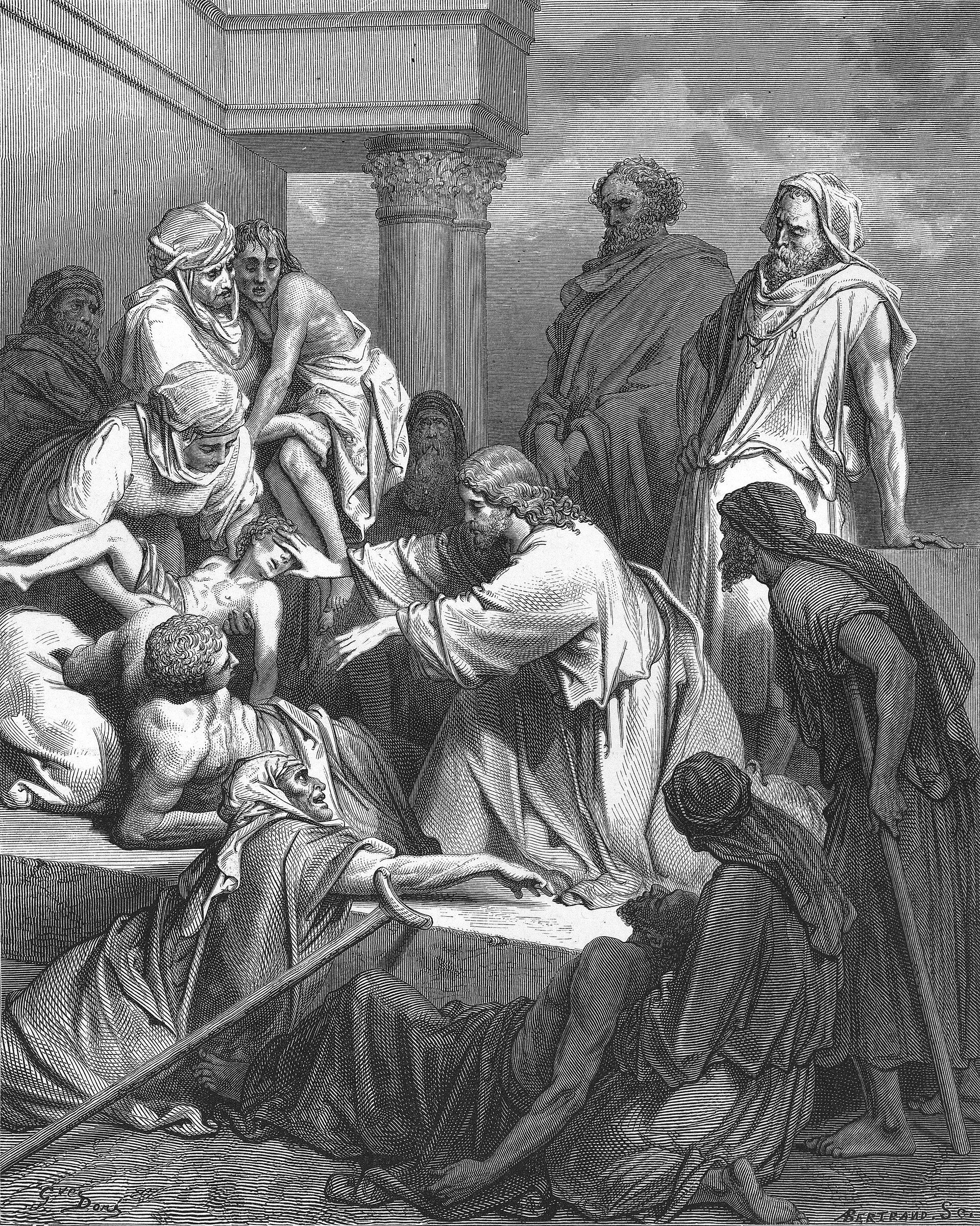
The painting
The Healing at the Pool of Bethesda, Gustave Doré (engraving), public domain