
John 5:1
in John 5Some time later there was a feast of the Jews, and Jesus went up to Jerusalem.
BSB
The same verse in ASV and KJV ▾
ASV
After these things there was a feast of the Jews; and Jesus went up to Jerusalem.
KJV
After this there was a feast of the Jews; and Jesus went up to Jerusalem.
⋯
This verse in John 5
Commentary
22 notes on this verseA commentator
Albert Barnes1798–1870
Notes, Explanatory and Practical, on the Old and New Testaments (1832-1869)
A feast - Probably the Passover, though it is not certain. There were two other feasts - the Pentecost and the Feast of Tabernacles - at which all the males were required to be present, and it might have been one of them. It is of no consequence, however, which of them is intended.
This site's exposition
a feast of the Jews
on John 5:1-2
John names the feast only as a feast of the Jews, and Jesus goes up to Jerusalem for it. The pool stood near the Sheep Gate and carried a Hebrew name, Bethesda, read as house of mercy or house of outpouring.
The record, by era
The Church Fathers5 voices
It ought not to be a matter of wonder that a miracle was wrought by God; the wonder would be if man had wrought it. Rather ought we to rejoice than wonder that our Lord and Saviour Jesus Christ was made man, than that He performed divine works among men. It is of greater importance to our salvation what He was made for men, than what He did among men: it is more important that He healed the faults of souls, than that He healed the weaknesses of mortal bodies. But as the soul knew not Him by whom it was to be healed, and had eyes in the flesh whereby to see corporeal deeds, but had not yet sound eyes in the heart with which to recognise Him as God concealed in the flesh, He wrought what the soul was able to see, in order to heal that by which it was not able to see. He entered a place where lay a great multitude of sick folk - of blind, lame, withered; and being the physician both of souls and bodies, and having come to heal all the souls of them that should believe, of those sick folk He chose one for healing, thereby to signify unity. If in doing this we regard Him with a commonplace mind, with the mere human understanding and wit, as regards power it was not a great matter that He performed; and also as regards goodness He performed too little. There lay so many there, and yet only one was healed, whilst He could by a word have raised them all up. What, then, must we understand but that the power and the goodness was doing what souls might, by His deeds, understand for their everlasting salvation, than what bodies might gain for temporal health? For that which is the real health of bodies, and which is looked for from the Lord, will be at the end, in the resurrection of the dead. What shall live then shall no more die; what shall be healed shall no more be sick; what shall be satisfied shall no more hunger and thirst; what shall be made new shall not grow old. […]
(de Con. Evang. l. iv. c. 10) After the miracle in Galilee, He returns to Jerusalem: After this there was a feast of the Jews, and Jesus went up to Jerusalem.
But it is greatly to be wondered at, how it has come to pass that, while affirming that they have found out the mysteries of God, they have not examined the Gospels to ascertain how often after His baptism the Lord went up, at the time of the passover, to Jerusalem, in accordance with what was the practice of the Jews from every land, and every year, that they should assemble at this period in Jerusalem, and there celebrate the feast of the passover. First of all, after He had made the water wine at Cana of Galilee, He went up to the festival day of the passover, on which occasion it is written, "For many believed in Him, when they saw the signs which He did," as John the disciple of the Lord records.
He chose the time when everybody gathered to offer his help to everyone. Therefore he went to Jerusalem at that time. He did not think it was necessary to travel around and go to every place where people were ill, so that it might not …
And thus, the former gifts of grace being withdrawn, "the law and the prophets were until John," and the fishpool of Bethsaida until the advent of Christ: thereafter it ceased curatively to remove from Israel infirmities of health; since, as the result of their perseverance in their frenzy, the name of the Lord was through them blasphemed, as it is written: "On your account the name of God is blasphemed among the Gentiles: " for it is from them that the infamy (attached to that name) began, and (was propagated during) the interval from Tiberius to Vespasian.
15 more voices on this verse
The Church Fathers2 voices
If it seems a novelty for an angel to be present in waters, an example of what was to come to pass has forerun. An angel, by his intervention, was wont to stir the pool at Bethsaida. They who were complaining of ill-health used to watch for him; for whoever had been the first to descend into them, after his washing, ceased to complain.
"After this there was a feast of the Jews." What "feast"? Methinks that of Pentecost. "And Jesus went up to Jerusalem." Continually at the feasts He frequenteth the City, partly that He might appear to feast with them, partly that He might attract the multitude that was free from guile; for during these days especially, the more simply disposed ran together more than at other times.
The Medieval Church3 voices
The feast of the Jews was at hand; I think it was the feast of Pentecost. The Lord goes to the feast partly so as not to appear an opponent of the law, but to show Himself a participant in the feast of the people; …
That principal part has been concluded in which the manifestation of the incarnate Word is treated insofar as it regards conditions on the part of those to whom the manifestation is made: here begins the second principal part, in which the manifestation of the incarnate …
Above, our Lord dealt with spiritual rebirth; here he deals with the benefits God gives to those who are spiritually reborn. Now we see that parents give three things to those who are physically born from them: life, nourishment, and instruction or discipline. And those …
The Reformation1 voice
There was a feast of the Jews. Though the Evangelist does not expressly state what feast this was, yet the probable conjecture is that he means Pentecost, at least if what is here related took place immediately after that Christ came into Galilee.
The Puritans and the Awakening3 voices
The sermon was Christ's vindication of himself before the sanhedrim, when he was prosecuted as a criminal for healing the man on the sabbath day, in which, 1. He asserts his authority as Messiah, and Mediator between God and man,
After this there was a feast of the Jews,....
(2.) It was to be hoped that they were in a good frame, for they came together to worship God and to spend their time in religious exercises. Now a mind inclined to devotion, and sequestering itself to the exercises of piety, lies very open to the further discoveries of divine light and love, and to it Christ will be acceptable.
The Nineteenth Century6 voices
A commentator
Jamieson, Fausset & Brown1802–1910
Commentary Critical and Explanatory on the Whole Bible (1871)
In our judgment the evidence is in favor of its being a Passover, but the reasons cannot be stated here. 2, 3. sheep market--The supplement should be (as in Margin) "sheep [gate]," mentioned in Ne 3:1, 32. Bethesda--that is, "house (place) of mercy," from the cures wrought there. five porches--for shelter to the patients.
A commentator
J.C. Ryle1816–1900
Expository Thoughts on the Gospels: John (lightly modernized text, Grace Gems edition) (1869)
proposed
We have in this passage one of the few miracles of Christ, which John records. Like every other miracle in this Gospel, it is described with great minuteness and particularity. And like more than one other miracle it leads on to a discourse full of singularly deep instruction. We are taught, for one thing, in this passage, what misery sin has brought into the world. We read of a man who had been ill for no less than thirty-eight years! For thirty-eight weary summers and winters he had endured pain and infirmity.
A commentator
J.C. Ryle1816–1900
Expository Thoughts on the Gospels: John (lightly modernized text, Grace Gems edition) (1869)
proposed
We have in this passage one of the few miracles of Christ, which John records. Like every other miracle in this Gospel, it is described with great minuteness and particularity. And like more than one other miracle it leads on to a discourse full of singularly deep instruction. We are taught, for one thing, in this passage, what misery sin has brought into the world. We read of a man who had been ill for no less than thirty-eight years! For thirty-eight weary summers and winters he had endured pain and infirmity. He had seen others healed at the waters of Bethesda, and going to their homes rejoicing. But for him there had been no healing. Friendless, helpless, and hopeless, he lay near the wonder-working waters, but derived no benefit from them. Year after year passed away, and left him still uncured. No relief or change for the better seemed likely to come, except from the grave. When we read of cases of sickness like this, we should remember how deeply we ought to hate sin! Sin was the original root, and cause, and fountain of every disease in the world. God did not create man to be full of aches, and pains, and infirmities. These things are the fruits of the Fall. There would have been no sickness, if there had been no sin. No greater proof can be shown of man's inbred unbelief, than his carelessness about sin. "Fools," says the wise man, "make a mock at sin." (Pro. 14:9.) Thousands delight in things which are explicitly evil, and run greedily after that which is downright poison. They love that which God abhors, and dislike that which God loves. They are like the madman, who loves his enemies and hates his friends. Their eyes are blinded. Surely if men would only look at hospitals and infirmaries, and think what havoc sin has made on this earth, they would never take pleasure in sin as they do. Well may we be told to pray for the coming of God's kingdom!
THE scene of this miracle was Bethesda, a pool, according to the Evangelist, adjoining the sheep market, or near the sheep gate—the place through which, I suppose, the cattle consumed by the inhabitants of Jerusalem would be driven— and the pool where, perhaps, the sheep intended for sale to the offerers in the temple were washed. So common was sickness in the days of the Savior that the infirmities of men intruded upon the place which had been allotted to cattle!
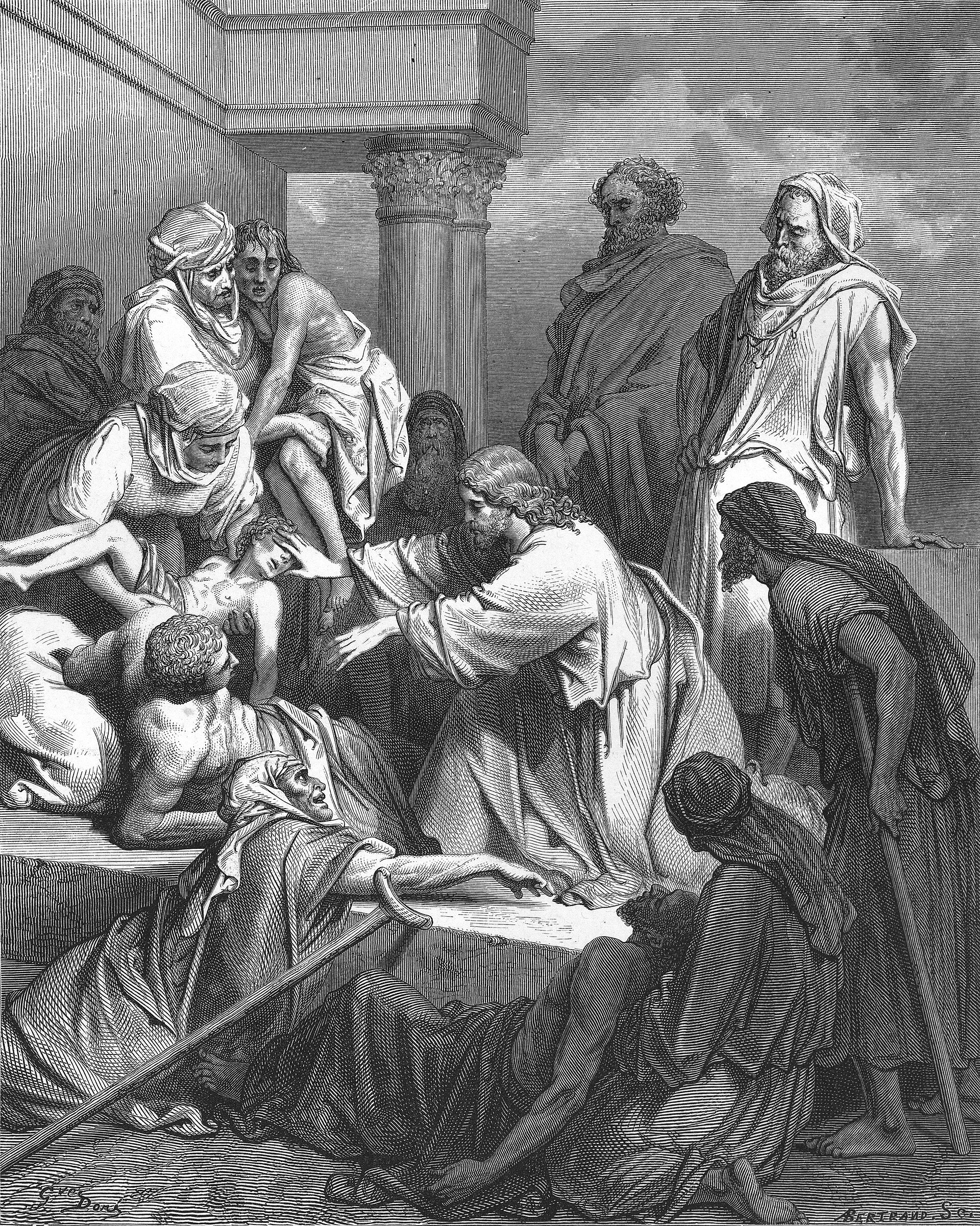
THE scene of this miracle was Bethesda, a pool, according to the Evangelist, adjoining the sheep market, or near the sheep gate—the place through which, I suppose, the cattle consumed by the inhabitants of Jerusalem would be driven— and the pool where, perhaps, the sheep intended for sale to the offerers in the temple were washed. So common was sickness in the days of the Savior that the infirmities of men intruded upon the place which had been allotted to cattle! And the place where sheep had been washed became the spot where sick folk congregated in great multitudes, longing for a cure. We do not hear that anyone remonstrated at the intrusion, or that public opinion was shocked. The needs of mankind must override all considerations of taste. A hospital must have preference over a sheep market. This day you have another case in point. If the physical infirmities of Jerusalem intruded into the sheep market, I shall ask no excuse if, on these Sundays, the spiritual sickness of London should demand that this spacious place, which has up to now been given up to the lowing of cattle and to the bleating of sheep, should be consecrated to the preaching of the Gospel—to the manifestation of the healing virtue of Christ Jesus among the spiritually sick! This day there is, by the sheep market, a pool, and impotent folk are here in exceeding great multitudes. We might never have heard of Bethesda if an august visitor had not condescended to honor it with His Presence—Jesus, the Son of God, walked in the five porches by the pool. It was the place where we might expect to meet Him, for where should the Great Physician be found if not in the place where the sick are gathered? Here was work for Jesus' healing hand and restoring word.
A feast - This is generally supposed, by the best critics, to have been the feast of the passover, which was the most eminent feast among the Jews. In several excellent MSS. the article is added, ἡ ἑορτη, The feast, the grand, the principal festival. Petavius supposes that the feast of Purim, or lots, is here meant; and one MS. reads ἡ σκηνοπηγια, the feast of Tabernacles. Several of the primitive fathers believe Pentecost to be intended; and they are followed by many of the moderns, because, in Joh 7:2, mention is made of the feast of Tabernacles, which followed Pentecost, and was about the latter end of our September; and, in Joh 10:22, mention is made of the feast of Dedication, which was held about the latter end of November. See Bp. Pearce. See Joh 10:22. Calmet, however, argues that there is no other feast with which all the circumstances marked here so well agree as with the passover; and Bp. Newcome, who is of Calmet’s opinion, thinks Bp. Pearce’s argument concerning the succession of the feasts to be inconclusive; because it is assumed, not proved, that the three feasts which he mentions above must have happened in the same year. See much on the same subject in Bp. Newcome’s notes to his Harmony, p. 15, etc. Lightfoot has observed, that the other evangelists speak very sparingly of our Lord’s acts in Judea. They mention nothing of the passovers, from our Lord’s baptism till his death, excepting the very last: but John points at them all. The first he speaks of, Joh 2:13; the third, Joh 6:4; the fourth, Joh 13:1; and the second in this place: for although he does not call it the passover, but a feast in general, yet the circumstances agree best with this feast; and our Lord’s words, Joh 4:35, seem to cast light on this subject. See the note there.
How the passage was read
On John 5:1-18On John 5:1-18
The mat, the carrying rule, and where the ways part
“It is the sabbath day: it is not lawful for thee to carry thy bed.” The objectors stand on a real rule with a prophetic root: Jeremiah 17:21-22 forbids bearing burdens through Jerusalem's gates on the Sabbath, and the tradition codified carrying between domains as the last of the thirty-nine categories of forbidden labor (Mishnah Shabbat 7:2). The tradition's own case law even makes the fine distinction the scene turns on: one who carries out a living person on a bed is exempt FOR THE PERSON, “because the bed is secondary to the person” (Mishnah Shabbat 10:5); it is the mat alone the rule could name. Note also what no one disputes: the healing itself. Jesus healed by a word; a thirty-eight-year lameness was chronic, not mortal (mortal danger overrides the Sabbath, Mishnah Yoma 8:6), so on the tradition's categories the man could have waited one more day. Jesus refuses the wait.
Where the ways part
At verse 18 the scene reaches the real parting of the ways, and honesty requires it be said plainly: Jesus “said also that God was his Father, making himself equal with God.” Here the difference is not over practice but over an essential of the Christian faith. Judaism then and now confesses the one God and reads such a claim by a man as blasphemy; Christian confession holds that Jesus' claim is true, that the Son does what the Father does (5:19-29). The two readings cannot both be right, and this page presents each side in its own words, with respect and without blur.
This section is reception history: how the passage was read and kept in the Jewish tradition. Where a reading parts from an essential of the Christian faith, the section says so at that point.
Sources: Mishnah Shabbat 7:2 (carrying, the last category) · Mishnah Shabbat 10:5 (the person exempt, the bed secondary) · Mishnah Yoma 8:6 (danger to life overrides the Sabbath)
The words behind it
11 Greek wordsEvery Greek word of this verse in the order it stands, with what it means and the door to its own study. The last column counts the times a word stands in the whole Bible: the rarer the word, the more the places it appears belong together.
| Greek | Sound | Meaning | Word study | In the Bible |
|---|---|---|---|---|
| Μετὰ | meta | After | G3326 → | 461 times |
| ταῦτα | tauta | these things | G3778 → | 1381 times |
| ἦν | en | there was | G1510 → | 2333 times |
| ἑορτὴ | he'orte | feast | G1859 → | 25 times |
| τῶν | ton | of the | G3588 → | 19766 times |
| Ἰουδαίων, | ioudaion | Jews, | G2453 → | 192 times |
| καὶ | kai | and | G2532 → | 9120 times |
| ἀνέβη | anebe | went up | G305 → | 82 times |
| Ἰησοῦς | iesous | Jesus | G2424 → | 908 times |
| εἰς | eis | to | G1519 → | 1755 times |
| Ἱεροσόλυμα. | hi'erosoluma | Jerusalem. | G2414 → | 62 times |
ΜετὰAfter
metaG3326 →461 times
ταῦταthese things
tautaG3778 →1381 times
ἦνthere was
enG1510 →2333 times
ἑορτὴfeast
he'orteG1859 →25 times
τῶνof the
tonG3588 →19766 times
Ἰουδαίων,Jews,
ioudaionG2453 →192 times
καὶand
kaiG2532 →9120 times
ἀνέβηwent up
anebeG305 →82 times
ἸησοῦςJesus
iesousG2424 →908 times
εἰςto
eisG1519 →1755 times
Ἱεροσόλυμα.Jerusalem.
hi'erosolumaG2414 →62 times
A shaded row is a word that stands 400 times or fewer in the Bible.
The walk
8 stopsEach card is a verse this one points to, and under it the verses that one points to in turn. Where several paths arrive at the same place, that place is listed first: the text keeps returning to it.
Through
Deuteronomy 16:16Three times a year all your men are to appear before the LORD your God in the place He will choose: at the Feast of Unleavened Bread, the Feast of Weeks, and the Feast…
it leads to
- Proverbs 3:9–10
Honor the LORD with your wealth and with the firstfruits of all your harvest;
- Psalms 96:8
Ascribe to the LORD the glory due His name; bring an offering and enter His courts.
- Haggai 1:9
You expected much, but behold, it amounted to little. And what you brought home, I blew away. Why? declares the LORD of Hosts. Because My house still lies in ruins, while each of you…
- Exodus 23:14–17
Three times a year you are to celebrate a feast to Me.
- Matthew 2:11
On coming to the house, they saw the Child with His mother Mary, and they fell down and worshiped Him. Then they opened their treasures and presented Him with gifts of gold and frankincense…
- Proverbs 3:9–10
Through
John 2:13When the Jewish Passover was near, Jesus went up to Jerusalem.
it leads to
- Luke 2:41
Every year His parents went to Jerusalem for the Feast of the Passover.
- John 11:55
Now the Jewish Passover was near, and many people went up from the country to Jerusalem to purify themselves before the Passover.
- Luke 2:41
Through
Exodus 34:23Three times a year all your males are to appear before the Lord GOD, the God of Israel.
it leads to
- Exodus 23:14
Three times a year you are to celebrate a feast to Me.
- Exodus 23:14
Where this verse is studied
On this page
About John
Who and where
1 name in this verse with a page on the site.
This page draws on 19 works. Open the list of works
This page draws on Adam Clarke, Commentary on the Bible; Albert Barnes, Notes, Explanatory and Practical, on the Old and New Testaments (1832-1869); Albert Barnes, Notes, Explanatory and Practical, on the Gospels; Augustine of Hippo, Tractates on John 17; Augustine of Hippo, Catena Aurea by Aquinas; Bonaventure, Commentary on John, Chapter 5; Charles Spurgeon, The Metropolitan Tabernacle Pulpit, Sermon No. 744: “Jesus At Bethesda—or, Waiting Changed for Believing” (lightly modernized text, CCEL edition); Irenaeus, Irenaeus Against Heresies Book 2; J.C. Ryle, Expository Thoughts on the Gospels: John (lightly modernized text, Grace Gems edition); Jamieson, Fausset & Brown, Commentary Critical and Explanatory on the Whole Bible; John Calvin, Commentaries; John Chrysostom, Homily on the Gospel of John 36; John Gill, Exposition of the New Testament (1746-1748); Matthew Henry, Commentary on the Whole Bible; Tertullian, An Answer to the Jews; Tertullian, On Baptism; Theodore of Mopsuestia, COMMENTARY ON JOHN 2.5.1; Theophylact of Ohrid, Commentary on John and Thomas Aquinas, Commentary on John.