
John 5:2
in John 5Now there is in Jerusalem near the Sheep Gate a pool with five covered colonnades, which in Hebrew is called Bethesda.
BSB
The same verse in ASV and KJV ▾
ASV
Now there is in Jerusalem by the sheep gate a pool, which is called in Hebrew Bethesda, having five porches.
KJV
Now there is at Jerusalem by the sheep market a pool, which is called in the Hebrew tongue Bethesda, having five porches.
⋯
This verse in John 5
Commentary
21 notes on this verseNow there is at Jerusalem by the sheep market,.... The word "market" is not in the text, and of such a market, no account is given in the Scripture, nor in the Jewish writings; and besides, in our Lord's time, sheep and oxen were sold in the temple; rather therefore this signifies, the sheep gate, of which mention is made, in Neh 3:1, through which the sheep were brought into the city, to the temple. A pool.
This site's exposition
a feast of the Jews
on John 5:1-2
John names the feast only as a feast of the Jews, and Jesus goes up to Jerusalem for it. The pool stood near the Sheep Gate and carried a Hebrew name, Bethesda, read as house of mercy or house of outpouring. Excavation near St. Anne's church found a pool with five porches.
The record, by era
The Church Fathers4 voices
Of this pool, which was surrounded with five porches, in which lay a great multitude of sick folk, I remember that I have very often treated. That pool and that water seem to me to have signified the Jewish people. For that peoples are signified under the name of waters the Apocalypse of John clearly indicates to us, where, after he had been shown many waters, and he had asked what they were, was answered that they were peoples. That water, then - namely, that people - was shut in by the five books of Moses, as by five porches. But those books brought forth the sick, not healed them. For the law convicted, not acquitted sinners. Accordingly the letter, without grace, made men guilty, whom on confessing grace delivered. For this is what the apostle saith: "For if a law had been given which could have given life, verily righteousness should have been by the law." Why, then, was the law given? He goes on to say, "But the Scripture hath concluded all under sin, that the promise by faith of Jesus Christ might be given to them that believe." What more evident? Have not these words expounded to us both the five porches, and also the multitude of sick folk? The five porches are the law. Why did not the five porches heal the sick folk? Because, "if there had been a law given which could have given life, verily righteousness should have been by the law." Why, then, did the porches contain those whom they did not heal? Because "the Scripture hath concluded all under sin, that the promise by faith of Jesus Christ might be given to them that believe."
(Tr. xvii. c. 1) Judging on low and human notions of this miracle, it is not at all a striking display of power, and only a moderate one of goodness. Of so many, who lay sick, only one was healed; though, had He chosen, He could have restored them all by a single word. How must we account for this? By supposing that His power and goodness were asserted more for imparting a knowledge of eternal salvation to the soul, than working a temporal cure on the body. That which received the temporal cure was certain to decay at last, when death arrived: whereas the soul which believed passed into life eternal. The pool and the water seem to me to signify the Jewish people: for John in the Apocalypse obviously uses water to express people. (Rev. 17:15.) (Tr. xvii. c. 2) The water then, i. e. the people, was enclosed within five porches, i. e. the five books of Moses. But those books only betrayed the impotent, and did not recover them; that is to say, the Law convicted the sinner, but did not absolve him.
What manner of cure is this? What mystery doth it signify to us? For these things are not written carelessly, or without a purpose, but as by a figure and type they show in outline things to come, in order that what was exceedingly strange might not by coming unexpectedly harm among the many the power of faith. What then is it that they show in outline? A Baptism was about to be given, possessing much power, and the greatest of gifts, a Baptism purging all sins, and making men alive instead of dead. These things then are foreshown as in a picture by the pool, and by many other circumstances. And first is given a water which purges the stains of our bodies, and those defilements which are not, but seem to be, as those from touching the dead, those from leprosy, and other similar causes; under the old covenant one may see many things done by water on this account.
First then, as I before said, He causeth defilements of our bodies, and afterwards infirmities of different kinds, to be done away by water. Because God, desiring to bring us nearer to faith in baptism, no longer healeth defilements only, but diseases also. For those figures which came nearer in time to the reality, both as regarded Baptism, and the Passion, and the rest, were plainer than the more ancient; and as the guards near the person of the prince are more splendid than those before, so was it with the types. And "an Angel came down and troubled the water," and endued it with a healing power, that the Jews might learn that much more could the Lord of Angels heal the diseases of the soul. Yet as here it was not simply the nature of the water that healed, (for then this would have always taken place,) but water joined to the operation of the Angel; so in our case, it is not merely the water that worketh, but when it hath received the grace of the Spirit, then it putteth away all our sins. Around this pool "lay a great multitude of impotent folk, of blind, halt, withered, waiting for the moving of the water"; but then infirmity was a hindrance to him who desired to be healed, now each hath power to approach, for now it is not an Angel that troubleth, it is the Lord of Angels who worketh all. The sick man cannot now say, "I have no man"; he cannot say, "While I am coming another steppeth down before me"; though the whole world should come, the grace is not spent, the power is not exhausted, but remaineth equally great as it was before. Just as the sun's beams give light every day, yet are not exhausted, nor is their light made less by giving so abundant a supply; so, and much more, the power of the Spirit is in no way lessened by the numbers of those who enjoy it. […]
The Medieval Church1 voice
The specific place of the miracle was the pool called the Sheep Pool; so he says, Now at Jerusalem there is a Sheep Pool. This is described here in four ways: by its name, its structure, from its occupants, and from its power. First, it …
14 more voices on this verse
The Medieval Church4 voices
The pool was called "Sheep" because sacrificial sheep were driven to it and their entrails were washed in it. By the Sheep Pool, understand, if you will, the grace of baptism, by which the Lord Jesus, the Lamb slain for us, was washed, having been …
Here second is touched upon the disposition of the place where the healing was done, because it was in the place of healing, which was the sheep pool; on account of which he says: "Now there is at Jerusalem a sheep pool," that is, a …
The pool by the sheep-market, is the place where the priest washed the animals that were going to be sacrificed.
It is fitly described as a sheep pool. By sheep are meant people, according to the passage, We are Thy people, and the sheep of Thy pasture. (Ps. 95:7)
The Reformation1 voice
There was in Jerusalem, at the sheep-market, a pool. The circumstance of the place is added, from which we learn that the miracle was not concealed or known to a few persons only; for the five porches show that the place was celebrated for the great number of persons who resorted to it, and this was also implied in its vicinity to the temple.
The Puritans and the Awakening3 voices
The sermon was Christ's vindication of himself before the sanhedrim, when he was prosecuted as a criminal for healing the man on the sabbath day, in which, 1. He asserts his authority as Messiah, and Mediator between God and man,
How it was called: It was a pool (a pond or bath), which is called in Hebrew, Bethesda--the house of mercy; for therein appeared much of the mercy of God to the sick and diseased. In a world of so much misery as this is, it is well that there are some Bethesdas--houses of mercy (remedies against those maladies), that the scene is not all melancholy.
There is in Jerusalem - Hence it appears, that St. John wrote his Gospel before Jerusalem was destroyed: it is supposed about thirty years after the ascension.
The Nineteenth Century6 voices
There Is - This is thought by some to be a proof that John wrote his Gospel before the destruction of Jerusalem; and that the pool and its porticoes were still remaining. Though there can be little doubt that Jerusalem was destroyed many years before John wrote, yet this does not necessarily imply that the pool and its porticoes must have been destroyed too. It, or something in its place, is shown to travelers to the present day. See Maundrell’s Jour. p. 1
A commentator
J.C. Ryle1816–1900
Expository Thoughts on the Gospels: John (lightly modernized text, Grace Gems edition) (1869)
proposed
We have in this passage one of the few miracles of Christ, which John records. Like every other miracle in this Gospel, it is described with great minuteness and particularity. And like more than one other miracle it leads on to a discourse full of singularly deep instruction. We are taught, for one thing, in this passage, what misery sin has brought into the world. We read of a man who had been ill for no less than thirty-eight years! For thirty-eight weary summers and winters he had endured pain and infirmity.
A commentator
J.C. Ryle1816–1900
Expository Thoughts on the Gospels: John (lightly modernized text, Grace Gems edition) (1869)
proposed
We have in this passage one of the few miracles of Christ, which John records. Like every other miracle in this Gospel, it is described with great minuteness and particularity. And like more than one other miracle it leads on to a discourse full of singularly deep instruction. We are taught, for one thing, in this passage, what misery sin has brought into the world. We read of a man who had been ill for no less than thirty-eight years! For thirty-eight weary summers and winters he had endured pain and infirmity. He had seen others healed at the waters of Bethesda, and going to their homes rejoicing. But for him there had been no healing. Friendless, helpless, and hopeless, he lay near the wonder-working waters, but derived no benefit from them. Year after year passed away, and left him still uncured. No relief or change for the better seemed likely to come, except from the grave. When we read of cases of sickness like this, we should remember how deeply we ought to hate sin! Sin was the original root, and cause, and fountain of every disease in the world. God did not create man to be full of aches, and pains, and infirmities. These things are the fruits of the Fall. There would have been no sickness, if there had been no sin. No greater proof can be shown of man's inbred unbelief, than his carelessness about sin. "Fools," says the wise man, "make a mock at sin." (Pro. 14:9.) Thousands delight in things which are explicitly evil, and run greedily after that which is downright poison. They love that which God abhors, and dislike that which God loves. They are like the madman, who loves his enemies and hates his friends. Their eyes are blinded. Surely if men would only look at hospitals and infirmaries, and think what havoc sin has made on this earth, they would never take pleasure in sin as they do. Well may we be told to pray for the coming of God's kingdom!
THE scene of this miracle was Bethesda, a pool, according to the Evangelist, adjoining the sheep market, or near the sheep gate—the place through which, I suppose, the cattle consumed by the inhabitants of Jerusalem would be driven— and the pool where, perhaps, the sheep intended for sale to the offerers in the temple were washed. So common was sickness in the days of the Savior that the infirmities of men intruded upon the place which had been allotted to cattle!
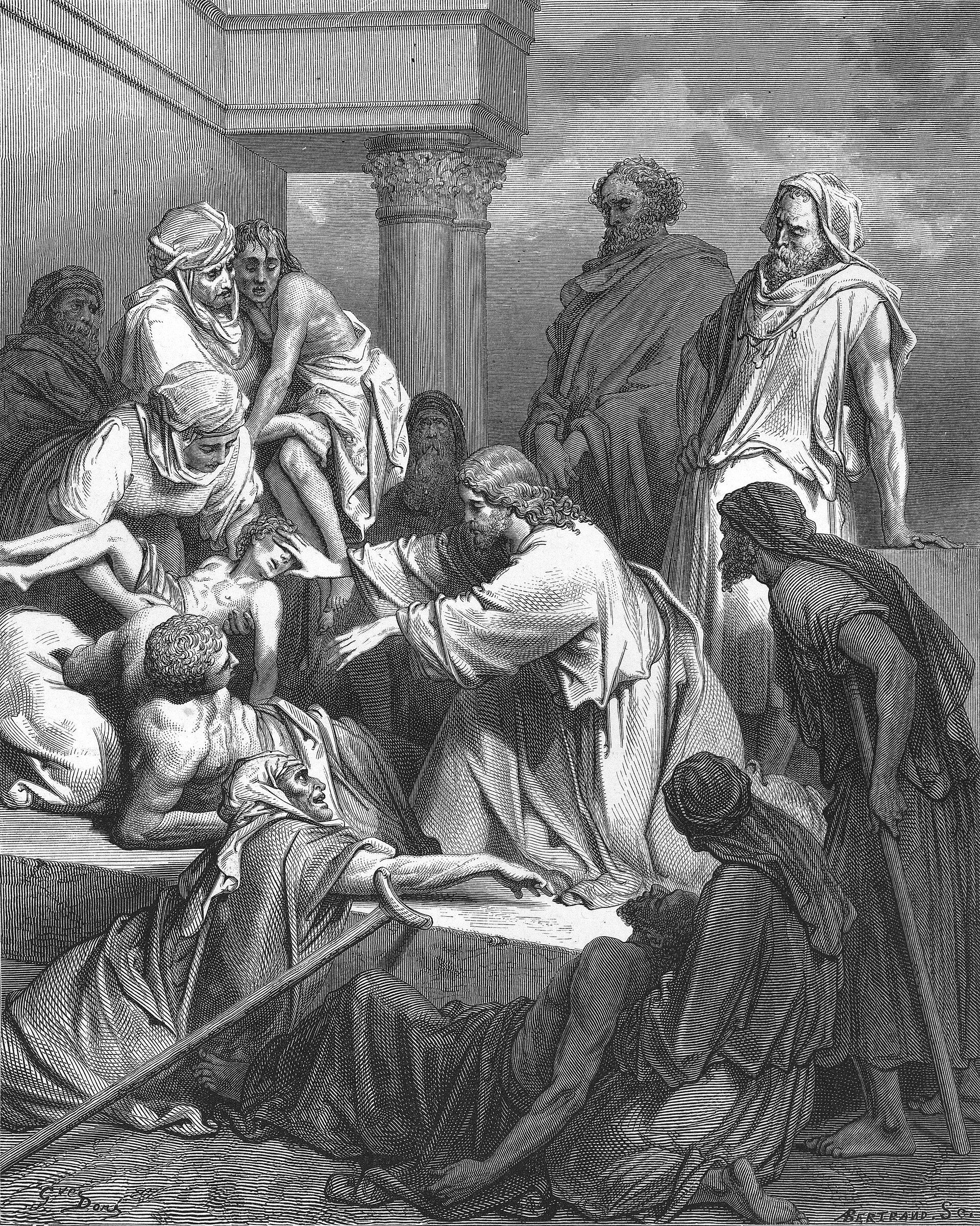
THE scene of this miracle was Bethesda, a pool, according to the Evangelist, adjoining the sheep market, or near the sheep gate—the place through which, I suppose, the cattle consumed by the inhabitants of Jerusalem would be driven— and the pool where, perhaps, the sheep intended for sale to the offerers in the temple were washed. So common was sickness in the days of the Savior that the infirmities of men intruded upon the place which had been allotted to cattle! And the place where sheep had been washed became the spot where sick folk congregated in great multitudes, longing for a cure. We do not hear that anyone remonstrated at the intrusion, or that public opinion was shocked. The needs of mankind must override all considerations of taste. A hospital must have preference over a sheep market. This day you have another case in point. If the physical infirmities of Jerusalem intruded into the sheep market, I shall ask no excuse if, on these Sundays, the spiritual sickness of London should demand that this spacious place, which has up to now been given up to the lowing of cattle and to the bleating of sheep, should be consecrated to the preaching of the Gospel—to the manifestation of the healing virtue of Christ Jesus among the spiritually sick! This day there is, by the sheep market, a pool, and impotent folk are here in exceeding great multitudes. We might never have heard of Bethesda if an august visitor had not condescended to honor it with His Presence—Jesus, the Son of God, walked in the five porches by the pool. It was the place where we might expect to meet Him, for where should the Great Physician be found if not in the place where the sick are gathered? Here was work for Jesus' healing hand and restoring word.
A commentator
Albert Barnes1798–1870
Notes, Explanatory and Practical, on the Old and New Testaments (1832-1869)
proposed
The sheep-market - This might have been rendered the “sheep-gate,” or the gate through which the sheep were taken into the city for sacrifice. The marginal rendering is “gate,” and the word “market” is not in the original, nor is a “sheep-market” mentioned in the Scriptures or in any of the Jewish writings. A “sheep-gate” is repeatedly mentioned by Nehemiah Neh 3:1, Neh 3:32; Neh 12:39, being that by which sheep and oxen were brought into the city. As these were brought mainly for sacrifice, the gate was doubtless near the temple, and near the present place which is shown as the pool of Bethesda. A pool - This word may either mean a small lake or pond in which one can swim, or a place for fish, or any waters collected for bathing or washing. Hebrew tongue - Hebrew language. The language then spoken, which did not differ essentially from the ancient Hebrew. Bethesda - The house of mercy. It was so called on account of its strong healing properties - the property of restoring health to the sick and infirm. Five porches - The word “porch” commonly means a covered place surrounding a building, in which people can walk or sit in hot or wet weather. Here it probably means that there were five covered places, or apartments, in which the sick could remain, from each one of which they could have access to the water. This “pool” is thus described by Professor Hackett (“Illustrations of Scripture,” pp. 291, 292): “Just to the east of the Turkish garrison, and under the northern wall of the mosque, is a deep excavation, supposed by many to be the ancient pool of Bethesda, into which the sick descended after the troubling of the water, and were healed, Joh 5:1 ff. It is 360 feet long, 130 feet wide, and 75 deep. The evangelist says that this pool was near the sheep-gate, as the Greek probably signifies, rather than sheep-market, as rendered in the English version. […]
How the passage was read
On John 5:1-18On John 5:1-18
The mat, the carrying rule, and where the ways part
“It is the sabbath day: it is not lawful for thee to carry thy bed.” The objectors stand on a real rule with a prophetic root: Jeremiah 17:21-22 forbids bearing burdens through Jerusalem's gates on the Sabbath, and the tradition codified carrying between domains as the last of the thirty-nine categories of forbidden labor (Mishnah Shabbat 7:2). The tradition's own case law even makes the fine distinction the scene turns on: one who carries out a living person on a bed is exempt FOR THE PERSON, “because the bed is secondary to the person” (Mishnah Shabbat 10:5); it is the mat alone the rule could name. Note also what no one disputes: the healing itself. Jesus healed by a word; a thirty-eight-year lameness was chronic, not mortal (mortal danger overrides the Sabbath, Mishnah Yoma 8:6), so on the tradition's categories the man could have waited one more day. Jesus refuses the wait.
Where the ways part
At verse 18 the scene reaches the real parting of the ways, and honesty requires it be said plainly: Jesus “said also that God was his Father, making himself equal with God.” Here the difference is not over practice but over an essential of the Christian faith. Judaism then and now confesses the one God and reads such a claim by a man as blasphemy; Christian confession holds that Jesus' claim is true, that the Son does what the Father does (5:19-29). The two readings cannot both be right, and this page presents each side in its own words, with respect and without blur.
This section is reception history: how the passage was read and kept in the Jewish tradition. Where a reading parts from an essential of the Christian faith, the section says so at that point.
Sources: Mishnah Shabbat 7:2 (carrying, the last category) · Mishnah Shabbat 10:5 (the person exempt, the bed secondary) · Mishnah Yoma 8:6 (danger to life overrides the Sabbath)
The words behind it
16 Greek wordsEvery Greek word of this verse in the order it stands, with what it means and the door to its own study. The last column counts the times a word stands in the whole Bible: the rarer the word, the more the places it appears belong together.
| Greek | Sound | Meaning | Word study | In the Bible |
|---|---|---|---|---|
| ἔστιν | estin | There is | G1510 → | 2333 times |
| δὲ | de | now | G1161 → | 2765 times |
| ἐν | en | in | G1722 → | 2738 times |
| τοῖς | tois | <the> | G3588 → | 19766 times |
| Ἱεροσολύμοις | hi'erosolumois | Jerusalem | G2414 → | 62 times |
| ἐπὶ | epi | by | G1909 → | 883 times |
| τῇ | tea | the | G3588 → | 19766 times |
| προβατικῇ | probatikea | Sheep Gate | G4262 → | |
| κολυμβήθρα, | kolumbethra | a pool, | G2861 → | 3 times |
| ἡ | he | which | G3588 → | 19766 times |
| ἐπιλεγομένη | epilegomene | is being called | G1951 → | |
| Ἑβραϊστὶ | hebraisti | in Hebrew | G1447 → | 7 times |
| Βηθζαθά, | bethzatha | Bethzatha, | G964 → | |
| πέντε | pente | five | G4002 → | 38 times |
| στοὰς | stoas | porches | G4745 → | |
| ἔχουσα. | echousa | having. | G2192 → | 707 times |
ἔστινThere is
estinG1510 →2333 times
δὲnow
deG1161 →2765 times
ἐνin
enG1722 →2738 times
τοῖς<the>
toisG3588 →19766 times
ἹεροσολύμοιςJerusalem
hi'erosolumoisG2414 →62 times
ἐπὶby
epiG1909 →883 times
τῇthe
teaG3588 →19766 times
προβατικῇSheep Gate
probatikeaG4262 →
κολυμβήθρα,a pool,
kolumbethraG2861 →3 times
ἡwhich
heG3588 →19766 times
ἐπιλεγομένηis being called
epilegomeneG1951 →
Ἑβραϊστὶin Hebrew
hebraistiG1447 →7 times
Βηθζαθά,Bethzatha,
bethzathaG964 →
πέντεfive
penteG4002 →38 times
στοὰςporches
stoasG4745 →
ἔχουσα.having.
echousaG2192 →707 times
A shaded row is a word that stands 400 times or fewer in the Bible.
The walk
8 stopsEach card is a verse this one points to, and under it the verses that one points to in turn. Where several paths arrive at the same place, that place is listed first: the text keeps returning to it.
Through
Nehemiah 3:1At the Sheep Gate, Eliashib the high priest and his fellow priests began rebuilding. They dedicated it and installed its doors. After building as far as the Tower of the Hundred and the Tower…
it leads to
- Nehemiah 12:39
over the Gate of Ephraim, the Jeshanah Gate, the Fish Gate, the Tower of Hananel, and the Tower of the Hundred, as far as the Sheep Gate. And they stopped at the Gate of…
Reached by 2 separate paths from here.
- Jeremiah 31:38
“The days are coming,” declares the LORD, “when this city will be rebuilt for Me, from the tower of Hananel to the Corner Gate.
- Zechariah 14:10
All the land from Geba to Rimmon south of Jerusalem will be turned into a plain, but Jerusalem will be raised up and will remain in her place, from the Benjamin Gate to the…
- Nehemiah 12:39
Through
Nehemiah 12:39over the Gate of Ephraim, the Jeshanah Gate, the Fish Gate, the Tower of Hananel, and the Tower of the Hundred, as far as the Sheep Gate. And they stopped at the Gate of…
it leads to
- Nehemiah 3:1
At the Sheep Gate, Eliashib the high priest and his fellow priests began rebuilding. They dedicated it and installed its doors. After building as far as the Tower of the Hundred and the Tower…
Reached by 2 separate paths from here.
- Nehemiah 8:16
And the people went out, brought back branches, and made booths on their own rooftops, in their courtyards, in the court of the house of God, and in the squares by the Water Gate…
- Nehemiah 3:3
The Fish Gate was rebuilt by the sons of Hassenaah. They laid its beams and installed its doors, bolts, and bars.
- Nehemiah 3:6
The Jeshanah Gate was repaired by Joiada son of Paseah and Meshullam son of Besodeiah. They laid its beams and installed its doors, bolts, and bars.
- Nehemiah 3:1
Through
Isaiah 22:11You built a reservoir between the walls for the waters of the ancient pool, but you did not look to the One who made it, or consider Him who planned it long ago.
it leads to
- Jeremiah 33:2–3
“Thus says the LORD who made the earth, the LORD who formed it and established it, the LORD is His name:
- Jeremiah 33:2–3
Where this verse is studied
About John
Who and where
1 name in this verse with a page on the site.
This page draws on 18 works. Open the list of works
This page draws on Adam Clarke, Commentary on the Bible; Albert Barnes, Notes, Explanatory and Practical, on the Gospels; Albert Barnes, Notes, Explanatory and Practical, on the Old and New Testaments (1832-1869); Alcuin of York, Catena Aurea by Aquinas; Augustine of Hippo, Tractates on John 17; Augustine of Hippo, Catena Aurea by Aquinas; Bede, Catena Aurea by Aquinas; Bonaventure, Commentary on John, Chapter 5; Charles Spurgeon, The Metropolitan Tabernacle Pulpit, Sermon No. 744: “Jesus At Bethesda—or, Waiting Changed for Believing” (lightly modernized text, CCEL edition); J.C. Ryle, Expository Thoughts on the Gospels: John (lightly modernized text, Grace Gems edition); Jamieson, Fausset & Brown, Commentary Critical and Explanatory on the Whole Bible; John Calvin, Commentaries; John Chrysostom, Homily on the Gospel of John 36; John Gill, Exposition of the New Testament (1746-1748); John Wesley, Explanatory Notes upon the New Testament; Matthew Henry, Commentary on the Whole Bible; Theophylact of Ohrid, Commentary on John and Thomas Aquinas, Commentary on John.