
John 5:7
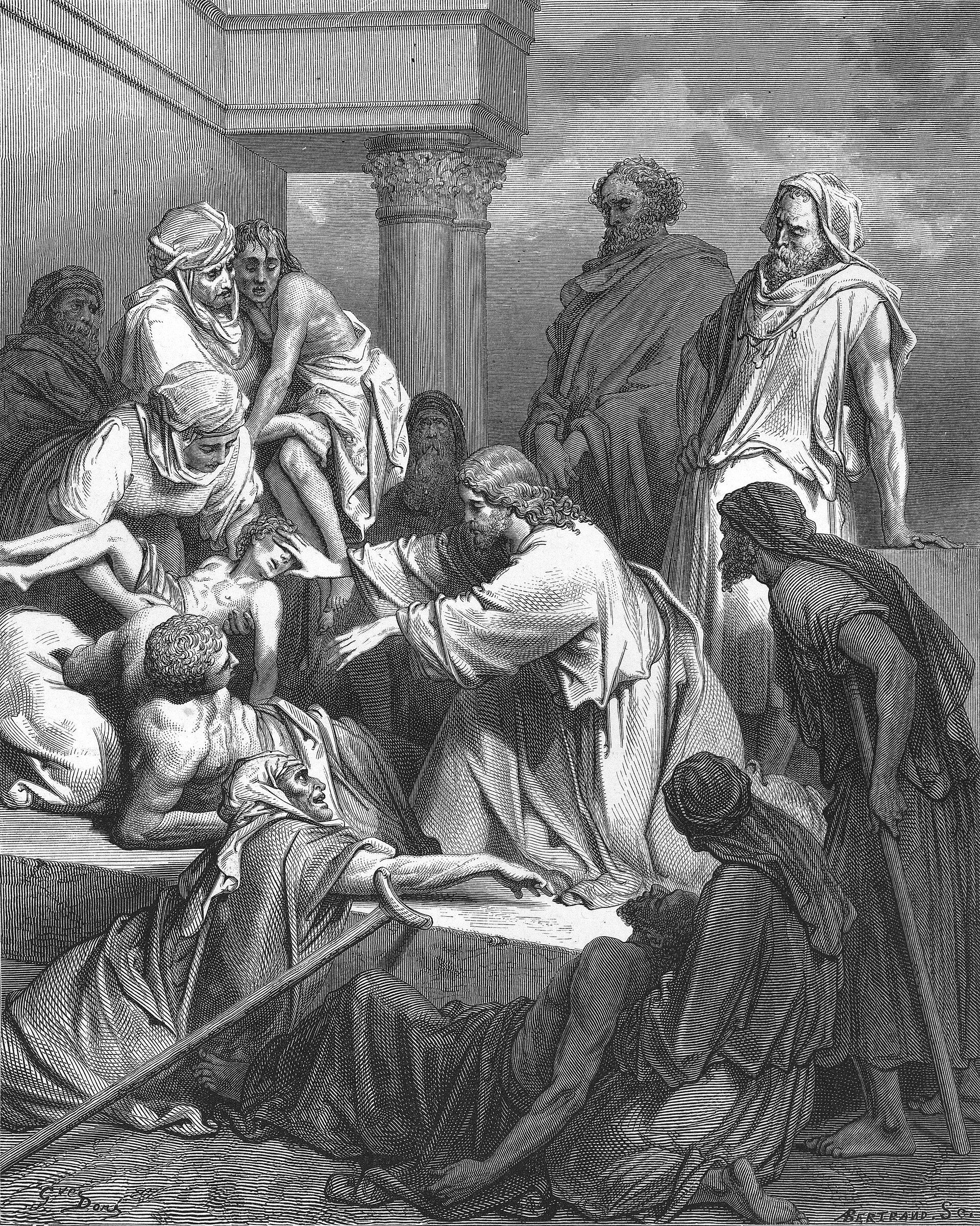
in John 5“Sir,” the invalid replied, “I have no one to help me into the pool when the water is stirred. While I am on my way, someone else goes in before me.”
BSB
The same verse in ASV and KJV ▾
ASV
The sick man answered him, Sir, I have no man, when the water is troubled, to put me into the pool: but while I am coming, another steppeth down before me.
KJV
The impotent man answered him, Sir, I have no man, when the water is troubled, to put me into the pool: but while I am coming, another steppeth down before me.
⋯
This verse in John 5
Commentary
24 notes on this verseAbout the day of the holy Pentecost, Angels coming down from heaven used to trouble the water of the pool, then they would make the plash therefrom the herald of their presence. And the water would be sanctified by the holy spirits, and whoever was beforehand of the multitude of sick people in getting down, he would come up again disburdened of the suffering that troubled him,, yet to one alone, him who first seized it, was the might of healing meted out.
This site's exposition
an invalid for thirty-eight years
on John 5:5-7
Thirty-eight years is longer than most men in that porch had been alive, and Jesus picks him out of the crowd. His answer names his trouble, that no one carries him into the pool when the water stirs. A friendless man lay in a crowd of the friendless.
This site's exposition
I have no one to help me
Albert Barnes hears a yes in the reply, together with a further grief, that the man had no friend. No one gave up a turn for him, Matthew Henry notes. Cyril of Alexandria describes the belief behind the complaint, that only the first into the stirred water was healed.
The record, by era
The Church Fathers3 voices
Therefore let us now see the sacred mystery whereby this impotent man is healed by the Lord. The Lord Himself came, the Teacher of love, full of love, "shortening," as it was predicted of Him, "the word upon the earth," and showed that the law and the prophets hang on two precepts of love. Upon these hung Moses with his number forty, upon these Elias with his; and the Lord brought in this number in His testimony. This impotent man is healed by the Lord in person; but before healing him, what does He say to him? "Wilt thou be made whole?" The man answered that he had not a man to put him into the pool. Truly he had need of a "man" to his healing, but that "man" one who is also God. "For there is one God, and one Mediator between God and man, the man Christ Jesus." He came, then, the Man who was needed: why should the healing be delayed? "Arise," saith He; "take up thy bed, and walk." He said three things: "Arise, Take up thy bed, and Walk." But that "Arise" was not a command to do a work, but the operation of healing. And the man, on being made whole, received two commands: "Take up thy bed, and Walk." I ask you, why was it not enough to say, "Walk?" Or, at any rate, why was it not enough to say, "Arise"? For when the man had arisen whole, he would not have remained in the place. Would it not be for the purpose of going away that he would have arisen? My impression is, that He who found the man lacking two things, gave him these two precepts: for, by ordering him to do two things, it is as if He filled up that which was lacking.
This man who had been paralytic for thirty and eight years, and who saw each year others delivered, and himself bound by his disease, not even so fell back and despaired, though in truth not merely despondency for the past, but also hopelessness for the future, was sufficient to overthrow him. Hear now what he says, and learn the greatness of his sufferings. For when Christ had said, "Wilt thou be made whole?" "Yea, Lord," he saith, "but I have no man, when the water is troubled, to put me into the pool." What can be more pitiable than these words? What more sad than these circumstances? Seest thou a heart crushed through long sickness? Seest thou all violence subdued? He uttered no blasphemous word, nor such as we hear the many use in reverses, he cursed not his day, he was not angry at the question, nor did he say, "Art Thou come to make a mock and a jest of us, that Thou askest whether I desire to be made whole?" but replied gently, and with great mildness, "Yea, Lord"; yet he knew not who it was that asked him, nor that He would heal him, but still he mildly relates all the circumstances and asks nothing further, as though he were speaking to a physician, and desired merely to tell the story of his sufferings. Perhaps he hoped that Christ might be so far useful to him as to put him into the water, and desired to attract Him by these words.
But why did Jesus, leaving the rest, come to one who was of thirty-eight years standing? And why did He ask him, "Wilt thou be made whole?" Not that He might learn, that was needless; but that He might show the man's perseverance, and that we might know that it was on this account that He left the others and came to him. What then saith he? "Yea Lord," he saith, but "I have no man when the water is troubled to put me into the pool, but while I am coming another steppeth down before me." It was that we might learn these circumstances that Jesus asked, "Wilt thou be made whole?" and said not, "Wilt thou that I heal thee?" (for as yet the man had formed no exalted notions concerning Him,) but "Wilt thou be made whole?" Astonishing was the perseverance of the paralytic, he was of thirty and eight years standing, and each year hoping to be freed from his disease, he continued in attendance, and withdrew not. Had he not been very persevering, would not the future, if not the past, have been sufficient to lead him from the spot? Consider, I pray you, how watchful it was likely that the other sick men there would be since the time when the water was troubled was uncertain. The lame and halt indeed might observe it, but how did the blind see? Perhaps they learnt it from the clamor which arose.
The Medieval Church2 voices
A commentator
Symeon the New TheologianCommentary (church-history corpus) · Written before 1022.
proposed
So then, let everyone who wants approach Him, and let the one say: "Son of David, have mercy on me"; and, if he hears, "What do you want Me to do for you?" let him say quickly, "Lord, let me receive my sight," and right …
Then (v 7), the answer of the sick man is given. Two reasons are given for the length of his illness: his poverty and his weakness. As he was poor, he could not afford a man to plunge him into the pool; so he says, …
16 more voices on this verse
The Medieval Church2 voices
What then does he do? He answers very meekly. "Yes," he says, "Lord, I desire to, but I have no man to put me into the water." He utters no blasphemy, he does not reject Christ as having asked an inappropriate question, he does not …
"The sick man answered him: Lord, I have no man, so that when the water is stirred, he might put me into the pool": and so I am destitute, and there is none to help: the Psalm: "Trouble is near and there is none to …
The Puritans and the Awakening4 voices
The impotent man answered him, Sir,.... Which was a common and courteous way of speaking, much in use with the Jews, especially to strangers.
The sermon was Christ's vindication of himself before the sanhedrim, when he was prosecuted as a criminal for healing the man on the sabbath day, in which, 1. He asserts his authority as Messiah, and Mediator between God and man,
There was a great multitude of poor cripples here at Bethesda, but Christ fastened his eye upon this one, and singled him out from the rest, because he was senior of the house, and in a more deplorable condition than any of the rest; and Christ delights to help the helpless, and hath mercy on whom he will have mercy.
None had the charity to say, "Your case is worse than mine, do you go in now, and I will stay till the next time;" for there is no getting over the old maxim, Every one for himself. Having been so often disappointed, he begins to despair, and now is Christ's time to come to his relief; he delights to help in desperate cases.
The Nineteenth Century9 voices
A commentator
Albert Barnes1798–1870
Notes, Explanatory and Practical, on the Old and New Testaments (1832-1869)
Sir, I have no man ... - The answer of the man implied that he did wish it, but, in addition to all his other trials, he had no “friend” to aid him. This is an additional circumstance that heightened his affliction.
A commentator
Jamieson, Fausset & Brown1802–1910
Commentary Critical and Explanatory on the Whole Bible (1871)
Wait therefore he will, wait he does, and when Christ comes to heal him, lo! he is waiting his turn. What an attitude for a sinner at Mercy's gate! The man's hopes seemed low enough ere Christ came to him.
A commentator
J.C. Ryle1816–1900
Expository Thoughts on the Gospels: John (lightly modernized text, Grace Gems edition) (1869)
proposed
We have in this passage one of the few miracles of Christ, which John records. Like every other miracle in this Gospel, it is described with great minuteness and particularity. And like more than one other miracle it leads on to a discourse full of singularly deep instruction. We are taught, for one thing, in this passage, what misery sin has brought into the world. We read of a man who had been ill for no less than thirty-eight years! For thirty-eight weary summers and winters he had endured pain and infirmity.
THE scene of this miracle was Bethesda, a pool, according to the Evangelist, adjoining the sheep market, or near the sheep gate—the place through which, I suppose, the cattle consumed by the inhabitants of Jerusalem would be driven— and the pool where, perhaps, the sheep intended for sale to the offerers in the temple were washed. So common was sickness in the days of the Savior that the infirmities of men intruded upon the place which had been allotted to cattle!
THE scene of this miracle was Bethesda, a pool, according to the Evangelist, adjoining the sheep market, or near the sheep gate—the place through which, I suppose, the cattle consumed by the inhabitants of Jerusalem would be driven— and the pool where, perhaps, the sheep intended for sale to the offerers in the temple were washed. So common was sickness in the days of the Savior that the infirmities of men intruded upon the place which had been allotted to cattle! And the place where sheep had been washed became the spot where sick folk congregated in great multitudes, longing for a cure. We do not hear that anyone remonstrated at the intrusion, or that public opinion was shocked. The needs of mankind must override all considerations of taste. A hospital must have preference over a sheep market. This day you have another case in point. If the physical infirmities of Jerusalem intruded into the sheep market, I shall ask no excuse if, on these Sundays, the spiritual sickness of London should demand that this spacious place, which has up to now been given up to the lowing of cattle and to the bleating of sheep, should be consecrated to the preaching of the Gospel—to the manifestation of the healing virtue of Christ Jesus among the spiritually sick! This day there is, by the sheep market, a pool, and impotent folk are here in exceeding great multitudes. We might never have heard of Bethesda if an august visitor had not condescended to honor it with His Presence—Jesus, the Son of God, walked in the five porches by the pool. It was the place where we might expect to meet Him, for where should the Great Physician be found if not in the place where the sick are gathered? Here was work for Jesus' healing hand and restoring word.
A commentator
Charles Spurgeon1834–1892
The Metropolitan Tabernacle Pulpit, Sermon No. 2269: “Impotence and Omnipotence” (lightly modernized text, CCEL edition) · Written before 1892.
proposed
THIS man had been lying, with many others, round the pool, hoping that it would be stirred by the angel, and that he might be the first put into the water and so might be healed. There he waited long, and waited in vain. Why did he wait? Because Jesus was not there. Where Jesus is not, you must wait! If it is only an angel and a pool, you must wait— and one may get a blessing—and many may get no blessing. But when Jesus came, there was no waiting.
A commentator
Charles Spurgeon1834–1892
The Metropolitan Tabernacle Pulpit, Sermon No. 2269: “Impotence and Omnipotence” (lightly modernized text, CCEL edition) · Written before 1892.
proposed
THIS man had been lying, with many others, round the pool, hoping that it would be stirred by the angel, and that he might be the first put into the water and so might be healed. There he waited long, and waited in vain. Why did he wait? Because Jesus was not there. Where Jesus is not, you must wait! If it is only an angel and a pool, you must wait— and one may get a blessing—and many may get no blessing. But when Jesus came, there was no waiting. He walked in among the crowd of sick folk, spied out this man, bade him to take up his mattress and walk home—and he was healed at once. Now, I commend this man for waiting. I admire him for his patience and his perseverance. But I beg you not to make his case your own. He waited, for Jesus was not there. You may not wait, you must not wait—as I have told you—for Jesus is here! There was necessity for him to wait. As I have told you, there was an angel and a pool, and nothing more. But where Christ is, there should be no waiting.
A commentator
J.C. Ryle1816–1900
Expository Thoughts on the Gospels: John (lightly modernized text, Grace Gems edition) (1869)
proposed
We have in this passage one of the few miracles of Christ, which John records. Like every other miracle in this Gospel, it is described with great minuteness and particularity. And like more than one other miracle it leads on to a discourse full of singularly deep instruction. We are taught, for one thing, in this passage, what misery sin has brought into the world. We read of a man who had been ill for no less than thirty-eight years! For thirty-eight weary summers and winters he had endured pain and infirmity. He had seen others healed at the waters of Bethesda, and going to their homes rejoicing. But for him there had been no healing. Friendless, helpless, and hopeless, he lay near the wonder-working waters, but derived no benefit from them. Year after year passed away, and left him still uncured. No relief or change for the better seemed likely to come, except from the grave. When we read of cases of sickness like this, we should remember how deeply we ought to hate sin! Sin was the original root, and cause, and fountain of every disease in the world. God did not create man to be full of aches, and pains, and infirmities. These things are the fruits of the Fall. There would have been no sickness, if there had been no sin. No greater proof can be shown of man's inbred unbelief, than his carelessness about sin. "Fools," says the wise man, "make a mock at sin." (Pro. 14:9.) Thousands delight in things which are explicitly evil, and run greedily after that which is downright poison. They love that which God abhors, and dislike that which God loves. They are like the madman, who loves his enemies and hates his friends. Their eyes are blinded. Surely if men would only look at hospitals and infirmaries, and think what havoc sin has made on this earth, they would never take pleasure in sin as they do. Well may we be told to pray for the coming of God's kingdom!
Sir, I have no man - Ναι, Κυριε - “Yes, sir; but I have no man:” - this is the reading of C*GH, fourteen others, both the Syriac, later Persic, Arabic, and Chrysostom. Reader, be thankful to God for health and outward comforts. When long affliction has been allied to deep poverty, how deplorable is the state!
Modern Voices1 voice
A commentator
Smith Wigglesworth1859–1947
Ever Increasing Faith, Chapter 4: "Wilt Thou Be Made Whole?" (1924)
proposed
Jesus said it, and His Word is from everlasting to everlasting. This is His Word to you, poor, tried and tested one today.
How the passage was read
On John 5:1-18On John 5:1-18
The mat, the carrying rule, and where the ways part
“It is the sabbath day: it is not lawful for thee to carry thy bed.” The objectors stand on a real rule with a prophetic root: Jeremiah 17:21-22 forbids bearing burdens through Jerusalem's gates on the Sabbath, and the tradition codified carrying between domains as the last of the thirty-nine categories of forbidden labor (Mishnah Shabbat 7:2). The tradition's own case law even makes the fine distinction the scene turns on: one who carries out a living person on a bed is exempt FOR THE PERSON, “because the bed is secondary to the person” (Mishnah Shabbat 10:5); it is the mat alone the rule could name. Note also what no one disputes: the healing itself. Jesus healed by a word; a thirty-eight-year lameness was chronic, not mortal (mortal danger overrides the Sabbath, Mishnah Yoma 8:6), so on the tradition's categories the man could have waited one more day. Jesus refuses the wait.
Where the ways part
At verse 18 the scene reaches the real parting of the ways, and honesty requires it be said plainly: Jesus “said also that God was his Father, making himself equal with God.” Here the difference is not over practice but over an essential of the Christian faith. Judaism then and now confesses the one God and reads such a claim by a man as blasphemy; Christian confession holds that Jesus' claim is true, that the Son does what the Father does (5:19-29). The two readings cannot both be right, and this page presents each side in its own words, with respect and without blur.
This section is reception history: how the passage was read and kept in the Jewish tradition. Where a reading parts from an essential of the Christian faith, the section says so at that point.
Sources: Mishnah Shabbat 7:2 (carrying, the last category) · Mishnah Shabbat 10:5 (the person exempt, the bed secondary) · Mishnah Yoma 8:6 (danger to life overrides the Sabbath)
The words behind it
27 Greek wordsEvery Greek word of this verse in the order it stands, with what it means and the door to its own study. The last column counts the times a word stands in the whole Bible: the rarer the word, the more the places it appears belong together.
| Greek | Sound | Meaning | Word study | In the Bible |
|---|---|---|---|---|
| ἀπεκρίθη | apekrithe | Answered | G611 → | 231 times |
| αὐτῷ | auto | Him | G846 → | 5565 times |
| ὁ | ho | the [one] | G3588 → | 19766 times |
| ἀσθενῶν· | asthenon | ailing; | G770 → | 33 times |
| κύριε, | kurie | Sir, | G2962 → | 711 times |
| ἄνθρωπον | anthropon | a man | G444 → | 549 times |
| οὐκ | ouk | not | G3756 → | 1664 times |
| ἔχω | echo | I have | G2192 → | 707 times |
| ἵνα | ina | that | G2443 → | 668 times |
| ὅταν | hotan | when | G3752 → | 123 times |
| ταραχθῇ | tarachthea | may be stirred | G5015 → | 17 times |
| τὸ | to | the | G3588 → | 19766 times |
| ὕδωρ | hudor | water | G5204 → | 76 times |
| βάλῃ | bale | he may put | G906 → | 121 times |
| με | me | me | G3165 → | 1936 times |
| εἰς | eis | into | G1519 → | 1755 times |
| τὴν | ten | the | G3588 → | 19766 times |
| κολυμβήθραν· | kolumbethran | pool; | G2861 → | 3 times |
| ἐν | en | in | G1722 → | 2738 times |
| ᾧ | ho | which | G3739 → | 1405 times |
| δὲ | de | now | G1161 → | 2765 times |
| ἔρχομαι | erchomai | am going | G2064 → | 628 times |
| ἐγώ, | ego | I myself, | G1473 → | 839 times |
| ἄλλος | allos | another | G243 → | 155 times |
| πρὸ | pro | before | G4253 → | 47 times |
| ἐμοῦ | emou | me | G1473 → | 839 times |
| καταβαίνει. | katabainei | descends. | G2597 → | 81 times |
ἀπεκρίθηAnswered
apekritheG611 →231 times
αὐτῷHim
autoG846 →5565 times
ὁthe [one]
hoG3588 →19766 times
ἀσθενῶν·ailing;
asthenonG770 →33 times
κύριε,Sir,
kurieG2962 →711 times
ἄνθρωπονa man
anthroponG444 →549 times
οὐκnot
oukG3756 →1664 times
ἔχωI have
echoG2192 →707 times
ἵναthat
inaG2443 →668 times
ὅτανwhen
hotanG3752 →123 times
ταραχθῇmay be stirred
tarachtheaG5015 →17 times
τὸthe
toG3588 →19766 times
ὕδωρwater
hudorG5204 →76 times
βάλῃhe may put
baleG906 →121 times
μεme
meG3165 →1936 times
εἰςinto
eisG1519 →1755 times
τὴνthe
tenG3588 →19766 times
κολυμβήθραν·pool;
kolumbethranG2861 →3 times
ἐνin
enG1722 →2738 times
ᾧwhich
hoG3739 →1405 times
δὲnow
deG1161 →2765 times
ἔρχομαιam going
erchomaiG2064 →628 times
ἐγώ,I myself,
egoG1473 →839 times
ἄλλοςanother
allosG243 →155 times
πρὸbefore
proG4253 →47 times
ἐμοῦme
emouG1473 →839 times
καταβαίνει.descends.
katabaineiG2597 →81 times
A shaded row is a word that stands 400 times or fewer in the Bible.
The walk
8 stopsEach card is a verse this one points to, and under it the verses that one points to in turn. Where several paths arrive at the same place, that place is listed first: the text keeps returning to it.
Through
1 Corinthians 9:24Do you not know that in a race all the runners run, but only one receives the prize? Run in such a way as to take the prize.
it leads to
- Philippians 3:14
I press on toward the goal to win the prize of God’s heavenly calling in Christ Jesus.
- Hebrews 12:1
Therefore, since we are surrounded by such a great cloud of witnesses, let us throw off every encumbrance and the sin that so easily entangles, and let us run with endurance the race set…
- 2 Timothy 4:7–8
I have fought the good fight, I have finished the race, I have kept the faith.
- Revelation 3:11
I am coming soon. Hold fast to what you have, so that no one will take your crown.
- Philippians 2:16
as you hold forth the word of life, in order that I may boast on the day of Christ that I did not run or labor in vain.
- Philippians 3:14
Through
Psalms 72:12For he will deliver the needy who cry out and the afflicted who have no helper.
it leads to
- Job 29:12
because I rescued the poor who cried out and the fatherless who had no helper.
- Revelation 3:17–18
You say, ‘I am rich; I have grown wealthy and need nothing.’ But you do not realize that you are wretched, pitiful, poor, blind, and naked.
- Psalms 102:17
He will turn toward the prayer of the destitute; He will not despise their prayer.
- Job 29:12
Where this verse is studied
On this page
About John
This page draws on 18 works. Open the list of works
This page draws on Adam Clarke, Commentary on the Bible; Albert Barnes, Notes, Explanatory and Practical, on the Old and New Testaments (1832-1869); Augustine of Hippo, Tractates on John 17; Bonaventure, Commentary on John, Chapter 5; Charles Spurgeon, The Metropolitan Tabernacle Pulpit, Sermon No. 744: “Jesus At Bethesda—or, Waiting Changed for Believing” (lightly modernized text, CCEL edition); Charles Spurgeon, The Metropolitan Tabernacle Pulpit, Sermon No. 2269: “Impotence and Omnipotence” (lightly modernized text, CCEL edition); Cyril of Alexandria, Commentary on the Gospel of John, Book 2; J. C. Ryle, Expository Thoughts on the Gospels, John; J.C. Ryle, Expository Thoughts on the Gospels: John (lightly modernized text, Grace Gems edition); Jamieson, Fausset & Brown, Commentary Critical and Explanatory on the Whole Bible; John Chrysostom, Homily on the Gospel of John 37; John Chrysostom, Homily on the Gospel of John 36; John Gill, Exposition of the New Testament (1746-1748); Matthew Henry, Commentary on the Whole Bible; Smith Wigglesworth, Ever Increasing Faith, Chapter 4: "Wilt Thou Be Made Whole?"; Symeon the New Theologian, Commentary (church-history corpus); Theophylact of Ohrid, Commentary on John and Thomas Aquinas, Commentary on John.