
John 5:31
in John 5If I testify about Myself, My testimony is not valid.
BSB
The same verse in ASV and KJV ▾
ASV
If I bear witness of myself, my witness is not true.
KJV
If I bear witness of myself, my witness is not true.
⋯
This verse in John 5
Commentary
22 notes on this verseThe most wise Solomon, gathering together the things in which a man may very reasonably glory, and show his manner of life to be enviable, and placing them before those who are apt to learn, says, The righteous man is his own accuser in the opening of the trial, and again, Let thy neighbour praise thee and not thine own mouth, a stranger and not thine own lips.
This site's exposition
If I testify about Myself
on John 5:31-32
The law required two or three witnesses to establish a matter, and a man's word about himself carried no legal weight. Jesus grants the rule and names another who testifies for Him. The chapter then calls its witnesses in turn, John, the works, the Father and the Scriptures.
The record, by era
The Church Fathers5 voices
The Son speaks thus:—"For the works which the Father hath given Me to finish, the same works which I do, bear witness of Me that the Father hath sent Me; and the Father Himself which hath sent Me hath borne witness of Me." God the Only-begotten proves His Sonship by an appeal not only to the name, but to the power; the works which He does are evidence that He has been sent by the Father. What, I ask, is the fact which these works prove? That He was sent. That He was sent, is used as a proof of His sonlike obedience and of His Father's authority: for the works which He does could not possibly be done by any other than Him Who is sent by the Father. Yet the evidence of His works fails to convince the unbelieving that the Father sent Him. For He proceeds, "And the Father Himself which hath sent Me hath borne witness of Me; and ye have neither heard His voice nor seen His shape." What was this witness of the Father concerning Him? Turn over the pages of the Gospels and review their contents. Read us other of the attestations given by the Father beside those which we have heard already; "This is My beloved Son, in Whom I am well pleased," and "Thou art My Son." John, who heard these words, needed them not, for He knew the truth already. It was for our instruction that the Father spoke. But this is not all. John in the wilderness was honoured with this revelation; the Apostles were not to be denied the same assurance. It came to them in the very same words, but with an addition which John did not receive. He had been a prophet from the womb, and needed not the commandment, "Hear Him." Yes; I will hear Him, and will hear none but Him and His Apostle, who heard for my instruction. Even though the books contained no further witness, borne by the Father to the Son, than that He is the Son, I have, for confirmation of the truth, the evidence of His Father's works which He does. […]
No one who comes on the authority of another establishes that authority as his own but rather guards against such an understanding, for first must come the support of the one who gives him his authority. Now, [Christ] will not be acknowledged as Son if the Father never called him this. Nor will people believe he is the sent One if no sender gave him a commission.
It is true that he tells us himself that he was a persecutor before he became an apostle, still this is not enough for any man who examines before he believes, since even the Lord Himself did not bear witness of Himself. But let them believe without the Scriptures, if their object is to believe contrary to the Scriptures.
Think you that my testimony of myself is better than that of God? when the Lord Himself teaches, and says that testimony is not true, if any one himself appears as a witness concerning himself, for the reason that every one would assuredly favour himself. Nor would any one put forward mischievous and adverse things against himself, but there may be a simple confidence of truth if, in what was announced of us, another is the announcer and witness. "If," He says, "I bear witness of myself, my testimony is not true; but there is another who beareth witness of me." but if the Lord Himself, who will by and by judge all things, was unwilling to be believed on His own testimony, but preferred to be approved by the judgment and testimony of God the Father, how much more does it be-hove His servants to observe this, who are not only approved by, but even glory in the judgment and testimony of God! But with you the fabrication of hostile and malignant men has prevailed against the divine decree, and against our conscience resting upon the strength of its faith, as if among lapsed and profane persons placed outside the Church, from whose breasts the Holy Spirit has departed, there could be anything else than a depraved mind and a deceitful tongue, and venomous hatred, and sacrilegious lies, which whosoever believes, must of necessity be found with them when the day of judgment shall come.
If any one unpracticed in the art undertake to work a mine, he will get no gold, but confounding all aimlessly and together, will undergo a labor unprofitable and pernicious: so also they who understand not the method of Holy Scripture, nor search out its peculiarities and laws, but go over all its points carelessly and in one manner, will mix the gold with earth, and never discover the treasure which is laid up in it. I say this now because the passage before us containeth much gold, not indeed manifest to view, but covered over with much obscurity, and therefore by digging and purifying we must arrive at the legitimate sense. For who would not at once be troubled at hearing Christ say, "If I testify of Myself, My witness is not true"; inasmuch as He often appeareth to have testified of Himself? For instance, conversing with the Samaritan woman He said, "I Am that speak unto thee": and in like manner to the blind man, "It is He that talketh with thee"; and rebuking the Jews, "Ye say, thou blasphemest, because I said I am the Son of God." And in many other places besides He doth this. If now all these assertions be false, what hope of salvation shall we have? And where shall we find truth when Truth Itself declareth, "My witness is not true"? Nor doth this appear to be the only contradiction; there is another not less than this. He saith farther on, "Though I bear witness of Myself, yet My witness is true"; which then, tell me, am I to receive, and which deem a falsehood? If we take them out thus [from the context] simply as they are said, without carefully considering the person to whom nor the cause for which they are said, nor any other like circumstances, they will both be falsehoods. For if His witness be "not true," then this assertion is not true either, not merely the second, but the first also. What then is the meaning? […]
15 more voices on this verse
The Church Fathers3 voices
The Jews were about to object to Him, "If thou bearest witness concerning thyself, thy witness is not true": therefore He spake these words in anticipation; as though He had said, "Ye will surely say to Me, we believe thee not; for no one that witnesseth of himself is readily held trustworthy among men." So that the "is not true" must not be read absolutely, but with reference to their suspicions, as though He had said, "to you it is not true"; and so He uttered the words not looking to His own dignity, but to their secret thoughts. When He saith, "My witness is not true," He rebuketh their opinion of Him, and the objection about to be urged by them against Him; but when He saith, "Though I bear witness of Myself, My witness is true," He declareth the very nature of the thing itself, namely, that as God they ought to deem Him trustworthy even when speaking of Himself.
For since He had spoken of the resurrection of the dead, and of the judgment, and that he that believeth on Him is not judged, but cometh unto life, and that He shall sit to require account of all men, and that He hath the same Authority and Power with the Father; and since He was about again otherwise to prove these things, He necessarily put their objection first. "I told you," He saith, "that 'as the Father raiseth the dead and quickeneth them, so the Son quickeneth whom He will'; I told you that 'the Father judgeth no man, but hath committed all judgment unto the Son'; I told you that men must 'honor the Son as they honor the Father'; I told you that 'he that honoreth not the Son honoreth not the Father'; I told you that 'he that heareth My words and believeth them shall not see death, but hath passed from death unto life'; that My voice shall raise the dead, some now, some hereafter; that I shall demand account from all men of their transgressions, that I shall judge righteously, and recompense those who have walked uprightly." Now since all these were assertions, since the things asserted were important, and since no clear proof of them had as yet been afforded to the Jews but one rather indistinct, He putteth their objection first when He is about to proceed to establish His assertions, speaking somewhat in this way if not in these very words: "Perhaps ye will say, thou assertest all this, but thou art not a credible witness, since thou testifiest of thyself." First then checking their disputatious spirit by setting forth what they would say, and showing that He knew the secrets of their hearts, and giving this first proof of His power, after stating the objection He supplieth other proofs clear and indisputable, producing three witnesses to what He said, namely, the works wrought by Him, the witness of the Father, and the preaching of John.
(de Verb. Dom. s. 43) He knew Himself that His witness of Himself was true, but in compassion to the weak and unbelieving, the Sun sought for candles, that their weak sight might not be dazzled by His full blaze. And therefore John was brought forward to give his testimony to the truth. Not that there is such testimony really, for whatever witnesses bear witness to Him, it is really He who bears witness to Himself; as it is His dwelling in the witnesses, which moves them so to give their witness to the truth.
The Medieval Church4 voices
Or thus; Christ, being both God and man, He shows the proper existence of both, by sometimes speaking according to the nature he took from man, sometimes according to the majesty of the Godhead. If I bear witness of Myself, My witness is not true: this is to be understood of His humanity; the sense being, If I, a man, bear witness of Myself, i. e. without God, My witness is not true: and then follows, There is another that beareth witness of Me. The Father bore witness of Christ, by the voice which was heard at the baptism, and at the transfiguration on the mount. And I know that His witness is true; because He is the God of truth. How then can His witness be otherwise than true?
Having given us the teaching on the life-giving power of the Son, he now confirms it. First, he confirms, with several testimonies, what he had said about the excellence of his power. In the second place, he reproves them because of their slowness to believe …
Here the Lord apparently contradicts Himself. For He repeatedly bore witness about Himself, for example, He said to the Samaritan woman "I am the Christ" (John 4:25–26), to the blind man (John 9:35–37), and at other times on several occasions. If this is false, then …
This is the fourth part of the chapter, in which is determined the corroboration of the aforesaid refutation, which was made by manifold testimony approving what the Lord said above. And this part has two sections: because first is adduced the certainty of the testimonies; …
The Puritans and the Awakening3 voices
If I bear witness of myself,.... Which was not allowed any man to do; nor indeed is it proper that a man should be a witness in his own cause: and, according to the Jewish canons, a man might not be a witness for his wife, because she was reckoned as himself.
If I testify of myself - That is, if I alone, (which indeed is impossible,) my testimony is not valid.
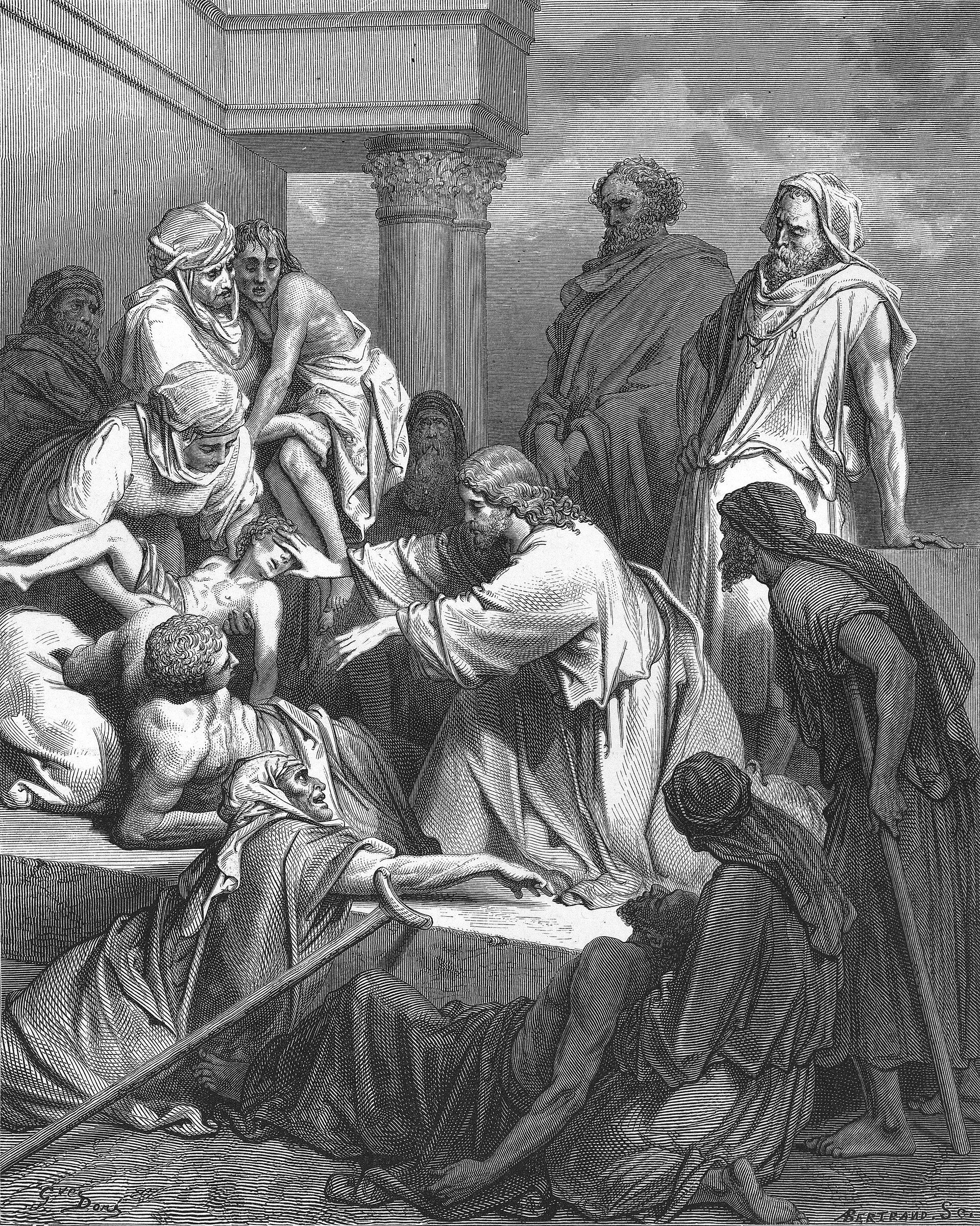
The Cure at the Pool of Bethesda. 1 After this there was a feast of the Jews; and Jesus went up to Jerusalem. 2 Now there is at Jerusalem by the sheep market a pool, which is called in the Hebrew tongue Bethesda, having five porches.
quarantine:scripture (2026-07-29) — scripture-overlap:91%@v1-3
The Nineteenth Century5 voices
A commentator
Albert Barnes1798–1870
Notes, Explanatory and Practical, on the Old and New Testaments (1832-1869)
If I bear witness of myself - If I have no other evidence than my own testimony about myself. My witness - My testimony; my evidence. The proof would not be decisive. Is not true - The word “true,” here, means worthy of belief, or established by suitable evidence. See Mat 22:16; “We Know that thou art true” - that is, worthy of confidence, or that thou hast been truly sent from God, Luk 20:21; Joh 8:13, Joh 8:17. The law did not admit a man to testify in his own case, but required two witnesses, Deu 17:
A commentator
J.C. Ryle1816–1900
Expository Thoughts on the Gospels: John (lightly modernized text, Grace Gems edition) (1869)
In these verses we see the proof of our Lord Jesus Christ being the promised Messiah, set forth before the Jews in one view. Four different witnesses are brought forward. Four kinds of evidence are offered. His Father in heaven—His forerunner, John the Baptist—the miraculous works He had done—the Scriptures, which the Jews professed to honor—each and all are named by our Lord, as testifying that He was the Christ, the Son of God. Hard must those hearts have been which could hear such testimony; and yet remain unmoved!
A commentator
Jamieson, Fausset & Brown1802–1910
Commentary Critical and Explanatory on the Whole Bible (1871)
proposed
of mine own self do nothing--that is, apart from the Father, or in any interest than My own. (See on Joh 5:19). as I hear--that is, "My judgments are all anticipated in the bosom of My Father, to which I have immediate access, and by Me only responded to and reflected.
quarantine:debris (2026-07-29) — starts-lowercase+odd-straight-quotes
A commentator
J.C. Ryle1816–1900
Expository Thoughts on the Gospels: John (lightly modernized text, Grace Gems edition) (1869)
proposed
In these verses we see the proof of our Lord Jesus Christ being the promised Messiah, set forth before the Jews in one view. Four different witnesses are brought forward. Four kinds of evidence are offered. His Father in heaven—His forerunner, John the Baptist—the miraculous works He had done—the Scriptures, which the Jews professed to honor—each and all are named by our Lord, as testifying that He was the Christ, the Son of God. Hard must those hearts have been which could hear such testimony; and yet remain unmoved! But it only proves the truth of the old saying—that unbelief does not arise so much from lack of evidence, as from lack of will to believe. Let us observe for one thing in this passage, the honor Christ puts on His faithful SERVANTS. See how He speaks of John the Baptist. "He bore witness of the truth"—"He was a burning and a shining light." John had probably passed away from his earthly labors when these words were spoken. He had been persecuted, imprisoned, and put to death by Herod—none interfering, none trying to prevent his murder. But this murdered disciple was not forgotten by his Divine Master. If no one else remembered him, Jesus did. He had honored Christ, and Christ honored him. These things ought not to be overlooked. They are written to teach us that Christ cares for all His believing people, and never forgets them. Forgotten and despised by the world, perhaps, they are never forgotten by their Savior. He knows where they dwell, and what their trials are. A book of remembrance is written for them. "Their tears are all in His bottle." (Psalm 56:8.) Their names are engraved on the palms of His hands. He notices all they do for Him in this evil world, though they think it not worth notice, and He will confess it one day publicly, before His Father and the holy angels. He that bore witness to John the Baptist never changes.
If I bear witness - If I had no proof to bring of my being the Messiah, and equal to God, common sense would direct you to reject my testimony; but the mighty power of God, by which I work my miracles, sufficiently attests that my pretensions are well founded. Bishop Pearce gives a different turn to this verse, by translating it interrogatively, thus: “If I only bear witness of myself, is not my witness true? i.e. is it, on that account, not true? In Joh 8:14, he says, Though I bear record of myself, yet my record is true. And in Joh 8:18, he says, I am one that bear witness of myself.”
The words behind it
11 Greek wordsEvery Greek word of this verse in the order it stands, with what it means and the door to its own study. The last column counts the times a word stands in the whole Bible: the rarer the word, the more the places it appears belong together.
| Greek | Sound | Meaning | Word study | In the Bible |
|---|---|---|---|---|
| Ἐὰν | ean | If | G1437 → | 352 times |
| ἐγὼ | ego | I myself | G1473 → | 839 times |
| μαρτυρῶ | marturo | shall bear witness | G3140 → | 76 times |
| περὶ | peri | concerning | G4012 → | 332 times |
| ἐμαυτοῦ, | emautou | Myself, | G1473 → | 839 times |
| ἡ | he | the | G3588 → | 19766 times |
| μαρτυρία | marturia | testimony | G3141 → | 37 times |
| μου | mou | of Mine | G3165 → | 1936 times |
| οὐκ | ouk | not | G3756 → | 1664 times |
| ἔστιν | estin | is | G1510 → | 2333 times |
| ἀληθής· | alethes | true; | G227 → | 26 times |
ἘὰνIf
eanG1437 →352 times
ἐγὼI myself
egoG1473 →839 times
μαρτυρῶshall bear witness
marturoG3140 →76 times
περὶconcerning
periG4012 →332 times
ἐμαυτοῦ,Myself,
emautouG1473 →839 times
ἡthe
heG3588 →19766 times
μαρτυρίαtestimony
marturiaG3141 →37 times
μουof Mine
mouG3165 →1936 times
οὐκnot
oukG3756 →1664 times
ἔστινis
estinG1510 →2333 times
ἀληθής·true;
alethesG227 →26 times
A shaded row is a word that stands 400 times or fewer in the Bible.
The walk
8 stopsEach card is a verse this one points to, and under it the verses that one points to in turn. Where several paths arrive at the same place, that place is listed first: the text keeps returning to it.
Through
Proverbs 27:2Let another praise you, and not your own mouth—a stranger, and not your own lips.
it leads to
- 2 Corinthians 10:18
For it is not the one who commends himself who is approved, but the one whom the Lord commends.
Reached by 2 separate paths from here.
- Proverbs 25:27
It is not good to eat too much honey or to search out one’s own glory.
Reached by 2 separate paths from here.
- 2 Corinthians 10:12
We do not dare to classify or compare ourselves with some who commend themselves. When they measure themselves by themselves and compare themselves with themselves, they show their ignorance.
- 2 Corinthians 10:18
Through
Revelation 3:14To the angel of the church in Laodicea write: These are the words of the Amen, the faithful and true Witness, the Originator of God’s creation.
it leads to
- Colossians 1:15
The Son is the image of the invisible God, the firstborn over all creation.
- Revelation 1:5
and from Jesus Christ, the faithful witness, the firstborn from the dead, and the ruler of the kings of the earth. To Him who loves us and has released us from our sins by…
- 2 Corinthians 1:20
For all the promises of God are “Yes” in Christ. And so through Him, our “Amen” is spoken to the glory of God.
- Colossians 1:18
And He is the head of the body, the church; He is the beginning and firstborn from among the dead, so that in all things He may have preeminence.
- Revelation 3:7
To the angel of the church in Philadelphia write: These are the words of the One who is holy and true, who holds the key of David. What He opens no one can shut,…
- Colossians 1:15
Where this verse is studied
About John
This page draws on 20 works. Open the list of works
This page draws on Adam Clarke, Commentary on the Bible; Albert Barnes, Notes, Explanatory and Practical, on the Gospels; Albert Barnes, Notes, Explanatory and Practical, on the Old and New Testaments (1832-1869); Alcuin of York, Catena Aurea by Aquinas; Augustine of Hippo, Catena Aurea by Aquinas; Bonaventure, Commentary on John, Chapter 5; Cyprian, Epistle LXVIII; Cyril of Alexandria, Commentary on the Gospel of John, Book 2; Hilary of Poitiers, On the Trinity, Book 6.27; J.C. Ryle, Expository Thoughts on the Gospels: John (lightly modernized text, Grace Gems edition); Jamieson, Fausset & Brown, Commentary Critical and Explanatory on the Whole Bible; John Chrysostom, Homily on the Gospel of John 40; John Gill, Exposition of the New Testament; John Gill, Exposition of the New Testament (1746-1748); John Wesley, Explanatory Notes upon the New Testament; Matthew Henry, Commentary on the Whole Bible; Tertullian, AGAINST MARCION 3.2; Tertullian, The Prescription Against Heretics; Theophylact of Ohrid, Commentary on John and Thomas Aquinas, Commentary on John.