
John 5:14
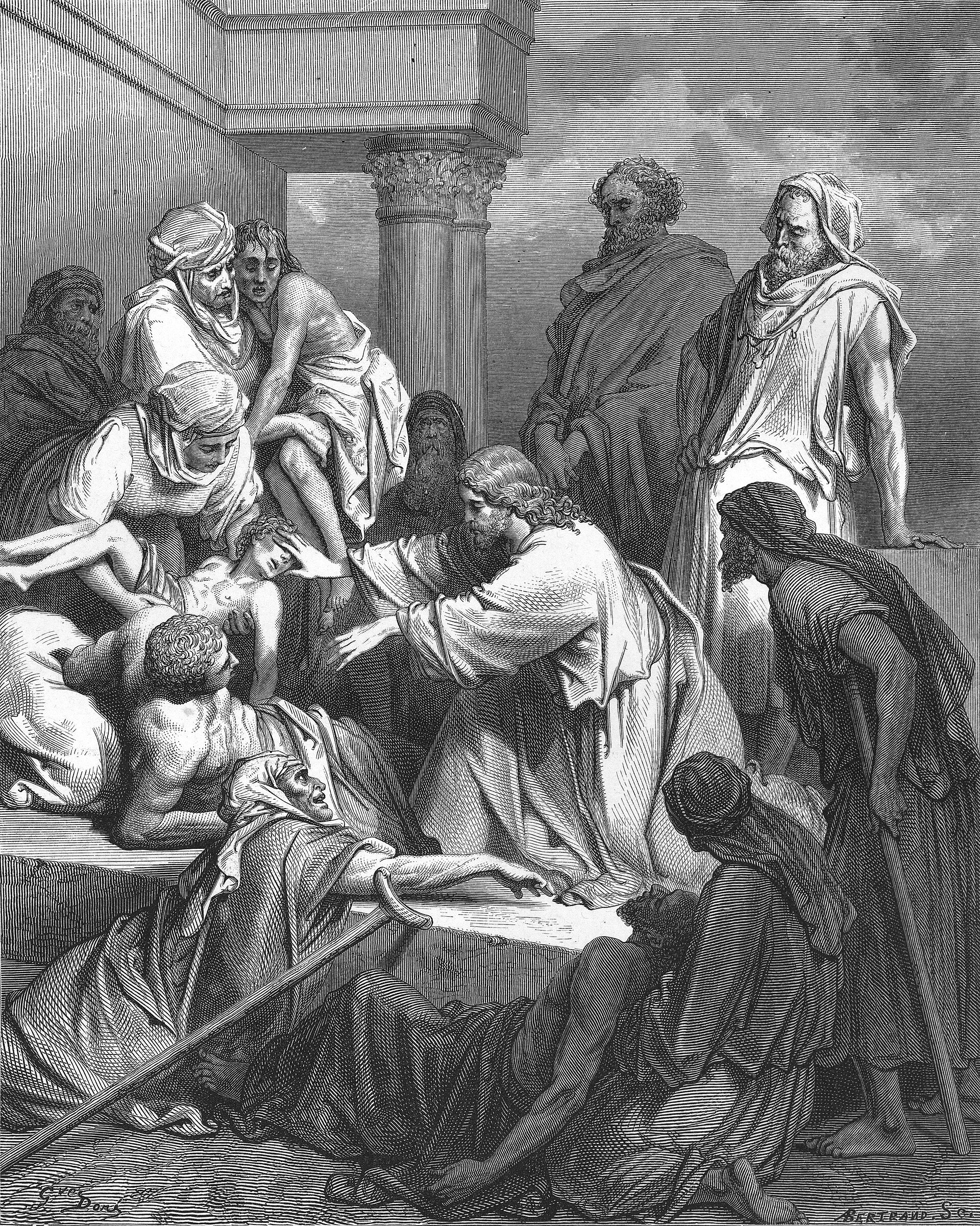
in John 5Afterward, Jesus found the man at the temple and said to him, “See, you have been made well. Stop sinning, or something worse may happen to you.”
BSB
The same verse in ASV and KJV ▾
ASV
Afterward Jesus findeth him in the temple, and said unto him, Behold, thou art made whole: sin no more, lest a worse thing befall thee.
KJV
Afterward Jesus findeth him in the temple, and said unto him, Behold, thou art made whole: sin no more, lest a worse thing come unto thee.
⋯
This verse in John 5
Commentary
34 notes on this verseJesus findeth him in the temple - The man being conscious that it was through the mercy of God that he was restored, (though he did not as yet know distinctly who Christ was), went to the temple to return thanks to God for his cure.
This site's exposition
Stop sinning, or something worse may happen
Jesus finds the man at the temple and leaves him with a warning. Stop sinning ties the man's future to how he now lives, and something worse than thirty-eight years of sickness is in view. The healing came with a word about his life.
The record, by era
The Church Fathers5 voices
In a word, even now as yet thou knowest not Jesus, not yet seest Jesus: what follows thereafter? Since that man desisted not from taking up his bed and walking, "Jesus seeth him afterwards in the temple." He did not see Jesus in the crowd, he saw Him in the temple. The Lord Jesus, indeed, saw him both in the crowd and in the temple; but the impotent man does not know Jesus in the crowd, but he knows Him in the temple. The man came then to the Lord: saw Him in the temple, saw Him in a consecrated, saw Him in a holy place. And what does the Lord say to him? "Behold, thou art made whole; sin no more, lest some worse thing befall thee."
(Tr. xvii. c. 11) The Lord Jesus saw him both in the crowd, and in the temple. The impotent man does not recognise Jesus in the crowd; but in the temple, being a sacred place, he does.
And for this reason did the Lord most plainly manifest Himself and the Father to His disciples, lest, forsooth, they might seek after another God besides Him who formed man, and who gave him the breath of life; and that men might not rise to such a pitch of madness as to feign another Father above the Creator.
This is in accordance with what the Lord said to the man who had been healed: "Behold, thou art made whole; sin no more, lest a worse thing come unto thee." For he who is good, and righteous, and pure, and spotless, will endure nothing evil, nor unjust, nor detestable in His wedding chamber. This is the Father of our Lord, by whose providence all things consist, and all are administered by His command; and He confers His free gifts upon those who should [receive them]; but the most righteous Retributor metes out [punishment] according to their deserts, most deservedly, to the ungrateful and to those that are insensible of His kindness...
After the paralytic apologized, saying that another had ordered him to take up his mat on a sabbath, the Jews turned their rage against the one who had given the order.… When he pointed Jesus out to such an enraged and furious people, however, he …
27 more voices on this verse
The Church Fathers14 voices
Yesterday you were flung upon a bed, exhausted and paralyzed, and you had no one to put you into the pool when the water should be troubled. Today you have him who is in one person man and God, or rather God and man. You were raised up from your bed, or rather you took up your bed and publicly acknowledged the benefit. Do not again be thrown on your bed by sinning.… But as you now are, so walk, mindful of the command.… Sin no more lest a worse thing happen to you if you prove yourself to be evil after the blessing you have received.
A commentator
Cyril of AlexandriaCommentary on the Gospel of John, Book 2 · Written before 444.
proposed
Being hid at first economically, He appears again economically, observing the time fit for each. For it was not possible that ought should be done by Him Who knew no sin, which should not really have its fit reason. The reason then of His speaking to him He made a message for his soul's health, saying that it behoved him to transgress no more, lest he be tormented by worse evils than those past. Herein He teaches that not only does God treasure up man's transgressions unto the judgment to come, but manifoldly scourgeth those yet living in their bodies, even before the great and notable day of Him That shall judge all. But that we are oftentimes smitten when we stumble and grieve God, the most wise Paul will testify, crying, For this cause many are weak and sickly among you, and many sleep: for if we would judge ourselves, we should not be judged: but when we are judged, we are chastened of the Lord, that we be not condemned with the world.
Or if he appoints himself a searcher and judge of the heart and reins, let him in all cases judge equally. And as he knows that it is written, "Behold, thou art made whole; sin no more, lest a worse thing happen unto thee," let him separate the fraudulent and adulterers from his side and from his company, since the case of an adulterer is by far both graver and worse than that of one who has taken a certificate, because the latter has sinned by necessity, the former by free will: the latter, thinking that it is sufficient for him that he has not sacrificed, has been deceived by an error; the former, a violator of the matrimonial tie of another, or entering a brothel, into the sink and filthy gulf of the common people, has befouled by detestable impurity a sanctified body and God's temple, as says the apostle: "Every sin that a man doeth is without the body, but he that committeth fornication sinneth against his own body." And yet to these persons themselves repentance is granted, and the hope of lamenting and atoning is left, according to the saying of the same apostle: "I fear lest, when I come to you, I shall bewail many of those who have sinned already, and have not repented of the uncleanness, and fornication, and lasciviousness which they have committed."
Yet I exhort you by our common faith, by the true and simple love of my heart towards you, that, having overcome the adversary in this first encounter, you should hold fast your glory with a brave and persevering virtue. We are still in the world; we are still placed in the battle-field; we fight daily for our lives. Care must be taken, that after such beginnings as these there should also come an increase, and that what you have begun to be with such a blessed commencement should be consummated in you. It is a slight thing to have been able to attain anything; it is more to be able to keep what you have attained; even as faith itself and saving birth makes alive, not by being received, but by being preserved. Nor is it actually the attainment, but the perfecting, that keeps a man for God. The Lord taught this in His instruction when He said, "Behold, thou art made whole; sin no more, lest a worse thing come unto thee."3 Conceive of Him as saying this also to His confessor, "Lo thou art made a confessor; sin no more, lest a worse thing come unto thee." Solomon also, and Saul, and many others, so long as they walked in the Lord's ways, were able to keep the grace given to them. When the discipline of the Lord was forsaken by them, grace also forsook them.
But if in Holy Scripture discipline is frequently and everywhere prescribed, and the whole foundation of religion and of faith proceeds from obedience and fear; what is more fitting for us urgently to desire, what more to wish for and to hold fast, than to stand with roots strongly fixed, and with our houses based with solid mass upon the rock unshaken by the storms and whirlwinds of the world, so that we may come by the divine precepts to the rewards of God? considering as well as knowing that our members, when purged from all the filth of the old contagion by the sanctification of the layer of life, are God's temples, and must not be violated nor polluted, since he who does violence to them is himself injured. We are the worshippers and priests of those temples; let us obey Him whose we have already begun to be. Paul tells us in his epistles, in which he has formed us to a course of living by divine teaching, "Ye are not your own, for ye are bought with a great price; glorify and bear God in your body." Let us glorify and bear God in a pure and chaste body, and with a more complete obedience; and since we have been redeemed by the blood of Christ, let us obey and give furtherance to the empire of our Redeemer by all the obedience of service, that nothing impure or profane may be brought into the temple of God, lost He should be offended, and forsake the temple which He inhabits. […]
A commentator
CyprianTreatise XII. Three Books of Testimonies Against the Jews. · Written before 258.
proposed
That even a baptized person loses the grace that he has attained, unless he keep innocency. In the Gospel according to John: "Lo, thou art made whole: sin no more, lest a worse thing happen unto thee." Also in the first Epistle of Paul to the Corinthians: "Know ye not that ye are the temple of God, and the Spirit of God abideth in you? If any one violate the temple of God, him will God destroy." Of this same thing in the Chronicles: "God is with you, while ye are with Him: if ye forsake Him, He will forsake you."
A Fearful thing is sin, fearful, and the ruin of the soul, and the mischief oftentimes through its excess has overflowed and attacked men's bodies also. For since for the most part when the soul is diseased we feel no pain, but if the body receive though but a little hurt, we use every exertion to free it from its infirmity, because we are sensible of the infirmity, therefore God oftentimes punisheth the body for the transgressions of the soul, so that by means of the scourging of the inferior part, the better part also may receive some healing.
Now what do we learn from this? First, that his disease had been produced by his sins; secondly, that the accounts of hell fire are to be believed; thirdly, that the punishment is long, nay endless. Where now are those who say, "I murdered in an hour, I committed adultery in a little moment of time, and am I eternally punished?" For behold this man had not sinned for so many years as he suffered, for he had spent a whole lifetime in the length of his punishment; and sins are not judged by time, but by the nature of the transgressions.
Besides this, we may see another thing, that though we have suffered severely for former sins, if we afterwards fall into the same, we shall suffer much more severely. And with good reason; for he who is not made better even by punishment, is afterwards led as insensible and a despiser to still heavier chastisement. The fault should of itself be sufficient to check and to render more sober the man who once has slipped, but when not even the addition of punishment effects this, he naturally requires more bitter torments.
"And wherefore," saith some one, "are not all thus punished? for we see many bad men well in body, vigorous, and enjoying great prosperity." But let us not be confident, let us mourn for them in this case most of all, since their having suffered nothing here, helps them on to a severer vengeance hereafter. As Paul declares when he saith, "But now that we are judged, we are chastened of the Lord, that we should not be condemned with the world" (1 Cor. xi. 32); for the punishments here are for warning, there for vengeance.
"What then," saith one, "do all diseases proceed from sin?" Not all, but most of them; and some proceed from different kinds of loose living, since gluttony, intemperance, and sloth, produce such like sufferings. But the one rule we have to observe, is to bear every stroke thankfully; for they are sent because of our sins, as in the Kings we see one attacked by gout (1 Kings xv. 23); they are sent also to make us approved, as the Lord saith to Job, "Thinkest thou that I have spoken to thee, save that thou mightest appear righteous?" (Job xl. 8 LXX.)
But why is it that in the case of these paralytics Christ bringeth forward their sins? For He saith also to him in Matthew who lay on a bed, "Son, be of good cheer, thy sins are forgiven thee" (Matt. ix. 2): and to this man, "Behold, thou art made whole; sin no more." I know that some slander this paralytic, asserting that he was an accuser of Christ, and that therefore this speech was addressed to him; what then shall we say of the other in Matthew, who heard nearly the same words? For Christ saith to him also, "Thy sins be forgiven thee." Whence it is clear, that neither was this man thus addressed on the account which they allege.
And observe the absence of boasting. He said not, "Behold, I have made thee whole," but, "Thou art made whole; sin no more." And again, not, "lest I punish thee," but, "lest a worse thing come unto thee"; putting both expressions not personally, and showing that the cure was rather of grace than of merit. For He declared not to him that he was delivered after suffering the deserved amount of punishment, but that through lovingkindness he was made whole. Had this not been the case, He would have said, "Behold, thou hast suffered a sufficient punishment for thy sins, be thou steadfast for the future." But now He spake not so, but how? "Behold, thou art made whole; sin no more." Let us continually repeat these words to ourselves, and if after having been chastised we have been delivered, let each say to himself, "Behold, thou art made whole; sin no more."
And not only by strengthening the sick man's body, but also in another way, did He afford him a strong proof of His Divinity; for by saying, "Sin no more," He showed that He knew all the transgressions that had formerly been committed by him; and by this He would gain his belief as to the future.
The Medieval Church4 voices
From the Lord's words to the paralytic: "Behold, you have been made well; sin no more," we learn, first, that the illness befell this man on account of his sins, and second, that the teaching about Gehenna is true and that the torment is eternal. …
"Afterward Jesus found him in the temple," namely when he had withdrawn from the crowd. Augustine: "Placed in the crowd he did not recognize Jesus, but afterward in the temple": in which we are taught that whoever wishes to attain the vision of God should …
(in loc.)c. For if we would know our Maker's grace, and attain to the sight of Him, we must avoid the crowd of evil thoughts and affections, convey ourselves out of the congregation of the wicked, and flee to the temple; in order that we may make ourselves the temple of God, souls whom God will visit, and in whom He will deign to dwell. And (He) said unto him, Behold, thou art made whole; sin no more, lest a worse thing come upon thee.
Then (v 14), the Evangelist tells us how Jesus was found. First, he says that he was found. Secondly, that after having been found, he taught. Thirdly, that after having taught, his identity was reported to the Jews. The Evangelist tells us both where and …
The Puritans and the Awakening4 voices
Sin no more - It seems his former illness was the effect or punishment of sin.
The sermon was Christ's vindication of himself before the sanhedrim, when he was prosecuted as a criminal for healing the man on the sabbath day, in which, 1. He asserts his authority as Messiah, and Mediator between God and man,
9 . [2.] He gives him a caution against sin, in consideration hereof, Being made whole, sin no more. This implies that his disease was the punishment of sin; whether of some remarkably flagrant sin, or only of sin in general, we cannot tell, but we know that sin is the procuring cause of sickness, Ps. cvii.
Afterward Jesus findeth him in the temple,....
The Nineteenth Century5 voices
A commentator
Jamieson, Fausset & Brown1802–1910
Commentary Critical and Explanatory on the Whole Bible (1871)
Jesus, there Himself for His own ends, "findeth him there"--not all accidentally, be assured. sin no more, &c.--a glimpse this of the reckless life he had probably led before his thirty-eight years' infirmity had come upon him, and which not improbably had brought on, in the just judgment of God, his chronic complaint.
A commentator
Jamieson, Fausset & Brown1802–1910
Commentary Critical and Explanatory on the Whole Bible (1871)
The Jews--that is, those in authority. (See on Joh 1:19.) it is not lawful to carry thy bed--a glorious testimony to the cure, as instantaneous and complete, from the lips of the most prejudiced!
A commentator
J.C. Ryle1816–1900
Expository Thoughts on the Gospels: John (lightly modernized text, Grace Gems edition) (1869)
proposed
We have in this passage one of the few miracles of Christ, which John records. Like every other miracle in this Gospel, it is described with great minuteness and particularity. And like more than one other miracle it leads on to a discourse full of singularly deep instruction. We are taught, for one thing, in this passage, what misery sin has brought into the world. We read of a man who had been ill for no less than thirty-eight years! For thirty-eight weary summers and winters he had endured pain and infirmity.
A commentator
J.C. Ryle1816–1900
Expository Thoughts on the Gospels: John (lightly modernized text, Grace Gems edition) (1869)
proposed
We have in this passage one of the few miracles of Christ, which John records. Like every other miracle in this Gospel, it is described with great minuteness and particularity. And like more than one other miracle it leads on to a discourse full of singularly deep instruction. We are taught, for one thing, in this passage, what misery sin has brought into the world. We read of a man who had been ill for no less than thirty-eight years! For thirty-eight weary summers and winters he had endured pain and infirmity. He had seen others healed at the waters of Bethesda, and going to their homes rejoicing. But for him there had been no healing. Friendless, helpless, and hopeless, he lay near the wonder-working waters, but derived no benefit from them. Year after year passed away, and left him still uncured. No relief or change for the better seemed likely to come, except from the grave. When we read of cases of sickness like this, we should remember how deeply we ought to hate sin! Sin was the original root, and cause, and fountain of every disease in the world. God did not create man to be full of aches, and pains, and infirmities. These things are the fruits of the Fall. There would have been no sickness, if there had been no sin. No greater proof can be shown of man's inbred unbelief, than his carelessness about sin. "Fools," says the wise man, "make a mock at sin." (Pro. 14:9.) Thousands delight in things which are explicitly evil, and run greedily after that which is downright poison. They love that which God abhors, and dislike that which God loves. They are like the madman, who loves his enemies and hates his friends. Their eyes are blinded. Surely if men would only look at hospitals and infirmaries, and think what havoc sin has made on this earth, they would never take pleasure in sin as they do. Well may we be told to pray for the coming of God's kingdom!
A commentator
Albert Barnes1798–1870
Notes, Explanatory and Practical, on the Old and New Testaments (1832-1869)
proposed
Findeth him - Fell in with him, or saw him. In the temple - The man seems to have gone at once to the temple - perhaps a privilege of which he had been long deprived. They who are healed from sickness should seek the sanctuary of God and give him thanks for his mercy. Compare the notes at Isa 38:20. There is nothing more improper, when we are raised up from a bed of pain, than to forget God our benefactor, and neglect to praise him for his mercies. Thou art made whole - Jesus calls to his remembrance the fact that he was healed, in order that he might admonish him not to sin again. Sin no more - By this expression it was implied that the infirmity of this man was caused by sin - perhaps by vice in his youth. His crime or dissipation had brought on him this long and distressing affliction. Jesus shows him that he knew the cause of his sickness, and takes occasion to warn him not to repeat it. No man who indulges in vice can tell what may be its consequences. It must always end in evil, and not unfrequently it results in loss of health, and in long and painful disease. This is always the case with intemperance and all gross pleasures. Sooner or later, sin will always result in misery. Sin no more - Do not repeat the vice. You have had dear-bought experience, and if repeated it will be worse. When a man has been restored from the effects of sin, he should learn to avoid the very appearance of evil. He should shun the place of temptation; he should not mingle again with his old companions; he should touch not, taste not, handle not. God visits with heavier judgment those who have been once restored from the ways of sin and who return again to it. […]
How the passage was read
On John 5:1-18On John 5:1-18
The mat, the carrying rule, and where the ways part
“It is the sabbath day: it is not lawful for thee to carry thy bed.” The objectors stand on a real rule with a prophetic root: Jeremiah 17:21-22 forbids bearing burdens through Jerusalem's gates on the Sabbath, and the tradition codified carrying between domains as the last of the thirty-nine categories of forbidden labor (Mishnah Shabbat 7:2). The tradition's own case law even makes the fine distinction the scene turns on: one who carries out a living person on a bed is exempt FOR THE PERSON, “because the bed is secondary to the person” (Mishnah Shabbat 10:5); it is the mat alone the rule could name. Note also what no one disputes: the healing itself. Jesus healed by a word; a thirty-eight-year lameness was chronic, not mortal (mortal danger overrides the Sabbath, Mishnah Yoma 8:6), so on the tradition's categories the man could have waited one more day. Jesus refuses the wait.
Where the ways part
At verse 18 the scene reaches the real parting of the ways, and honesty requires it be said plainly: Jesus “said also that God was his Father, making himself equal with God.” Here the difference is not over practice but over an essential of the Christian faith. Judaism then and now confesses the one God and reads such a claim by a man as blasphemy; Christian confession holds that Jesus' claim is true, that the Son does what the Father does (5:19-29). The two readings cannot both be right, and this page presents each side in its own words, with respect and without blur.
This section is reception history: how the passage was read and kept in the Jewish tradition. Where a reading parts from an essential of the Christian faith, the section says so at that point.
Sources: Mishnah Shabbat 7:2 (carrying, the last category) · Mishnah Shabbat 10:5 (the person exempt, the bed secondary) · Mishnah Yoma 8:6 (danger to life overrides the Sabbath)
The words behind it
23 Greek wordsEvery Greek word of this verse in the order it stands, with what it means and the door to its own study. The last column counts the times a word stands in the whole Bible: the rarer the word, the more the places it appears belong together.
| Greek | Sound | Meaning | Word study | In the Bible |
|---|---|---|---|---|
| μετὰ | meta | After | G3326 → | 461 times |
| ταῦτα | tauta | these things | G3778 → | 1381 times |
| εὑρίσκει | heuriskei | finds | G2147 → | 175 times |
| αὐτὸν | auton | him | G846 → | 5565 times |
| ὁ | ho | <the> | G3588 → | 19766 times |
| Ἰησοῦς | iesous | Jesus | G2424 → | 908 times |
| ἐν | en | in | G1722 → | 2738 times |
| τῷ | to | the | G3588 → | 19766 times |
| ἱερῷ | hi'ero | temple | G2411 → | 70 times |
| καὶ | kai | and | G2532 → | 9120 times |
| εἶπεν | eipen | said | G2036 → | 925 times |
| αὐτῷ· | auto | to him; | G846 → | 5565 times |
| ἴδε | ide | Behold | G2396 → | 30 times |
| ὑγιὴς | hugies | well | G5199 → | 11 times |
| γέγονας· | gegonas | you have become; | G1096 → | 667 times |
| μηκέτι | meketi | no more | G3371 → | |
| ἁμάρτανε | hamartane | do sin | G264 → | 42 times |
| ἵνα | ina | that | G2443 → | 668 times |
| μὴ | me | not | G3361 → | 1066 times |
| χεῖρόν | cheiron | worse | G5501 → | |
| σοί | soi | to you | G4771 → | 2973 times |
| τι | ti | something | G5100 → | 528 times |
| γένηται. | genetai | may happen. | G1096 → | 667 times |
μετὰAfter
metaG3326 →461 times
ταῦταthese things
tautaG3778 →1381 times
εὑρίσκειfinds
heuriskeiG2147 →175 times
αὐτὸνhim
autonG846 →5565 times
ὁ<the>
hoG3588 →19766 times
ἸησοῦςJesus
iesousG2424 →908 times
ἐνin
enG1722 →2738 times
τῷthe
toG3588 →19766 times
ἱερῷtemple
hi'eroG2411 →70 times
καὶand
kaiG2532 →9120 times
εἶπενsaid
eipenG2036 →925 times
αὐτῷ·to him;
autoG846 →5565 times
ἴδεBehold
ideG2396 →30 times
ὑγιὴςwell
hugiesG5199 →11 times
γέγονας·you have become;
gegonasG1096 →667 times
μηκέτιno more
meketiG3371 →
ἁμάρτανεdo sin
hamartaneG264 →42 times
ἵναthat
inaG2443 →668 times
μὴnot
meG3361 →1066 times
χεῖρόνworse
cheironG5501 →
σοίto you
soiG4771 →2973 times
τιsomething
tiG5100 →528 times
γένηται.may happen.
genetaiG1096 →667 times
A shaded row is a word that stands 400 times or fewer in the Bible.
The walk
8 stopsEach card is a verse this one points to, and under it the verses that one points to in turn. Where several paths arrive at the same place, that place is listed first: the text keeps returning to it.
Through
John 8:11“No one, Lord,” she answered. “Then neither do I condemn you,” Jesus declared. “Now go and sin no more.”
it leads to
- John 3:17
For God did not send His Son into the world to condemn the world, but to save the world through Him.
- John 8:15
You judge according to the flesh; I judge no one.
- Isaiah 1:16–18
Wash and cleanse yourselves. Remove your evil deeds from My sight. Stop doing evil!
- Luke 15:7
In the same way, I tell you that there will be more joy in heaven over one sinner who repents than over ninety-nine righteous ones who do not need to repent.
- Luke 5:32
I have not come to call the righteous, but sinners, to repentance.”
- John 3:17
Through
Psalms 118:18The LORD disciplined me severely, but He has not given me over to death.
it leads to
- 1 Corinthians 11:32
But when we are judged by the Lord, we are being disciplined so that we will not be condemned with the world.
- Job 5:17–18
Blessed indeed is the man whom God corrects; so do not despise the discipline of the Almighty.
- 2 Corinthians 6:9
as unknown, yet well-known; dying, and yet we live on; punished, yet not killed;
- 1 Corinthians 11:32
Where this verse is studied
On this page
About John
This page draws on 25 works. Open the list of works
This page draws on Adam Clarke, Commentary on the Bible; Albert Barnes, Notes, Explanatory and Practical, on the Gospels; Albert Barnes, Notes, Explanatory and Practical, on the Old and New Testaments (1832-1869); Alcuin of York, Catena Aurea by Aquinas; Augustine of Hippo, Tractates on John 17; Augustine of Hippo, Catena Aurea by Aquinas; Bonaventure, Commentary on John, Chapter 5; Cyprian, Epistle LI; Cyprian, Epistle VI; Cyprian, Treatise II. On the Dress of Virgins.; Cyprian, Treatise XII. Three Books of Testimonies Against the Jews.; Cyril of Alexandria, Commentary on the Gospel of John, Book 2; Gregory of Nazianzus, ON HOLY BAPTISM, ORATION 40.33; Irenaeus, Irenaeus Against Heresies Book 5; Irenaeus, Irenaeus Against Heresies Book 4; J. C. Ryle, Expository Thoughts on the Gospels, John; J.C. Ryle, Expository Thoughts on the Gospels: John (lightly modernized text, Grace Gems edition); Jamieson, Fausset & Brown, Commentary Critical and Explanatory on the Whole Bible; John Chrysostom, Homily on the Gospel of John 38; John Gill, Exposition of the New Testament (1746-1748); John Wesley, Explanatory Notes upon the New Testament; Matthew Henry, Commentary on the Whole Bible; Theodore of Mopsuestia, COMMENTARY ON JOHN 2.5.12-15; Theophylact of Ohrid, Commentary on John and Thomas Aquinas, Commentary on John.