
John 5:36
in John 5But I have testimony more substantial than that of John. For the works that the Father has given Me to accomplish—the very works I am doing—testify about Me that the Father has sent Me.
BSB
The same verse in ASV and KJV ▾
ASV
But the witness which I have is greater than that of John; for the works which the Father hath given me to accomplish, the very works that I do, bear witness of me, that the Father hath sent me.
KJV
But I have greater witness than that of John: for the works which the Father hath given me to finish, the same works that I do, bear witness of me, that the Father hath sent me.
⋯
This verse in John 5
Commentary
20 notes on this verseEven though he was the lamp (saith He) both depicted by the books of the law, and proclaimed afore by the voice of the holy Prophets, that he should one day appear, beaming before the true Light, and declaring among you, that ye ought to put in good order the way of your Lord and God: yet since he haply seemeth to you not trustworthy, albeit so great in virtue, by reason of your innate unruly and most absurd folly, I proceed now to what is greater, against which probably ye will say nothing, ashamed before the very beauty of truth even against your own will.
This site's exposition
testimony more substantial than that of John
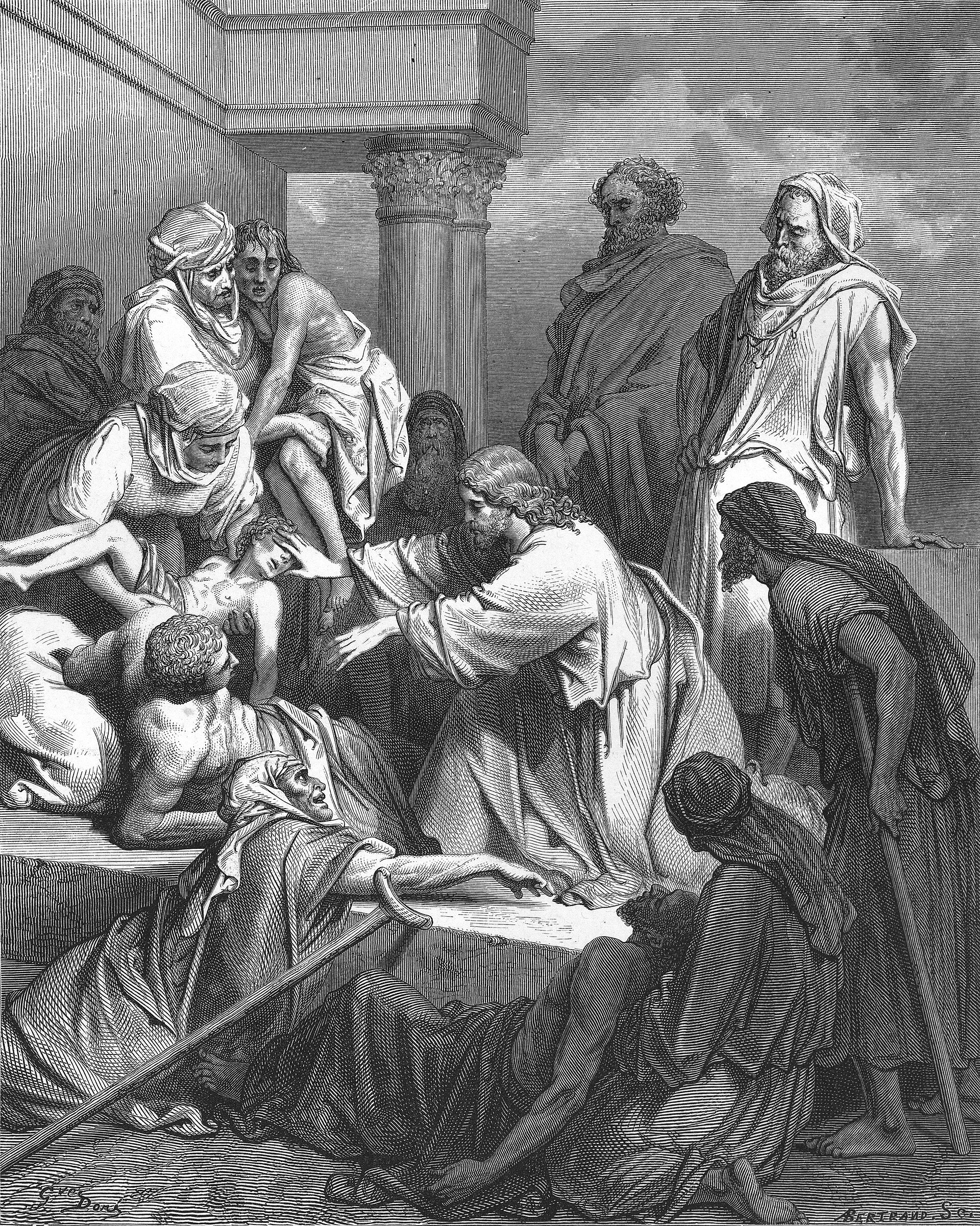
The second witness is the works themselves, given by the Father for the Son to accomplish. This Gospel calls such works signs, semeia in Greek, and the healing at Bethesda is one of them. The works testify that the Father has sent Him.
The record, by era
The Church Fathers5 voices
The Son speaks thus:—For the works which the Father hath given Me to finish, the same works which I do, bear witness of Me that the Father hath sent Me; and the Father Himself which hath sent Me hath borne witness of Me. God the Only-begotten proves His Sonship by an appeal not only to the name, but to the power; the works which He does are evidence that He has been sent by the Father. What, I ask, is the fact which these works prove? That He was sent. That He was sent, is used as a proof of His sonlike obedience and of His Father's authority: for the works which He does could not possibly be done by any other than Him Who is sent by the Father.
(vi. de Trin. c. 27) The Only-begotten God shows Himself to be the Son, on the testimony not of man only, but of His own power. The works which He does, bear witness to His being sent from the Father. Therefore the obedience of the Son and the authority of the Father are set forth in Him who was sent.
Are they blameless, in that they did not know the testimony of the Father, Who was never heard or seen amongst them, and Whose word was not abiding in them? No, for they cannot plead that His testimony was hidden from them; as Christ says, the testimony of His works is the testimony of the Father concerning Him. His works testify of Him that He was sent of the Father; but the testimony of these works is the Father's testimony; since, therefore, the working of the Son is the Father's testimony, it follows of necessity that the same nature was operative in Christ, by which the Father testifies of Him. So Christ, Who works the works, and the Father Who testifies through them, are revealed as possessing one inseparable nature through the birth, for the operation of Christ is signified to be itself the testimony of God concerning Him.
Afterwards He goes on to say: "But I have greater witness than that of John; for the works which the Father hath given me to finish-those very works bear witness of me that the Father hath sent me. And the Father Himself, which hath sent me, hath also borne witness of me." But He at once adds, "Ye have neither heard His voice at any time, nor seen His shape; " thus affirming that in former times it was not the Father, but the Son, who used to be seen and heard.
"But I have greater witness than that of John." "For had ye been willing to admit faith according to the (natural) consequence of the facts, I would have brought you over by My works more than he by his words. But since ye will not, I bring you to John, not as needing his testimony, but because I do all 'that ye may be saved.' For I have greater witness than that of John, namely, that from My works; yet I do not merely consider how I may be made acceptable to you by credible evidence, but how by that (of persons) known to and admired by you." Then glancing at them and saying that they rejoiced for a season in his (John's) light, He declared that their zeal was but temporary and uncertain.
13 more voices on this verse
The Church Fathers2 voices
Having then proved them altogether unworthy of forgiveness, He went on to say, "I have greater witness than that of John." "What is that?" It is that from His works. "For the works," He saith, "which the Father hath given Me to finish, the same works that I do bear witness of Me that the Father sent Me." By this He reminded them of the paralytic restored, and of many other things. The words perhaps one of them might have asserted were mere boast, and said by reason of John's friendship towards Him, (though indeed it was not in their power to say even this of John, a man equal to the exact practice of wisdom, and on this account admired by them,) but the works could not even among the maddest of them admit this suspicion; therefore He added this second testimony, saying, "The works which the Father hath given Me to finish, the same works that I do bear witness of Me that the Father sent Me."
In this place He also meeteth the accusation respecting the violation of the Sabbath. For since those persons argued, "How can he be from God, seeing that he keepeth not the Sabbath?", therefore He saith, "Which My Father hath given unto Me." Yet in truth, He acted with absolute power, but in order most abundantly to show that He doth nothing contrary to the Father, therefore He hath put the expression of much inferiority. Since why did He not say, "The works which the Father hath given Me testify that I am equal to the Father"? for both of these truths were to be learned from the works, that He did nothing contrary, and that He was equal to Him who begat Him; a point which He is establishing elsewhere, where He saith, "If ye believe not Me, believe the works: that ye may know and believe that I am in the Father and the Father in Me." In both respects, therefore, the works bare witness to Him, that He was equal to the Father, and that He did nothing contrary to Him. Why then said He not so, instead of leaving out the greater and putting forward this? Because to establish this was His first object. For although it was a far less thing to have it believed that He came from God, than to have it believed that God was equal with Him, (for that belonged to the Prophets also, but this never,) still He taketh much pains as to the lesser point, as knowing that, this admitted, the other would afterwards be easily received. So that making no mention of the more important portion of the testimony, He putteth its lesser office, that by this they may receive the other also...
The Medieval Church4 voices
That He enlightens the blind, that He opens the deaf ear, looses the mouth of the dumb, casts out devils, raises the dead; these works bear witness of Christ.
Then (v 36), he presents the divine testimony. First, he mentions its greatness; and then he continues on to describe it. He says: I do not need proof from men for my sake, but for your sake, for I have testimony that is greater than …
"John," He says, "bore witness about Me — John, whom you consider more trustworthy than all others." But since some slanderers might be found who would say, "What is that to us? John was favorable to You, and therefore gave a very good testimony," He …
"But I have testimony." Here the second testimony is touched upon, namely that of works, which is greater than the aforesaid. Therefore He says: "But I have testimony greater than John," because it is more persuasive for believing in Me. "For the very works, which …
The Puritans and the Awakening2 voices
The Cure at the Pool of Bethesda. 1 After this there was a feast of the Jews; and Jesus went up to Jerusalem. 2 Now there is at Jerusalem by the sheep market a pool, which is called in the Hebrew tongue Bethesda, having five porches.
quarantine:scripture (2026-07-29) — scripture-overlap:91%@v1-3
But I have greater witness than that of John,....
The Nineteenth Century5 voices
But I have greater witness - However decisive the judgment of such a man as John may be, who was the lamp of Israel, a miracle of grace, filled with the spirit of Elijah, and more than any prophet, because he pointed out, not the Messiah who was to come, but the Messiah who was already come: nevertheless, I am not obliged to depend on his testimony alone; for I have a greater one, that of Him whom you acknowledge to be your God. And how do I prove that this God bears testimony to me?
A commentator
J.C. Ryle1816–1900
Expository Thoughts on the Gospels: John (lightly modernized text, Grace Gems edition) (1869)
In these verses we see the proof of our Lord Jesus Christ being the promised Messiah, set forth before the Jews in one view. Four different witnesses are brought forward. Four kinds of evidence are offered. His Father in heaven—His forerunner, John the Baptist—the miraculous works He had done—the Scriptures, which the Jews professed to honor—each and all are named by our Lord, as testifying that He was the Christ, the Son of God. Hard must those hearts have been which could hear such testimony; and yet remain unmoved!
A commentator
Jamieson, Fausset & Brown1802–1910
Commentary Critical and Explanatory on the Whole Bible (1871)
I have greater witness--rather, "The witness which I have is greater." the works . . . bear witness of me--not simply as miracles nor even as a miracle of mercy, but these miracles, as He did them, with a will and a power, a majesty and a grace manifestly His own.
A commentator
J.C. Ryle1816–1900
Expository Thoughts on the Gospels: John (lightly modernized text, Grace Gems edition) (1869)
proposed
In these verses we see the proof of our Lord Jesus Christ being the promised Messiah, set forth before the Jews in one view. Four different witnesses are brought forward. Four kinds of evidence are offered. His Father in heaven—His forerunner, John the Baptist—the miraculous works He had done—the Scriptures, which the Jews professed to honor—each and all are named by our Lord, as testifying that He was the Christ, the Son of God. Hard must those hearts have been which could hear such testimony; and yet remain unmoved! But it only proves the truth of the old saying—that unbelief does not arise so much from lack of evidence, as from lack of will to believe. Let us observe for one thing in this passage, the honor Christ puts on His faithful SERVANTS. See how He speaks of John the Baptist. "He bore witness of the truth"—"He was a burning and a shining light." John had probably passed away from his earthly labors when these words were spoken. He had been persecuted, imprisoned, and put to death by Herod—none interfering, none trying to prevent his murder. But this murdered disciple was not forgotten by his Divine Master. If no one else remembered him, Jesus did. He had honored Christ, and Christ honored him. These things ought not to be overlooked. They are written to teach us that Christ cares for all His believing people, and never forgets them. Forgotten and despised by the world, perhaps, they are never forgotten by their Savior. He knows where they dwell, and what their trials are. A book of remembrance is written for them. "Their tears are all in His bottle." (Psalm 56:8.) Their names are engraved on the palms of His hands. He notices all they do for Him in this evil world, though they think it not worth notice, and He will confess it one day publicly, before His Father and the holy angels. He that bore witness to John the Baptist never changes.
A commentator
Albert Barnes1798–1870
Notes, Explanatory and Practical, on the Old and New Testaments (1832-1869)
proposed
Greater witness - Stronger, more decisive evidence. The works - The miracles - healing the sick and raising the dead. Hath given me - Hath committed to me, or appointed me to do. Certain things he intrusted in his hands to accomplish. To finish - To do or to perform until the task is completed. The word is applied to the “termination” of anything, as we say a task is “ended” or a work is completed. So Jesus said, when he expired, It is “finished” Joh 19:30. From this it appears that Jesus came to “accomplish” a certain work; and hence we see the reason why he so often guarded his life and sought his safety until the task was fully completed. These works or miracles bore witness of him; that is, they showed that he was sent from God, because none but God could perform them, and because God would not give such power to any whose life and doctrines he did not approve. They were more decisive proof than the testimony of John, because: 1. John worked no miracles, Joh 10:41. 2. It was possible that a man might be deceived or be an impostor. It was not possible for God to deceive. 3. The miracles which Jesus performed were such as no human being could work, and no angel. He that could raise the dead must have all power, and he who commissioned Jesus, therefore, must be God.
The words behind it
32 Greek wordsEvery Greek word of this verse in the order it stands, with what it means and the door to its own study. The last column counts the times a word stands in the whole Bible: the rarer the word, the more the places it appears belong together.
| Greek | Sound | Meaning | Word study | In the Bible |
|---|---|---|---|---|
| ἐγὼ | ego | I myself | G1473 → | 839 times |
| δὲ | de | however | G1161 → | 2765 times |
| ἔχω | echo | have | G2192 → | 707 times |
| τὴν | ten | the | G3588 → | 19766 times |
| μαρτυρίαν | marturian | testimony | G3141 → | 37 times |
| μείζω | meizo | greater than | G3173 → | 243 times |
| τοῦ | tou | that | G3588 → | 19766 times |
| Ἰωάννου· | ioannou | of John; | G2491 → | 134 times |
| τὰ | ta | <the> | G3588 → | 19766 times |
| γὰρ | gar | For | G1063 → | 1039 times |
| ἔργα | erga | the works | G2041 → | 168 times |
| ἃ | ha | that | G3739 → | 1405 times |
| δέδωκέν | dedoken | has given | G1325 → | 412 times |
| μοι | moi | Me | G3165 → | 1936 times |
| ὁ | ho | the | G3588 → | 19766 times |
| πατὴρ | pater | Father | G3962 → | 410 times |
| ἵνα | ina | that | G2443 → | 668 times |
| τελειώσω | teleioso | I may complete | G5048 → | 23 times |
| αὐτά, | auta | them, | G846 → | 5565 times |
| αὐτὰ | auta | same | G846 → | 5565 times |
| τὰ | ta | the | G3588 → | 19766 times |
| ἔργα | erga | works | G2041 → | 168 times |
| ἃ | ha | which | G3739 → | 1405 times |
| ποιῶ, | poio | I do, | G4160 → | 569 times |
| μαρτυρεῖ | marturei | bear witness | G3140 → | 76 times |
| περὶ | peri | concerning | G4012 → | 332 times |
| ἐμοῦ | emou | Me | G1473 → | 839 times |
| ὅτι | hoti | that | G3754 → | 1292 times |
| ὁ | ho | the | G3588 → | 19766 times |
| πατήρ | pater | Father | G3962 → | 410 times |
| με | me | Me | G3165 → | 1936 times |
| ἀπέσταλκεν. | apestalken | has sent. | G649 → | 132 times |
ἐγὼI myself
egoG1473 →839 times
δὲhowever
deG1161 →2765 times
ἔχωhave
echoG2192 →707 times
τὴνthe
tenG3588 →19766 times
μαρτυρίανtestimony
marturianG3141 →37 times
μείζωgreater than
meizoG3173 →243 times
τοῦthat
touG3588 →19766 times
Ἰωάννου·of John;
ioannouG2491 →134 times
τὰ<the>
taG3588 →19766 times
γὰρFor
garG1063 →1039 times
ἔργαthe works
ergaG2041 →168 times
ἃthat
haG3739 →1405 times
δέδωκένhas given
dedokenG1325 →412 times
μοιMe
moiG3165 →1936 times
ὁthe
hoG3588 →19766 times
πατὴρFather
paterG3962 →410 times
ἵναthat
inaG2443 →668 times
τελειώσωI may complete
teleiosoG5048 →23 times
αὐτά,them,
autaG846 →5565 times
αὐτὰsame
autaG846 →5565 times
τὰthe
taG3588 →19766 times
ἔργαworks
ergaG2041 →168 times
ἃwhich
haG3739 →1405 times
ποιῶ,I do,
poioG4160 →569 times
μαρτυρεῖbear witness
martureiG3140 →76 times
περὶconcerning
periG4012 →332 times
ἐμοῦMe
emouG1473 →839 times
ὅτιthat
hotiG3754 →1292 times
ὁthe
hoG3588 →19766 times
πατήρFather
paterG3962 →410 times
μεMe
meG3165 →1936 times
ἀπέσταλκεν.has sent.
apestalkenG649 →132 times
A shaded row is a word that stands 400 times or fewer in the Bible.
The walk
8 stopsEach card is a verse this one points to, and under it the verses that one points to in turn. Where several paths arrive at the same place, that place is listed first: the text keeps returning to it.
Through
John 2:23While He was in Jerusalem at the Passover Feast, many people saw the signs He was doing and believed in His name.
it leads to
- John 7:31
Many in the crowd, however, believed in Him and said, “When the Christ comes, will He perform more signs than this man?”
Reached by 2 separate paths from here.
- John 6:14
When the people saw the sign that Jesus had performed, they began to say, “Truly this is the Prophet who is to come into the world.”
- John 7:31
Through
John 15:24If I had not done among them the works that no one else did, they would not be guilty of sin; but now they have seen and hated both Me and My Father.
it leads to
- John 14:9
Jesus replied, “Philip, I have been with you all this time, and still you do not know Me? Anyone who has seen Me has seen the Father. How can you say, ‘Show us the…
- John 10:37
If I am not doing the works of My Father, then do not believe Me.
- John 10:32
But Jesus responded, “I have shown you many good works from the Father. For which of these do you stone Me?”
- John 9:32
Never before has anyone heard of opening the eyes of a man born blind.
- John 14:9
Through
John 10:25“I already told you,” Jesus replied, “but you did not believe. The works I do in My Father’s name testify on My behalf.
it leads to
- John 10:38
But if I am doing them, even though you do not believe Me, believe the works themselves, so that you may know and understand that the Father is in Me, and I am in…
- John 8:58
“Truly, truly, I tell you,” Jesus declared, “before Abraham was born, I am!”
- John 10:38
Where this verse is studied
On this page
About John
This page draws on 17 works. Open the list of works
This page draws on Adam Clarke, Commentary on the Bible; Albert Barnes, Notes, Explanatory and Practical, on the Old and New Testaments (1832-1869); Alcuin of York, Catena Aurea by Aquinas; Bonaventure, Commentary on John, Chapter 5; Brooke Foss Westcott, The Gospel according to St. John; Cyril of Alexandria, Commentary on the Gospel of John, Book 3; Hilary of Poitiers, ON THE TRINITY 6.27; Hilary of Poitiers, Catena Aurea by Aquinas; Hilary of Poitiers, ON THE TRINITY 9.20; J.C. Ryle, Expository Thoughts on the Gospels: John (lightly modernized text, Grace Gems edition); Jamieson, Fausset & Brown, Commentary Critical and Explanatory on the Whole Bible; John Chrysostom, Homily on the Gospel of John 40; John Gill, Exposition of the New Testament (1746-1748); Matthew Henry, Commentary on the Whole Bible; Tertullian, Against Praxeas; Theophylact of Ohrid, Commentary on John and Thomas Aquinas, Commentary on John.