
John 5:41
in John 5I do not accept glory from men,
BSB
The same verse in ASV and KJV ▾
ASV
I receive not glory from men.
KJV
I receive not honour from men.
⋯
This verse in John 5
Commentary
15 notes on this verseHe perceives again, yea rather He sees in a God-befitting way, that the stubborn and contumacious band of the Pharisees were cut to the heart, and that not altogether at being accused of not searching the Divine Scriptures as they ought, but rather at His saying, Ye will not come to Me. For what diseases themselves easily fall into, these they think can take hold of the Saviour also. For they imagined (it seems) of their great folly that the Lord was ambitious, and wished to obtain for Himself honour from all, through His calling them to be His disciples.
This site's exposition
glory from men
on John 5:41-44
Jesus takes no glory from men, and He names what holds them, the glory they trade with one another. A man arriving in his own name will be received, and the Son who came in the Father's name was turned away. Faith and the love of praise pull apart.
The record, by era
The Church Fathers2 voices
After he had rebuked with all these words those who did not want to believe in him, and after he had confirmed with different [arguments] those words said about him, he opportunely rejected the foolish conclusion that had followed his words by saying: I do …
"I receive not honor from men." That is, "I need it not": "My nature," He saith, "is not of such a kind as to need the honor which is from men, for if the sun can receive no addition from the light of a candle, much farther am I from needing the honor which is from men." "Why then," asks some one, "sayest thou these things, if thou needest it not?" "That ye may be saved." This He positively asserted above, and the same He implied here also, by saying, "that ye might have life." Moreover, He putteth another reason: "But I know you that ye have not the love of God in you." For when under pretense of loving God they persecuted Him because He made Himself equal with God, and He knew that they would not believe Him, lest any one should ask, "why speakest thou these words?" "I speak them," He saith, "to convict you of this, that it is not for the love of God that ye persecute Me, if it be so that He testifieth to Me both by works and by the Scriptures. For as before this when ye deemed Me an enemy of God ye drove Me away, so now, since I have declared these things, ye ought to have hastened to Me, if ye had really loved God. But ye love Him not. And therefore have I spoken these words, to show that you are possessed with excessive pride, that you are vainly boasting and shading over your own enviousness." And the same He proveth not by these things only, but by those that should come to pass.
The Medieval Church3 voices
Or, I receive not honour from men: i. e. I seek not human praise; for I came not to receive carnal honour from men, but to give spiritual honour to men. I do not bring forward this testimony then, because I seek my own glory; but because I compassionate your wanderings, and wish to bring you back to the way of truth. Hence what follows, But I know you that ye have not the love of God in you.
After God confirmed the greatness of his power by the testimonies of men, of God, and of the Scriptures, he here rebukes the Jews for being slow to believe. Now the Jews persecuted Christ on two grounds: for breaking the Sabbath, by which he seemed …
When He reminded them of the testimony of John, the testimony of the Father, and the testimony of His works, solely out of desire for their salvation, and meanwhile many could think that He was saying this out of love for glory, He therefore says: …
8 more voices on this verse
The Medieval Church1 voice
"I do not receive glory from men," but from the Father: below in chapter seventeen: "Father, glorify your Son"; therefore I do not accuse you on account of love of my own glory, but on account of the lack of divine love. It is asked …
The Puritans and the Awakening2 voices
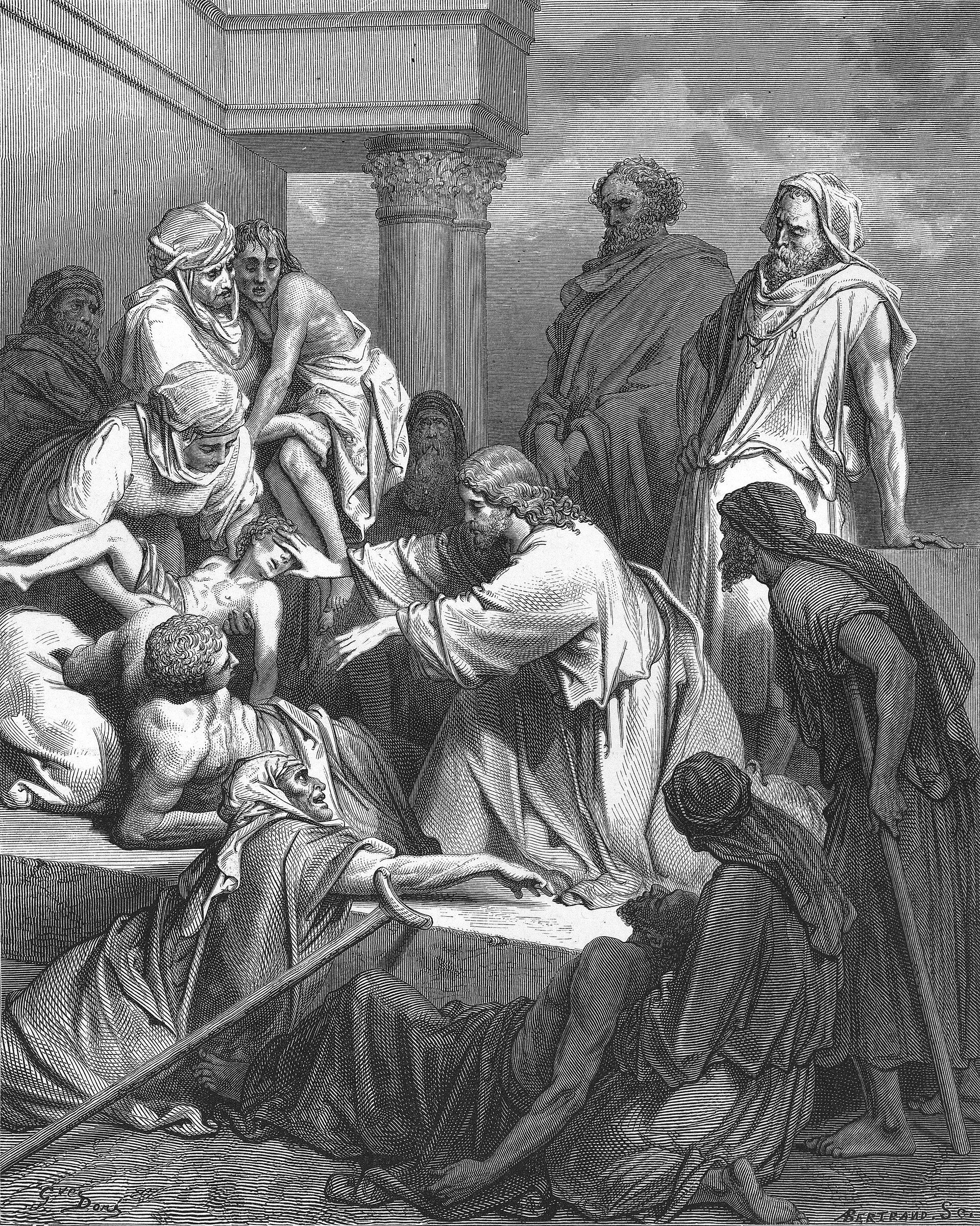
The Cure at the Pool of Bethesda. 1 After this there was a feast of the Jews; and Jesus went up to Jerusalem. 2 Now there is at Jerusalem by the sheep market a pool, which is called in the Hebrew tongue Bethesda, having five porches.
quarantine:scripture (2026-07-29) — scripture-overlap:91%@v1-3
I receive not honour from men.
The Nineteenth Century5 voices
A commentator
Albert Barnes1798–1870
Notes, Explanatory and Practical, on the Old and New Testaments (1832-1869)
I receive not honour ... - “I do not say these things because I am desirous of human applause, but to account for the fact that you do not believe on me. The reason is, that you have not the love of God in you.” In this passage we see: 1. That we should not seek for human applause. It is of very little value, and it often keeps men from the approbation of God, Joh 5:44. 2. They who will not believe on Jesus Christ give evidence that they have no love for God.
A commentator
J.C. Ryle1816–1900
Expository Thoughts on the Gospels: John (lightly modernized text, Grace Gems edition) (1869)
This passage concludes our Lord Jesus Christ's wondrous defense of His own divine mission. It is a conclusion worthy of the defense, full of heart-searching appeals to the consciences of His enemies, and rich in deep truths. A mighty sermon is followed by a mighty application. Let us mark, in this passage, the reason why many souls are lost. The Lord Jesus says to the unbelieving Jews—"You will not come to me that you might have life." These words are a golden sentence, which ought to be engraved in our memories, and treasured up in our minds.
A commentator
Jamieson, Fausset & Brown1802–1910
Commentary Critical and Explanatory on the Whole Bible (1871)
How touching and gracious are these last words! Observe here (1) The honor which Christ gives to the Scriptures, as a record which all have a right and are bound to search--the reverse of which the Church of Rome teaches; (2) The opposite extreme is, resting in the mere Book without the living Christ, to direct the soul to whom is its main use and chiefest glory.
A commentator
J.C. Ryle1816–1900
Expository Thoughts on the Gospels: John (lightly modernized text, Grace Gems edition) (1869)
proposed
This passage concludes our Lord Jesus Christ's wondrous defense of His own divine mission. It is a conclusion worthy of the defense, full of heart-searching appeals to the consciences of His enemies, and rich in deep truths. A mighty sermon is followed by a mighty application. Let us mark, in this passage, the reason why many souls are lost. The Lord Jesus says to the unbelieving Jews—"You will not come to me that you might have life." These words are a golden sentence, which ought to be engraved in our memories, and treasured up in our minds. It is lack of will to come to Christ for salvation that will be found, at last, to have shut the many out of heaven. It is not men's sins. All manner of sin may be forgiven. It is not any decree of God. We are not told in the Bible of any whom God has only created to be destroyed. It is not any limit in Christ's work of redemption. He has paid a price sufficient for all mankind. It is something far more than this. It is man's own innate unwillingness to come to Christ, repent, and believe. Either from pride, or laziness, or love of sin, or love of the world, the many have no mind, or wish, or heart, or desire to seek life in Christ. "God has given to us eternal life, and this life is in his Son." (1 John 5:11.) But men stand still, and will not stir hand or foot to get life. And this is the whole reason why many of the lost are not saved. This is a painful and solemn truth, but one that we can never know too well. It contains a first principle in Christian theology. Thousands, in every age, are constantly laboring to shift the blame of their condition from off themselves. They talk of their inability to change. They tell you complacently, that they cannot help being what they are! They know, undeniably, that they are wrong, but they cannot be different! It will not do.
I receive not honor from men - I do not stand in need of you or your testimony. I act neither through self-interest nor vanity. Your salvation can add nothing to me, nor can your destruction injure me: I speak only through my love for your souls, that ye may be saved.
The words behind it
5 Greek wordsEvery Greek word of this verse in the order it stands, with what it means and the door to its own study. The last column counts the times a word stands in the whole Bible: the rarer the word, the more the places it appears belong together.
| Greek | Sound | Meaning | Word study | In the Bible |
|---|---|---|---|---|
| δόξαν | doxan | Glory | G1391 → | 165 times |
| παρὰ | para | from | G3844 → | 192 times |
| ἀνθρώπων | anthropon | men | G444 → | 549 times |
| οὐ | ou | not | G3756 → | 1664 times |
| λαμβάνω· | lambano | I take; | G2983 → | 257 times |
δόξανGlory
doxanG1391 →165 times
παρὰfrom
paraG3844 →192 times
ἀνθρώπωνmen
anthroponG444 →549 times
οὐnot
ouG3756 →1664 times
λαμβάνω·I take;
lambanoG2983 →257 times
A shaded row is a word that stands 400 times or fewer in the Bible.
The walk
8 stopsEach card is a verse this one points to, and under it the verses that one points to in turn. Where several paths arrive at the same place, that place is listed first: the text keeps returning to it.
Through
John 5:44How can you believe if you accept glory from one another, yet do not seek the glory that comes from the only God?
it leads to
- John 12:43
For they loved praise from men more than praise from God.
- Romans 2:29
No, a man is a Jew because he is one inwardly, and circumcision is a matter of the heart, by the Spirit, not by the written code. Such a man’s praise does not come…
- Philippians 2:3
Do nothing out of selfish ambition or empty pride, but in humility consider others more important than yourselves.
- Matthew 23:5
All their deeds are done for men to see. They broaden their phylacteries and lengthen their tassels.
- John 12:43
Through
1 Thessalonians 2:6Nor did we seek praise from you or from anyone else, although as apostles of Christ we had authority to demand it.
it leads to
- Galatians 1:10
Am I now seeking the approval of men, or of God? Or am I striving to please men? If I were still trying to please men, I would not be a servant of Christ.
- Galatians 1:10
Through
John 7:18He who speaks on his own authority seeks his own glory, but He who seeks the glory of the One who sent Him is a man of truth; in Him there is no falsehood.
it leads to
- John 13:31–32
When Judas had gone out, Jesus said, “Now the Son of Man is glorified, and God is glorified in Him.
- 1 Corinthians 10:31–33
So whether you eat or drink or whatever you do, do it all to the glory of God.
- Philippians 2:3–5
Do nothing out of selfish ambition or empty pride, but in humility consider others more important than yourselves.
- John 13:31–32
Where this verse is studied
About John
This page draws on 15 works. Open the list of works
This page draws on Adam Clarke, Commentary on the Bible; Albert Barnes, Notes, Explanatory and Practical, on the Gospels; Albert Barnes, Notes, Explanatory and Practical, on the Old and New Testaments (1832-1869); Alcuin of York, Catena Aurea by Aquinas; Bonaventure, Commentary on John, Chapter 5; Cyril of Alexandria, Commentary on the Gospel of John, Book 3; J. C. Ryle, Expository Thoughts on the Gospels, John; J.C. Ryle, Expository Thoughts on the Gospels: John (lightly modernized text, Grace Gems edition); Jamieson, Fausset & Brown, Commentary Critical and Explanatory on the Whole Bible; John Chrysostom, Homily on the Gospel of John 41; John Gill, Exposition of the New Testament (1746-1748); Matthew Henry, Commentary on the Whole Bible; Theodore of Mopsuestia, COMMENTARY ON JOHN 2.5.41-42; Theophylact of Ohrid, Commentary on John and Thomas Aquinas, Commentary on John.