
John 5:10
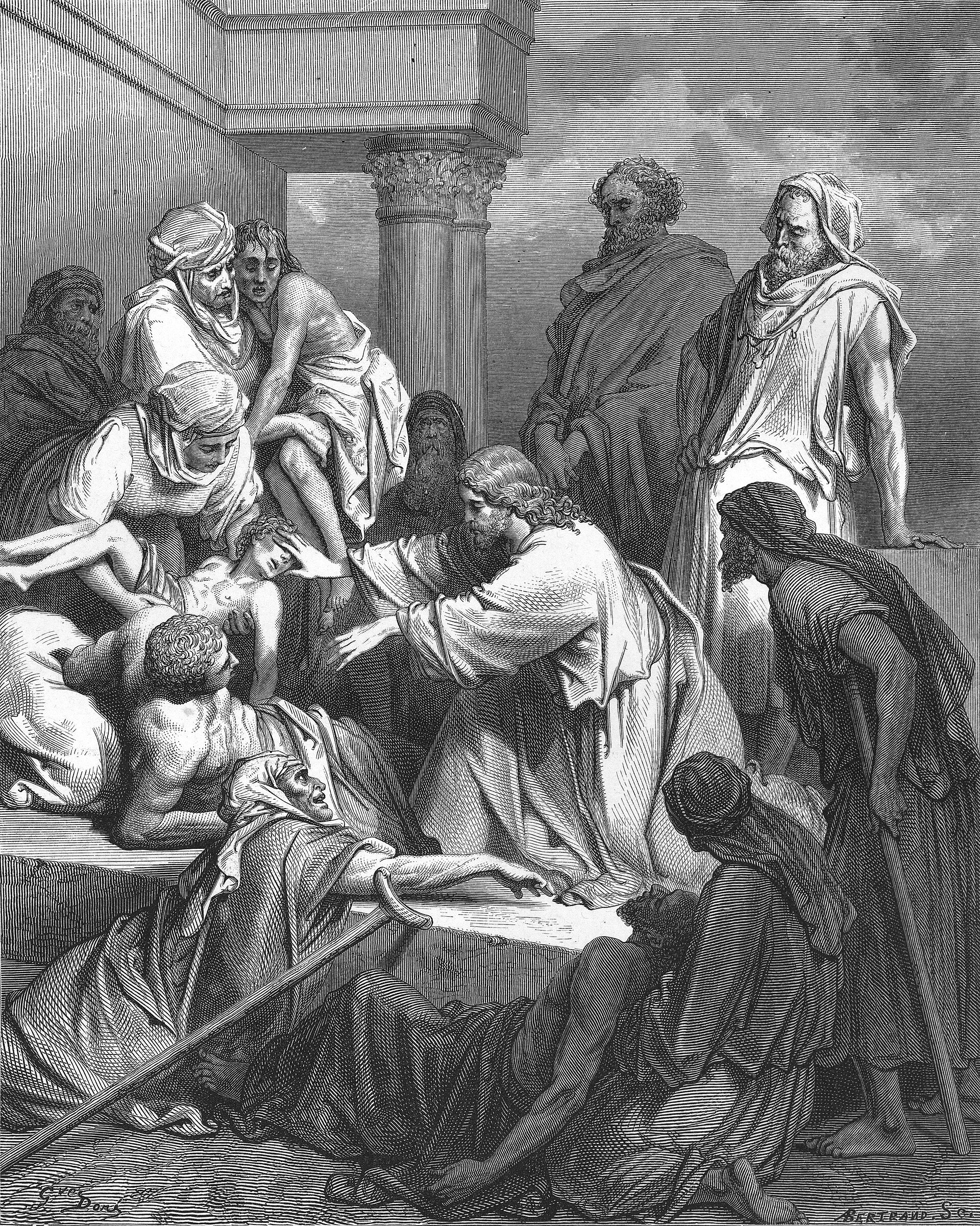
in John 5so the Jews said to the man who had been healed, “This is the Sabbath! It is unlawful for you to carry your mat.”
BSB
The same verse in ASV and KJV ▾
ASV
So the Jews said unto him that was cured, It is the sabbath, and it is not lawful for thee to take up thy bed.
KJV
The Jews therefore said unto him that was cured, It is the sabbath day: it is not lawful for thee to carry thy bed.
⋯
This verse in John 5
Commentary
16 notes on this verseA commentator
Albert Barnes1798–1870
Notes, Explanatory and Practical, on the Old and New Testaments (1832-1869)
Not lawful - It was forbidden, they supposed, in the Old Testament. The Jews were very strenuous in the observation of the external duties of religion.
This site's exposition
It is unlawful for you to carry your mat
on John 5:10-13
The Jews here are the Judean authorities, and the rabbinic Sabbath code counted carrying a burden among the forbidden labors. The healed man points them to the one who made him well, and Jesus had already slipped into the crowd. He has no name to give them.
The record, by era
The Church Fathers5 voices
(Tr. xvii. c. 10) They did not charge our Lord with healing on the sabbath, for He would have replied that if an ox or an ass of theirs had fallen into a pit, would not they have taken it out on the sabbath day: but they addressed the man as he was carrying his bed, as if to say, Even if the healing could not be delayed, why enjoin the work?
The man did this, and the Jews were offended. For they saw a man carrying his bed on the Sabbath-day, and they did not blame the Lord for healing him on the Sabbath, that He should be able to answer them, that if any of them had a beast fallen into a well, he would surely draw it out on the Sabbath-day, and save his beast; and so, now they did not object to Him that a man was made whole on the Sabbath-day, but that the man was carrying his bed. But if the healing was not to be deferred, should a work also have been commanded? "It is not lawful for thee," say they, to do what thou art doing, "to take up thy bed."
What followed was even far more admirable. That he believed at first, when no one troubled him, was not so marvelous, but that afterwards, when the Jews were full of madness and pressed upon him on all sides, accusing and besieging him and saying, "It is not lawful for thee to take up thy bed," that then he gave no heed to their madness, but most boldly in the midst of the assembly proclaimed his Benefactor and silenced their shameless tongues, this, I say, was an act of great courage. For when the Jews arose against him, and said in a reproachful and insolent manner to him, "It is the Sabbath day, it is not lawful for thee to carry thy bed"; hear what he saith: "He that made me whole, the Same said unto me, Take up thy bed, and walk." All but saying, "Ye are silly and mad who bid me not to take Him for my Teacher who has delivered me from a long and grievous malady, and not to obey whatever He may command." Had he chosen to act in an unfair manner, he might have spoke differently, as thus, "I do not this of my own will, but at the bidding of another; if this be a matter of blame, blame him who gave the order, and I will set down the bed." And he might have concealed the cure, for he well knew that they were vexed not so much at the breaking of the Sabbath, as at the curing of his infirmity. Yet he neither concealed this, nor said that, nor asked for pardon, but with loud voice confessed and proclaimed the benefit. Thus did the paralytic; but consider how unfairly they acted. For they said not, "Who is it that hath made thee whole?" on this point they were silent, but kept on bringing forward the seeming transgression.
A commentator
Cyril of AlexandriaCommentary on the Gospel of John, Book 2 · Written before 444.
proposed
Jesus does not pray to relieve the patient's sickness in case he [Jesus] should seem to be like one of the holy prophets. Rather, as the Lord of powers, he commands with authority that it be so. He tells him to go home rejoicing, to take his bed on his shoulders, to be a memento to those who would see the might of the one who had healed him.
A commentator
Cyril of AlexandriaCommentary on the Gospel of John, Book 2 · Written before 444.
proposed
Most seasonably (I think) doth He cry over them, Hear now this O foolish people and heartless, which have eyes and see not. For what can be more uninstructed than such people, or what greater in senselessness? For they do not even admit into their mind that they ought to wonder at the Power of the Healer: but being bitter reprovers, and skilled in this alone, they lay the charge of breaking the law about him who had just and with difficulty recovered from a long disease, and foolishly bid him lie down again, as though the honour due to the Sabbath were paid by having to be ill.
9 more voices on this verse
The Medieval Church3 voices
He heals "on the Sabbath," teaching people to understand the rites of the law differently and to place the honoring of the Sabbath not in bodily understood inactivity, but in abstaining from evil. For the law, being the law of the ever-beneficent God, cannot forbid …
"The Jews therefore said to him who had been made well," calumniating him: "It is the Sabbath; it is not lawful for you to take up your mat." For to take up a mat seemed to be servile work, which was forbidden to be done …
Then (v 10), the Evangelist gives the accusation brought against the man who was healed. First, we have the accusation; and secondly, the explanation given by the man who was healed (v 11). The man was accused for carrying his mat on the Sabbath, and …
The Puritans and the Awakening3 voices
The sermon was Christ's vindication of himself before the sanhedrim, when he was prosecuted as a criminal for healing the man on the sabbath day, in which, 1. He asserts his authority as Messiah, and Mediator between God and man,
It does not appear whether they were magistrates, who had power to punish him, or common people, who could only inform against him; but thus far was commendable, that, while they knew not by what authority he did it, they were jealous for the honour of the sabbath, and could not unconcernedly see it profaned; like Nehemiah.
The Jews therefore said unto him that was cured,.... When they saw him, either at the place, or as he walked through the streets, with his bed on his back: it is the sabbath day: do not you know it? surely you forget yourself, or you would never be guilty of such an action as this; it is not lawful for thee to carry thy bed.
The Nineteenth Century3 voices
A commentator
Jamieson, Fausset & Brown1802–1910
Commentary Critical and Explanatory on the Whole Bible (1871)
The Jews--that is, those in authority. (See on Joh 1:19.) it is not lawful to carry thy bed--a glorious testimony to the cure, as instantaneous and complete, from the lips of the most prejudiced!
A commentator
J.C. Ryle1816–1900
Expository Thoughts on the Gospels: John (lightly modernized text, Grace Gems edition) (1869)
proposed
We have in this passage one of the few miracles of Christ, which John records. Like every other miracle in this Gospel, it is described with great minuteness and particularity. And like more than one other miracle it leads on to a discourse full of singularly deep instruction. We are taught, for one thing, in this passage, what misery sin has brought into the world. We read of a man who had been ill for no less than thirty-eight years! For thirty-eight weary summers and winters he had endured pain and infirmity.
A commentator
J.C. Ryle1816–1900
Expository Thoughts on the Gospels: John (lightly modernized text, Grace Gems edition) (1869)
proposed
We have in this passage one of the few miracles of Christ, which John records. Like every other miracle in this Gospel, it is described with great minuteness and particularity. And like more than one other miracle it leads on to a discourse full of singularly deep instruction. We are taught, for one thing, in this passage, what misery sin has brought into the world. We read of a man who had been ill for no less than thirty-eight years! For thirty-eight weary summers and winters he had endured pain and infirmity. He had seen others healed at the waters of Bethesda, and going to their homes rejoicing. But for him there had been no healing. Friendless, helpless, and hopeless, he lay near the wonder-working waters, but derived no benefit from them. Year after year passed away, and left him still uncured. No relief or change for the better seemed likely to come, except from the grave. When we read of cases of sickness like this, we should remember how deeply we ought to hate sin! Sin was the original root, and cause, and fountain of every disease in the world. God did not create man to be full of aches, and pains, and infirmities. These things are the fruits of the Fall. There would have been no sickness, if there had been no sin. No greater proof can be shown of man's inbred unbelief, than his carelessness about sin. "Fools," says the wise man, "make a mock at sin." (Pro. 14:9.) Thousands delight in things which are explicitly evil, and run greedily after that which is downright poison. They love that which God abhors, and dislike that which God loves. They are like the madman, who loves his enemies and hates his friends. Their eyes are blinded. Surely if men would only look at hospitals and infirmaries, and think what havoc sin has made on this earth, they would never take pleasure in sin as they do. Well may we be told to pray for the coming of God's kingdom!
How the passage was read
On John 5:1-18On John 5:1-18
The mat, the carrying rule, and where the ways part
“It is the sabbath day: it is not lawful for thee to carry thy bed.” The objectors stand on a real rule with a prophetic root: Jeremiah 17:21-22 forbids bearing burdens through Jerusalem's gates on the Sabbath, and the tradition codified carrying between domains as the last of the thirty-nine categories of forbidden labor (Mishnah Shabbat 7:2). The tradition's own case law even makes the fine distinction the scene turns on: one who carries out a living person on a bed is exempt FOR THE PERSON, “because the bed is secondary to the person” (Mishnah Shabbat 10:5); it is the mat alone the rule could name. Note also what no one disputes: the healing itself. Jesus healed by a word; a thirty-eight-year lameness was chronic, not mortal (mortal danger overrides the Sabbath, Mishnah Yoma 8:6), so on the tradition's categories the man could have waited one more day. Jesus refuses the wait.
Where the ways part
At verse 18 the scene reaches the real parting of the ways, and honesty requires it be said plainly: Jesus “said also that God was his Father, making himself equal with God.” Here the difference is not over practice but over an essential of the Christian faith. Judaism then and now confesses the one God and reads such a claim by a man as blasphemy; Christian confession holds that Jesus' claim is true, that the Son does what the Father does (5:19-29). The two readings cannot both be right, and this page presents each side in its own words, with respect and without blur.
This section is reception history: how the passage was read and kept in the Jewish tradition. Where a reading parts from an essential of the Christian faith, the section says so at that point.
Sources: Mishnah Shabbat 7:2 (carrying, the last category) · Mishnah Shabbat 10:5 (the person exempt, the bed secondary) · Mishnah Yoma 8:6 (danger to life overrides the Sabbath)
The words behind it
16 Greek wordsEvery Greek word of this verse in the order it stands, with what it means and the door to its own study. The last column counts the times a word stands in the whole Bible: the rarer the word, the more the places it appears belong together.
| Greek | Sound | Meaning | Word study | In the Bible |
|---|---|---|---|---|
| ἔλεγον | elegon | Were saying | G3004 → | 1325 times |
| οὖν | oun | therefore | G3767 → | 497 times |
| οἱ | hoi | the | G3588 → | 19766 times |
| Ἰουδαῖοι | ioudaioi | Jews | G2453 → | 192 times |
| τῷ | to | to the [one] | G3588 → | 19766 times |
| τεθεραπευμένῳ· | tetherapeumeno | healed; | G2323 → | |
| σάββατόν | sabbaton | Sabbath | G4521 → | 68 times |
| ἐστιν, | estin | it is, | G1510 → | 2333 times |
| καὶ | kai | and | G2532 → | 9120 times |
| οὐκ | ouk | not | G3756 → | 1664 times |
| ἔξεστίν | exestin | it is lawful | G1832 → | |
| σοι | soi | for you | G4771 → | 2973 times |
| ἆραι | arai | to take up | G142 → | 100 times |
| τὸν | ton | the | G3588 → | 19766 times |
| κράβαττόν | krabatton | mat | G2895 → | 11 times |
| σου.¶ | sou | of you. | G4771 → | 2973 times |
ἔλεγονWere saying
elegonG3004 →1325 times
οὖνtherefore
ounG3767 →497 times
οἱthe
hoiG3588 →19766 times
ἸουδαῖοιJews
ioudaioiG2453 →192 times
τῷto the [one]
toG3588 →19766 times
τεθεραπευμένῳ·healed;
tetherapeumenoG2323 →
σάββατόνSabbath
sabbatonG4521 →68 times
ἐστιν,it is,
estinG1510 →2333 times
καὶand
kaiG2532 →9120 times
οὐκnot
oukG3756 →1664 times
ἔξεστίνit is lawful
exestinG1832 →
σοιfor you
soiG4771 →2973 times
ἆραιto take up
araiG142 →100 times
τὸνthe
tonG3588 →19766 times
κράβαττόνmat
krabattonG2895 →11 times
σου.¶of you.
souG4771 →2973 times
A shaded row is a word that stands 400 times or fewer in the Bible.
The walk
8 stopsEach card is a verse this one points to, and under it the verses that one points to in turn. Where several paths arrive at the same place, that place is listed first: the text keeps returning to it.
Through
Luke 6:2But some of the Pharisees asked, “Why are you doing what is unlawful on the Sabbath?”
it leads to
- Matthew 12:2
When the Pharisees saw this, they said to Him, “Look, Your disciples are doing what is unlawful on the Sabbath.”
Reached by 3 separate paths from here.
- Matthew 12:2
Through
Mark 3:4And He asked them, “Which is lawful on the Sabbath: to do good or to do evil, to save life or to destroy it?” But they were silent.
it leads to
- Luke 6:9
Then Jesus said to them, “I ask you, which is lawful on the Sabbath: to do good or to do evil, to save life or to destroy it?”
- Matthew 12:10–12
and a man with a withered hand was there. In order to accuse Jesus, they asked Him, “Is it lawful to heal on the Sabbath?”
- Luke 6:9
Through
Jeremiah 17:21This is what the LORD says: Take heed for yourselves; do not carry a load or bring it through the gates of Jerusalem on the Sabbath day.
it leads to
- Nehemiah 13:15–21
In those days I saw people in Judah treading winepresses on the Sabbath and bringing in grain and loading it on donkeys, along with wine, grapes, and figs. All kinds of goods were being…
- Numbers 15:32–36
While the Israelites were in the wilderness, a man was found gathering wood on the Sabbath day.
- Nehemiah 13:15–21
Through
Luke 13:14But the synagogue leader was indignant that Jesus had healed on the Sabbath. “There are six days for work,” he told the crowd. “So come and be healed on those days and not on…
it leads to
- Exodus 20:9
Six days you shall labor and do all your work,
- John 9:14–16
Now the day on which Jesus had made the mud and opened his eyes was a Sabbath.
- Exodus 20:9
Through
John 9:16Because of this, some of the Pharisees said, “This man is not from God, for He does not keep the Sabbath.” But others said, “How can a sinful man perform such signs?” And there…
it leads to
- John 7:43
So there was division in the crowd because of Jesus.
- John 7:43
Where this verse is studied
On this page
About John
This page draws on 13 works. Open the list of works
This page draws on Albert Barnes, Notes, Explanatory and Practical, on the Old and New Testaments (1832-1869); Augustine of Hippo, Catena Aurea by Aquinas; Augustine of Hippo, Tractates on John 17; Bonaventure, Commentary on John, Chapter 5; Cyril of Alexandria, Commentary on the Gospel of John, Book 2; J.C. Ryle, Expository Thoughts on the Gospels: John (lightly modernized text, Grace Gems edition); Jamieson, Fausset & Brown, Commentary Critical and Explanatory on the Whole Bible; John Chrysostom, Homily on the Gospel of John 37; John Gill, Exposition of the New Testament (1746-1748); John Lightfoot, Horae Hebraicae et Talmudicae on John; Matthew Henry, Commentary on the Whole Bible; Theophylact of Ohrid, Commentary on John and Thomas Aquinas, Commentary on John.