
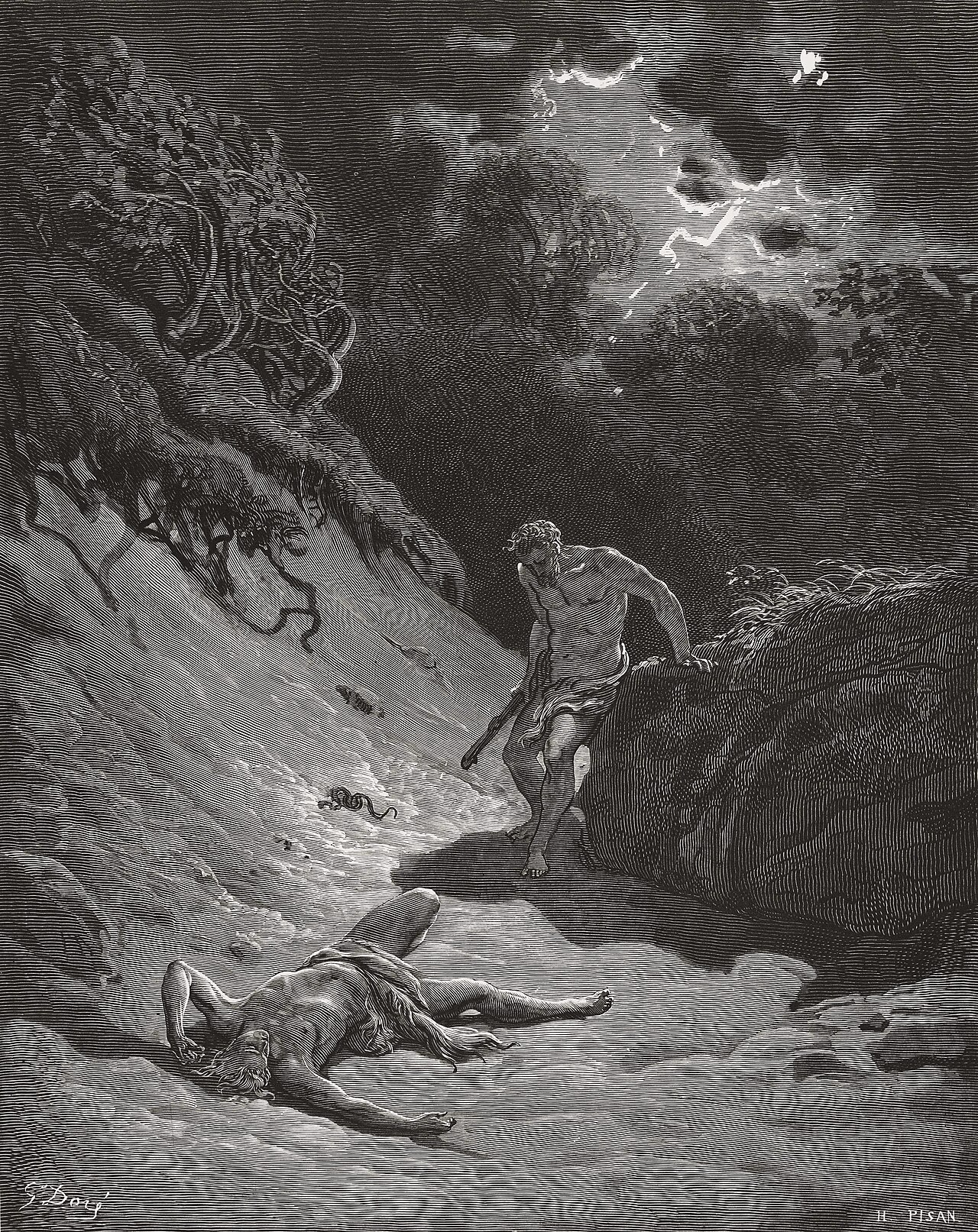
Genesischapter 4
26 verses · Moses, by tradition · 15th to 13th century BC · The Law
And Cain had relations with his wife, and she conceived and gave birth to Enoch. Then Cain built a city and named it after his son Enoch.
Introduction
Moses, by tradition, The Law, Genesis Overview.
This chapter was written for Israel in the wilderness, a people about to be given an altar and a whole system of offerings, and tradition gives it to Moses. It follows the first family after the garden into ordinary life, farming, herding and building. It asks what God looks for in worship and what happens when anger is left unmastered. Listen for the questions God asks and the answers He receives. Notice also how the skills of settled life and the growth of violence run in the same family line. Its last sentences point to the line the book will follow next.
Context
- Who
- Israel in the wilderness, being taught what God receives at an altar
- What
- An account of the first murder, God's judgment on Cain, the line of Cain to Lamech, and the birth of Seth.
- Where
- The fields and pastures east of Eden, then the land of Nod and the first city.
- When
- Before any dated history; the chapter runs from the birth of Cain to the seventh generation of his line.
- Why
- To show that sin spreads from one generation to the next and that God still keeps a line through which to carry His promise.
Historical context
The chapter follows Cain, the firstborn outside the garden, and closes on Lamech in the seventh generation of his line. God speaks twice, once before the killing and once after it.
Show the rest of the historical context, 4 more paragraphs
The two brothers stand for the two oldest ways of making a living in that region, the settled farmer and the herdsman moving between pastures. Grazing flocks and standing grain compete for the same ground, and the strain between the two was permanent.
Their offerings follow ordinary practice, since first fruits of the harvest and the firstborn of the flock were the expected gifts anywhere in the ancient Near East. The text marks a difference in the men, since Abel brings the fat portions and Cain brings some of the fruit of the ground.
Blood on the ground carried a legal weight a reader today has to be told about. Across the region unavenged blood was held to be a debt the land itself carried until it was paid, which is why the avenger from the victim's family was a recognised figure. God takes that office out of human hands here and marks Cain instead.
The chapter closes with the first city and a short list of beginnings, tents and herding, the harp and the pipe, and tools of bronze and iron. Lamech's boast of a sevenfold and seventy-sevenfold vengeance stands at the end of the same line.
Significance
A people about to be given an altar and a system of sacrifice heard, at the first offering ever made, that God looks at the worshipper before he looks at the gift.
Show the rest of the significance, 1 more paragraph
They heard as well that the crafts of settled life and the reach of violence grew together in one family, which was a warning to a nation on its way to build towns of its own.
This chapter in Jewish lifeWhat this chapter is in Jewish life and reading.
What is done
This chapter is heard inside the opening portion of the annual cycle, which runs from the first verse of Genesis into Genesis 6 and is read in one sitting (src/lib/hebraic/readings.ts). The first murder is therefore read on the same Sabbath as the creation account and the fall. The card above carries the portion and the prophetic reading set beside it.
How it is read
Rashi is the main voice on this chapter in the corpus, in the public domain edition of M. Rosenbaum and A. M. Silbermann, Pentateuch with Rashi's commentary, 1929 to 1934. Radak stands beside him on two verses, in the CC-BY translation of Eliyahu Munk, HaChut Hameshulash.
Rashi reads the offerings by what each brother brought. Abel kept flocks because the ground had been cursed, and Cain brought "of the worst fruits" of the ground (Rashi on Genesis 4:2:1 and 4:3:1, the second citing Genesis Rabbah 22:5). Rashi takes the regard God had for the one offering as a turning toward it, and the lack of regard as a turning away (Rashi on Genesis 4:4:1). He reads the words Cain spoke to his brother as the picking of a quarrel, and he says that the Midrash explains them further while this is the plain sense (Rashi on Genesis 4:8:1).
Radak reads the same two verses toward repentance. He holds that the offering was refused because "His intention had not been good and pure". Cain learned of the refusal when fire came down on his brother's offering and none came down on his own (Radak on Genesis 4:5:1). He reads God's question to Cain as discipline meant to bring him back, and as the teaching of repentance for the generations after him (Radak on Genesis 4:6:1).
The exchange at the ninth and thirteenth verses is read in the same direction. Rashi holds that God asked where Abel was in order to open a friendly conversation, so that Cain might repent and own the killing (Rashi on Genesis 4:9:1, citing Genesis Rabbah 19:11). He reads Cain's answer about his punishment as a question put back to God. The One who bears the worlds above and below is asked whether He can bear one man's sin (Rashi on Genesis 4:13:1, citing Genesis Rabbah 22:11).
Ibn Ezra comments on two verses of this chapter, and the corpus holds the text of neither, because the licence Sefaria reports for that English version keeps it out. They are Ibn Ezra on Genesis 4:14:1 and 4:21:1.
What the rabbis say
Rashi carries three of the best known traditional insights on this chapter, and each stands here as what the rabbis taught.
The first is on the plural word for blood in the tenth verse. He reads it as the blood of Abel together with the blood of the descendants he would have had. His second reading is that Cain struck many blows, because he did not know from which wound the life would leave (Rashi on Genesis 4:10:1, citing Genesis Rabbah 22:9 and Sanhedrin 37b).
The second is on the sons of Lamech. Rashi reports the Midrash that the tents and cattle of the twentieth verse were shrines for idol worship. The harp and pipe of his brother made the music for it (Rashi on Genesis 4:20:1, citing Genesis Rabbah 23:3). Of Tubal-cain he says that the man refined the handicraft of Cain by making weapons for murderers (Rashi on Genesis 4:22:1, same locator).
The third is the story behind the song of Lamech. Rashi reports that Lamech was blind and that Tubal-cain led him about. The son saw Cain at a distance, took him for an animal, and told his father to draw the bow, and so Lamech killed his own forefather. Learning what he had done, Lamech struck his hands together and killed his son between them. This is why the wives of Lamech separated from him and why he sang to win them back (Rashi on Genesis 4:23:1). Rashi reads the sevenfold vengeance of the fifteenth verse in the same story, holding that Lamech was the seventh generation and the one by whom the promise was kept (Rashi on Genesis 4:19:1 and 4:24:1).
The corpus records forty places where the Midrash and the Talmud cite this chapter, thirty two under Midrash and eight under Talmud, with the locator for each one and no text. Bereshit Rabbah runs the length of the chapter. It reads the first verse at 21:9 and 22:1, the second at 22:3 and 30:8, the third at 22:4 and 22:5, the fourth at 22:6 and the eighth at 22:7. It reads the ninth verse at 19:11, the eleventh at 22:10, the thirteenth at 22:11 and the seventeenth at 23:1. It reads the eighteenth at 23:2, the twentieth at 23:3, the twenty third at 22:8 and the twenty sixth at 2:3.
Bamidbar Rabbah reads the fourth verse at 13:2, the tenth at 20:6, the twelfth at 9:7 and the fifteenth at 7:5. Bereshit Rabbati reads the ninth verse at Parashat Bereshit 80, the twelfth at Parashat Noah 6, the fourteenth at Parashat Bereshit 86 and the nineteenth at Parashat Vayishlach 36. Midrash Sekhel Tov reads the sixth verse at Bereshit 20:16:3 and 40:6:2, and the Mekhilta of Rabbi Shimon ben Yochai reads the eleventh at 15:12.
The Talmud is cited at Arakhin 15b:19 on the thirteenth verse and at Jerusalem Talmud Bava Batra 2:2:2 on the twenty second. Avot DeRabbi Natan carries the other six, at 16:3 and 31:2 and 14:6, and in its second recension at 44:1, 45:5 and 44:2.
Sources: Rashi, Rashi on Genesis 4, in Pentateuch with Rashi's commentary by M. Rosenbaum and A. M. Silbermann, 1929 to 1934, public domain, about 1090; Radak, Radak on Genesis 4:5:1 and 4:6:1, in HaChut Hameshulash, translated by Eliyahu Munk, CC-BY, about 1200; Ibn Ezra, his two comments on Genesis 4, cited by reference; the licence Sefaria reports for the English version keeps the text out of the corpus; The Midrash and the Talmud, the forty locators on Genesis 4 in scripts/data/sources/sefaria/genesis/4.json; MannaFest, the annual cycle table at src/lib/hebraic/readings.ts, 2026.
The heads below are this chapter's scenes. The numbered points under each are its verses.
Two Brothers, Two Offerings
Genesis 4:1-2
Eve's words at Cain's birth are hard in the Hebrew and have often been read as a hope that this son is the seed promised in chapter 3. Abel's name means breath or vapour. Abel was a keeper of sheep and Cain a tiller of the soil, and the writer gives the younger brother's work first.
Genesis 4:1
“Eve said, I have gotten a man from the Lord--that is, "by the help of the Lord"--an expression of pious gratitude--and she called him Cain, that is, "a possession," as if valued above everything else; while the arrival of another son reminding Eve of the misery she had entailed on her offspring, led to the name Abel, that is, either weakness, vanity (Ps 39:5), or grief, lamentation.”
Jamieson, Fausset & Brown · Commentary Critical and Explanatory on the Whole Bible (1871)reformed
a keeper of sheep: The Hebrew reads that she added to bear his brother, and Adam Clarke took the wording to mean Cain and Abel were twins. Bede heard grief in Abel's name, a sign of his early death. The two trades set up the two offerings that follow.
Genesis 4:2
“And she again bare his brother Abel - Literally, She added to bear (ותסף ללדת vattoseph laledeth) his brother. From the very face of this account it appears evident that Cain and Abel were twins.”
Adam Clarke · Commentary on the Bible (1810-1826)evangelical
2 more voices on this verse
Genesis 4:2
“Again, she bore his brother Abel. Abel is interpreted as grief or miserable, by which name from the earliest age was foreshadowed the condition of his lamentable untimely death.”
Bede · written before 735 · Commentary on Genesis (Hexaemeron)patristic
Genesis 4:2
“Abel was a keeper of sheep--literally, "a feeder of a flock," which, in Oriental countries, always includes goats as well as sheep. Abel, though the younger, is mentioned first, probably on account of the pre-eminence of his religious character.”
Jamieson, Fausset & Brown · Commentary Critical and Explanatory on the Whole Bible (1871)reformed
Genesis 4:3-5
some of the fruit of the soil: Both brothers brought what they had, and the LORD looked with favor on one offering. The verse names the man before the gift in both cases, and Hebrews 11:4 says Abel offered his by faith. Abel's came from the firstborn of his flock, the best portions of it. The younger brother is preferred here, and Genesis does it again.
Genesis 4:3
“In process of time - מקץ ימים mikkets yamim, at the end of days. Some think the anniversary of the creation to be here intended; it is more probable that it means the Sabbath, on which Adam and his family undoubtedly offered oblations to God, as the Divine worship was certainly instituted, and no doubt the Sabbath properly observed in that family. This worship was, in its original institution, very simple. It appears to have consisted of two parts: 1. Thanksgiving to God as the author and dispenser of all the bounties of nature, and oblations indicative of that gratitude.”
Adam Clarke · Commentary on the Bible (1810-1826)evangelical
1 more voice on this verse
Genesis 4:3
“CAIN was of the Wicked One and slew his brother. "The way of Cain" is not hard to describe. He is too proud to offer atonement for his sin. He prefers his own way of sacrifice. He presents a bloodless oblation. He hates the obedience of faith. He smites the faithful Abel. Beware of the way of Cain, O proud self-righteous ones, lest you run therein, for the steps are few from self-righteous pride to hatred of true Believers and murder is not far thereafter.”
the firstborn of his flock: Why Abel's gift was accepted has been read two ways. John Wesley saw a sacrifice of atonement, blood shed by a man who owned himself a sinner. Philoxenus of Mabbug found the difference in the brothers themselves, the simple offering accepted and the wicked one refused.
Genesis 4:4
“And moreover, we may also see simplicity in Abel, and the Holy Book sheweth us that he was more simple than Cain; for they both brought offerings to the Lord, and the offering of simplicity was accepted, but the offering of wickedness was rejected.”
Philoxenus of Mabbug · written before 523 · 13 Ascetic Discourses, Discourse 4 -- On Faith: First Discourse on Simplicitypatristic
2 more voices on this verse
Genesis 4:4
“Abel, he also brought of the firstlings of his flock - Dr. Kennicott contends that the words he also brought, הביא גם הוא hebi gam hu, should be translated, Abel brought it also, i.e. a minchah or gratitude offering; and beside this he brought of the first-born (מבכרות mibbechoroth) of his flock, and it was by this alone that he acknowledged himself a sinner, and professed faith in the promised Messiah.”
Adam Clarke · Commentary on the Bible (1810-1826)evangelical
Genesis 4:4
“Abel's was a more excellent sacrifice than Cain's; Cain's was only a sacrifice of acknowledgment offered to the Creator; the meat- offerings of the fruit of the ground were no more: but Abel brought a sacrifice of atonement, the blood whereof was shed in order to remission, thereby owning himself a sinner, deprecating God's wrath, and imploring his favour in a Mediator.”
John Wesley · Explanatory Notes upon the Old Testament (1765)evangelical
ConnectionsHebrews 11:4
his countenance fell: The verse never says how Cain learned that the LORD had no regard for his offering. Adam Clarke suggested fire from heaven, as at 1 Kings 18:38. Origen of Alexandria held that the LORD saw the wickedness in Cain's heart before he killed his brother.
Genesis 4:5
“In the case of Cain his wickedness did not begin when he killed his brother. For even before that God, who knows the heart, had no regard for Cain and his sacrifice. But his baseness was made evident when he killed Abel.”
Origen of Alexandria · written before 253 · ON PRAYER 29.18patristic
1 more voice on this verse
Genesis 4:5
“Unto Cain - As being unconscious of his sinfulness, and consequently unhumbled, and to his offering, as not being accompanied, as Abel’s was, with faith and a sacrifice for sin, he had not respect - He could not, consistently with his holiness and justice, approve of the one or receive the other. Of the manner in which God testified his approbation we are not informed; it was probably, as in the case of Elijah, by sending down fire from heaven, and consuming the sacrifice.”
Adam Clarke · Commentary on the Bible (1810-1826)evangelical
Genesis 4:6-7
God speaks to Cain before he kills, and the door is still open to him. This is the first time the word sin appears in the Bible, and it appears as an animal crouching at a door and wanting him. Clarke reads the same Hebrew noun as a sin offering couching at the door, which sets a remedy beside the warning. Cain is told he must master it.
Genesis 4:6
“SINNERS are not all of the laughing sort—Cain's mind was angry and his heart was heavy. The short life of the vicious is not always a merry one. See, here you have a man who is utterly without God, but he is not without sorrow. His countenance has fallen, his looks are sullen—he is a miserable man. There are many ungodly people still in the world who are not happy in the condition in which they find themselves. The present does not content them and they have no future from which to borrow the light of hope.”
will you not be accepted?: The Hebrew for accepted is se'et, a lifting up, and it answers the face that fell in verses 5 and 6. Cain's face can be raised again. Adam Clarke read the question as an open door, since God rejects no one who serves Him in sincerity.
Genesis 4:7
“If thou doest well - That which is right in the sight of God, shalt thou not be accepted? Does God reject any man who serves him in simplicity and godly sincerity? But if thou doest not well, can wrath and indignation against thy righteous brother save thee from the displeasure under which thou art fallen? On the contrary, have recourse to thy Maker for mercy; לפתח חטאת רבץ lappethach chattath robets, a sin-offering lieth at thy door; an animal proper to be offered as an atonement for sin is now couching at the door of thy fold.”
Adam Clarke · Commentary on the Bible (1810-1826)evangelical
Cain Kills His Brother Abel
Cain rose up against his brother Abel: The first death in the human family is a murder, out in the field where the blood goes into the ground. Jerome noted that the Hebrew leaves Cain's sentence to Abel blank and the Samaritan text supplies it, and the Berean prints it, Let us go out to the field. The reason stands at 1 John 3:12: Cain's own works were evil and his brother's were righteous.
Genesis 4:8
“And Cain talked with Abel,.... Or "said", or "spoke unto" him (l); either what the Lord God said to him in the foregoing verses, as Aben Ezra; or he spoke to him in a kind and friendly manner, and thereby got him to take a walk in the field with him.”
1 more voice on this verse
Genesis 4:8
“Cain talked with Abel his brother - ויאמר קין vaiyomer Kayin, and Cain said, etc.; not talked, for this construction the word cannot bear without great violence to analogy and grammatical accuracy. But why should it be thus translated? Because our translators could not find that any thing was spoken on the occasion; and therefore they ventured to intimate that there was a conversation, indefinitely.”
Adam Clarke · Commentary on the Bible (1810-1826)evangelical
Genesis 4:9-10
God asks Cain where his brother Abel is, as He asked Adam where he was one chapter earlier. Cain answered that he does not know, and asks whether he is his brother's keeper. Henry notes that the Hebrew reads bloods, in the plural. The voice of Abel's blood cries from the ground, and Hebrews 12:24 says the blood of Jesus speaks a better word.
Genesis 4:9
To what a shameful pitch of presumptuous impudence had Cain arrived when he could thus insult the Lord God! If it had not been on record in the pages of Inspiration, we might almost have doubted whether a man could speak so impudently when actually conscious that God Himself was addressing Him. Men blaspheme frightfully, but it is usually because they forget God and ignore His Presence. But Cain was conscious that God was speaking to him. He heard Him say, "Where is Abel your brother?"
cries out to Me: Origen of Alexandria applied this cry to every martyr whose blood is shed wickedly. Revelation 6:9 and 10 has the souls of the slain calling out to God for justice. Adam Clarke thought Cain had buried the body.
Genesis 4:10
“We also know that what was said of Abel, when he was slain by the wicked murderer Cain, is suitable for all whose blood has been shed wickedly. Let us suppose that the verse "The voice of your brother's blood is crying to me from the ground" is said as well for each of the martyrs, the voice of whose blood cries to God from the ground.”
Origen of Alexandria · written before 253 · EXHORTATION TO MARTYRDOM 50patristic
3 more voices on this verse
Genesis 4:10
“The voice of thy brother’s blood - It is probable that Cain, having killed his brother, dug a hole and buried him in the earth, hoping thereby to prevent the murder from being known; and that this is what is designed in the words, Thy brother’s blood crieth unto me From The Ground - which hath opened her mouth to receive it from thy hand.”
Adam Clarke · Commentary on the Bible (1810-1826)evangelical
Genesis 4:10
“The patient sufferers cried for pardon ( Father, forgive them ), but their blood cries for vengeance. Though they hold their peace, their blood has a loud and constant cry, to which the ear of the righteous God is always open.”
Matthew Henry · Commentary on the Whole Bible (1707-1721)puritan
Genesis 4:10
“The first shedding of human blood was a very terrible experiment. Whether Cain's murderous blow was premeditated or not, the sight of a bleeding human corpse must have been a terrible novelty to him. He had not been hardened by reading details of warfare, or listening to tales of murder. Killing and slaying were new terrors to mankind, and he who was the ringleader in such violence must have been filled with mingled astonishment at the result of his blow, and apprehension as to its consequences.”
ConnectionsHebrews 12:24
Genesis 4:11-12
cursed and banished from the ground: The ground cursed for Adam in chapter 3 now refuses Cain its produce altogether. The earth that opened its mouth to receive his brother's blood will no longer feed him. He goes out a fugitive and a wanderer. Adam was put outside the garden and still worked the soil, and Cain is driven off it.
Genesis 4:11
“In the original the word is plural, thy brother's bloods, not only his blood, but the blood of all those that might have descended from him; or the blood of all the seed of the woman, who should, in like manner, seal the truth with their blood. Christ puts all on one score ( Matt. xxiii. 35 ); or because account was kept of every drop of blood shed.”
Matthew Henry · Commentary on the Whole Bible (1707-1721)puritan
a fugitive and a wanderer: The ground Cain tills will yield him no produce. The Hebrew pair is na and nad, and Adam Clarke tied the land of Nod to the second word. Cyril of Jerusalem pointed to this sentence to show the LORD's forbearance toward a man who killed his brother.
Genesis 4:12
“Do you, who have but lately come to the catechesis, wish to see the loving kindness of God? Would you want to behold the loving kindness of God and the extent of his forbearance? Listen to the story of [Cain].… Cain, the firstborn man, became a fratricide, from whose wicked designings first stemmed murder and envy. Yet consider his sentence for slaying his brother. "Groaning and trembling shall you be upon the earth." Though the sin was great, the sentence was light.”
Cyril of Jerusalem · written before 386 · Catechetical Lecture 2:7patristic
Genesis 4:13-14
Cain answered the sentence and never the sin. Clarke notes that the same Hebrew can be rendered as iniquity too great to be forgiven, which turns the line into despair. What Cain names is the loss, hidden from God's face, driven from the ground, hunted by whoever finds him. Verse 15 answers him with a mark.
Genesis 4:13
“My punishment is greater than I can bear - The margin reads, Mine iniquity is greater than that it may be forgiven. The original words, גדול עוני מנשוא gadol avoni minneso, may be translated, Is my crime too great to be forgiven? words which we may presume he uttered on the verge of black despair. It is most probable that עון avon signifies rather the crime than the punishment; in this sense it is used Lev 26:41, Lev 26:43 1Sa 28:10; 2Ki 7:9; and נשא nasa signifies to remit or forgive.”
Adam Clarke · Commentary on the Bible (1810-1826)evangelical
1 more voice on this verse
Genesis 4:13
“There is forgiveness with the God of pardons for the greatest sins and sinners; but those forfeit it who despair of it. Just now Cain made nothing of his sin, but now he is in the other extreme: Satan drives his vassals from presumption to despair. We cannot think too ill of sin, provided we do not think it unpardonable.”
Matthew Henry · Commentary on the Whole Bible (1707-1721)puritan
Cain fears for his life. Genesis 5:4 says Adam had other sons and daughters, and John Gill set these events near the one hundred thirtieth year of the world. Adam Clarke noted that Cain adds his own fears, hidden from the LORD's face and killed by whoever finds him, to the sentence the LORD gave.
Genesis 4:14
“Therefore, everyone who finds me will kill me. Since from the trembling of the body and the fury of the trembling one, or from the instability of the wanderer and fugitive, he understands him to be one who deserves to be killed.”
Bede · written before 735 · Commentary on Genesis (Hexaemeron)patristic
1 more voice on this verse
Genesis 4:14
“Behold, thou hast driven me out - In Gen 4:11, Gen 4:12, God states two parts of Cain’s punishment: 1. The ground was cursed, so that it was not to yield any adequate recompense for his most careful tillage. 2. He was to be a fugitive and a vagabond having no place in which he could dwell with comfort or security. To these Cain himself adds others.”
Adam Clarke · Commentary on the Bible (1810-1826)evangelical
placed a mark on Cain: The mark is protection, and the LORD placed it so that anyone who found Cain would leave him alive. What the mark was the verse never says, and Clarke runs through the old guesses to show that none of them stands in the text. If anyone slays Cain, the LORD said, Cain will be avenged sevenfold, and Lamech seizes that figure at verse 24. Judgment and restraint come down together.
Genesis 4:15
“Indeed, it was not without reason that the mark was set upon Cain, that no one might kill him. Thus it was indicated that evil is not destroyed or removed from the earth. Cain was afraid that he might be killed, because he did not know how to flee. For evil is augmented and amassed by the practice of evil, and it exists without moderation or limit, fights through guile and deceit and is revealed by its deeds and by the blood of the slain, even as Cain also was revealed.”
Ambrose of Milan · written before 397 · FLIGHT FROM THE WORLD 7.39patristic
2 more voices on this verse
Genesis 4:15
“The Lord set a mark upon Cain - What this mark was, has given rise to a number of frivolously curious conjectures. Dr. Shuckford collects the most remarkable. Some say he was paralytic; this seems to have arisen from the version of the Septuagint, Στενων και τρεμων εση, Groaning and trembling shalt thou be. The Targum of Jonathan ben Uzziel says the sign was from the great and precious name, probably one of the letters of the word Yehovah.”
Adam Clarke · Commentary on the Bible (1810-1826)evangelical
Genesis 4:15
“Condemned prisoners are under the special protection of the law; those that are appointed sacrifices to public justice must not be sacrificed to private revenge.”
Matthew Henry · Commentary on the Whole Bible (1707-1721)puritan
Genesis 4:16-17
went out from the presence of the LORD: Cain settles east of Eden, in the land of Nod, where the way back to the garden was barred. He builds a city and names it after his son Enoch. Settled life in Genesis starts in the line of the man under judgment. Cain's line is the first to build.
Genesis 4:16
“The land of Nod - As נוד nod signifies the same as נד sa , a vagabond, some think this verse should be rendered, And Cain went out from the presence of the Lord, from the east of Eden, and dwelt a vagabond on the earth; thus the curse pronounced on him, Gen 4:12, was accomplished.”
Adam Clarke · Commentary on the Bible (1810-1826)evangelical
3 more voices on this verse
Genesis 4:16
“By means of righteousness we come into God's presence, as Moses did when he entered the thick cloud where God was. On the other hand, by the practice of evil a person leaves the presence of the Lord. For example, Cain, when he killed his brother, left the Lord's presence as far as his will was concerned.”
Athanasius of Alexandria · written before 373 · FESTAL LETTERS 10patristic
Genesis 4:16
“Hell is destruction from the presence of the Lord, 2 Thess. i. It is a perpetual banishment from the fountain of all good. This is the choice of sinners; and so shall their doom be, to their eternal confusion.”
Matthew Henry · Commentary on the Whole Bible (1707-1721)puritan
Genesis 4:16
“Leaving it, he not only severed himself from his relatives but forsook the ordinances of religion, probably casting off all fear of God from his eyes so that the last end of this man is worse than the first (Mt 12:45). land of Nod--of flight or exile--thought by many to have been Arabia-Petræa--which was cursed to sterility on his account.”
Jamieson, Fausset & Brown · Commentary Critical and Explanatory on the Whole Bible (1871)reformed
Cain's Line and Lamech's Boast
Cain built a city: Cain's wife is never named. John Gill left open whether she was a sister or a later descendant of Adam. Matthew Henry set Cain's city against the tents of those who looked for a heavenly one, and saw in it a man seeking his settlement here below.
Genesis 4:17
“And Cain knew his wife,.... Who this woman was is not certain, nor whether it was his first wife or not; whether his sister, or one that descended from Adam by another of his sons, since this was about the one hundred and thirtieth year of the creation.”
2 more voices on this verse
Genesis 4:17
“And here is an account of his posterity, at least the heirs of his family, for seven generations. His son was Enoch, of the same name, but not of the same character with that holy man that walked with God. The names of more of his posterity are mentioned, and but just mentioned, as those of the holy seed, chap. v, 1-32.”
John Wesley · Explanatory Notes upon the Old Testament (1765)evangelical
Genesis 4:17
“Those who looked for the heavenly city chose, while on earth, to dwell in tabernacles; but Cain, as one that minded not that city, built himself one on earth. Those that are cursed of God are apt to seek their settlement and satisfaction here below, Ps. xvii. (3.) See what method Cain took to defend himself against the terrors with which he was perpetually haunted.”
Matthew Henry · Commentary on the Whole Bible (1707-1721)puritan
Genesis 4:18-19
to Enoch was born Irad: The line runs seven names from Cain and then stops. Irad, Mehujael, Methusael and Lamech carry it from Enoch to the end. Lamech then married two women, the first man in Scripture to do so. Adah and Zillah are the first wives named together.
Genesis 4:18
“And unto Enoch was born Irad,.... But of neither of them is any other mention made, either in sacred or profane history; nor is it said how old Enoch was when Irad was born, nor how long he lived after; as is recorded of Adam, Seth, and their posterity: and Irad begat Mehujael, and Mehujael begat Methusael; of whom also we have no other account: and Methusael begat Lamech; and it seems for the sake of Lamech that the genealogy of Cain's posterity is described and carried down thus far, some things being to be taken notice of concerning him.”
Lamech married two women: John Gill set this marriage against Genesis 2:24, where a man is united to his wife and the two become one flesh. The practice began in Cain's line and later appeared among God's people. Jacob married Leah and Rachel at Genesis 29.
Genesis 4:19
“And Lamech took unto him two wives,.... He was the first we read of that introduced polygamy, contrary to the first institution of marriage, whereby only one man and one woman were to be joined together, and become one flesh, Gen 2:24. This evil practice, though it began in the race of wicked Cain, was in later ages followed by some among the people of God, which was connived at because of the hardness of their hearts; otherwise it was not so from the beginning.”
Genesis 4:20-22
the father of those who dwell in tents: Jabal fathers the herdsmen in tents, Jubal the players of harp and flute, and Tubal-cain the forgers of bronze and iron. These are real gifts, and the text records that they arose in the line of the man who went out from the presence of the LORD. The line of promise ran through Seth. Naamah is named, and the name is all the verse gives.
Genesis 4:20
“Jabal - was the father - The inventor or teacher, for so the word is understood, 1Sa 10:12. He was the first who invented tent-making, and the breeding and managing of cattle; or he was, in these respects, the most eminent in that time. Though Abel was a shepherd, it is not likely he was such on an extensive scale.”
Adam Clarke · Commentary on the Bible (1810-1826)evangelical
the harp and flute: Jubal is the brother of Jabal, and their names differ by one letter, as John Gill noted. Adam Clarke read the Hebrew words behind harp and flute, kinnor and ugab, as the headings for stringed and wind instruments. David played the kinnor for Saul at 1 Samuel 16:23.
Genesis 4:21
“And his brother's name was Jubal,.... This was another son of Lamech by Adah, and his name differs only in one letter from his brother's: he was the father of all such that handle the harp and organ: he was the inventor of instrumental music, both of stringed instruments, such as were touched by the fingers, or struck with a quill, as the "harp"; and of wind instruments, such as were blown, as the "organ", which seems not to be the same we call so, being a late invention; but however a pleasant instrument, as its name signifies.”
2 more voices on this verse
Genesis 4:21
“Jubal - the father - i.e. The inventor of musical instruments, such as the כנור kinnor, which we translate harp, and the עוגב ugab, which we render organ; it is very likely that both words are generic, the former including under it all stringed instruments, and the latter, all wind instruments.”
Adam Clarke · Commentary on the Bible (1810-1826)evangelical
Genesis 4:21
“Jubal was a famous musician, and particularly an organist, and the first that gave rules for that noble art or science of music. When Jabal had set them in a way to be rich, Jubal put them in a way to be merry. From Jubal probably the Jubilee trumpet was so called; for the best music was that which proclaimed liberty and redemption.”
John Wesley · Explanatory Notes upon the Old Testament (1765)evangelical
a forger of every implement: Tubal-cain works bronze and iron, the first metalworker named in Scripture. Adam Clarke reasoned that farming tools existed earlier, for Adam and Cain both tilled the ground. Clarke counts warlike instruments among Tubal-cain's work, and Lamech's song of killing follows at once.
Genesis 4:22
“Tubal-cain - The first smith on record, who taught how to make warlike instruments and domestic utensils out of brass and iron. Agricultural instruments must have been in use long before, for Cain was a tiller of the ground, and so was Adam, and they could not have cultivated the ground without spades, hooks, etc. Some of these arts were useless to man while innocent and upright, but after his fall they became necessary. Thus is the saying verified: God made man upright, but they have sought out many inventions.”
Adam Clarke · Commentary on the Bible (1810-1826)evangelical
Genesis 4:23-24
wives of Lamech, listen to my speech: Lamech's words to his wives are set out as a song, and the song is about a man he killed. He takes what the LORD said in protection of Cain and makes it a private licence, seventy-sevenfold where the LORD had said sevenfold. Jesus answers Peter with the same number at Matthew 18:22. The number comes back turned the other way.
Genesis 4:23
“And Lamech said unto his wives - The speech of Lamech to his wives is in hemistichs in the original, and consequently, as nothing of this kind occurs before this time, it is very probably the oldest piece of poetry in the world. The following is, as nearly as possible, a literal translation: “And Lamech said unto his wives, Adah and Tsillah, hear ye my voice; Wives of Lamech, hearken to my speech; For I have slain a man for wounding me, And a young man for having bruised me.”
Adam Clarke · Commentary on the Bible (1810-1826)evangelical
3 more voices on this verse
Genesis 4:23
Some suppose that Cain was slain by Lamech, and that he survived to this generation that he might suffer a longer punishment. But this is not the case. Lamech evidently committed two murders, from what he says himself, "I have slain a man and a young man," the man to his wounding, and the young man to his hurt. There is a difference between wounding and hurt. And there is a difference between a man and a young man. "If Cain shall be avenged sevenfold, truly Lamech seventy and sevenfold."
Basil of Caesarea · written before 379 · Letter 260patristic
Genesis 4:23
“This passage is extremely obscure. We know not whom he slew, or on what occasion: neither what ground he had to be so confident of the Divine protection.”
John Wesley · Explanatory Notes upon the Old Testament (1765)evangelical
Genesis 4:23
“Lamech said unto his wives--This speech is in a poetical form, probably the fragment of an old poem, transmitted to the time of Moses. It seems to indicate that Lamech had slain a man in self-defense, and its drift is to assure his wives, by the preservation of Cain, that an unintentional homicide, as he was, could be in no danger.”
Jamieson, Fausset & Brown · Commentary Critical and Explanatory on the Whole Bible (1871)reformed
Lamech stands seventh from Adam in Cain's line, and Enoch stands seventh in Seth's line at Genesis 5. Jude 14 counts Enoch as the seventh from Adam. Bede read Cain's sevenfold as the penalty he bore as a wanderer down to the seventh generation.
Genesis 4:24
“Sevenfold vengeance shall be taken for Cain, but for Lamech seventy-sevenfold. Sevenfold vengeance was taken for Cain, as he bore the penalties of fratricide and envy as a wandering fugitive up to the seventh generation.”
Bede · written before 735 · Commentary on Genesis (Hexaemeron)patristic
Seth, and Calling on the Lord
Genesis 4:25-26
named him Seth: Eve names the new son Seth, another seed in place of Abel. The promised seed of Genesis 3:15 has a line again. Genesis 5 follows Seth, and Cain's line is never traced again. In the days of Seth's son, men began to call on the name of the LORD.
Genesis 4:25
“And Adam knew his wife again,.... The Targum of Jonathan adds, at the end of a hundred and thirty years after Abel was killed, see Gen 5:3 but, according to Bishop Usher, Seth was born the same year, which is most probable.”
ConnectionsGenesis 3:15
call upon the name: The margin of older English Bibles reads that men began to call themselves by the name of the LORD, and Adam Clarke took that as the godly line marking itself off. John Wesley read public worship beginning, in solemn assemblies as well as at home. Seth's son Enosh bears another Hebrew word for man.
Genesis 4:26
“Then began men to call upon the name of the Lord - The marginal reading is, Then began men to call themselves by the name of the Lord; which words are supposed to signify that in the time of Enos the true followers of God began to distinguish themselves, and to be distinguished by others, by the appellation of sons of God; those of the other branch of Adam’s family, among whom the Divine worship was not observed, being distinguished by the name, children of men.”
Adam Clarke · Commentary on the Bible (1810-1826)evangelical
1 more voice on this verse
Genesis 4:26
“The worshippers of God began to stir up themselves to do more in religion than they had done; perhaps not more than had been done at first, but more than had been done since the defection of Cain. Now men began to worship God, not only in their closets and families, but in public and solemn assemblies.”
John Wesley · Explanatory Notes upon the Old Testament (1765)evangelical
How this psalm is built
The form: A narrative of the first family, carrying an account of Cain's posterity for seven generations, as Wesley classes it.
The patterns in this chapter
| Device | What it does | Where to see it |
|---|---|---|
| The song of Lamech, said in matched lines | Adam Clarke prints verses 23 and 24 as hemistichs and holds them very probably the oldest piece of poetry in the world. Each thought is said twice in different words: the two wives named and then named again by their husband, and the man who wounded him set beside the young man who struck him. Jamieson, Fausset and Brown read the same lines as the fragment of an old poem transmitted to the time of Moses.Adam Clarke, Commentary on the Bible, 1832, on Genesis 4:23. | Genesis 4:23, Genesis 4:24 |
| The sevenfold taken up as the seventy-sevenfold | The number the LORD speaks in protection of Cain at verse 15 comes back in Lamech's mouth at verse 24, multiplied. This site's published exposition reads the repetition as a private licence seized from a divine protection. John Gill records Lamech's line as it stands.This site's published exposition of Genesis 4, the note at Genesis 4:23 to 24, wives of Lamech, listen to my speech. | Genesis 4:15, Genesis 4:24 |
| The trades of Lamech's three sons | Verses 20 to 22 list three sons and the work each fathered, the herdsmen in tents, the players of harp and flute, and the forgers of bronze and iron. Adam Clarke reads the word father here as inventor or teacher, and takes Tubal-cain as the first smith on record. He grants that agricultural tools must have been in use long before, since Cain and Adam both tilled the ground.Adam Clarke, Commentary on the Bible, 1832, on Genesis 4:20 to 4:22. | Genesis 4:20, Genesis 4:21, Genesis 4:22 |
| The two questions put to Cain | God questions Cain twice, once before the murder and once after it, and Cain answers both. Charles Spurgeon reads the answer at verse 9 as spoken while Cain was conscious that God Himself was addressing him, which he holds to be the mark of the presumption in it. This site's published exposition sets the question at verse 9 beside the question God put to Adam one chapter earlier.Charles Spurgeon, The Metropolitan Tabernacle Pulpit, Sermon No. 1399: Am I My Brother's Keeper?, 1878, on Genesis 4:9. | Genesis 4:6, Genesis 4:9 |
| The land named for what Cain became | Adam Clarke holds that the Hebrew name of the land at verse 16 carries the same sense as the word for a vagabond in the sentence at verse 12, so the verse may be rendered to say that Cain dwelt a wanderer on the earth, and that the sentence passed on him was carried out in the place he settled in.Adam Clarke, Commentary on the Bible, 1832, on Genesis 4:16. | Genesis 4:12, Genesis 4:16 |
The debate over why one offering was accepted
20 more paragraphs on the patterns
The chapter states the LORD's regard for Abel and his offering and His want of regard for Cain and his, and it gives no reason in either case. The pool's voices supply four different reasons.
John Wesley reads the difference in the kind of sacrifice. He holds Cain's to be only a sacrifice of acknowledgment offered to the Creator, which is all a meat offering of the fruit of the ground could be, and Abel's to be a sacrifice of atonement whose blood was shed in order to remission, by which he owned himself a sinner and implored God's favour in a Mediator (Explanatory Notes upon the Old Testament, 1765, on Genesis 4:4). The strongest objection is that the text names the men before the gifts in both cases, which puts the difference in the worshippers first.
Adam Clarke reads the difference in the worshipper and then in the gift. He holds that Cain was unconscious of his sinfulness and unhumbled, and that his offering lacked the faith and the sacrifice for sin that Abel's had. He adds a reading he takes from Dr. Kennicott, that the Hebrew of verse 4 should be rendered to say that Abel brought a gratitude offering also, and besides it brought of the firstborn of his flock, so that the two offerings together made the confession (Commentary on the Bible, 1832, on Genesis 4:4 and 4:5). The objection is that the rendering rests on a disputed reading of two Hebrew words.
Jamieson, Fausset and Brown read verse 7 in another direction altogether. They hold the better rendering of the promise to Cain to be a question about having the excellency, which they refer to the high privileges and authority belonging to the firstborn in patriarchal times (Commentary Critical and Explanatory on the Whole Bible, 1871, on Genesis 4:7). The objection is that the rest of the verse speaks of sin and of mastering it, which fits acceptance better than precedence.
This site's published exposition keeps to what the text and the New Testament together supply: the verse names the man before the gift in both cases, Hebrews 11:4 says Abel offered his by faith, and Abel's came from the firstborn of his flock.
The debate over what crouches at the door
This chapter carries the first appearance of the word sin in the Bible, and the voices divide over what the clause means.
Adam Clarke reads the Hebrew noun as a sin offering, and takes the clause to say that an animal proper to be offered as an atonement is couching at the door of Cain's fold, so that the verse directs him to the remedy (Commentary on the Bible, 1832, on Genesis 4:7). The strongest objection is in the rest of the verse, which says that the thing at the door desires him and that he must master it, and those are the words for a power over a man rather than for a beast waiting to be offered.
This site's published exposition takes the other reading, that the word is sin itself and that it appears as an animal crouching at a door and wanting him. The objection to it is that the same Hebrew noun does carry the sense of a sin offering in many later passages, which is what Clarke builds on.
This site's published exposition also marks that the two words of verse 7, desire and rule, are the pair that stand together at Genesis 3:16, which any reading of the verse has to account for.
The debate over Lamech's song
Jamieson, Fausset and Brown read verses 23 and 24 as self-defence. They hold that Lamech had slain a man in self-defence and that the drift of the speech is to assure his wives, by the LORD's preservation of Cain, that an unintentional homicide stood in no danger (Commentary Critical and Explanatory on the Whole Bible, 1871, on Genesis 4:23). The strongest objection is that the song multiplies the LORD's number by eleven, which is a claim about vengeance rather than about safety.
John Wesley holds the passage extremely obscure. He states that we do not know whom Lamech slew or on what occasion, nor what ground he had to be so confident of divine protection (Explanatory Notes upon the Old Testament, 1765, on Genesis 4:23). The objection is that a reader still has to decide what the song is doing in the chapter at the end of Cain's line.
This site's published exposition reads the speech as a man taking what the LORD said in protection of Cain and making it a private licence, and it sets the number beside Matthew 18:22, where Jesus gives Peter the same figure as a measure of forgiveness.
The New Testament's use
Hebrews 11:4 grounds the acceptance of Abel's offering in faith, which this site's published exposition names as the New Testament's own answer to the chapter's silence. 1 John 3:12 calls Cain's works evil and his brother's righteous. Hebrews 12:24 sets the blood of Jesus against the blood of verse 10 and says it speaks a better word. Matthew 18:22 gives Peter the seventy-seven of verse 24 as forgiveness. Matthew Henry reads the plural of verse 10 with Matthew 23:35, where the Lord puts the blood of all the righteous on one account (Commentary on the Whole Bible, 1710, on Genesis 4:11).
What the chapter claims and what is contested
What the text says is that tents and livestock, stringed and wind instruments, and bronze and iron working all began in three named brothers of Cain's line.
What is claimed is Adam Clarke's reading of the word father in those verses as inventor or teacher, which he supports from 1 Samuel 10:12, and his judgment that Tubal-cain is the first smith on record. He himself limits the claim in the same note, granting that agricultural tools must have been in use long before, since Cain and Adam both worked the ground.
What is contested is whether the verses name inventors at all. Adam Clarke allows the alternative in the same breath, that Jabal may have been the most eminent man of his time in those crafts rather than the first, and John Gill records Hillerus reading all three names as meaning a river and grants he cannot say why a father would name three sons the same thing. This site's published exposition states the fact the chapter does settle: these are real gifts, and they arose in the line of the man sent away at Genesis 4:16.
Keep studying
Studies13
Places1
Words12
Subjects1
Sources for this chapter
The summary
Jamieson, Fausset & Brown, Commentary Critical and Explanatory; John Wesley, Notes on the Old Testament and Matthew Henry, Complete Commentary.
The context
John Calvin, Commentary on Genesis and Matthew Henry, Commentary on the Whole Bible.
The form and classifications
Adam Clarke, Commentary on the Bible, 1832, on Genesis 4:23; Jamieson, Fausset & Brown, Commentary Critical and Explanatory on the Whole Bible, 1871, on Genesis 4:23 and John Wesley, Explanatory Notes upon the Old Testament, 1765, on Genesis 4:17.
The exposition
Adam Clarke, Commentary on the Bible; Bede, Commentary on Genesis (Hexaemeron); Cyril of Jerusalem, Catechetical Lecture 2:7; Jamieson, Fausset & Brown, Commentary Critical and Explanatory on the Whole Bible; Jerome, Hebrew Questions on Genesis; John Calvin, Commentary on Genesis; John Gill; John Wesley, Explanatory Notes upon the Old Testament; Matthew Henry, Commentary on the Whole Bible; Origen of Alexandria and Philoxenus of Mabbug, 13 Ascetic Discourses, Discourse 4 -- On Faith: First Discourse on Simplicity.