
Genesis 4:12
in Genesis 4When you till the ground, it will no longer yield its produce to you. You will be a fugitive and a wanderer on the earth.”
BSB
The same verse in ASV and KJV ▾
ASV
when thou tillest the ground, it shall not henceforth yield unto thee its strength; a fugitive and a wanderer shalt thou be in the earth.
KJV
When thou tillest the ground, it shall not henceforth yield unto thee her strength; a fugitive and a vagabond shalt thou be in the earth.
⋯
This verse in Genesis 4
Commentary
9 notes on this verseDo you, who have but lately come to the catechesis, wish to see the loving kindness of God? Would you want to behold the loving kindness of God and the extent of his forbearance? Listen to the story of [Cain].… Cain, the firstborn man, became a fratricide, from whose wicked designings first stemmed murder and envy. Yet consider his sentence for slaying his brother. "Groaning and trembling shall you be upon the earth." Though the sin was great, the sentence was light.
This site's exposition
cursed and banished from the ground
on Genesis 4:11-12
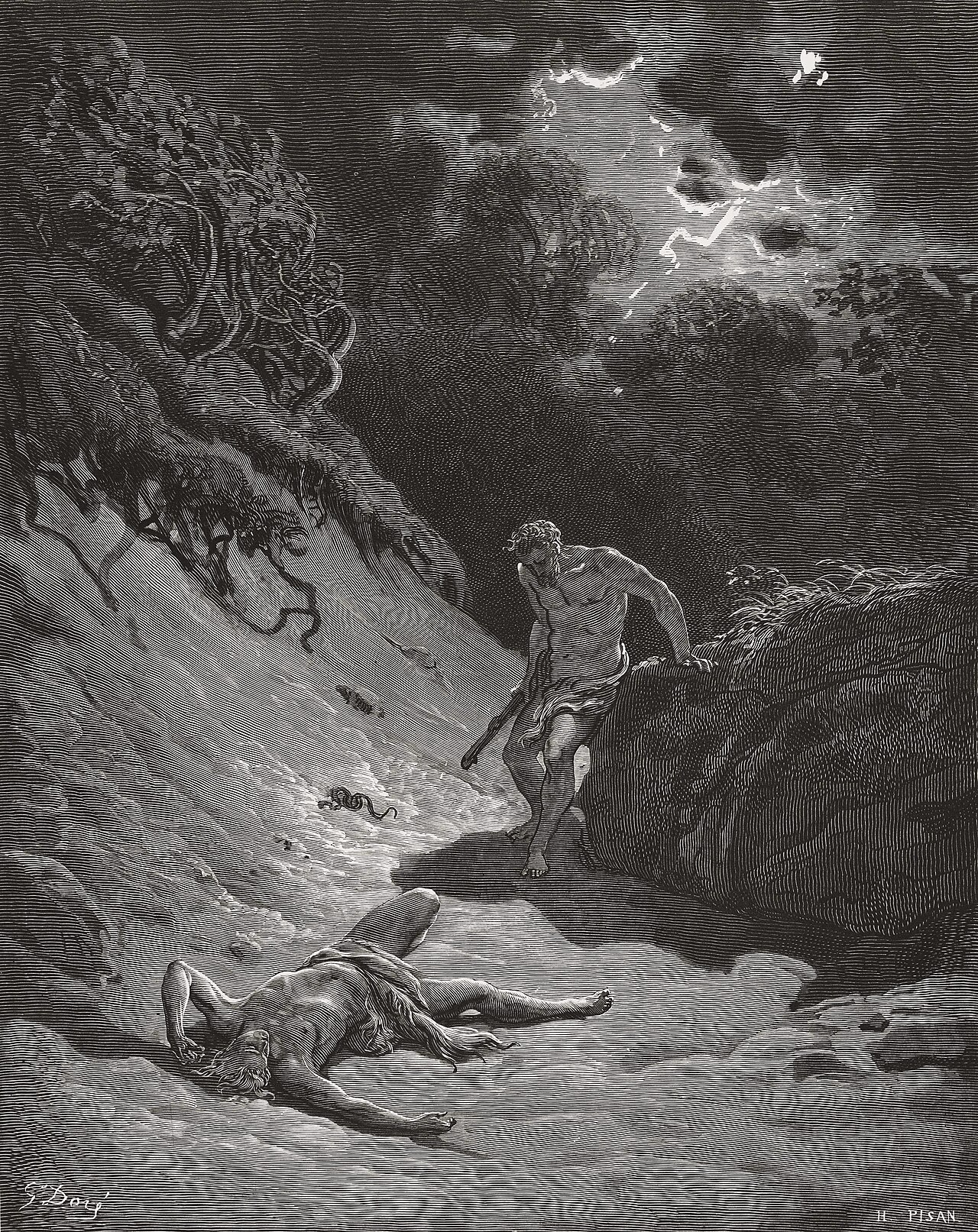
The ground cursed for Adam in chapter 3 now refuses Cain its produce altogether. The earth that opened its mouth to receive his brother's blood will no longer feed him. He goes out a fugitive and a wanderer. Adam was put outside the garden and still worked the soil, and Cain is driven off it.
This site's exposition
a fugitive and a wanderer
The ground Cain tills will yield him no produce. The Hebrew pair is na and nad, and Adam Clarke tied the land of Nod to the second word. Cyril of Jerusalem pointed to this sentence to show the LORD's forbearance toward a man who killed his brother.
The record, by era
The Church Fathers2 voices
A commentator
John ChrysostomAGAINST JUDAIZING CHRISTIANS 8.2.10 · Written in the 5th century.
proposed
The punishment of which God spoke seems to be excessively harsh, but rightly understood it gives us a glimpse of his great solicitude. God wanted men of later times to exercise self-control. Therefore, he designed the kind of punishment that was capable of setting Cain free from his sin. If God had immediately destroyed him, Cain would have disappeared, his sin would have stayed concealed, and he would have remained unknown to men of later times. But as it is, God let him live a long time with that bodily tremor of his. The sight of Cain's palsied limbs was a lesson for all he met. It served to teach all men and exhort them never to dare do what he had done, so that they might not suffer the same punishment. And Cain himself became a better man again. His trembling, his fear, the mental torment that never left him, his physical paralysis kept him, as it were, shackled. They kept him from leaping again to any other like deed of bold folly. They constantly reminded him of his former crime. Through them he achieved greater self-control in his soul.
A commentator
Philoxenus of Mabbug13 Ascetic Discourses, Discourse 6 -- First Discourse on the Fear of God · Written before 523.
proposed
Over Cain, who did not fear God of his own freewill, did fear rule of necessity, and he became a vagabond and a wanderer in the earth; for because he did not fear the One Who was worthy to be feared, he was filled with …
The Medieval Church1 voice
When you have worked it, it will not give you its fruits. The same people worked that land which the head of the Church Christ bore, that is, in his flesh our salvation, by crucifying him who died for our sins, and that land did …
The Puritans and the Awakening1 voice
When thou tillest the ground,....
The Nineteenth Century1 voice
A commentator
Jamieson, Fausset & Brown1802–1910
Commentary Critical and Explanatory on the Whole Bible (1871)
proposed
a fugitive--condemned to perpetual exile; a degraded outcast; the miserable victim of an accusing conscience. My punishment is greater than I can bear--What an overwhelming sense of misery; but no sign of penitence, nor cry for pardon.
quarantine:debris (2026-07-29) — starts-lowercase
1 more voice on this verse
The Nineteenth Century1 voice
A fugitive and a vagabond shalt thou be - Thou shalt be expelled from the presence of God, and from thy family connections, and shalt have no fixed secure residence in any place. The Septuagint render this στενων και τρεμων εση, thou shalt be groaning and trembling upon the earth - the horror of thy crime shall ever haunt thee, and thou shalt never have any well-grounded hope that God will remit the punishment thou deservest. No state out of endless perdition can be considered more awful than this.
How the passage was read
What the Jewish commentators add
On the verses either side of this one
CURSED ART THOU FROM THE GROUND — more than it has already been cursed on account of its sin. In this, too, it has further sinned in that it hath opened its mouth to take thy brother’s blood.
1 more on this passage, in their own words ▾
This is in the form of a question: “You bear the worlds above and below, and is it impossible for You to bear my sin?” Thus the words of Rashi quoting Bereshith Rabbah. 439:25. The correct plain interpretation is that it is a confession.
This section is reception history: how the passage was read and kept in the Jewish tradition. Where a reading parts from an essential of the Christian faith, the section says so at that point.
Texts and citation data: Sefaria; each excerpt follows its version’s licence. 3 further sources are cited on this chapter that carry no English text this site may quote or only restate the verse.
The words behind it
13 Hebrew wordsEvery Hebrew word of this verse in the order it stands, with what it means and the door to its own study. The last column counts the times a word stands in the whole Bible: the rarer the word, the more the places it appears belong together.
| Hebrew | Sound | Meaning | Word study | In the Bible |
|---|---|---|---|---|
| כִּ֤י | ki | for | H3588 → | 4482 times |
| תַֽעֲבֹד֙ | taavod | you will till | H5647 → | 288 times |
| אֶת־ | ʾet- | <obj.> | H853 → | 10935 times |
| הָ֣אֲדָמָ֔ה | haadamah | the ground | H127 → | 225 times |
| לֹֽא־ | lo'- | not | H3808 → | 5168 times |
| תֹסֵ֥ף | tosef | <it> will repeat | H3254 → | 212 times |
| תֵּת־ | tet- | to give | H5414 → | 2011 times |
| כֹּחָ֖הּ | kochah | produce its | H3581 → | 126 times |
| לָ֑ךְ | lakh | to <the> you | ||
| נָ֥ע | na' | a wanderer | H5128 → | |
| וָנָ֖ד | vanad | and a fugitive | H5110 → | |
| תִּֽהְיֶ֥ה | tihyeh | you will be | H1961 → | 3559 times |
| בָאָֽרֶץ׃ | vaaretz | on the earth | H776 → | 2504 times |
כִּ֤יfor
kiH3588 →4482 times
תַֽעֲבֹד֙you will till
taavodH5647 →288 times
אֶת־<obj.>
ʾet-H853 →10935 times
הָ֣אֲדָמָ֔הthe ground
haadamahH127 →225 times
לֹֽא־not
lo'-H3808 →5168 times
תֹסֵ֥ף<it> will repeat
tosefH3254 →212 times
תֵּת־to give
tet-H5414 →2011 times
כֹּחָ֖הּproduce its
kochahH3581 →126 times
לָ֑ךְto <the> you
lakh
נָ֥עa wanderer
na'H5128 →
וָנָ֖דand a fugitive
vanadH5110 →
תִּֽהְיֶ֥הyou will be
tihyehH1961 →3559 times
בָאָֽרֶץ׃on the earth
vaaretzH776 →2504 times
A shaded row is a word that stands 400 times or fewer in the Bible.
The walk
8 stopsEach card is a verse this one points to, and under it the verses that one points to in turn. Where several paths arrive at the same place, that place is listed first: the text keeps returning to it.
Through
Hosea 9:17My God will reject them because they have not obeyed Him; and they shall be wanderers among the nations.
it leads to
- Deuteronomy 28:64–65
Then the LORD will scatter you among all the nations, from one end of the earth to the other, and there you will worship other gods, gods of wood and stone, which neither you…
- Hosea 7:13
Woe to them, for they have strayed from Me! Destruction to them, for they have rebelled against Me! Though I would redeem them, they speak lies against Me.
- Zechariah 7:11–14
But they refused to pay attention and turned a stubborn shoulder; they stopped up their ears from hearing.
- Micah 7:7
But as for me, I will look to the LORD; I will wait for the God of my salvation. My God will hear me.
- Deuteronomy 28:64–65
Through
Leviticus 26:36As for those of you who survive, I will send a faintness into their hearts in the lands of their enemies, so that even the sound of a windblown leaf will put them to…
it leads to
- Ezekiel 21:7
And when they ask, ‘Why are you groaning?’ you are to say, ‘Because of the news that is coming. Every heart will melt, and every hand will go limp. Every spirit will faint, and…
- Isaiah 30:17
A thousand will flee at the threat of one; at the threat of five you will all flee, until you are left alone like a pole on a mountaintop, like a banner on a…
- Ezekiel 21:7
Through
Leviticus 26:20and your strength will be spent in vain. For your land will not yield its produce, and the trees of the land will not bear their fruit.
it leads to
- Psalms 127:1
Unless the LORD builds the house, its builders labor in vain; unless the LORD protects the city, its watchmen stand guard in vain.
- Deuteronomy 11:17
or the anger of the LORD will be kindled against you. He will shut the heavens so that there will be no rain, nor will the land yield its produce, and you will soon…
- Psalms 127:1
Where this verse is studied
About Genesis
This page draws on 9 works. Open the list of works
This page draws on Adam Clarke, Commentary on the Bible; Bede, Commentary on Genesis (Hexaemeron); Cyril of Jerusalem, Catechetical Lecture 2:7; Jamieson, Fausset & Brown, Commentary Critical and Explanatory on the Whole Bible; John Calvin, Commentary on Genesis; John Chrysostom, AGAINST JUDAIZING CHRISTIANS 8.2.10; John Gill, Exposition of the Old Testament; John Gill, Exposition of the Old Testament (1748-1763) and Philoxenus of Mabbug, 13 Ascetic Discourses, Discourse 6 -- First Discourse on the Fear of God.