
Genesis 4:15
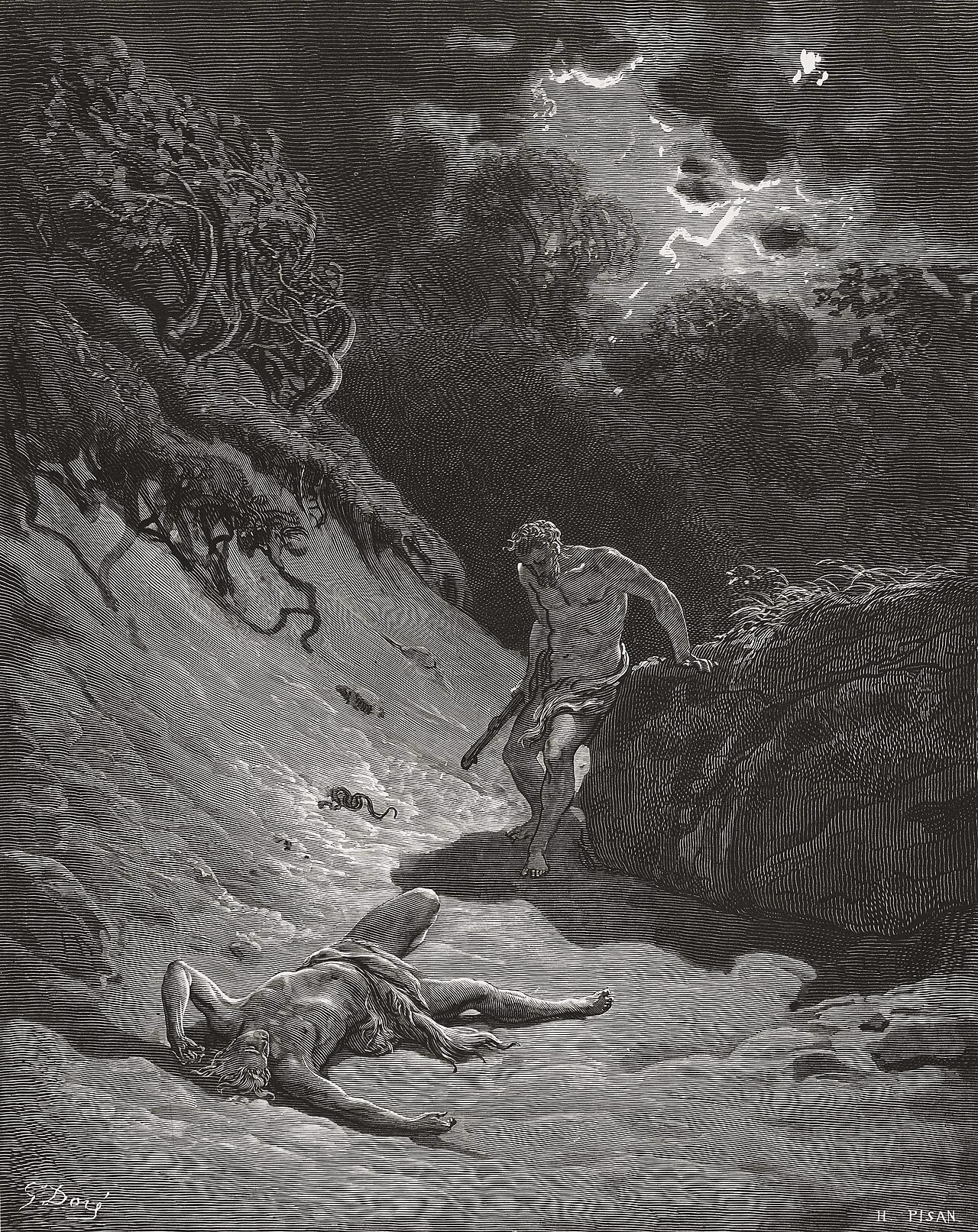
in Genesis 4“Not so!” replied the LORD. “If anyone slays Cain, then Cain will be avenged sevenfold.” And the LORD placed a mark on Cain, so that no one who found him would kill him.
BSB
The same verse in ASV and KJV ▾
ASV
And Jehovah said unto him, Therefore whosoever slayeth Cain, vengeance shall be taken on him sevenfold. And Jehovah appointed a sign for Cain, lest any finding him should smite him.
KJV
And the Lord said unto him, Therefore whosoever slayeth Cain, vengeance shall be taken on him sevenfold. And the Lord set a mark upon Cain, lest any finding him should kill him.
⋯
This verse in Genesis 4
Commentary
15 notes on this verseIndeed, it was not without reason that the mark was set upon Cain, that no one might kill him. Thus it was indicated that evil is not destroyed or removed from the earth. Cain was afraid that he might be killed, because he did not know how to flee. For evil is augmented and amassed by the practice of evil, and it exists without moderation or limit, fights through guile and deceit and is revealed by its deeds and by the blood of the slain, even as Cain also was revealed.
This site's exposition
placed a mark on Cain
The mark is protection. What the mark was the verse never says, and Clarke runs through the old guesses to show that none of them stands in the text. If anyone slays Cain, the LORD said, Cain will be avenged sevenfold, and Lamech seizes that figure at verse 24.
The record, by era
The Church Fathers3 voices
(Verse 15.) Everyone who kills Cain will suffer sevenfold vengeance. Aquila interpreted it sevenfold. Symmachus, the seventh. Theodotion, by the week. On this chapter, our letter to Bishop Damasus exists.
when Cain petitioned for death through horror at his fratricide, did God not give it, but rather delivered him over to a still heavier punishment, namely, to remain on the earth lamenting and trembling—an evil from which he said death would be a deliverance? God …
Therefore as a slave he received a sign, but even thus he could not escape death. Thus the sinner is a slave to fear, to cupidity, to avarice, to lust, to malice, to anger, nay, he is a greater slave than if he were set under tyrants.
The Medieval Church2 voices
A commentator
BonaventureCollations on the Hexaemeron, Collation 16 · Written in the 13th century.
proposed
Now Adam, in the act of making fruitful, represents those doctors who, falling upon the law as lovers upon their spouse, consumed the tree of the knowledge in order to observe the Law, and consented to the Serpent who persuaded them to do so, whence …
By no means, he said, shall it be so, but whoever kills Cain shall be avenged sevenfold. You shall not die as you think, and you shall not receive death as a remedy, but you shall live for a long time as an example to …
8 more voices on this verse
The Medieval Church3 voices
And God set a sign upon Cain, lest anyone who found him would kill him. The very sign by which it was evident that he would always live as a trembling, groaning, wandering, and fugitive; reminded by his own misery, because he could not be …
And God set a mark upon Cain, so that no one who found him would kill him. The Jewish people, whether under pagan or Christian rulers, have the mark of their law, by which they are distinguished from other nations and peoples, and every emperor …
A commentator
BonaventureCollations on the Hexaemeron, Collation 14 · Written in the 13th century.
proposed
Christ is symbolized most of all by the murder of Abel; for Christ was killed by His brothers; and an inscription was placed among the Jews, that they be not killed, but become errant and fugitive on the earth.
The Puritans and the Awakening3 voices
Condemned prisoners are under the special protection of the law; those that are appointed sacrifices to public justice must not be sacrificed to private revenge.
And the Lord said unto him,....
Condemned prisoners are under the special protection of the law; those that are appointed sacrifices to public justice must not be sacrificed to private revenge.
The Nineteenth Century2 voices
The Lord set a mark upon Cain - What this mark was, has given rise to a number of frivolously curious conjectures. Dr. Shuckford collects the most remarkable. Some say he was paralytic; this seems to have arisen from the version of the Septuagint, Στενων και τρεμων εση, Groaning and trembling shalt thou be. The Targum of Jonathan ben Uzziel says the sign was from the great and precious name, probably one of the letters of the word Yehovah.
A commentator
Jamieson, Fausset & Brown1802–1910
Commentary Critical and Explanatory on the Whole Bible (1871)
proposed
whosoever slayeth Cain--By a special act of divine forbearance, the life of Cain was to be spared in the then small state of the human race. set a mark--not any visible mark or brand on his forehead, but some sign or token of assurance that his life would be preserved.
quarantine:debris (2026-07-29) — starts-lowercase
How the passage was read
What the Jewish commentators add
On the verses either side of this one
[AND FROM THY FACE SHALL I BE HID.] All the world is full of God’s glory.
This section is reception history: how the passage was read and kept in the Jewish tradition. Where a reading parts from an essential of the Christian faith, the section says so at that point.
Texts and citation data: Sefaria; each excerpt follows its version’s licence. 3 further sources are cited on this chapter that carry no English text this site may quote or only restate the verse.
The words behind it
18 Hebrew wordsEvery Hebrew word of this verse in the order it stands, with what it means and the door to its own study. The last column counts the times a word stands in the whole Bible: the rarer the word, the more the places it appears belong together.
| Hebrew | Sound | Meaning | Word study | In the Bible |
|---|---|---|---|---|
| וַיֹּ֧אמֶר | vaiyomer | and he said | H559 → | 5305 times |
| ל֣וֹ | lo | to <the> him | ||
| יְהוָ֗ה | yahweh | Yahweh | H3068 → | 6520 times |
| לָכֵן֙ | lakhen | <to> therefore | H3651 → | 771 times |
| כָּל־ | kol- | any | H3605 → | 5413 times |
| הֹרֵ֣ג | horeg | [one who] kills | H2026 → | 167 times |
| קַ֔יִן | kayin | <of> Cain | H7014 → | 19 times |
| שִׁבְעָתַ֖יִם | shivatayim | sevenfold | H7659 → | |
| יֻקָּ֑ם | yukam | he will be avenged | H5358 → | |
| וַיָּ֨שֶׂם | vaiyasem | and he appointed | H7760 → | 584 times |
| יְהוָ֤ה | yahweh | Yahweh | H3068 → | 6520 times |
| לְקַ֙יִן֙ | lekayin | for Cain | H7014 → | 19 times |
| א֔וֹת | ʾot | a sign | H226 → | 80 times |
| לְבִלְתִּ֥י | levilti | to not | H1115 → | 112 times |
| הַכּוֹת־ | hakot- | to strike | H5221 → | 499 times |
| אֹת֖וֹ | ʾoto | <obj.> him | H853 → | 10935 times |
| כָּל־ | kol- | any | H3605 → | 5413 times |
| מֹצְאֽוֹ׃ | motzeo | [one who] found him | H4672 → | 455 times |
וַיֹּ֧אמֶרand he said
vaiyomerH559 →5305 times
ל֣וֹto <the> him
lo
יְהוָ֗הYahweh
yahwehH3068 →6520 times
לָכֵן֙<to> therefore
lakhenH3651 →771 times
כָּל־any
kol-H3605 →5413 times
הֹרֵ֣ג[one who] kills
horegH2026 →167 times
קַ֔יִן<of> Cain
kayinH7014 →19 times
שִׁבְעָתַ֖יִםsevenfold
shivatayimH7659 →
יֻקָּ֑םhe will be avenged
yukamH5358 →
וַיָּ֨שֶׂםand he appointed
vaiyasemH7760 →584 times
יְהוָ֤הYahweh
yahwehH3068 →6520 times
לְקַ֙יִן֙for Cain
lekayinH7014 →19 times
א֔וֹתa sign
ʾotH226 →80 times
לְבִלְתִּ֥יto not
leviltiH1115 →112 times
הַכּוֹת־to strike
hakot-H5221 →499 times
אֹת֖וֹ<obj.> him
ʾotoH853 →10935 times
כָּל־any
kol-H3605 →5413 times
מֹצְאֽוֹ׃[one who] found him
motzeoH4672 →455 times
A shaded row is a word that stands 400 times or fewer in the Bible.
The walk
8 stopsEach card is a verse this one points to, and under it the verses that one points to in turn. Where several paths arrive at the same place, that place is listed first: the text keeps returning to it.
Through
Ezekiel 9:4“Go throughout the city of Jerusalem,” said the LORD, “and put a mark on the foreheads of the men sighing and groaning over all the abominations committed there.”
it leads to
- Revelation 9:4
They were told not to harm the grass of the earth or any plant or tree, but only those who did not have the seal of God on their foreheads.
Reached by 2 separate paths from here.
- 2 Corinthians 1:22
placed His seal on us, and put His Spirit in our hearts as a pledge of what is to come.
- Revelation 14:1
Then I looked and saw the Lamb standing on Mount Zion, and with Him 144,000 who had His name and His Father’s name written on their foreheads.
- Revelation 7:2–3
And I saw another angel ascending from the east, with the seal of the living God. And he called out in a loud voice to the four angels who had been given power to…
- Revelation 20:4
Then I saw the thrones, and those seated on them had been given authority to judge. And I saw the souls of those who had been beheaded for their testimony of Jesus and for…
- Revelation 9:4
Through
Ezekiel 9:6Slaughter the old men, the young men and maidens, the women and children; but do not go near anyone who has the mark. Now begin at My sanctuary.” So they began with the elders…
it leads to
- Exodus 12:23
When the LORD passes through to strike down the Egyptians, He will see the blood on the top and sides of the doorframe and will pass over that doorway; so He will not allow…
- Jeremiah 25:29
For behold, I am beginning to bring disaster on the city that bears My Name, so how could you possibly go unpunished? You will not go unpunished, for I am calling down a sword…
- 2 Timothy 2:19
Nevertheless, God’s firm foundation stands, bearing this seal: “The Lord knows those who are His,” and, “Everyone who calls on the name of the Lord must turn away from iniquity.”
- Exodus 12:23
Where this verse is studied
On this page
Studies21
On this verse
On this chapter
- Adam to Noah
- The Designer's Fingerprint
- Eve: The Mother of All Living
- The Hall of Faith
- Hebel: the word the Berean text renders futility
- Parallelism: the Bible's Rhyme of Thoughts
Show the next 6 titles
About Genesis
Who and where
1 name in this verse with a page on the site.
This page draws on 12 works. Open the list of works
This page draws on Adam Clarke, Commentary on the Bible; Ambrose of Milan, FLIGHT FROM THE WORLD 7.39; Ambrose of Milan, Letter 37, To Simplician; Bede, Commentary on Genesis (Hexaemeron); Bonaventure, Collations on the Hexaemeron, Collation 16; Bonaventure, Collations on the Hexaemeron, Collation 14; Cosmas Indicopleustes, The Christian Topography, Book 5; Jamieson, Fausset & Brown, Commentary Critical and Explanatory on the Whole Bible; Jerome, Hebrew Questions on Genesis; John Gill, Exposition of the Old Testament; John Gill, Exposition of the Old Testament (1748-1763) and Matthew Henry, Commentary on the Whole Bible.