
Genesis 4:8
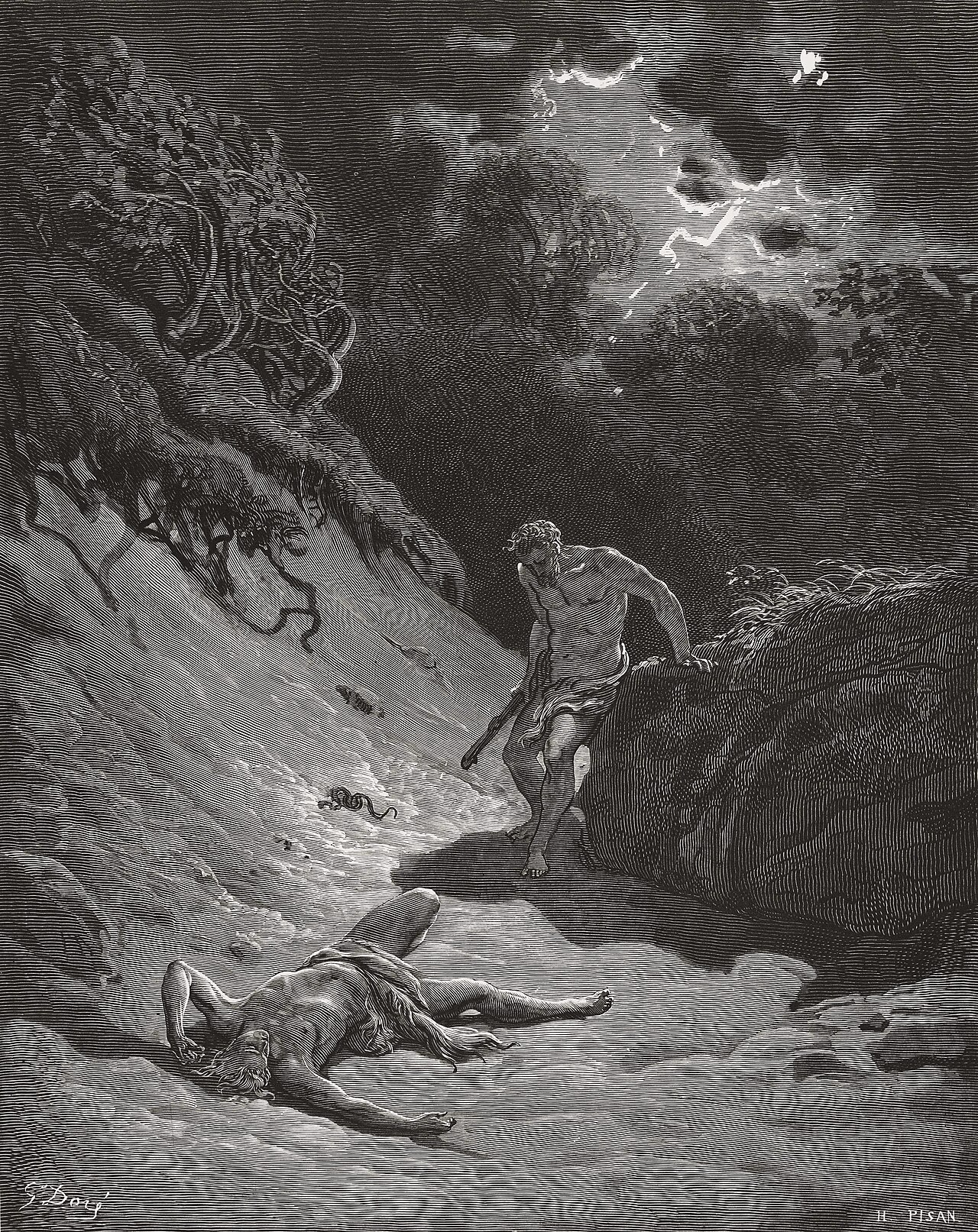
in Genesis 4Then Cain said to his brother Abel, “Let us go out to the field.” And while they were in the field, Cain rose up against his brother Abel and killed him.
BSB
The same verse in ASV and KJV ▾
ASV
And Cain told Abel his brother. And it came to pass, when they were in the field, that Cain rose up against Abel his brother, and slew him.
KJV
And Cain talked with Abel his brother: and it came to pass, when they were in the field, that Cain rose up against Abel his brother, and slew him.
⋯
This verse in Genesis 4
Commentary
12 notes on this verse(Verse 8) And Cain said to his brother Abel. It is understood what the Lord said. Therefore, it is superfluous, what is found in the Samaritan and our volume, Let us go to the field.
This site's exposition
Cain rose up against his brother Abel
The first death in the human family is a murder, out in the field where the blood goes into the ground. Jerome noted that the Hebrew leaves Cain's sentence to Abel blank and the Samaritan text supplies it, and the Berean prints it, Let us go out to the field. The reason stands at 1 John 3:12: Cain's own works were evil and his brother's were righteous.
The record, by era
The Church Fathers2 voices
A commentator
Philoxenus of Mabbug13 Ascetic Discourses, Discourse 11 -- On Abstinence · Written before 523.
proposed
Now this is the first lust which conquered the world, and because of it the first transgression of the law took place; and next Cain also, in turning unto this, meditated the killing of his brother that he might inherit the earth by himself.
A commentator
Philoxenus of Mabbug13 Ascetic Discourses, Discourse 4 -- On Faith: First Discourse on Simplicity · Written before 523.
proposed
And moreover we may see the cunning of Cain from the outlet which he found for his wickedness, for when he meditated slaying Abel his brother, and was not able to do it because he was near unto his parents, he said "Let us go …
The Medieval Church3 voices
A commentator
BonaventureCollations on the Hexaemeron, Collation 14 · Written in the 13th century.
proposed
Christ is symbolized most of all by the murder of Abel; for Christ was killed by His brothers; and an inscription was placed among the Jews, that they be not killed, but become errant and fugitive on the earth.
Some understand the murderer Cain as the Jews' lack of faith, the killing of Abel as the passion of the Lord and Savior, and the earth that opened its mouth and received Abel's blood from Cain's hand as the church (which received, in the mystery …
Cain led his brother out into the field and killed him. The Jewish people led the Lord out of their city Jerusalem and crucified Him at Calvary; from both instances of this ordeal we are reminded typically to go out to the Lord outside the …
5 more voices on this verse
The Medieval Church2 voices
And Cain said to Abel his brother: Let us go out into the field. And when they were in the field, Cain rose up against Abel his brother, and killed him.
Why did Cain become a fratricide? Was it not by his evil will? He preferred himself to his Creator and followed after evil thoughts and so became abandoned to envy and committed murder.
The Puritans and the Awakening2 voices
And Cain talked with Abel,.... Or "said", or "spoke unto" him (l); either what the Lord God said to him in the foregoing verses, as Aben Ezra; or he spoke to him in a kind and friendly manner, and thereby got him to take a walk in the field with him.
And Cain talked with Abel,.... Or "said", or "spoke unto" him (l); either what the Lord God said to him in the foregoing verses, as Aben Ezra; or he spoke to him in a kind and friendly manner, and thereby got him to take a walk in the field with him.
The Nineteenth Century1 voice
Cain talked with Abel his brother - ויאמר קין vaiyomer Kayin, and Cain said, etc.; not talked, for this construction the word cannot bear without great violence to analogy and grammatical accuracy. But why should it be thus translated? Because our translators could not find that any thing was spoken on the occasion; and therefore they ventured to intimate that there was a conversation, indefinitely.
The words behind it
16 Hebrew wordsEvery Hebrew word of this verse in the order it stands, with what it means and the door to its own study. The last column counts the times a word stands in the whole Bible: the rarer the word, the more the places it appears belong together.
| Hebrew | Sound | Meaning | Word study | In the Bible |
|---|---|---|---|---|
| וַיֹּ֥אמֶר | vaiyomer | and he said | H559 → | 5305 times |
| קַ֖יִן | kayin | Cain | H7014 → | 19 times |
| אֶל־ | ʾel- | to | H413 → | 5510 times |
| הֶ֣בֶל | hevel | Abel | H1893 → | 8 times |
| אָחִ֑יו | ʾachiv | brother his | H251 → | 630 times |
| וַֽיְהִי֙ | vayhi | and it was | H1961 → | 3559 times |
| בִּהְיוֹתָ֣ם | bihyotam | when were they | H1961 → | 3559 times |
| בַּשָּׂדֶ֔ה | basadeh | in the field | H7704 → | 334 times |
| וַיָּ֥קָם | vaiyakom | and he rose up | H6965 → | 628 times |
| קַ֛יִן | kayin | Cain | H7014 → | 19 times |
| אֶל־ | ʾel- | against | H413 → | 5510 times |
| הֶ֥בֶל | hevel | Abel | H1893 → | 8 times |
| אָחִ֖יו | ʾachiv | brother his | H251 → | 630 times |
| וַיַּהַרְגֵֽהוּ׃ | vaiyahargehu | and he killed him | H2026 → | 167 times |
| נֵלְכָה | nelekhah | let us go | H1980 → | 1546 times |
| הַשָּׂדֶה | hasadeh | [into] the field | H7704 → | 334 times |
וַיֹּ֥אמֶרand he said
vaiyomerH559 →5305 times
קַ֖יִןCain
kayinH7014 →19 times
אֶל־to
ʾel-H413 →5510 times
הֶ֣בֶלAbel
hevelH1893 →8 times
אָחִ֑יוbrother his
ʾachivH251 →630 times
וַֽיְהִי֙and it was
vayhiH1961 →3559 times
בִּהְיוֹתָ֣םwhen were they
bihyotamH1961 →3559 times
בַּשָּׂדֶ֔הin the field
basadehH7704 →334 times
וַיָּ֥קָםand he rose up
vaiyakomH6965 →628 times
קַ֛יִןCain
kayinH7014 →19 times
אֶל־against
ʾel-H413 →5510 times
הֶ֥בֶלAbel
hevelH1893 →8 times
אָחִ֖יוbrother his
ʾachivH251 →630 times
וַיַּהַרְגֵֽהוּ׃and he killed him
vaiyahargehuH2026 →167 times
נֵלְכָהlet us go
nelekhahH1980 →1546 times
הַשָּׂדֶה[into] the field
hasadehH7704 →334 times
A shaded row is a word that stands 400 times or fewer in the Bible.
The walk
8 stopsEach card is a verse this one points to, and under it the verses that one points to in turn. Where several paths arrive at the same place, that place is listed first: the text keeps returning to it.
Through
Matthew 23:35And so upon you will come all the righteous blood shed on earth, from the blood of righteous Abel to the blood of Zechariah son of Berechiah, whom you murdered between the temple and…
it leads to
- Hebrews 11:4
By faith Abel offered God a better sacrifice than Cain did. By faith he was commended as righteous when God gave approval to his gifts. And by faith he still speaks, even though he…
Reached by 3 separate paths from here.
- Zechariah 1:1
In the eighth month of the second year of Darius, the word of the LORD came to the prophet Zechariah son of Berechiah, the son of Iddo, saying:
Reached by 2 separate paths from here.
- Hebrews 11:4
Through
Luke 11:51from the blood of Abel to the blood of Zechariah, who was killed between the altar and the sanctuary. Yes, I tell you, all of it will be charged to this generation.
it leads to
- 2 Chronicles 24:20–22
Then the Spirit of God came upon Zechariah son of Jehoiada the priest, who stood up before the people and said to them, “This is what God says: ‘Why do you transgress the commandments…
Reached by 2 separate paths from here.
- Matthew 23:35
And so upon you will come all the righteous blood shed on earth, from the blood of righteous Abel to the blood of Zechariah son of Berechiah, whom you murdered between the temple and…
- 2 Chronicles 24:20–22
Through
Jude 1:11Woe to them! They have traveled the path of Cain; they have rushed headlong into the error of Balaam; they have perished in Korah’s rebellion.
it leads to
- 1 John 3:12
Do not be like Cain, who belonged to the evil one and murdered his brother. And why did Cain slay him? Because his own deeds were evil, while those of his brother were righteous.
Reached by 2 separate paths from here.
- 2 Peter 2:15
They have left the straight way and wandered off to follow the way of Balaam son of Beor, who loved the wages of wickedness.
- Revelation 2:14
But I have a few things against you, because some of you hold to the teaching of Balaam, who taught Balak to place a stumbling block before the Israelites so they would eat food…
- Genesis 4:3–14
So in the course of time, Cain brought some of the fruit of the soil as an offering to the LORD,
- 1 John 3:12
Where this verse is studied
On this page
Studies12
About Genesis
Who and where
2 names in this verse with a page on the site.
This page draws on 10 works. Open the list of works
This page draws on Adam Clarke, Commentary on the Bible; Bede, Homilies on the Gospels 1.14; Bede, Commentary on Genesis (Hexaemeron); Bonaventure, Collations on the Hexaemeron, Collation 14; Jerome, Hebrew Questions on Genesis; John Gill, Exposition of the Old Testament (1748-1763); Matthew Henry, Commentary on the Whole Bible; Philoxenus of Mabbug, 13 Ascetic Discourses, Discourse 11 -- On Abstinence; Philoxenus of Mabbug, 13 Ascetic Discourses, Discourse 4 -- On Faith: First Discourse on Simplicity and Symeon the New Theologian, DISCOURSES 4.2.