
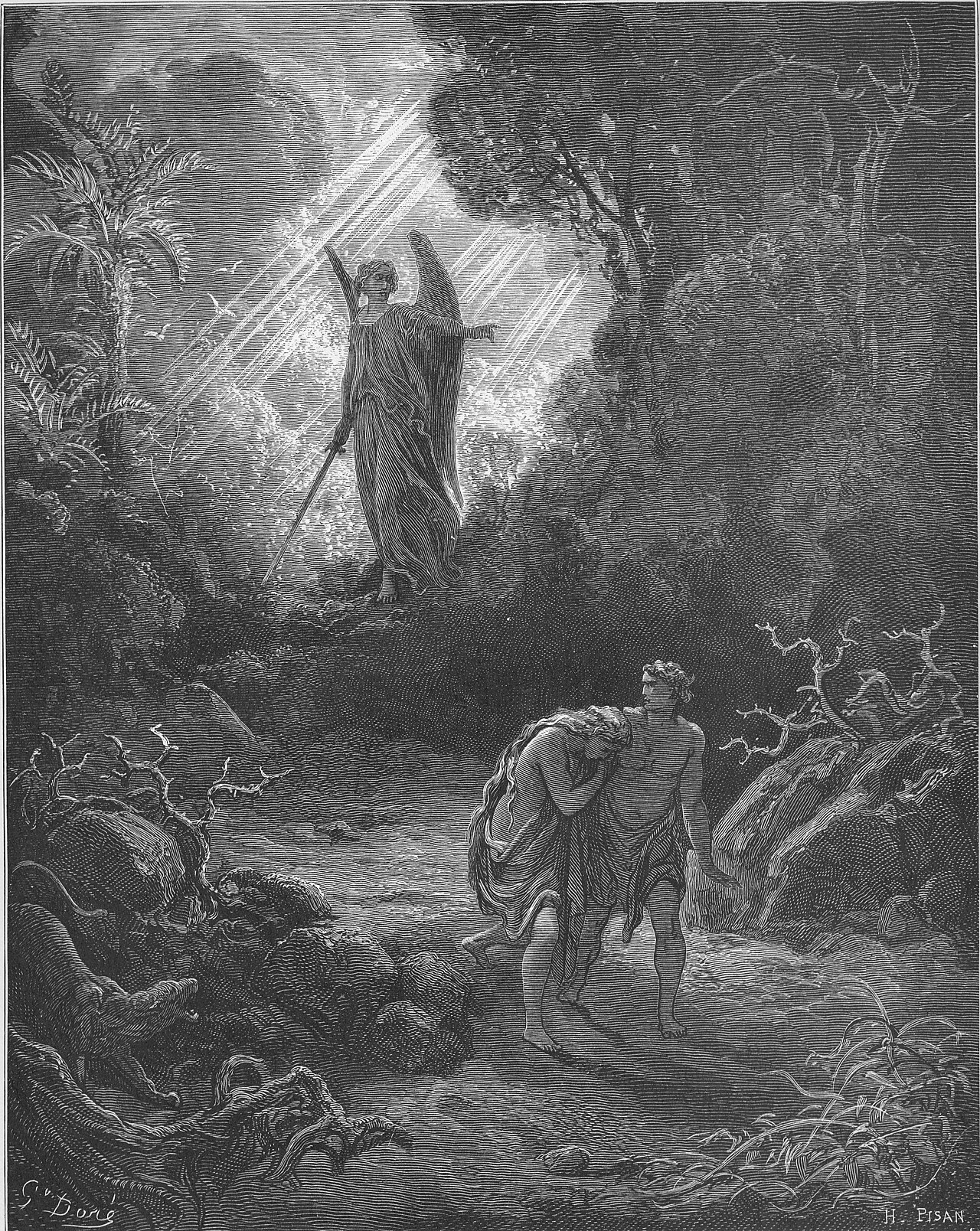
Genesischapter 3
24 verses · Moses, by tradition · 15th to 13th century BC · The Law
In Jewish life
The reading
Weekly portion 1 of 54
בְּרֵאשִׁית Bereshit, Genesis 1:1 to 6:8
Read with it: Isaiah 42:5 to 43:10 in Ashkenazi use, and Isaiah 42:5 to 42:21 in Sephardi use.
The verse numbers here are the ones a Hebrew Bible carries, which differ from an English Bible by a verse or two in several places. The Sephardi reading is named only where this site records a difference; communities vary beyond what is listed. What these books are, and how a Christian reader meets them →
What is done
This chapter is heard inside the opening portion of the annual cycle, in the same sitting as the creation account and the garden (src/lib/hebraic/readings.ts). The portion carries it on to the generations of Adam and the days of Noah, so the fall is read as one step in a long reading. The card above carries the portion and the prophetic reading set beside it.
How it is read
Radak is the one commentator on this chapter whose English the corpus holds, in the translation of Eliyahu Munk, HaChut Hameshulash, licensed CC-BY. He reads the woman's answer to the serpent as a misquotation she made herself. God had forbidden the eating of the tree, and she added the touching of it, which Radak calls "an addition which had been altogether her own" (Radak on Genesis 3:2:1). He reads her thought as a kindness on God's part, that God kept them from touching the tree as a guard against eating from it. His second comment is on the spelling of the word for naked in the tenth verse, which he reads as a lengthened syllable (Radak on Genesis 3:10:1).
Rashi comments on twenty one of the twenty four verses of this chapter, and the corpus holds the text of none of them, because the licence Sefaria reports for that English version keeps it out. They run from Rashi on Genesis 3:1:1 on the serpent to Rashi on Genesis 3:24:1 on the turning sword, and they are cited and linked here. Ibn Ezra on Genesis 3:23:1, on the sending out of the garden, is cited the same way.
The reading of the fifteenth verse is the point where this chapter meets the Christian reading most directly. This site records that the Targums read the seed of the woman of the days of King Messiah, with the head of the serpent crushed at the end. The holders are Targum Pseudo-Jonathan and Targum Neofiti on Genesis 3:15 (src/components/book/guides/genesis/GenesisGuide.tsx, the Jewish tradition section). A modern Jewish reading takes the verse of the standing enmity between people and snakes. The older Jewish reading and the Christian one meet at the same verse, and this site reports both with their holders.
What the rabbis say
The corpus records forty places where the Midrash and the Talmud cite this chapter, thirty under Midrash and ten under Talmud. It carries the locator for each one with no text, so the references stand here and the sayings are read at the source.
Bereshit Rabbah is the heaviest of them, and it reads this chapter through from the woman's answer to the sending out. The locators are 19:3 and 19:4 on the second verse, 19:6 on the seventh, and 19:9 and 19:10 on the eleventh. It reads the thirteenth verse at 20:10, the eighteenth at 21:1, the twentieth at 20:11 and the twenty third at 21:7. It reads the serpent at 85:2 across the seam of the chapters. Aggadat Bereshit reads the sixth verse at 50:4, the twelfth at 11:2 and 62:2, the fourteenth at 79:5, the fifteenth at 83:1, the seventeenth at 53:3 and the twenty first at 43:1.
Eikhah Rabbah reads the question God puts to the man at 1:1, which sets the first hiding in the garden beside the mourning over Jerusalem. Devarim Rabbah reads the serpent's promise at 5:10, and Yalkut Shimoni on Torah at 856:1. Bamidbar Rabbah reads the sixteenth verse at 9:7 and 10:2, the twenty second at 13:3 and the twenty fourth at 23:13.
The Talmud is cited at Berakhot 3b:3 on the serpent and at Berakhot 40a:14 on the sewing of the leaves. The Jerusalem Talmud reads the woman's answer at Sotah 7:1:3, and Avodah Zarah 8a:7 reads the return to the dust. Avot DeRabbi Natan carries five of the ten, at 39:3 on the serpent, 1:6 on the sixth verse, 34:6 and 37:9 on the eighth, and 1:7 on the curse of the serpent.
The text, verse by verse
Each word shows the Hebrew, the English under it, how it sounds and its Strong’s number. A rule between verses marks where the Hebrew manuscripts end a paragraph.
The Serpent's Question
Ibn Ezra on Genesis 3:1
Some say that the woman understood and knew the language of the animals.
Read it in full at Sefaria · Ibn Ezra's commentary on the Pentateuch, tran. and annot. by H. Norman Strickman and Arthur M. Silver. Menorah Pub., 1988-2004
Hiding from God Among the Trees
Sforno on Genesis 3:10
ואירא, this feeling of fear is similar to that experienced by the Jewish people in Exodus,30 when, because of the sin of the golden calf, the people were afraid to face him after his face radiated light when he returned from Mount Sinai.
Read it in full at Sefaria · Eliyahu Munk, HaChut Hameshulash
Ibn Ezra on Genesis 3:11
Bilti with a lamed prefixed to it ( le-vilti ) means “not to.” Without this lamed ( bilti ) it means “only.”
Read it in full at Sefaria · Ibn Ezra's commentary on the Pentateuch, tran. and annot. by H. Norman Strickman and Arthur M. Silver. Menorah Pub., 1988-2004
Ramban on Genesis 3:12
The sense of it is to say: “The woman whom Thy Honor Himself gave me for a help, she gave me of the tree, and I thought that whatever she says to me is a help and benefit to me.
Read it in full at Sefaria · Commentary on the Torah by Ramban (Nachmanides). Translated and annotated by Charles B. Chavel. New York, Shilo Pub. House, 1971-1976
Ramban on Genesis 3:13
WHAT IS THIS THOU HAST DONE to transgress My commandment? For the woman was included in the admonition given to Adam since at that time she was yet bone of his bones, and similarly she was included in his punishment.
Read it in full at Sefaria · Commentary on the Torah by Ramban (Nachmanides). Translated and annotated by Charles B. Chavel. New York, Shilo Pub. House, 1971-1976
Curses on Serpent, Woman, and Ground
Ramban on Genesis 3:14
From a study of this verse, Rabbi Yehoshua the son of Chananya derived the fact that a serpent gives birth once in seven years; 394 Bechoroth 8a. See my Hebrew commentary, p. this they investigated and found to be so. 395 See Bereshith Rabbah:7.
Read it in full at Sefaria · Commentary on the Torah by Ramban (Nachmanides). Translated and annotated by Charles B. Chavel. New York, Shilo Pub. House, 1971-1976
Driven Out, Guarded by Flame
Hebrew words in this chapter
The 40 most used Hebrew words of the chapter, counted by lemma. The article, the object marker, the negatives and the common prepositions are left out.
| Word | Sense here | Uses | Strong’s |
|---|---|---|---|
| אָכַלʼâkal | to eat | 17 | H398 |
| אָמַרʼâmar | to say | 16 | H559 |
| אֱלֹהִיםʼĕlôhîym | God | 13 | H430 |
| אִשָּׁהʼishshâh | woman | 13 | H802 |
| עֵץʻêts | tree | 11 | H6086 |
| יְהֹוָהYᵉhôvâh | yahweh | 9 | H3068 |
| גַּןgan | Garden | 8 | H1588 |
| חַיchay | animal of | 7 | H2416 |
| אָדָםʼâdâm | man | 6 | H120 |
| נָחָשׁnâchâsh | and the snake | 5 | H5175 |
| עָשָׂהʻâsâh | he had made | 5 | H6213 |
| יָדַעyâdaʻ | to know | 4 | H3045 |
| יוֹםyôwm | day | 4 | H3117 |
| לָקַחlâqach | to take | 4 | H3947 |
| שָׂדֶהsâdeh | the field | 3 | H7704 |
| פְּרִיpᵉrîy | fruit | 3 | H6529 |
| מוּתmûwth | to die | 3 | H4191 |
| עַיִןʻayin | eyes your | 3 | H5869 |
| טוֹבṭôwb | good | 3 | H2896 |
| נָתַןnâthan | and she gave | 3 | H5414 |
| Word | Sense here | Uses | Strong’s |
|---|---|---|---|
| עֵירֹםʻêyrôm | naked | 3 | H5903 |
| שָׁמַעshâmaʻ | and they heard | 3 | H8085 |
| קוֹלqôwl | voice | 3 | H6963 |
| עָפָרʻâphâr | dust | 3 | H6083 |
| אֲדָמָהʼădâmâh | the ground | 3 | H127 |
| תָּוֶךְtâvek | in middle of | 2 | H8432 |
| פֵּןpên | lest | 2 | H6435 |
| פָּקַחpâqach | to open | 2 | H6491 |
| רַעraʻ | and evil | 2 | H7451 |
| אִישׁʼîysh | to husband her | 2 | H376 |
| הָלַךְhâlak | walking about | 2 | H1980 |
| חָבָאchâbâʼ | and he hid himself | 2 | H2244 |
| קָרָאqârâʼ | to call | 2 | H7121 |
| צָוָהtsâvâh | to command | 2 | H6680 |
| אָרַרʼârar | cursed | 2 | H779 |
| זֶרַעzeraʻ | offspring your | 2 | H2233 |
| שׁוּףshûwph | to bruise | 2 | H7779 |
| רָבָהrâbâh | certainly | 2 | H7235 |
| עִצָּבוֹןʻitstsâbôwn | pain your | 2 | H6093 |
| אָדָםʼÂdâm | Adam | 2 | H121 |
Keep studying
Studies27
Show the next 6 titles
Show the next 6 titles
Words12
Sources for this chapter
The Hebrew text
STEP Bible, the tagged Hebrew text and its English glosses and James Strong, Strong's Exhaustive Concordance.
In Jewish life
Radak, Radak on Genesis 3:2:1 and 3:10:1, in HaChut Hameshulash, translated by Eliyahu Munk, CC-BY; Rashi and Ibn Ezra, their twenty two comments on Genesis 3, cited by reference; the licence Sefaria reports for the English versions keeps the text out of the corpus; Targum Pseudo-Jonathan and Targum Neofiti, on Genesis 3:15, as this site records them at src/components/book/guides/genesis/GenesisGuide.tsx; The Midrash and the Talmud, the forty locators on Genesis 3 in scripts/data/sources/sefaria/genesis/3.json and MannaFest, the annual cycle table at src/lib/hebraic/readings.ts.
The rabbinic texts
Ramban, Commentary on the Torah by Ramban (Nachmanides). Translated and annotated by Charles B. Chavel. New York, Shilo Pub. House, 1971-1976; Ibn Ezra, Ibn Ezra's commentary on the Pentateuch, tran. and annot. by H. Norman Strickman and Arthur M. Silver. Menorah Pub., 1988-2004; Sforno, Eliyahu Munk, HaChut Hameshulash and Sefaria, texts and citation data.