
Genesischapter 22
24 verses · Moses, by tradition · 15th to 13th century BC · The Law
Some time later God tested Abraham and said to him, “Abraham!” “Here I am,” he answered.
Introduction
Moses, by tradition, The Law, Genesis Overview.
Moses, by tradition, Narrative, The Law, The Abraham cycle, Genesis Overview. Genesis was given to Israel as the story of their fathers, and this chapter is the one their fathers' faith is measured by. It opens by telling the reader what Abraham does not know, that the command is a test. The first hearers lived among peoples who gave children to their gods, and they were about to receive a law that forbade it absolutely. Listen for how little Abraham says, for the one question Isaac asks on the road, and for the name given to the mountain at the end. The New Testament returns to this chapter more than once, and a reader should hear why.
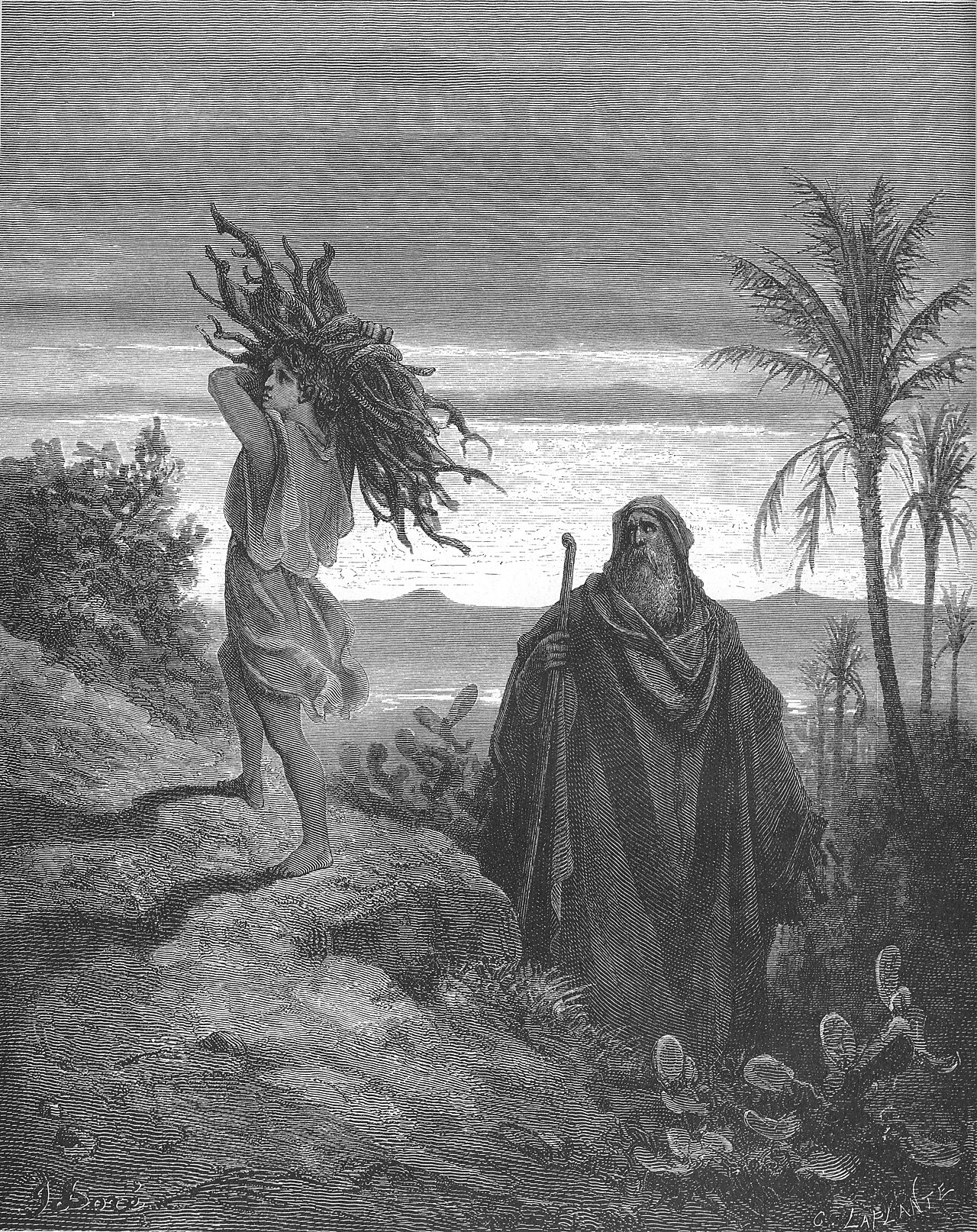
Context
- Who
- Israel in the wilderness, about to receive a sacrificial system and an absolute ban on child sacrifice
- What
- A narrative of the test in which God commands Abraham to offer Isaac, then stops his hand and provides a ram.
- Where
- Beersheba, three days of travel, and a mountain in the land of Moriah.
- When
- The patriarchal age, about 2050 BC on the traditional dating, with Isaac grown and his age unstated.
- Why
- To show that God provides the sacrifice He asks for, and that faith trusts Him with the promise itself.
Historical context
The chapter belongs to Abraham and to Isaac, who is old enough to carry a load of split wood up a hill and to ask his father a question on the way.
Show the rest of the historical context, 5 more paragraphs
The date is about 2050 BC on the traditional reckoning. The chapter states no age for Isaac, Josephus reckons him twenty five, common Jewish tradition gives thirty seven, and the death of Sarah at a hundred and twenty seven in the next chapter sets thirty seven as the ceiling the book itself allows.
The place is a three day walk from Beersheba to the land of Moriah, which John Gill puts at about forty miles, and 2 Chronicles 3:1 names Moriah as the hill where Solomon built the temple.
The occasion is a test, stated as such in the first verse.
A first hearer knew that child sacrifice was practised by peoples in that region and that the law of Moses condemned it in the strongest terms available, so what would have struck him about this chapter is the voice that stops it.
He also knew the equipment of an ordinary sacrifice and would have recognised every item. Wood had to be carried up because the heights were bare, fire meant carrying live coals, and the knife, the binding and an altar of stacked stones are what any offering required. The three days are part of the account, since they are three days in which a man could turn back.
Significance
Israel was about to begin bringing lambs to an altar, and this chapter told them at the outset that God provides the sacrifice and that He does not ask for their children.
Show the rest of the significance, 1 more paragraph
It also set the shape of faith for them. Abraham had been told the promise ran through Isaac, so obeying here meant trusting God with the promise itself.
This chapter in Jewish lifeWhat this chapter is in Jewish life and reading.
What is done
This chapter closes the fourth portion of the annual cycle, and the portion ends with its last verse (src/lib/hebraic/readings.ts).
It is also read on its own at a feast. This site records that Genesis 22 is read in the synagogue on Rosh Hashanah. The ram's horn sounded on that day recalls the ram caught in the thicket, and the liturgy pleads the merit of the binding for the descendants of Isaac. The record stands at src/app/featured/aqedah/page.tsx and at src/components/book/guides/genesis/GenesisGuide.tsx, which names Genesis Rabbah 56 and the Rosh Hashanah Musaf. The card above carries the portion and the prophetic reading set beside it.
How it is read
Rashi is quoted here from the public domain Rosenbaum and Silbermann edition, and Radak from the CC-BY translation of Eliyahu Munk, HaChut Hameshulash.
The tradition reads this chapter as the supreme test of Abraham, and it reads Isaac as a grown man who knew what was coming. Rashi holds that Isaac understood at the eighth verse that he was walking on to be killed (Rashi on Genesis 22:8:1). Rashi reads the request in the second verse as a request. God asks him to stand firm in this trial, so that nobody may say the earlier trials were no tests (Rashi on Genesis 22:2:1, citing Sanhedrin 89b). He reads the early rising of the third verse as eagerness to obey (Rashi on Genesis 22:3:1, citing Pesachim 4a).
Rashi reads the three days as time given on purpose. Had the place been shown at once, people would have said that Abraham was rushed into it and would have refused on reflection (Rashi on Genesis 22:4:1, citing Midrash Tanchuma, Vayera 22). On the binding itself he explains the word as hands and feet tied together behind (Rashi on Genesis 22:9:1). Radak reads the hand with the knife as the ordinary order of an offering, the killing before the burning (Radak on Genesis 22:10:1).
Radak reads the second call from heaven as the promise of a return. What Abraham was ready to do would be repaid to his children when the occasion came (Radak on Genesis 22:15:1). Rashi reads the doubled blessing of the seventeenth verse as one blessing for the father and one for the son (Rashi on Genesis 22:17:1, citing Genesis Rabbah 56:11).
A Christian reader comes to this chapter with the church's reading of a father and an only son, and this site sets that reading beside Israel's own and says which is which. The standard modern study of the Jewish tradition here is Jon D. Levenson, The Death and Resurrection of the Beloved Son, 1993, which this site names on its own page for the chapter (src/app/featured/aqedah/page.tsx). Ibn Ezra carries two comments the corpus holds by reference alone, at Ibn Ezra on Genesis 22:16:1 and 22:18:1.
What the rabbis say
Rashi carries the traditional insights of this chapter, and each stands here as what the rabbis taught.
The first is on what the first verse means by these things. Rashi reports one opinion that it follows the words of Satan, who said that Abraham had held great banquets and had never brought God so much as one bullock. God answered that Abraham would give his son at a word. He reports a second opinion, that it follows the words of Ishmael, who boasted to Isaac about his own circumcision (Rashi on Genesis 22:1:1, citing Sanhedrin 89b).
The second is on the knife. Rashi gives two readings of its name, one from the eating of flesh and one from the reward. Rashi writes that "Israel still eats of the reward given for it" (Rashi on Genesis 22:6:1, citing Genesis Rabbah 56:3).
The third is the moment on the mountain. Rashi reports that when the hand was stopped Abraham asked to draw at least a little blood from the boy. God answered that he was to put no blemish on him at all (Rashi on Genesis 22:12:1, citing Genesis Rabbah 56:7). He reports that the doubling of the name in the eleventh verse is affection (Rashi on Genesis 22:11:1, citing Genesis Rabbah 56:7).
The fourth is the ram. Rashi reports that it had been set apart for this since the six days of creation (Rashi on Genesis 22:13:1, citing Avot 5:5 and Midrash Tanchuma, Vayera 23). He reads the name given to the place as the choosing of that place for the Presence and for sacrifice (Rashi on Genesis 22:14:1). On the last verses he reports Abraham thinking on the way home that a slain son would have died childless. The news of the birth of Rebecca came for that reason (Rashi on Genesis 22:20:1).
The corpus records forty places where the Midrash and the Talmud cite this chapter, thirty four under Midrash and six under Talmud, with the locator for each one and no text. Bereshit Rabbah reads the fourth verse at 56:1, the sixth at 56:3, the seventh at 56:4 and the ninth at 56:5. It reads the tenth verse at 55:8 and 56:6, the fifteenth and sixteenth at 56:11 and the twentieth at 57:1.
Aggadat Bereshit reads the first verse at 31:1 and 31:3, the second at 22:2, the eighth at 19:1 and the twelfth at 16:2 and 31:2. It reads the fourteenth verse at 30:1 and 38:3. Bamidbar Rabbah reads the third verse at 20:12, the eleventh at 14:21 and 20:15, the thirteenth at 13:14, the seventeenth at 14:12 and the eighteenth at 2:13. Bereshit Rabbati reads five places in Parashat Vayera and Parashat Miketz, and Kohelet Rabbah reads the twenty third verse at 1:5:1.
The Talmud is cited at Bava Kamma 49a:5 on the fifth verse and Berakhot 62b:15 on the eighth. The Jerusalem Talmud reads the twenty first verse at Sotah 5:6:2. Avot DeRabbi Natan reads the ram at 1:8, and its second recension reads the second verse at 48:12 and the fifth at 43:1.
Sources: Rashi, Rashi on Genesis 22, in Pentateuch with Rashi's commentary by M. Rosenbaum and A. M. Silbermann, 1929 to 1934, public domain, about 1090; Radak, Radak on Genesis 22:7:1, 22:10:1, 22:15:1, 22:21:1, 22:22:1 and 22:24:1, in HaChut Hameshulash, translated by Eliyahu Munk, CC-BY, about 1200; Jon D. Levenson, The Death and Resurrection of the Beloved Son, 1993, named at src/app/featured/aqedah/page.tsx and cited there rather than quoted, 1993; MannaFest, the Rosh Hashanah reading and the merit of the binding, as recorded at src/app/featured/aqedah/page.tsx and src/components/book/guides/genesis/GenesisGuide.tsx, 2026; The Midrash and the Talmud, the forty locators on Genesis 22 in scripts/data/sources/sefaria/genesis/22.json.
The heads below are this chapter's scenes. The numbered points under each are its verses.
Take Your Son, Your Only Son
Some time later God tested Abraham: , and the Hebrew word means to put a man to the proof. James 1:13 keeps the sense clear, that God tempts no one with evil. Abraham answers, Here I am. He gives that same answer to Isaac at verse 7 and to the angel at verse 11.
Genesis 22:1
“WE may regard the father of the faithful as being a pattern of his children. As God dealt with Abraham, so will He deal in measure with all those who, as Believers, are the children of believing Abraham. Everything that will abide the fire shall go through the fire, that it may be both proved and improved. We clearly understand that when God is said to "tempt" Abraham, the word used does not carry its ordinary meaning.”
2 more voices on this verseWhat preachers and commentators have said about this verse, in their own words.
Genesis 22:1
“The author of the trial: God tempted him, not to draw him to sin, so Satan tempts (if Abraham had sacrificed Isaac, he would not have sinned, his orders would have justified him, and borne him out), but to discover his graces, how strong they were, that they might be found to praise, and honour, and glory, 1 Pet. i.”
Matthew Henry · Commentary on the Whole Bible (1707-1721)puritan
Genesis 22:1
“God did tempt Abraham--not incite to sin (Jas 1:13), but try, prove--give occasion for the development of his faith (1Pe 1:7). and he said, . . . Here I am--ready at a moment's warning for God's service.”
Jamieson, Fausset & Brown · Commentary Critical and Explanatory on the Whole Bible (1871)reformed
The command names the cost three times over, your only son Isaac, whom you love. Clarke, following Warburton, marks how each clause raises the price. Love is named here for the first time in Scripture, and it is a father's love for the son he is told to offer. Moriah is where 2 Chronicles 3:1 puts Solomon's temple.
Genesis 22:2
“Take now thy son - Bishop Warburton’s observations on this passage are weighty and important. “The order in which the words are placed in the original gradually increases the sense, and raises the passions higher and higher: Take now thy son, (rather, take I beseech thee נא na), thine only son whom thou lovest, even Isaac. Jarchi imagines this minuteness was to preclude any doubt in Abraham.”
Adam Clarke · Commentary on the Bible (1810-1826)evangelical
1 more voice on this verse
Genesis 22:2
“Take now thy son, &c.--Every circumstance mentioned was calculated to give a deeper stab to the parental bosom. To lose his only son, and by an act of his own hand, too!--what a host of conflicting feelings must the order have raised!”
Jamieson, Fausset & Brown · Commentary Critical and Explanatory on the Whole Bible (1871)reformed
Connections2 Chronicles 3:1, John 3:16
Genesis 22:3-4
Abraham got up early the next morning: Abraham gets up early and splits the wood himself, so he carries the means of his son's death for three days. Genesis gives no word of the night before and never says what he told Sarah, a silence Henry leaves standing. Gill puts Beersheba about forty miles from Moriah, which fills the two days before the third. Jerome reads the same three days as a start from Gerar.
Genesis 22:3
“Two of his young men - Eliezer and Ishmael, according to the Targum. Clave the wood - Small wood, fig and palm, proper for a burnt-offering - Targum.”
Adam Clarke · Commentary on the Bible (1810-1826)evangelical
2 more voices on this verse
Genesis 22:3
“He gets things ready for a sacrifice, and, as if he himself had been a Gibeonite, it should seem, with his own hands he cleaves the wood for the burnt-offering, that it might not be to seek when the sacrifice was to be offered. Spiritual sacrifices must thus be prepared for. It is very probable that he said nothing about it to Sarah.”
Matthew Henry · Commentary on the Whole Bible (1707-1721)puritan
Genesis 22:3
“From Beer-sheba to Moriah, a journey of two days, he had the painful secret pent up in his bosom. So distant a place must have been chosen for some important reason. It is generally thought that this was one the hills of Jerusalem, on which the Great Sacrifice was afterwards offered.”
Jamieson, Fausset & Brown · Commentary Critical and Explanatory on the Whole Bible (1871)reformed
On the third day Abraham looked up: Origen gathers the third days of Scripture around this one, the day of Israel's sacrifice after Egypt and the day of the resurrection. John Gill notes one donkey among the servants and Isaac, so they walked. Abraham saw the place on the third day.
Genesis 22:4
“Then on the third day,.... After he had received the command from God, and from his setting out on his journey; for he had now travelled two days, Mount Moriah being forty miles from Beersheba, where Abraham dwelt (s); or, as others compute it, forty: Hebron (t) was twenty miles from Beersheba, and Jerusalem twenty two from Hebron; and to travel twenty miles a day on foot, as Isaac and the servants seem to have done, there being but one ass among them, was far enough in those hot countries.”
1 more voice on this verse
Genesis 22:4
“The third day, however, is always applied to mysteries. For also when the people had departed from Egypt, they offer sacrifice to God on the third day and are purified on the third day. And the third day is the day of the Lord's resurrection. Many other mysteries also are included within this day.”
Origen of Alexandria · written before 253 · HOMILIES ON GENESIS 8.4patristic
The word for the boy here and at verse 12 is used of Joseph at seventeen in 37:2 and of Benjamin at 44:22 to 34, so the son carrying the wood is grown. Josephus reckons Isaac twenty-five, and Jewish tradition commonly gives thirty-seven. Abraham says he and the boy will worship and come back, and Hebrews 11:19 says he counted God able to raise the dead.
Genesis 22:5
“I and the lad will go and come again - How could Abraham consistently with truth say this, when he knew he was going to make his son a burnt-offering?”
Adam Clarke · Commentary on the Bible (1810-1826)evangelical
2 more voices on this verse
Genesis 22:5
“Thus, when Christ was entering upon his agony in the garden, he took only three of his disciples with him, and left the rest at the garden door. Note, It is our wisdom and duty, when we are going to worship God, to lay aside all those thoughts and cares which may divert us from the service, leave them at the bottom of the hill, that we may attend on the Lord without distraction.”
Matthew Henry · Commentary on the Whole Bible (1707-1721)puritan
Genesis 22:5
“It is more likely that his words were spoken evasively to his son in ignorance of the issue, yet in unbounded confidence that that son, though sacrificed, would, in some miraculous way, be restored (Heb 11:19).”
Jamieson, Fausset & Brown · Commentary Critical and Explanatory on the Whole Bible (1871)reformed
placed it on his son Isaac: Abraham lays the wood on his son Isaac. He carries the fire and the sacrificial knife in his own hands, so the son bears what will burn him. Wesley and the older writers set the son carrying the wood beside Christ carrying His cross, a reading that stands in their names. The line the two of them walked on together closes this verse and closes verse 8.
Genesis 22:6
“That Isaac carries on himself "the wood for the burnt offering" is a figure, because Christ also "himself carried his own cross," and yet to carry "the wood for the burnt offering" is the duty of a priest. He therefore becomes victim and priest. But what is added also is related to this: "And they both went off together." For when Abraham carries the fire and knife as if to sacrifice, Isaac does not go behind him but with him, that he might be shown to contribute equally with the priesthood itself.”
Origen of Alexandria · written before 253 · HOMILIES ON GENESIS 8.6patristic
2 more voices on this verse
Genesis 22:6
“Isaac's carrying the wood was a type of Christ, who carried his own cross, while Abraham, with a steady and undaunted resolution, carried the fatal knife and fire.”
John Wesley · Explanatory Notes upon the Old Testament (1765)evangelical
Genesis 22:6
“Took the wood - and laid it upon Isaac - Probably the mountain-top to which they were going was too difficult to be ascended by the ass; therefore either the father or the son must carry the wood, and it was most becoming in the latter.”
Adam Clarke · Commentary on the Bible (1810-1826)evangelical
Genesis 22:7-8
These are the only words Isaac speaks in the account, and they are the right question. He asks his father where the lamb is. Abraham answers that God Himself will provide the lamb, and what God provides on the mountain is a ram. Clarke takes the answer as prophecy and points on to the Lamb of God at John 1:29.
Genesis 22:7
“Behold the fire and the wood, but where is the lamb? - This is, 1. A trying question to Abraham; how could he endure to think that Isaac is himself the lamb? 'Tis a teaching question to us all, that when we are going to worship God, we should seriously consider whether we have every thing ready, especially the lamb for a burnt-offering.”
John Wesley · Explanatory Notes upon the Old Testament (1765)evangelical
2 more voices on this verse
Genesis 22:7
“Behold the fire and the wood: but where is the lamb - Nothing can be conceived more tender, affectionate, and affecting, than the question of the son and the reply of the father on this occasion. A paraphrase would spoil it; nothing can be added without injuring those expressions of affectionate submission on the one hand, and dignified tenderness and simplicity on the other.”
Adam Clarke · Commentary on the Bible (1810-1826)evangelical
Genesis 22:7
“Therefore he brings his well-beloved son to be sacrificed, and offered promptly him whom he had received late; nor is he restrained by being called by the name of father, when his son called him "Father," and he replied, "My son." Dear pledges of love are these names, but the commands of God are loved still more. And so although their hearts felt for each other, their purpose remained firm.”
Ambrose of Milan · written before 397 · On the Decease of His Brother Satyrus, Book 2, Section 97patristic
Origen marks that Abraham answers a question about the present with a word about the future. Origen and John Wesley both read the provided lamb as Christ, and Wesley says no one in heaven or earth could have found that lamb until God found the ransom Himself. Wesley adds that God provides the contrite heart too.
Genesis 22:8
Abraham's response, sufficiently accurate and cautious, moves me. I do not know what he saw in his spirit, for he does not speak about the present but about the future: "God himself will provide himself a sheep." He responded to his son's inquiry about present things with future things. For "the Lord himself will provide himself a sheep" in Christ, because also, "Wisdom herself has built herself a house," and "He himself humbled himself unto death."
Origen of Alexandria · written before 253 · HOMILIES ON GENESIS 8.6patristic
2 more voices on this verse
Genesis 22:8
“My son, God will provide himself a lamb - Here we find the same obedient unshaken faith for which this pattern of practical piety was ever remarkable. But we must not suppose that this was the language merely of faith and obedience; the patriarch spoke prophetically, and referred to that Lamb of God which He had provided for himself, who in the fullness of time should take away the sin of the world, and of whom Isaac was a most expressive type.”
Adam Clarke · Commentary on the Bible (1810-1826)evangelical
Genesis 22:8
“Christ the great sacrifice of atonement was of God's providing: when none in heaven or earth could have found a lamb for that burnt-offering, God himself found the ransom. All our sacrifices of acknowledgement are of God's providing too; 'tis he that prepares the heart. The broken and contrite spirit is a sacrifice of God, of his providing.”
John Wesley · Explanatory Notes upon the Old Testament (1765)evangelical
ConnectionsGenesis 3:21, John 1:29
The Lord Will Provide
He bound his son Isaac: Abraham builds the altar, arranges the wood, binds his son Isaac and lays him on it, and the Hebrew name for the episode, the Akedah, comes from that word for binding. Calvin and Clarke read the binding as something the son allowed, with his father past a hundred. Sarah dies at a hundred and twenty-seven and bore Isaac at ninety, which puts a ceiling of thirty-seven on his age here.
Genesis 22:9
“And bound Isaac his son - If the patriarch had not been upheld by the conviction that he was doing the will of God, and had he not felt the most perfect confidence that his son should be restored even from the dead, what agony must his heart have felt at every step of the journey, and through all the circumstances of this extraordinary business? What must his affectionate heart have felt at the questions asked by his innocent and amiable son?”
Adam Clarke · Commentary on the Bible (1810-1826)evangelical
1 more voice on this verse
Genesis 22:9
“Of our duty to God in return of that love we must tread in the steps of this faith of Abraham. God, by his word, calls us to part with all for Christ, all our sins, tho' they have been as a right hand, or a right eye, or an Isaac; all those things that are rivals with Christ for the sovereignity of our heart; and we must cheerfully let them all go.”
John Wesley · Explanatory Notes upon the Old Testament (1765)evangelical
reached out his hand and took the knife: Genesis gives the act in one verse and no word of what either man felt. The knife is in Abraham's hand to slaughter his son before heaven speaks. The test runs to the last moment it can. Ambrose reads the father's hand as steadier than his heart, fearing the stroke would miss.
Genesis 22:10
“The father's hand stretched out the knife over his son, and the father's heart struck the blow that the sentence might not fail of being carried out; he feared lest the stroke should miss, lest his right hand should fail. He felt the movings of fatherly affection, but did not shrink from the work of submission, and hastened his obedience, even when he heard the voice from heaven.”
Ambrose of Milan · written before 397 · On the Decease of His Brother Satyrus, Book 2, Section 97patristic
Genesis 22:11-12
the angel of the LORD called out to him from heaven: The voice calls the name twice, and a doubled name marks a turn at Jacob's call in 46:2 and at the burning bush in Exodus 3:4. The angel hands Abraham his own orders back, your only son, and stops the hand before it falls. God's reason is that Abraham did not withhold his son.
Genesis 22:11
“The angel of the Lord - The very person who was represented by this offering; the Lord Jesus, who calls himself Jehovah, Gen 22:16, and on his own authority renews the promises of the covenant. He was ever the great Mediator between God and man. See this point proved, Gen 15:7 (note).”
Adam Clarke · Commentary on the Bible (1810-1826)evangelical
1 more voice on this verse
Genesis 22:11
“The more imminent the danger is, and the nearer to be put in execution, the more wonderful and the more welcome is the deliverance. Abraham is not only approved, but applauded. He obtains an honourable testimony that he is righteous: Now know I that thou fearest God.”
Matthew Henry · Commentary on the Whole Bible (1707-1721)puritan
now I know that you fear God: Adam Clarke holds that the offering was already complete in will on both sides, the father yielding the son and the son yielding his life. God spares Abraham only the knife. Matthew Henry hears in now I know an honourable testimony given to Abraham.
Genesis 22:12
“Lay not thine hand upon the lad - As Isaac was to be the representative of Jesus Christ’s real sacrifice, it was sufficient for this purpose that in his own will, and the will of his father, the purpose of the immolation was complete. Isaac was now fully offered both by his father and by himself. The father yields up the son, the son gives up his life; on both sides, as far as will and purpose could go, the sacrifice was complete. God simply spares the father the torture of putting the knife to his son’s throat.”
Adam Clarke · Commentary on the Bible (1810-1826)evangelical
1 more voice on this verse
Genesis 22:12
“How does the angel know that Abraham fears God? Because he obeyed instantly, when it didn't make sense, when it was painful, and with no promise of benefit, he went the distance.”
a ram in a thicket, caught by its horns: The ram stands behind Abraham, caught fast by its horns, and it is there before he turns and before it is wanted. He offers it in place of his son. It is the first animal in Scripture to die in the place of a named man. Athanasius holds that Isaac's death would have bought nothing for the world, and that the offering was made for Abraham's testing.
Genesis 22:13
“He showed the ram in the thicket in the stead of the lad, that He might restore the son to his father, and yet the victim not fail the priest. And so Abraham was not stained with his son's blood, nor was God deprived of the sacrifice. The prophet spoke, and neither yielded to boastfulness nor continued obstinate, but took the ram in exchange for the lad. And by this is shown the more how piously he offered him whom he now so gladly received back.”
Ambrose of Milan · written before 397 · On the Decease of His Brother Satyrus, Book 2, Section 98patristic
3 more voices on this verse
Genesis 22:13
“Abraham lifted up his eyes . . . and behold . . . a ram, &c.--No method was more admirably calculated to give the patriarch a distinct idea of the purpose of grace than this scenic representation: and hence our Lord's allusion to it (Joh 8:56).”
Jamieson, Fausset & Brown · Commentary Critical and Explanatory on the Whole Bible (1871)reformed
Genesis 22:13
“Behold a ram - Tho' that blessed Seed was now typified by Isaac, yet the offering of him up was suspended 'till the latter end of the world, and in the mean time the sacrifice of beasts was accepted, as a pledge of that expiation which should be made by that great sacrifice.”
John Wesley · Explanatory Notes upon the Old Testament (1765)evangelical
Genesis 22:13
“Thus the sacrifice was not for the sake of Isaac but for that of Abraham, who was tested by being called upon to make this offering. And of course, God accepted his intentions, but he prevented him from slaying Isaac. The death of Isaac would not buy freedom for the world. No, that could be accomplished only by the death of our Savior, by whose stripes we are all healed.”
Athanasius of Alexandria · written before 373 · FESTAL LETTERS 6patristic
The LORD Will Provide: The name means the LORD will see, and Clarke marks it as the same verb Abraham used in his answer at verse 8. The saying that outlived him is passive: it will be provided on the mountain of the LORD. One morning's relief became a proverb. Jerome reports Jews of his own day saying it in distress, that as God had pity on Abraham so He will have pity on them.
Genesis 22:14
I believe that the Truth of God contained in the expression, "Jehovah-jireh," was ruling Abraham's thoughts long before he uttered it and appointed it to be the memorial name of the place where the Lord had provided a substitute for Isaac. It was this thought, I think, which enabled him to act as promptly as he did under the trying circumstances. His reason whispered within him, "If you slay your son, how can God keep His promise to you that your seed shall be as many as the stars of Heaven?"
1 more voice on this verse
Genesis 22:14
“Jehovah - jireh - יהוה יראה Yehovah-yireh, literally interpreted in the margin, The Lord will see; that is, God will take care that every thing shall be done that is necessary for the comfort and support of them who trust in him: hence the words are usually translated, The Lord will provide; so our translators, Gen 22:8, אלהים יראה Elohim yireh, God will provide; because his eye ever affects his heart, and the wants he sees his hand is ever ready to supply.”
Adam Clarke · Commentary on the Bible (1810-1826)evangelical
A Blessing God Swore by Himself
Genesis 22:15-16
the angel of the LORD called to Abraham from heaven a second time: Heaven speaks a second time, and what follows is the only oath in Genesis in which God swears by Himself. Hebrews 6:13 rests an argument on it, that He could swear by no one greater. Clarke takes the speaker who says declares the LORD and yet swears by Himself to be the Mediator the offering pointed to. That reading is his own.
Genesis 22:15
“These words require a concerned and attentive hearer. For this part of the statement is new: "And the angel of the Lord called to Abraham a second time from heaven." But what the text adds is not new. For "I shall certainly bless you" has already been said earlier, and "I shall certainly multiply you" has been promised earlier, and "your seed shall be as the stars of heaven and as the sand of the sea" also had been announced previously. What therefore is there now in addition which is declared a second time from heaven?”
Origen of Alexandria · written before 253 · HOMILIES ON GENESIS 9.1patristic
2 more voices on this verse
Genesis 22:15
“And the Angel of the Lord called unto Abraham out of heaven the second time. The Angel having restrained him from slaying his son, and having provided another sacrifice, which he offered, calls to him again; having something more to say to him, which was to renew the covenant he had made with him, and confirm it by an oath.”
Genesis 22:15
“Called unto Abraham - Probably while the ram was yet burning. Very high expressions are here of God's favour to Abraham, above any he had yet been blessed with.”
John Wesley · Explanatory Notes upon the Old Testament (1765)evangelical
The LORD swears by Himself because Abraham has not withheld his only son. Origen asks what is new in this second call from heaven, as the blessing and the descendants were promised before. John Gill reads it as the covenant confirmed by an oath.
Cross references
Genesis 22:16
- Quoted inHebrews 6:13“When God made His promise to Abraham, since He had no one greater to swear by, He swore by Himself,”
'Surely blessing I will bless thee' (God's oath to Abraham)
Genesis 22:17-18
I will multiply your descendants like the stars in the sky: The gates of their enemies is new here, added to the promise of stars and sand. Clarke reads the gate as the whole strength of an enemy, its troops, its counsels and its walled cities. The blessing on all nations was given freely in chapter 12 and is now sealed, because you have obeyed My voice. Galatians 3:16 quotes this promise's own words, and to your seed.
Genesis 22:17
“Shall possess the gate of his enemies - Instead of gate the Septuagint have πολεις, cities; but as there is a very near resemblance between πολεις, cities, and πυλας, gates, the latter might have been the original reading in the Septuagint, though none of the MSS. now acknowledge it. By the gates may be meant all the strength, whether troops, counsels, or fortified cities of their enemies.”
Adam Clarke · Commentary on the Bible (1810-1826)evangelical
ConnectionsGenesis 3:15
The LORD gives Isaac the same ground at 26:5, that Abraham obeyed His voice. Paul at Galatians 3:8 calls the promise to Abraham the gospel announced in advance, and Adam Clarke reads the offspring as Christ, through whom the blessing reaches the nations. The test ends on obedience.
Genesis 22:18
“And in thy seed, etc. - We have the authority of St. Paul, Gal 3:8, Gal 3:16, Gal 3:18, to restrain this to our blessed Lord, who was The Seed through whom alone all God’s blessings of providence, mercy, grace, and glory, should be conveyed to the nations of the earth.”
Adam Clarke · Commentary on the Bible (1810-1826)evangelical
Cross references
Genesis 22:18
- Quoted inActs 3:25“And you are sons of the prophets and of the covenant God made with your fathers when He said to Abraham, ‘Through your offspring all the families of the earth will be blessed.’”
'in thy seed shall all the kindreds of the earth be blessed' (Abrahamic covenant)
Connections2 Samuel 7:12, Acts 3:25, Galatians 3:16, Genesis 49:10, Psalms 89:4
Abraham went back to his servants: The verse counts the party going home and does not name Isaac among them. Genesis never again records the father and the son speaking to each other. Beersheba is where Isaac is living when the LORD appears to him in chapter 26. The next thing the book reports is Sarah's death.
The Children of Nahor
Genesis 22:20-22
News from home reaches Abraham straight after the mountain, and the book turns to a family register. The sons of Nahor are listed by name, and some of the names carry on through Scripture. Clarke ties Uz to the land where Job lived and Buz to Elihu the Buzite. Gill says the rest are listed for Bethuel's sake.
Genesis 22:20
“Behold, Milcah, she hath also borne children unto thy brother - This short history seems introduced solely for the purpose of preparing the reader for the transactions related Genesis 24, and to show that the providence of God was preparing, in one of the branches of the family of Abraham, a suitable spouse for his son Isaac.”
Adam Clarke · Commentary on the Bible (1810-1826)evangelical
1 more voice on this verse
Genesis 22:20
“This is recorded here, 1. To show that tho' Abraham saw his own family highly dignified with peculiar privileges, yet he did not look with contempt upon his relations, but was glad to hear of the increase and prosperity of their families.”
John Wesley · Explanatory Notes upon the Old Testament (1765)evangelical
Kemuel (the father of Aram): Adam Clarke reports that the Greek calls Kemuel the father of the Syrians, and he thinks of a Syrian tribe near the Euphrates. This Aram is a grandson of Abraham's brother Nahor. His brother Buz and Uz the firstborn lead the list.
Genesis 22:21
“Huz - He is supposed to have peopled the land of Uz or Ausitis, in Arabia Deserta, the country of Job. Buz his brother - From this person Elihu the Buzite, one of the friends of Job, is thought to have descended. Kemuel the father of Aram - Kamouel πατερα Συρων, the father of the Syrians, according to the Septuagint. Probably the Kamiletes, a Syrian tribe to the westward of the Euphrates are meant; they are mentioned by Strabo.”
Adam Clarke · Commentary on the Bible (1810-1826)evangelical
John Gill reports the common view that the Chaldeans came from Chesed, the fourth son on Nahor's list. He notes that Chaldeans appear earlier, so the name may be used ahead of its time. Of Hazo, Pildash and Jidlaph nothing more is heard.
Genesis 22:23-24
And Bethuel became the father of Rebekah: Bethuel is the last of the eight sons Milcah bore to Abraham's brother Nahor. Rebekah arrives at the end of the list, named once as Bethuel's daughter. Reumah, Nahor's concubine, bears four more sons. Two chapters on, Abraham's servant will travel to this town to find her.
Genesis 22:23
“Bethuel begat Rebekah - Who afterward became the wife of Isaac.”
Adam Clarke · Commentary on the Bible (1810-1826)evangelical
whose name was Reumah: John Gill describes a concubine as a secondary wife under the lawful wife, kept chiefly for children, as Hagar was in Abraham's house. Nahor's line now counts twelve sons, eight by Milcah and four by Reumah, as Ishmael and Jacob will each father twelve. Gill notes that Maacah is a man here.
Genesis 22:24
“And his concubine, whose name was Reumah,.... Not an harlot, but a secondary wife, who was under the proper and lawful wife, and a sort of a head servant in the family, and chiefly kept for the procreation of children; which was not thought either unlawful or dishonourable in those times such as was Hagar in Abraham's family: she bare also Tebah, and Gaham, and Thahash, and Maachah, of whom we have no account elsewhere; only it may be observed, that here Maachah is the name of a man, which sometimes is given to a woman, 1Ki 15:13.”
1 more voice on this verse
Genesis 22:24
“His concubine - We borrow this word from the Latin compound concubina, from con, together, and cubo, to lie, and apply it solely to a woman cohabiting with a man without being legally married. The Hebrew word is פילגש pilegesh, which is also a compound term, contracted, according to Parkhurst, from פלג palag, to divide or share, and נגש nagash, to approach; because the husband, in the delicate phrase of the Hebrew tongue, approaches the concubine, and shares the bed, etc., of the real wife with her.”
Adam Clarke · Commentary on the Bible (1810-1826)evangelical
How this psalm is built
The form: A trial of faith, God proving a man rather than inciting him to sin, as Jamieson, Fausset and Brown classes it.
The patterns in this chapter
| Device | What it does | Where to see it |
|---|---|---|
| Here I am, said three times | Abraham answers with the same two words at verse 1 to God, at verse 7 to Isaac, and at verse 11 to the angel who stops him. Jamieson, Fausset and Brown read the first as readiness at a moment's warning for God's service. The chapter puts the same answer in his mouth for the call, for the hardest question of his life, and for the reprieve.Jamieson, Fausset and Brown, Commentary Critical and Explanatory on the Whole Bible, 1871, on Genesis 22:1. | Genesis 22:1, Genesis 22:7, Genesis 22:11 |
| The two of them walked on together | The clause closes verse 6 and closes verse 8, so the only recorded conversation between the father and the son stands inside it. What is said between the two closings is a question about the missing lamb and an answer about God providing one. The frame is the chapter's quietest device and its heaviest. | Genesis 22:6, Genesis 22:8 |
| Your son, your only son, whom you love | The command names the cost in three steps that climb. Adam Clarke follows Bishop William Warburton on the order of the words in the original, that each clause raises the price of what is asked. Jamieson, Fausset and Brown read every circumstance named as calculated to give a deeper wound. The word love appears here for the first time in Scripture, and it is a father's love for the son he is told to offer.Adam Clarke, following William Warburton, Commentary on the Bible, 1832, on Genesis 22:2. | Genesis 22:2, Genesis 22:12, Genesis 22:16 |
| The LORD will see | Abraham's answer to Isaac at verse 8 uses a verb that means to see, and the name he gives the place at verse 14 is built on the same verb. Adam Clarke gives Yehovah-yireh literally as the LORD will see, and marks it as the word Abraham had already used. The saying that outlived him turns the verb around into the passive, that it will be provided on the mountain of the LORD.Adam Clarke, Commentary on the Bible, 1832, on Genesis 22:14. | Genesis 22:8, Genesis 22:14 |
The New Testament's use
11 more paragraphs on the patterns
Hebrews 11:19 gives the reading of verse 5 that the New Testament settles on, that Abraham counted God able to raise his son from the dead. Hebrews 6:13 takes the oath of verses 16 to 18 and reasons from it, that God swore by Himself because He could swear by no one greater. Galatians 3:16 quotes the promise's own wording about the seed, and Adam Clarke, on Paul's authority, restrains the singular to Christ.
Jamieson, Fausset and Brown read the ram of verse 13 against John 8:56, where Jesus says Abraham rejoiced to see His day. James 1:13 is the text every commentator reaches for at verse 1, and 1 Peter 1:7 is the one they reach for to explain what a proving is.
The debated concept
The first question is how old Isaac was. Genesis calls him a boy at verse 5, and the exposition of this chapter notes that the Hebrew word covers a young man of working age, used of Joseph at seventeen at Genesis 37:2. Josephus reckons him twenty five and Jewish tradition commonly gives thirty seven. The chapter's own arithmetic sets a ceiling, since Sarah was ninety when Isaac was born and dies at a hundred and twenty seven in the next chapter. The answers differ and the range is narrow.
The second is what Abraham meant at verse 5 when he said they would return. Adam Clarke asks the question directly, how Abraham could say it consistently with truth when he knew what he was going to do. Jamieson, Fausset and Brown hold that the words were spoken evasively to a son who did not know the issue, and spoken in unbounded confidence about what God would do, and they point to Hebrews 11:19. The letter to the Hebrews supplies the third answer, that he counted God able to raise him, which makes the sentence a statement of belief rather than a cover.
The third is who spoke from heaven. Adam Clarke identifies the angel of the LORD as the very person represented by the offering, and reads verse 16 as decisive, since the speaker says declares the LORD and swears by Himself. John Wesley says the same in his own words, that this is God Himself, the eternal Word, the Angel of the covenant. The objection a reader should weigh is the title, since the figure is called an angel, a sent one, in the same breath.
The fourth is how far the type may be pressed. John Wesley reads Isaac carrying the wood as a figure of Christ carrying His cross, and Matthew Henry and Wesley both read verse 8 as the great sacrifice being of God's own providing. Athanasius of Alexandria, cited in the chapter's exposition, holds that Isaac's death would have bought the world nothing, which is the limit the fathers set on the figure. Adam Clarke keeps the same limit at verse 12, saying that since Isaac was to represent the real sacrifice, it was enough for the purpose that the offering went as far as it did in intention.
The divine connection
The ram is the chapter's own answer to the question Isaac asked. Abraham said God would provide the lamb, and what stands behind him is a ram caught by its horns, already there before he turned and before it was wanted. It is offered in place of his son, which makes it the first animal in Scripture to die in the place of a named man.
The oath is the other half. It is the only place in Genesis where God swears by Himself, and Hebrews 6:13 makes the reason plain. What was given freely at Genesis 12:3 is here sealed with a reason attached, because you have obeyed My voice, and one new clause is added to the promise, that the descendants will possess the gates of their enemies. Adam Clarke reads the gate as standing for the whole strength of an enemy, its troops, its counsels and its walled cities.
The name outlived the morning. Jerome, cited in the chapter's exposition, reports Jews of his own day saying the words in distress, so one man's relief on one mountain became a proverb for everyone who came after.
Keep studying
Studies14
Words12
Trails1
Sources for this chapter
The summary
Jamieson, Fausset & Brown, Commentary Critical and Explanatory; John Calvin, Commentaries; John Wesley, Notes on the Old Testament and Matthew Henry, Complete Commentary.
The form and classifications
Charles Spurgeon; Jamieson, Fausset and Brown, Commentary Critical and Explanatory on the Whole Bible, 1871, on Genesis 22:1 and John Wesley, Explanatory Notes upon the Old Testament, 1765, on Genesis 22:2.
The exposition
Adam Clarke, Commentary on the Bible; Ambrose of Milan, On the Decease of His Brother Satyrus; Athanasius of Alexandria, Festal Letters 6; Jamieson, Fausset & Brown, Commentary Critical and Explanatory on the Whole Bible; Jerome, Hebrew Questions on Genesis; John Calvin, Commentary on Genesis; John Gill, Exposition of the Old Testament; John Wesley, Explanatory Notes upon the Old Testament; Matthew Henry, Commentary on the Whole Bible and Origen of Alexandria.