
Genesis 22:10
in Genesis 22Then Abraham reached out his hand and took the knife to slaughter his son.
BSB
The same verse in ASV and KJV ▾
ASV
And Abraham stretched forth his hand, and took the knife to slay his son.
KJV
And Abraham stretched forth his hand, and took the knife to slay his son.
⋯
This verse in Genesis 22
Commentary
5 notes on this verseA commentator
Ambrose of MilanOn the Decease of His Brother Satyrus, Book 2, Section 97 · Written before 397.
The father's hand stretched out the knife over his son, and the father's heart struck the blow that the sentence might not fail of being carried out; he feared lest the stroke should miss, lest his right hand should fail. He felt the movings of fatherly affection, but did not shrink from the work of submission, and hastened his obedience, even when he heard the voice from heaven.
This site's exposition
reached out his hand and took the knife
Genesis gives the act in one verse and no word of what either man felt. The knife is in Abraham's hand to slaughter his son before heaven speaks, and the test runs to the last moment it can. Ambrose reads the father's hand as steadier than his heart.
The record, by era
The Church Fathers1 voice
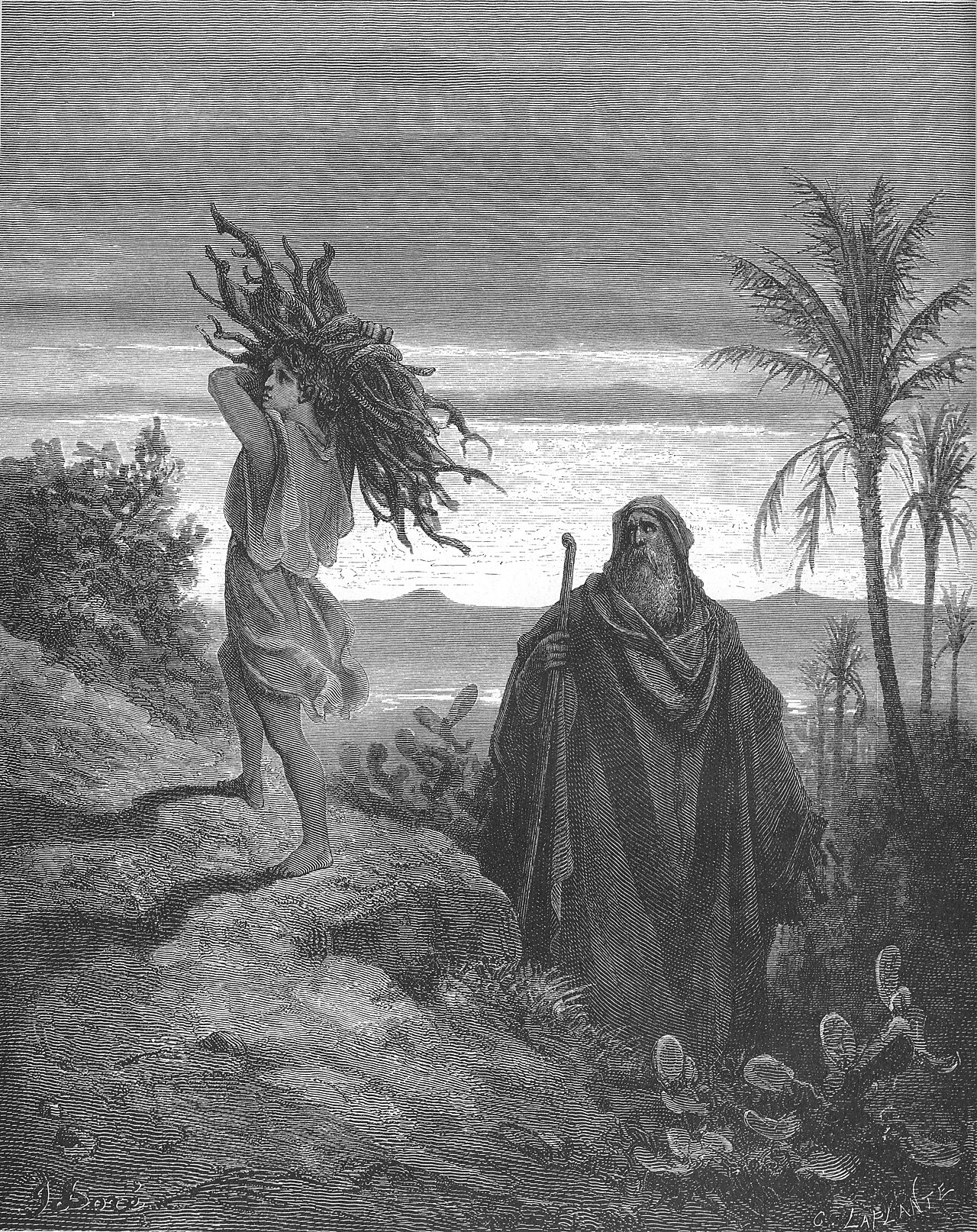
If someone of us desired to see the story of Abraham portrayed in a picture, how would the painter represent him? Would he do it in a single painting showing him doing all the things mentioned, or in successive pictures and distinctively, or in different images, but most often Abraham himself, for example, in one picture sitting on his donkey taking his son along and followed by his servants? In another one, again, with the donkey staying behind down below along with the servants, and Isaac being burdened with the wood while Abraham holds in his hands the knife and the fire? And, indeed, in a different painting, Abraham again in a different pose after he has bound the youth upon the wood and his right hand is armed with a sword in order that he might start the sacrifice? But this would not be a different Abraham each time, although he is seen most of the time in a different pose. It would be the same man in every instance with the skill of the artist continually disposing him according to the needs of the subject matter. For it would not be likely or at any rate probable that one would see him doing all the actions mentioned in a single painting.
The Puritans and the Awakening2 voices
(2.) Of our duty to God, in return for that love. We must tread in the steps of this faith of Abraham. God, by his word, calls us to part with all for Christ,--all our sins, though they have been as a right hand, or a right eye, or an Isaac--all those things that are competitors and rivals with Christ for the sovereignty of the heart ( Luke xiv.
quarantine:debris (2026-07-29) — unbalanced-parens
And Abraham stretched forth his hand,....
The words behind it
10 Hebrew wordsEvery Hebrew word of this verse in the order it stands, with what it means and the door to its own study. The last column counts the times a word stands in the whole Bible: the rarer the word, the more the places it appears belong together.
| Hebrew | Sound | Meaning | Word study | In the Bible |
|---|---|---|---|---|
| וַיִּשְׁלַ֤ח | vaiyishlach | and he stretched out | H7971 → | 845 times |
| אַבְרָהָם֙ | ʾavraham | Abraham | H85 → | 175 times |
| אֶת־ | ʾet- | <obj.> | H853 → | 10935 times |
| יָד֔וֹ | yado | hand his | H3027 → | 1618 times |
| וַיִּקַּ֖ח | vaiyikach | and he took | H3947 → | 966 times |
| אֶת־ | ʾet- | <obj.> | H853 → | 10935 times |
| הַֽמַּאֲכֶ֑לֶת | hamaakhelet | the knife | H3979 → | |
| לִשְׁחֹ֖ט | lishchot | to slaughter | H7819 → | |
| אֶת־ | ʾet- | <obj.> | H853 → | 10935 times |
| בְּנֽוֹ׃ | beno | son his | H1121 → | 4930 times |
וַיִּשְׁלַ֤חand he stretched out
vaiyishlachH7971 →845 times
אַבְרָהָם֙Abraham
ʾavrahamH85 →175 times
אֶת־<obj.>
ʾet-H853 →10935 times
יָד֔וֹhand his
yadoH3027 →1618 times
וַיִּקַּ֖חand he took
vaiyikachH3947 →966 times
אֶת־<obj.>
ʾet-H853 →10935 times
הַֽמַּאֲכֶ֑לֶתthe knife
hamaakheletH3979 →
לִשְׁחֹ֖טto slaughter
lishchotH7819 →
אֶת־<obj.>
ʾet-H853 →10935 times
בְּנֽוֹ׃son his
benoH1121 →4930 times
A shaded row is a word that stands 400 times or fewer in the Bible.
Where this verse is studied
On this page
About Genesis
Who and where
1 name in this verse with a page on the site.
This page draws on Ambrose of Milan, On the Decease of His Brother Satyrus, Book 2, Section 97; Ambrose of Milan, On the Decease of His Brother Satyrus; Cyril of Alexandria, LETTER 41.22; John Gill, Exposition of the Old Testament (1748-1763) and Matthew Henry, Commentary on the Whole Bible.