
Exoduschapter 9
35 verses · Moses, by tradition · 15th or 13th century BC · The Law
Then Pharaoh summoned Moses and Aaron. “This time I have sinned,” he said. “The LORD is righteous, and I and my people are wicked.
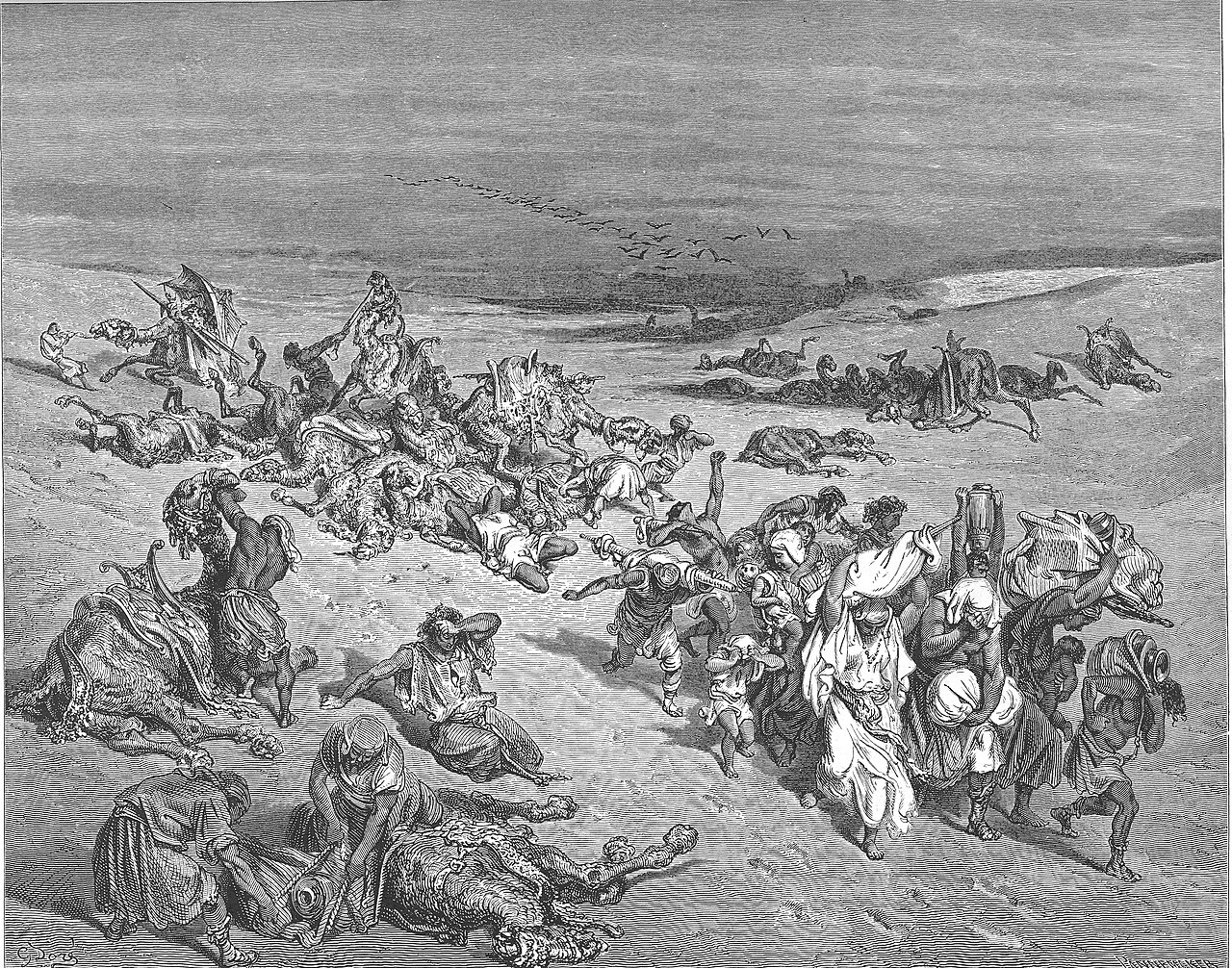
Introduction
Moses, by tradition, The Law, Exodus Overview.
This chapter brings the plagues from nuisance to ruin, striking the herds, the bodies of the people and the harvest. It was written for Israel as a record of how long God warned before He judged. Egypt was a farming nation whose wealth stood in cattle and grain, and every plague here touches that wealth. Listen for a change in how the hardening of Pharaoh's heart is reported. Notice also the Egyptians who took God's warning seriously, and see what became of what they owned.
Context
- Who
- Israel after the exodus, whose own herds had come through the plague
- What
- A narrative chapter reporting the plagues on the livestock, the boils and the hail, with the first statement that the LORD hardened Pharaoh's heart.
- Where
- The fields and pastures of Egypt, with the land of Goshen spared.
- When
- About 1446 BC on the traditional early date, in the season when the barley was ripe and the flax in bloom.
- Why
- To show that God warned before He struck and that His name would be proclaimed in all the earth.
Historical context
Exodus presents itself as Moses' own writing, at 17:14, 24:4 and 34:27, where he writes at the LORD's command. Moses had fled to Midian and come back at the call given at the bush, and at this chapter he carries the demand to Pharaoh with Aaron beside him.
Show the rest of the historical context, 2 more paragraphs
When the exodus happened is disputed, and no verdict is stamped on it here. The early date puts it at about 1446 BC, read from the four hundred and eighty years of 1 Kings 6:1 by Eugene Merrill, Bryant Wood and Andrew Steinmann. The late date puts it in the thirteenth century BC, read from the store cities of Exodus 1:11 by Kenneth Kitchen and James Hoffmeier. The place is Egypt again, its pastures, the furnaces of its brickyards and its open fields, and the occasion is the fifth, sixth and seventh strokes of the contest over Israel's release.
A first hearer knew what the losses meant, since Egypt honoured the bull as Apis at Memphis and the cow-goddess Hathor was among the most widely worshipped deities in the land. Sacred cattle dying in the field was therefore a religious event as much as an economic one, and cattle were also the measure of a household's wealth, recorded and taxed by the state. The boils were produced by throwing soot from a furnace toward heaven, a gesture that echoes an Egyptian rite in which ashes were scattered as a blessing. A man with erupting skin was disqualified from temple service, which is why the ritual specialists could not stand before Moses at verse 11.
Significance
The strokes had reached the herds and the season's food, so a household that lost its cattle lost its transport, its farming and its standing at once.
Show the rest of the significance, 1 more paragraph
Pharaoh granted for the first time that he had sinned and that the LORD was righteous, and he took it back as soon as the sky cleared. Israel also heard that God gave Egyptians a warning and a way to shelter, and that some of them took it.
This chapter in Jewish lifeWhat this chapter is in Jewish life and reading.
How it is read
Rashi keeps the plagues consistent with one another. At verse 10 he asks where the cattle struck by boils came from, since the pestilence had already killed the cattle of Egypt. His answer is that the pestilence was decreed only against cattle in the open field, and "everyone who feared the Lord took his cattle in-doors" (Rashi on Exodus 9:10:1). At verse 18 he reads the warning of hail as an appointment kept to the hour. Moses "scratched a mark on the wall", saying that the hail would fall when the sun reached it (Rashi on Exodus 9:18:1). At verse 24 he calls the fire inside the hail "a miracle within a miracle", and holds that the two made peace with one another to do their Maker's will (Rashi on Exodus 9:24:1). Those three are the Rosenbaum and Silbermann Rashi of 1929 to 1934, in the public domain. Ramban reads the absence of the magicians in verse 11 plainly. They were covered in boils and "imprisoned in their homes", so they came neither to the palace nor to the streets (Ramban on Exodus 9:11:1, the Chavel translation, Shilo, 1971 to 1976).
What the rabbis say
The rabbis take up the hand of the LORD on the livestock at Bamidbar Rabbah 9:14 and Avot DeRabbi Natan, Recension B 11:7. On the handfuls of soot thrown toward heaven they taught in Bereshit Rabbah 5:7. On the hail they taught in Bereshit Rabbah 19:7 and Avot DeRabbi Natan, Recension B 24:3. The Mekhilta carries the chapter at Tractate Pischa 13:6 and Tractate Vayehi Beshalach 7:6.
Sources: Rashi, Rashi on Exodus 9:10:1, 9:18:1 and 9:24:1, Pentateuch with Rashi's commentary by M. Rosenbaum and A. M. Silbermann, 1929 to 1934 (public domain); Ramban, Ramban on Exodus 9:11:1, Commentary on the Torah translated by Charles B. Chavel, Shilo, 1971 to 1976 (CC-BY); Ibn Ezra, Ibn Ezra on Exodus 9:12:1 and 9:16:1, cited by ref alone under the corpus licence rule; The Midrash, Bamidbar Rabbah 9:14, Avot DeRabbi Natan, Recension B 11:7 and 24:3, Bereshit Rabbah 5:7 and 19:7, and Mekhilta DeRabbi Yishmael, Tractate Pischa 13:6 and Tractate Vayehi Beshalach 7:6, cited by ref.
The heads below are this chapter's scenes. The numbered points under each are its verses.
Plague on the Livestock
Exodus 9:1-2
The fifth plague opens with the summons into the palace, which is the middle slot in each of the three groups of three: a warning at the water in the morning, a warning in the palace, then a stroke with no warning at all. The demand is the one Moses has carried since 4:23, freedom for a purpose, and let my people go, that they may serve me falls seven times in the book at 4:23, 7:16, 8:1, 8:20, 9:1, 9:13 and 10:3. The Hebrew root behind serve is the root Exodus 1:13 and 1:14 use five times over for the bondage, so the question between God and Pharaoh is whom Israel will serve rather than whether Israel will serve.
Exodus 9:1
The Lord God of the Hebrews - It is very likely that the term Lord, יויה Yehovah, is used here to point out particularly his eternal power and Godhead; and that the term God, אלהי Elohey, is intended to be understood in the sense of Supporter, Defender, Protector, etc. Thus saith the self-existent, omnipotent, and eternal Being, the Supporter and Defender of the Hebrews, “Let my people go, that they may worship me.”
Adam Clarke · Commentary on the Bible (1810-1826)evangelical
if you continue to restrain them: This verse carries the condition of the fifth plague, and the sentence runs on into verse 3. The words continue to restrain show that Pharaoh is still holding Israel by force after four plagues. The threat that follows falls on the livestock, and Matthew Henry, on verse 3, notes that God would now make poor the people who had made Israel poor.
Exodus 9:2
“For if thou refuse to let them go,.... Continue to refuse, as he had done: and wilt hold them still; in the land, and under his dominion and oppression.”
Exodus 9:3-4
The phrase the hand of the LORD occurs here for the first time in Scripture, and the word murrain occurs here and nowhere else in the King James Bible. No rod is lifted and no hand is stretched out for this plague, so it is the first stroke that arrives with no visible instrument in front of it. The severing between the cattle of Israel and the cattle of Egypt is the second of three such divisions, after the flies at 8:22 and before the hail at 9:26.
Exodus 9:3
“A very grievous murrain - Or “pestilence;” but the word “murrain,” i. e. “a great mortality,” exactly expresses the meaning. This terrible visitation struck far more severely than the preceding, which had caused distress and suffering; it attacked the resources of the nation. The camels - These animals are only twice mentioned, here and Gen 12:16, in connection with Egypt. Though camels are never represented on the monuments, they were known to the Egyptians, and were probably used on the frontier.”
2 more voices on this verse
Exodus 9:3
“The hand of the Lord immediately, without the stretching out of Aaron's hand, is upon the cattle, many of which, some of all kinds, should die by a sort of pestilence. This was greatly to the loss of the owners: they had made Israel poor, and now God would make them poor.”
Matthew Henry · Commentary on the Whole Bible (1707-1721)puritan
Exodus 9:3
“The murrain is appositely called God's "hand," because it arose from His just judgment; for this expression is opposed to natural causes, to the arts and devices of men, and to accidental chances -- as if Moses had said that the hand of God would appear in "the very grievous murrain," that Pharaoh may perceive the Deity to be wroth with him.”
John Calvin · Commentaries (1554)reformed
the LORD will make a distinction: As with the flies, the LORD separates Israel from Egypt, now in the matter of their livestock. The promise is exact: no animal belonging to the Israelites will die. Pharaoh sends officials to check it in verse 7. John Gill, on that verse, says the messengers went to Goshen to see whether the plague had touched the cattle of Israel.
Exodus 9:4
“The Lord shall sever - See Clarke on Exo 8:22 (note).”
Adam Clarke · Commentary on the Bible (1810-1826)evangelical
1 more voice on this verse
Exodus 9:4
“Note, When God's judgments are abroad, though they may fall both on the righteous and the wicked, yet God makes such a distinction that they are not the same to the one that they are to the other.”
Matthew Henry · Commentary on the Whole Bible (1707-1721)puritan
Exodus 9:5-6
A time is fixed in advance and the plague keeps it, which is the same device used at the frogs, where Pharaoh himself named the hour at 8:9 and 8:10. Verse 6 says all the cattle of Egypt died, and cattle stand in the field again thirteen verses later at 9:19 and 9:25. Verse 3 supplies the limit the summary leaves out, since the hand of the LORD is on the cattle which is in the field, and John Gill and Keil read the all of verse 6 inside that boundary.
Exodus 9:5
“To-morrow the Lord shall do this - By thus foretelling the evil, he showed his prescience and power; and from this both the Egyptians and Hebrews must see that the mortality that ensued was no casualty, but the effect of a predetermined purpose in the Divine justice.”
Adam Clarke · Commentary on the Bible (1810-1826)evangelical
All the livestock of the Egyptians died: The plague falls on the livestock of Egypt on the day the LORD set, and the animals of Israel live. Egyptian livestock remain for the hail in verse 19, so the word all needs explaining. John Wesley takes it of all that were in the field, Adam Clarke of all that died, and Jamieson, Fausset & Brown add that the plague struck at Egypt's veneration of animals.
Exodus 9:6
“All the cattle died - All that were in the field. The creature is made subject to vanity by the sin of man, being liable, according to its capacity, both to serve his wickedness, and to share in his punishment. The Egyptians worshipped their cattle; it was among them that the Israelites learned to make a God of a calf; in that therefore this plague meets with them.”
John Wesley · Explanatory Notes upon the Old Testament (1765)evangelical
1 more voice on this verse
Exodus 9:6
“The adaptation of this judgment consisted in Egyptians venerating the more useful animals such as the ox, the cow, and the ram; in all parts of the country temples were reared and divine honors paid to these domesticated beasts, and thus while the pestilence caused a great loss in money, it also struck a heavy blow at their superstition.”
Jamieson, Fausset & Brown · Commentary Critical and Explanatory on the Whole Bible (1871)reformed
Pharaoh sends men to check whether the division held, and the report comes back that it did. Matthew Henry reads the inquiry as proof that he understood the claim well enough to test it, which makes the refusal that follows a refusal against evidence he gathered himself. This is the seventh statement about his heart and the last one before the subject changes at verse 12.
Exodus 9:7
“Was hardened - See Exo 4:21. Pharaoh probably attributed the exemption of the Israelites to natural causes. They were a pastoral race, well acquainted with all that pertained to the care of cattle; and dwelling in a healthy district probably far more than the rest of Lower Egypt.”
Boils from a Handful of Ashes
Exodus 9:8-9
The sixth plague falls with no warning and no demand, closing the second group of three in the shape the third plague used to close the first at 8:16. Adam Clarke connects the furnace to the brick kilns the Hebrews worked at, so the dust thrown into the air is the dust of the bondage. Moses does the sprinkling, and from here the hand stretched out over Egypt is his rather than Aaron's, at 9:22, 10:12, 10:21 and 14:16.
Exodus 9:8
“The attitude he assumed was similar to that of Eastern magicians, who, "when they pronounce an imprecation on an individual, a village, or a country, take the ashes of cows' dung (that is, from a common fire) and throw them in the air, saying to the objects of their displeasure, such a sickness or such a curse shall come upon you" [ROBERTS].”
Jamieson, Fausset & Brown · Commentary Critical and Explanatory on the Whole Bible (1871)reformed
1 more voice on this verse
Exodus 9:8
“This is afterwards called the botch of Egypt ( Deut. xxviii. 27 ), as if it were some new disease, never heard of before, and known ever after by that name, Note, Sores in the body are to be looked upon as the punishments of sin, and to be hearkened to as calls to repentance.”
Matthew Henry · Commentary on the Whole Bible (1707-1721)puritan
festering boils will break out on man and beast: The soot Moses throws into the air becomes fine dust across Egypt, and festering boils break out on people and animals. The sixth plague strikes the body directly, and its link to the act of Moses before Pharaoh is plain to see. Albert Barnes takes the boil to be a burning tumor or carbuncle breaking out in ulcers.
Exodus 9:9
“A boil - Means probably a burning tumor or carbuncle breaking out in pustulous ulcers. The miracle consisting in the severity of the plague and its direct connection with the act of Moses.”
Exodus 9:10-11
The magicians reach the end of their part in three stages. They copied the rod, the blood and the frogs at 7:11, 7:22 and 8:7, they failed at the lice and told Pharaoh this is the finger of God at 8:19, and now they cannot stand in the room because the boils are on them. Egypt's own experts leave the account here and the book does not mention them again.
Exodus 9:10
“Moses took ashes from the furnace--Hebrew, "brick-kiln." The magicians, being sufferers in their own persons, could do nothing, though they had been called; and as the brick-kiln was one of the principal instruments of oppression to the Israelites [De 4:20; Jer 11:4], it was now converted into a means of chastisement to the Egyptians, who were made to read their sin in their punishment.”
Jamieson, Fausset & Brown · Commentary Critical and Explanatory on the Whole Bible (1871)reformed
The magicians could not stand before Moses: The magicians, who copied the staff, the blood and the frogs and failed at the gnats, now cannot even stand before Moses, because the boils are on them too. John Wesley links their defeat with 2 Timothy 3:9, where their folly is made plain to all. Adam Clarke observes that they are mentioned no more in the account.
Exodus 9:11
“The magicians were forced to retreat, and could not stand before Moses - To which the apostle refers, 2 Tim. iii, 9, when he saith, that their folly was manifested unto all men.”
John Wesley · Explanatory Notes upon the Old Testament (1765)evangelical
1 more voice on this verse
Exodus 9:11
“The boil was upon the magicians - They could not produce a similar malady by throwing ashes in the air; and they could neither remove the plague from the people, nor from their own tormented flesh. Whether they perished in this plague we know not, but they are no more mentioned. If they were not destroyed by this awful judgment, they at least left the field, and no longer contended with these messengers of God.”
Adam Clarke · Commentary on the Bible (1810-1826)evangelical
This is the first place in Scripture that says the LORD hardened Pharaoh's heart, and the order of the statements carries the argument. God says twice in advance that he will do it at 4:21 and 7:3, then through the first five plagues the act is put on Pharaoh or left stative at 7:13, 7:14, 7:22, 8:15, 8:19, 8:32 and 9:7. From this verse the LORD is the subject at 10:1, 10:20, 10:27, 11:10, 14:4, 14:8 and 14:17, with verses 34 and 35 of this chapter the last place Pharaoh hardens himself. R. C. Sproul reads the sequence as one act with two true descriptions, sovereignty and responsibility both real, while the free-will reading holds that God confirmed a man in the direction he had already taken, and three different Hebrew verbs stand behind the English harden across the book.
Exodus 9:12
“Note, Wilful hardness is commonly punished with judicial hardness. If men shut their eyes against the light, it is just with God to close their eyes. Let us dread this as the sorest judgment a man can be under on this side hell.”
Matthew Henry · Commentary on the Whole Bible (1707-1721)puritan
A Warning of Coming Hail
Exodus 9:13-14
The seventh plague opens the third group of three with the morning warning, the slot the blood and the flies held at 7:15 and 8:20. What follows is the heaviest language yet, all my plagues upon thine heart, and the stated aim is knowledge rather than damage, that thou mayest know that there is none like me in all the earth. The book gives that reason again and again, at 7:5, 8:10, 8:22, 9:29 and 14:18.
Exodus 9:13
“With the plague of hail begins the last series of plagues, which differ from the former both in their severity and their effects. Each produced a temporary, but real, change in Pharaoh’s feelings. Exo 9:14 All my plagues - This applies to all the plagues which follow; the effect of each was foreseen and foretold. The words “at this time” point to a rapid and continuous succession of blows.”
there is no one like Me in all the earth: The warning before the hail states the purpose of the plagues still to come. The LORD will send all His plagues so that Pharaoh may know there is no one like Him in all the earth. Albert Barnes, on verse 13, takes all My plagues to cover every plague that follows, each foreseen and foretold, and reads the warning as a promise of blows in quick succession.
Exodus 9:14
"Now I will send all my plagues. " Now that no place is found for repentance in Pharaoh, nothing can prevent his utter destruction, for that only would have prevented it. Now that God begins to harden his heart, his case is desperate.
Matthew Henry · Commentary on the Whole Bible (1707-1721)puritan
The verse describes a stroke that was available and was not used, since a pestilence that cut Pharaoh off from the earth would have ended the contest in one morning. John Calvin reads the delay as forbearance rather than weakness, and the pacing is what verse 16 then explains. Egypt gets nine warnings before the night of the firstborn.
Exodus 9:15
“For now I will stretch out my hand - In the Hebrew the verbs are in the past tense, and not in the future, as our translation improperly expresses them, by which means a contradiction appears in the text: for neither Pharaoh nor his people were smitten by a pestilence, nor was he by any kind of mortality cut off from the earth. It is true the first-born were slain by a destroying angel, and Pharaoh himself was drowned in the Red Sea; but these judgments do not appear to be referred to in this place.”
Adam Clarke · Commentary on the Bible (1810-1826)evangelical
Exodus 9:16-17
Romans 9:17 quotes this verse as scripture speaking to Pharaoh, and Romans 9:18 draws from it the line whom he will he hardeneth. The Hebrew verb behind raised thee up has been read as brought onto the stage and as kept alive to this point, and Paul follows the Septuagint's wording. The stated purpose is that a name be declared throughout all the earth, and the account never records the name of the king who asked at 5:2 who is the LORD.
Exodus 9:16
“But truly, on this very account, have I caused thee to subsist - (העמדחיך heemadticha), that I might cause thee to see my power, (הראתך את כחי harotheca eth cochi), and that my name might be declared throughout all the earth, (or, בכל הארץ becol haarets, in all this land). See Ainsworth and Houbigant.”
Adam Clarke · Commentary on the Bible (1810-1826)evangelical
Cross references
Exodus 9:16
- Quoted inRomans 9:17For the Scripture says to Pharaoh: “I raised you up for this very purpose, that I might display My power in you, and that My name might be proclaimed in all the earth.”
'For this same purpose have I raised thee up' ('the scripture saith unto Pharaoh')
you lord it over My people: The LORD names Pharaoh's fault in one line: he still lords it over Israel and will not let them go. The charge follows verses 15 and 16, where the LORD says He could already have destroyed Pharaoh and has raised him up to display His power. Adam Clarke, on verse 16, renders the verb there as God causing Pharaoh to subsist for this purpose.
Exodus 9:17
“As yet exaltest thou thyself against my people - So it appears that at this time he might have submitted, and thus prevented his own destruction.”
Adam Clarke · Commentary on the Bible (1810-1826)evangelical
1 more voice on this verse
Exodus 9:17
“As yet exaltest thou thyself against my people, that thou wilt not let them go?”
Exodus 9:18-19
The word hail occurs here for the first time in Scripture, and the plague is dated a day ahead as the murrain was at verse 5. Then comes something none of the earlier plagues carried, an instruction to Egyptians on how to get out from under it, since cattle and servants brought home under a roof will live. The judgment announces its own exit before it falls.
Exodus 9:18
“It was the more appalling because hailstones in Egypt are small and of little force; lightning also is scarcely ever known to produce fatal effects; and to enhance the wonder, not a trace of any storm was found in Goshen [Ex 9:26].”
Jamieson, Fausset & Brown · Commentary Critical and Explanatory on the Whole Bible (1871)reformed
give orders now to shelter your livestock: Before the hail falls, the LORD gives Egypt a way of escape: bring people and animals indoors and they will live. The warning shows mercy within judgment, since any Egyptian who heeds the word can save his household. Jamieson, Fausset & Brown, on verse 18, note that hailstones in Egypt are small and weak, which made this storm the more fearful.
Exodus 9:19
“Send - now, and gather thy cattle - So in the midst of judgment, God remembered mercy. The miracle should be wrought that they might know he was the Lord; but all the lives both of men and beasts might have been saved, had Pharaoh and his servants taken the warning so mercifully given them. While some regarded not the word of the Lord, others feared it, and their cattle and their servants were saved, See Exo 9:20, Exo 9:21.”
Adam Clarke · Commentary on the Bible (1810-1826)evangelical
1 more voice on this verse
Exodus 9:19
“If Pharaoh will not yield, and so prevent the judgment itself, yet an opportunity is given to those that have any dread of God and his word to save themselves from sharing in the judgment.”
Matthew Henry · Commentary on the Whole Bible (1707-1721)puritan
Exodus 9:20-21
The phrase feared the word of the LORD occurs once in the whole King James Bible and this is the verse. Egypt divides here along a line that is not national, since some of Pharaoh's own servants act on what Moses said while others leave their men and their animals standing in the field. The narrator records the split and says nothing about it, and a mixed multitude goes up with Israel at 12:38 without being identified.
disregarded the word of the LORD: The warning divides Pharaoh's own officials. Those who feared the word sheltered their servants and livestock, as verse 20 records, and those who disregarded it left them in the field. Belief in the word of the LORD now decides who lives among the Egyptians themselves. Matthew Henry, on verse 31, links this storm with Psalm 78 and with the seventh bowl in Revelation 16.
Exodus 9:21
“26 Only in the land of Goshen, where the children of Israel were, was there no hail. 27 And Pharaoh sent, and called for Moses and Aaron, and said unto them, I have sinned this time: the L ORD is righteous, and I and my people are wicked.”
Matthew Henry · Commentary on the Whole Bible (1707-1721)puritan
Hail and Fire Running Down
Exodus 9:22-23
The rod lifted here is the shepherd's staff of Exodus 4:2 that became a serpent at the bush, and it is the one instrument the book uses. It stretches over the locusts at 10:13, divides the sea at 14:16, and strikes the rock at 17:5 and 17:6, where God calls it the rod wherewith thou smotest the river. Fire runs along the ground with the hail, and Revelation 8:7 sounds the first trumpet with hail and fire mingled.
the LORD sent thunder and hail: Moses stretches his staff toward heaven, and the LORD answers with thunder, hail and lightning striking the ground. The seventh plague is the first to fall on Egypt from the sky. Adam Clarke notes that the Hebrew for thunder is literally voices, and he reads the fire on the ground as lightning that swept through the land and destroyed what it touched.
Exodus 9:23
“The Lord sent thunder - קלת koloth, voices; but loud, repeated peals of thunder are meant. And the fire ran along upon the ground - ותהלך אש ארצה vattihalac esh aretsah, and the fire walked upon the earth. It was not a sudden flash of lightning, but a devouring fire, walking through every part, destroying both animals and vegetables; and its progress was irresistible.”
Adam Clarke · Commentary on the Bible (1810-1826)evangelical
Exodus 9:24-26
Two measures of scale stand together, that there had been nothing like it in Egypt since it became a nation and that Goshen had none of it at all. This is the third division in three chapters, after the flies at 8:22 and the cattle at 9:4, and here the exemption is drawn on the map. Every herb of the field is smitten and every tree broken, which is what makes the locusts of the next chapter a second stroke on what the hail left, at 10:5 and 10:15.
Exodus 9:24
“So there was hail, and fire mingled with the hail,.... Which was a miracle within a miracle, as Aben Ezra observes; and very wonderful indeed it was, that the hail did not quench the fire, nor the fire melt the hail, as Philo the Jew (i) remarks: very grievous, such as there was none like it in all the land of Egypt, since it became a nation; See Gill on Exo 9:18. (i) De Vita. Mosis, l. 1. p. 620.”
stripped every tree: The hail strikes everything left in the field, people and animals alike, beats down the plants and strips the trees. Those who ignored the warning of verse 19 lose what they left outside, and verse 26 records that Goshen alone escaped. John Gill, on verse 24, cites Aben Ezra, who called the fire within the hail a miracle within a miracle.
The only place where it did not hail: Goshen, where the Israelites lived, is the one place in Egypt the hail did not touch. The distinction first made with the flies and the livestock holds again, now under a storm that covers the land. Jamieson, Fausset & Brown, on verse 18, note that no trace of the storm was found in Goshen, which added to the wonder.
Exodus 9:26
“Only in the land of Goshen, where the children of Israel were, was there no hail. So that such Egyptians as might dwell among them, they, their servants, their cattle, and their fruits, escaped this plague; and oftentimes do wicked men fare the better for the people of God that are among them.”
1 more voice on this verse
Exodus 9:26
“Only in the land of Goshen - was there no hail - What a signal proof of a most particular providence! Surely both the Hebrews and Egyptians profited by this display of the goodness and severity of God.”
Adam Clarke · Commentary on the Bible (1810-1826)evangelical
Exodus 9:27-28
I have sinned occurs here for the first time in Scripture and the mouth it comes out of is Pharaoh's. He grants the whole case, that the LORD is righteous and that he and his people are wicked, and then asks for one thing, that the thunder stop. He says it again at 10:16 and takes it back both times, which is why Matthew Henry reads the words as a man conceding the weather rather than repenting.
Exodus 9:27
“The Lord is righteous, and I and my people are wicked - The original is very emphatic: The Lord is The Righteous One, (הצדיק hatstaddik), and I and my people are The Sinners, (הרשעים hareshaim); i.e., He is alone righteous, and we alone are transgressors. Who could have imagined that after such an acknowledgment and confession, Pharaoh should have again hardened his heart?”
Adam Clarke · Commentary on the Bible (1810-1826)evangelical
1 more voice on this verse
Exodus 9:27
“See whether it is for this reason that God hardens the heart of Pharaoh, so that at a moment when he was not hardened he could say, "The Lord is just: I and my people are wicked." His heart has to be hardened further, and he has to suffer more, that he may not, because he has been freed of his hardheartedness too quickly, think too lightly of that hardheartedness and so may have to have his heart hardened over and over again.”
Origen of Alexandria · written before 253 · ON PRAYER 29.16patristic
there has been enough of God’s thunder and hail: Pharaoh asks Moses to pray and promises that Israel need stay no longer. His word enough shows that the storm has broken his resistance for the moment. Adam Clarke reads the phrase God's thunder, literally the voices of God, as a Hebrew way of saying exceedingly loud thunder, and compares the mountains of God in Psalm 36:6.
Exodus 9:28
“It is enough - There is no need of any farther plague; I submit to the authority of Jehovah and will rebel no more. Mighty thunderings - כלת אלהים koloth Elohim, voices of God; - that is, superlatively loud thunder. So mountains of God (Psa 36:6) means exceeding high mountains. So a prince of God (Gen 23:6) means a mighty prince. See a description of thunder, Psa 29:3-8: “The Voice Of The Lord is upon the waters: the God of glory thundereth; the Lord is upon many waters.”
Adam Clarke · Commentary on the Bible (1810-1826)evangelical
Exodus 9:29-30
Moses grants the request and gives the reason for granting it, that thou mayest know how that the earth is the LORD's, which is the same reason given at 8:22 and 9:14. He will not pray inside the city, and Adam Clarke reads that as keeping the answer clear of the idolatry the city was full of. Then he tells Pharaoh plainly that neither he nor his servants will yet fear the LORD God, and the word fear is the word used of the servants who obeyed at verse 20.
Exodus 9:29
“I will spread abroad my hands - That is, I will make supplication to God that he may remove this plague. This may not be an improper place to make some observations on the ancient manner of approaching the Divine Being in prayer. Kneeling down, stretching out the hands, and lifting them up to heaven, were in frequent use among the Hebrews in their religious worship. Solomon kneeled down on his knees, and spread forth his hands to heaven; 2Ch 6:13. So David, Psa 143:6: I stretch forth my hands unto thee.”
Adam Clarke · Commentary on the Bible (1810-1826)evangelical
Moses agrees to pray, yet he tells Pharaoh that he sees through the confession of verse 27. Pharaoh and his officials still do not fear the LORD, and verse 34 proves Moses right. Adam Clarke, on verse 27, asks who could have imagined that after such a confession Pharaoh would harden his heart again.
Exodus 9:31-32
The narrator stops the account to say which crops were standing, and this is the only agricultural date in the whole plague narrative. Barley in the ear and flax in bud puts the hail near the end of the Egyptian winter, which is where Clarke and Keil place it in January or February, and the wheat and the rie were still low enough to come through. What survived here is what the locusts eat in the next chapter.
Exodus 9:31
“In that country flax and barley are almost ripe when wheat and rye (spelt) are green. And hence the flax must have been "bolled"--that is, risen in stalk or podded in February, thus fixing the particular month when the event took place.”
Jamieson, Fausset & Brown · Commentary Critical and Explanatory on the Whole Bible (1871)reformed
2 more voices on this verse
Exodus 9:31
“In this plague the hot thunderbolts, as well as the hail, are said to destroy their flocks, Ps. lxxviii. Perhaps David alludes to this when, describing God's glorious appearances for the discomfiture of his enemies, he speaks of the hailstones and coals of fire he threw among them, Ps. xviii. And there is a plan reference to it on the pouring out of the seventh vial, Rev. xvi.”
Matthew Henry · Commentary on the Whole Bible (1707-1721)puritan
Exodus 9:31
“The flax and the barley was smitten - The word פשתה pishtah, flax, Mr. Parkhurst thinks, is derived from the root פשט pashat, to strip, because the substance which we term flax is properly the bark or rind of the vegetable, pilled or stripped off the stalks. From time immemorial Egypt was celebrated for the production and manufacture of flax: hence the linen and fine linen of Egypt, so often spoken of in ancient authors.”
Adam Clarke · Commentary on the Bible (1810-1826)evangelical
the wheat and spelt were not destroyed: Verses 31 and 32 pause the account to explain which crops were lost. Flax and barley were ruined because they were ripe or in bloom, while wheat and spelt ripen later and survived, which leaves food for the locusts of 10:5. Jamieson, Fausset & Brown use the stage of these crops to date the hail to about February, and Adam Clarke takes spelt to mean a bearded grain.
Exodus 9:32
“But the wheat and the rye were not smitten - Wheat, חטה chittah, which Mr. Parkhurst thinks should be derived from the Chaldee and Samaritan חטי chati, which signifies tender, delicious, delicate, because of the superiority of its flavor, etc., to every other kind of grain. But this term in Scripture appears to mean any kind of bread-corn. Rye, כסמת cussemeth, from כסם casam, to have long hair; and hence, though the particular species is not known, the word must mean some bearded grain.”
Adam Clarke · Commentary on the Bible (1810-1826)evangelical
Exodus 9:33-34
The prayer is answered exactly as it was promised, and the moment the pressure lifts Pharaoh sins yet more. Verse 34 is the last time in the book that Pharaoh is the one hardening his heart, and the servants are named with him, though some of them had feared the word at verse 20. From chapter 10 forward the subject of that verb is the LORD.
Exodus 9:33
“Note, Peace with God makes men thunderproof, for thunder is the voice of their Father. (2.) The gesture: He spread abroad his hands unto the Lord --an outward expression of earnest desire and humble expectation. Those that come to God for mercy must stand ready to receive it.”
Matthew Henry · Commentary on the Whole Bible (1707-1721)puritan
2 more voices on this verse
Exodus 9:33
“Spread abroad his hands - Probably with the rod of God in them. See what has been said on the spreading out of the hands in prayer, Exo 9:29. See Clarke on Exo 9:29 (note).”
Adam Clarke · Commentary on the Bible (1810-1826)evangelical
Exodus 9:33
“And such is the power of God's two witnesses, Rev. xi, 6. Yet neither Moses nor Elijah, nor those two witnesses, could subdue the hard hearts of men. Pharaoh was frighted into compliance by the judgment, but, when it was over, his convictions vanished.”
John Wesley · Explanatory Notes upon the Old Testament (1765)evangelical
Once the storm stops, Pharaoh and his officials harden their hearts, and the text calls it sin. Adam Clarke reads the hardening as Pharaoh's own act, Origen, on verse 27, holds that God hardened him again and again so that he would not think lightly of his hardness, and Albert Barnes notes that verses 34 and 35 use two different Hebrew verbs for it.
Exodus 9:34
“He sinned yet more, and hardened his heart - These were merely acts of his own; “for who can deny,” says Mr. Psalmanazar, “that what God did on Pharaoh was much more proper to soften than to harden his heart; especially when it is observable that it was not till after seeing each miracle, and after the ceasing of each plague, that his heart is said to have been hardened?”
Adam Clarke · Commentary on the Bible (1810-1826)evangelical
1 more voice on this verse
Exodus 9:34
“The prayer of Moses opened and shut heaven, like Elias's ( Jam. v. 17, 18 ), and such is the power of God's two witnesses ( Rev. xi. 6 ); yet neither Moses nor Elias, nor those two witnesses, could subdue the hard hearts of men. Pharaoh was frightened into a compliance by the judgment, but, when it was over, his convictions vanished, and his fair promises were forgotten.”
Matthew Henry · Commentary on the Whole Bible (1707-1721)puritan
The chapter closes on the same stative sentence that closed the fifth plague at verse 7, and between those two ends stands verse 12. The refrain as the LORD had spoken by Moses ties the outcome back to 4:21 and 7:3, which were said before the first plague fell. Three plagues remain, and the demand of verse 1 is repeated unchanged at 10:3.
Exodus 9:35
“Hardened - Different words in the Hebrew. In Exo 9:34 the word means “made heavy,” i. e. obtuse, incapable of forming a right judgment; in Exo 9:35 it is stronger, and implies a stubborn resolution.”
How this psalm is built
The form: A plague account in narrative prose, carrying the fifth, sixth and seventh strokes, as Keil and Delitzsch classes it.
The patterns in this chapter
| Device | What it does | Where to see it |
|---|---|---|
| The demand repeated with its purpose attached | The fifth plague and the seventh both open with the same demand and the same reason for it, at verse 1 and at verse 13. Keil and Delitzsch and Matthew Henry list the same words at 4:23, 7:16, 8:1, 8:20, 9:1, 9:13 and 10:3, seven places in the book. The Hebrew root behind the verb is the root Exodus 1:13 and 1:14 use for the bondage, so the question is whom Israel will serve.Keil and Delitzsch, Biblical Commentary on the Old Testament: The Pentateuch. | Exodus 9:1, Exodus 9:13 |
| The two matched closings that stand either side of verse 12 | Verse 7 closes the fifth plague with a stative sentence about the king's heart, and verse 35 closes the chapter with the same sentence. Between those two ends stands verse 12, the first place in Scripture that says the LORD hardened Pharaoh's heart. Keil and Delitzsch and John Gill note the matched ends, and the refrain about what the LORD had said ties the outcome back to 4:21 and 7:3.Keil and Delitzsch, Biblical Commentary on the Old Testament: The Pentateuch. | Exodus 9:7, Exodus 9:12, Exodus 9:35 |
| The livestock named one kind at a time | Verse 3 names the horses, the donkeys, the camels, the herds and the flocks. Adam Clarke and John Gill read the list as the measure of the loss, since those animals carried Egypt's transport, its farming and its army. Verse 3 also carries the limit that the summary at verse 6 leaves out, since the hand of the LORD is on the livestock in the field.John Gill, Exposition of the Old Testament. | Exodus 9:3, Exodus 9:6 |
| The confession made to Moses and the answer given back | At verse 27 Pharaoh summons Moses and says, This time I have sinned, and he grants the whole case against himself. What he asks for is that the thunder stop. Moses grants the prayer and then tells him plainly that he and his officials still do not fear the LORD. Matthew Henry reads the confession as a man conceding the weather.Matthew Henry, Commentary on the Whole Bible. | Exodus 9:27, Exodus 9:28, Exodus 9:29, Exodus 9:30 |
| The one word used of the servants who obeyed and denied of the king | Verse 20 says that some of Pharaoh's officials feared the word of the LORD and brought their people and animals under a roof. Verse 30 uses the same word when Moses tells the king that he does not yet fear the LORD. Adam Clarke and Matthew Henry read the second use against the first, so the king is measured by his own servants.Adam Clarke, Commentary on the Bible. | Exodus 9:20, Exodus 9:30 |
The chapter stands at the turn of the contest. Five plagues have fallen before it and three come after it. What changes here is the grammar of the hardening, and what stays the same is the reason given for the strokes. Verse 14 says the aim is knowledge, that Pharaoh may know there is no one like the LORD in all the earth, and verse 29 says the same of the earth itself. The book gives that reason at 7:5, 8:10, 8:22, 9:29 and 14:18.
9 more paragraphs on the patterns
The division between the two peoples runs on. The livestock of Israel are exempted at verse 4, and Goshen has no hail at verse 26. With the flies at 8:22 that makes three chapters running, and the darkness at 10:23 makes four.
Verses 15 and 16 give the reason the contest was not ended at once. A stroke was available that would have finished it in one morning, and John Calvin reads the delay as forbearance. Verse 16 states the purpose, that God's power be displayed and His name proclaimed in all the earth.
The New Testament's use
Romans 9:17 quotes verse 16 as Scripture speaking to Pharaoh, and Romans 9:18 draws from it the words about whom God wills to harden. Paul follows the wording of the Septuagint, and the Hebrew verb behind the phrase about raising Pharaoh up has been read as bringing him onto the stage and as keeping him alive to this point. Revelation 8:7 sounds the first trumpet with hail and fire mingled, which is the language of verses 23 and 24.
The debated point
Who hardens Pharaoh's heart is one of the four debated readings the dossier for this book carries, and verse 12 is the verse the argument turns on. One reading holds that Pharaoh hardens his own heart first and repeatedly, and that God's hardening confirms a choice the king had already made. The dossier names its holders as the majority evangelical reading. That reading rests on the order of the statements, since the self-hardening at 8:15, 8:32 and 9:34 stands in the account before any divine hardening is recorded.
The other reading holds that God's hardening is sovereign and purposeful from the start, part of raising Pharaoh up to display His own power. The dossier names it as a reading leaning on Paul's use of Pharaoh in Romans 9:17 and 9:18, held within parts of the Reformed tradition. R. C. Sproul, in Chosen by God, reads the whole sequence as one act with two true descriptions, divine sovereignty and human responsibility each real. Three different Hebrew verbs stand behind the English word harden across the book. No verdict is stamped here.
Where to go deeper
The sequence this chapter stands in is argued at The Ten Plagues. The deliverance it moves toward is argued at The Exodus. The country under the hail is set out at Egypt.
Keep studying
Studies1
Sources for this chapter
The summary
Jamieson, Fausset & Brown, Commentary Critical and Explanatory; John Calvin, Commentaries; John Wesley, Notes on the Old Testament and Matthew Henry, Complete Commentary.
The form and classifications
Keil and Delitzsch, Biblical Commentary on the Old Testament: The Pentateuch.
The exposition
Adam Clarke, Commentary on the Bible; Albert Barnes, Notes, Explanatory and Practical, on the Old and New Testaments; Jamieson, Fausset & Brown, Commentary Critical and Explanatory on the Whole Bible; John Calvin, Commentary on the Four Last Books of Moses Arranged in the Form of a Harmony; John Gill, Exposition of the Old Testament; John Wesley, Explanatory Notes upon the Old Testament; Keil and Delitzsch, Biblical Commentary on the Old Testament: The Pentateuch; Matthew Henry, Commentary on the Whole Bible; Origen of Alexandria, On Prayer and R. C. Sproul, Chosen by God.