
Exodus 9:2
in Exodus 9But if you continue to restrain them and refuse to let them go,
BSB
The same verse in ASV and KJV ▾
ASV
For if thou refuse to let them go, and wilt hold them still,
KJV
For if thou refuse to let them go, and wilt hold them still,
⋯
This verse in Exodus 9
Commentary
3 notes on this verseThis site's exposition
Go to Pharaoh and tell him
on Exodus 9:1-2
The demand “Let My people go, so that they may worship Me” falls seven times in the book. The Hebrew root behind worship is the one 1:13 and 1:14 use five times for the bondage. The question is whom Israel will serve.
This site's exposition
if you continue to restrain them
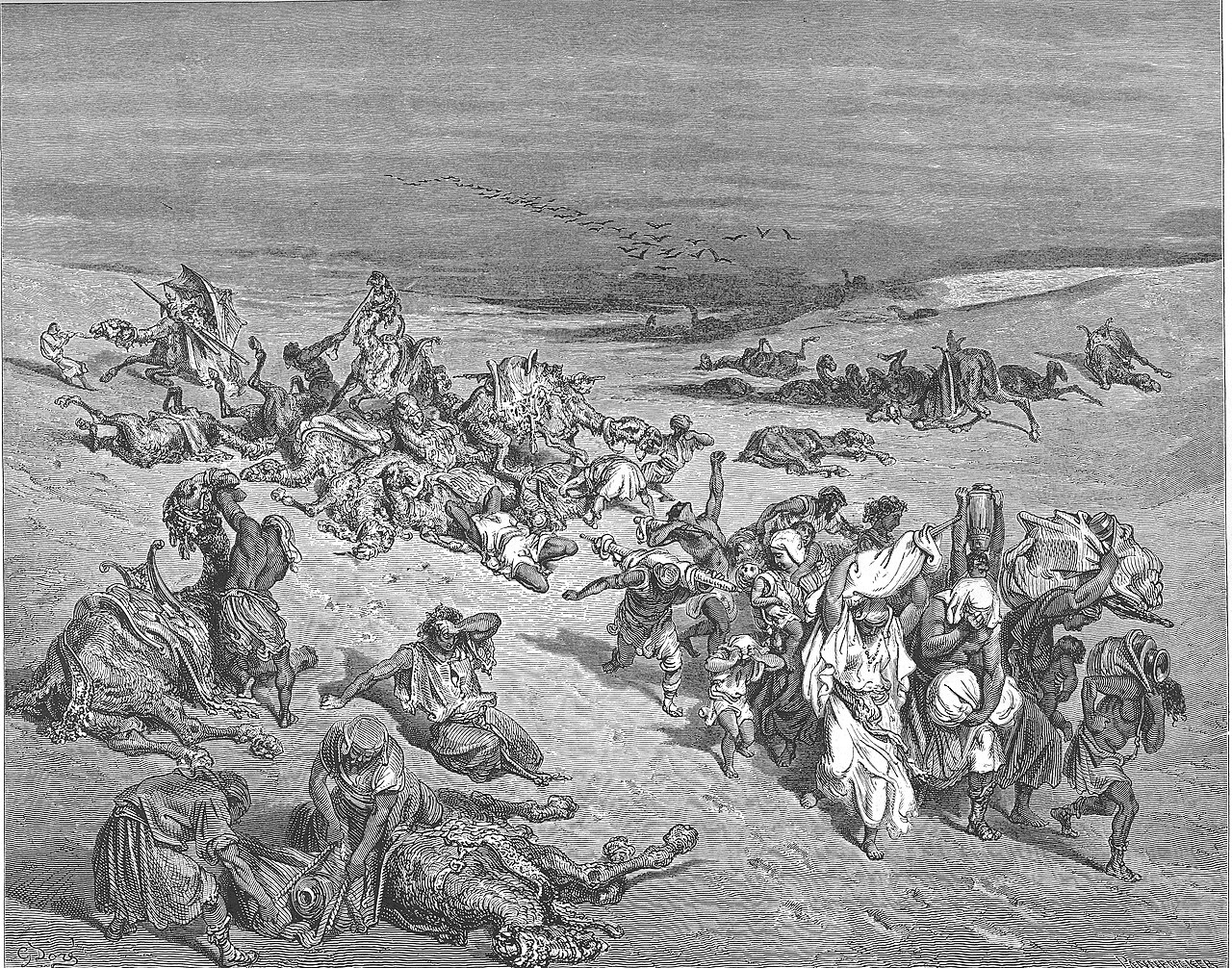
This verse carries the condition of the fifth plague, and the sentence runs on into verse 3. The words continue to restrain show that Pharaoh is still holding Israel by force after four plagues.
The record, by era
The Puritans and the Awakening1 voice
For if thou refuse to let them go,.... Continue to refuse, as he had done: and wilt hold them still; in the land, and under his dominion and oppression.
The words behind it
8 Hebrew wordsEvery Hebrew word of this verse in the order it stands, with what it means and the door to its own study. The last column counts the times a word stands in the whole Bible: the rarer the word, the more the places it appears belong together.
| Hebrew | Sound | Meaning | Word study | In the Bible |
|---|---|---|---|---|
| כִּ֛י | ki | that | H3588 → | 4482 times |
| אִם־ | ʾim- | except | H518 → | 1069 times |
| מָאֵ֥ן | maen | [are] refusing | H3986 → | 4 times |
| אַתָּ֖ה | ʾatah | you | H859 → | 1094 times |
| לְשַׁלֵּ֑חַ | leshaleach | to let [them] go | H7971 → | 845 times |
| וְעוֹדְךָ֖ | veodkha | and still you | H5750 → | 490 times |
| מַחֲזִ֥יק | machazik | [are] keeping hold | H2388 → | 291 times |
| בָּֽם׃ | bam | on <the> them |
כִּ֛יthat
kiH3588 →4482 times
אִם־except
ʾim-H518 →1069 times
מָאֵ֥ן[are] refusing
maenH3986 →4 times
אַתָּ֖הyou
ʾatahH859 →1094 times
לְשַׁלֵּ֑חַto let [them] go
leshaleachH7971 →845 times
וְעוֹדְךָ֖and still you
veodkhaH5750 →490 times
מַחֲזִ֥יק[are] keeping hold
machazikH2388 →291 times
בָּֽם׃on <the> them
bam
A shaded row is a word that stands 400 times or fewer in the Bible.
The walk
8 stopsEach card is a verse this one points to, and under it the verses that one points to in turn. Where several paths arrive at the same place, that place is listed first: the text keeps returning to it.
Through
Psalms 68:21Surely God will crush the heads of His enemies, the hairy crowns of those who persist in guilty ways.
it leads to
- Habakkuk 3:13
You went forth for the salvation of Your people, to save Your anointed. You crushed the head of the house of the wicked and stripped him from head to toe. Selah
- Luke 13:5
No, I tell you. But unless you repent, you too will all perish.”
- Psalms 110:6
He will judge the nations, heaping up the dead; He will crush the leaders far and wide.
- Psalms 7:12
If one does not repent, God will sharpen His sword; He has bent and strung His bow.
- Habakkuk 3:13
Through
Exodus 4:23and I told you to let My son go so that he may worship Me. But since you have refused to let him go, behold, I will kill your firstborn son!’”
it leads to
- Exodus 12:29
Now at midnight the LORD struck down every firstborn male in the land of Egypt, from the firstborn of Pharaoh, who sat on his throne, to the firstborn of the prisoner in the dungeon,…
- Exodus 11:5
and every firstborn son in the land of Egypt will die, from the firstborn of Pharaoh who sits on his throne, to the firstborn of the servant girl behind the hand mill, as well…
- Exodus 12:29
Through
Romans 2:8But for those who are self-seeking and who reject the truth and follow wickedness, there will be wrath and anger.
it leads to
- 1 Timothy 6:3–4
If anyone teaches another doctrine and disagrees with the sound words of our Lord Jesus Christ and with godly teaching,
- 2 Thessalonians 1:8
in blazing fire, inflicting vengeance on those who do not know God and do not obey the gospel of our Lord Jesus.
- 1 Timothy 6:3–4
Where this verse is studied
About Exodus
This page draws on John Gill, Exposition of the Old Testament (1748-1763); Keil and Delitzsch, Biblical Commentary on the Old Testament: The Pentateuch and Matthew Henry, Commentary on the Whole Bible.