
Exoduschapter 2
25 verses · Moses, by tradition · 15th or 13th century BC · The Law
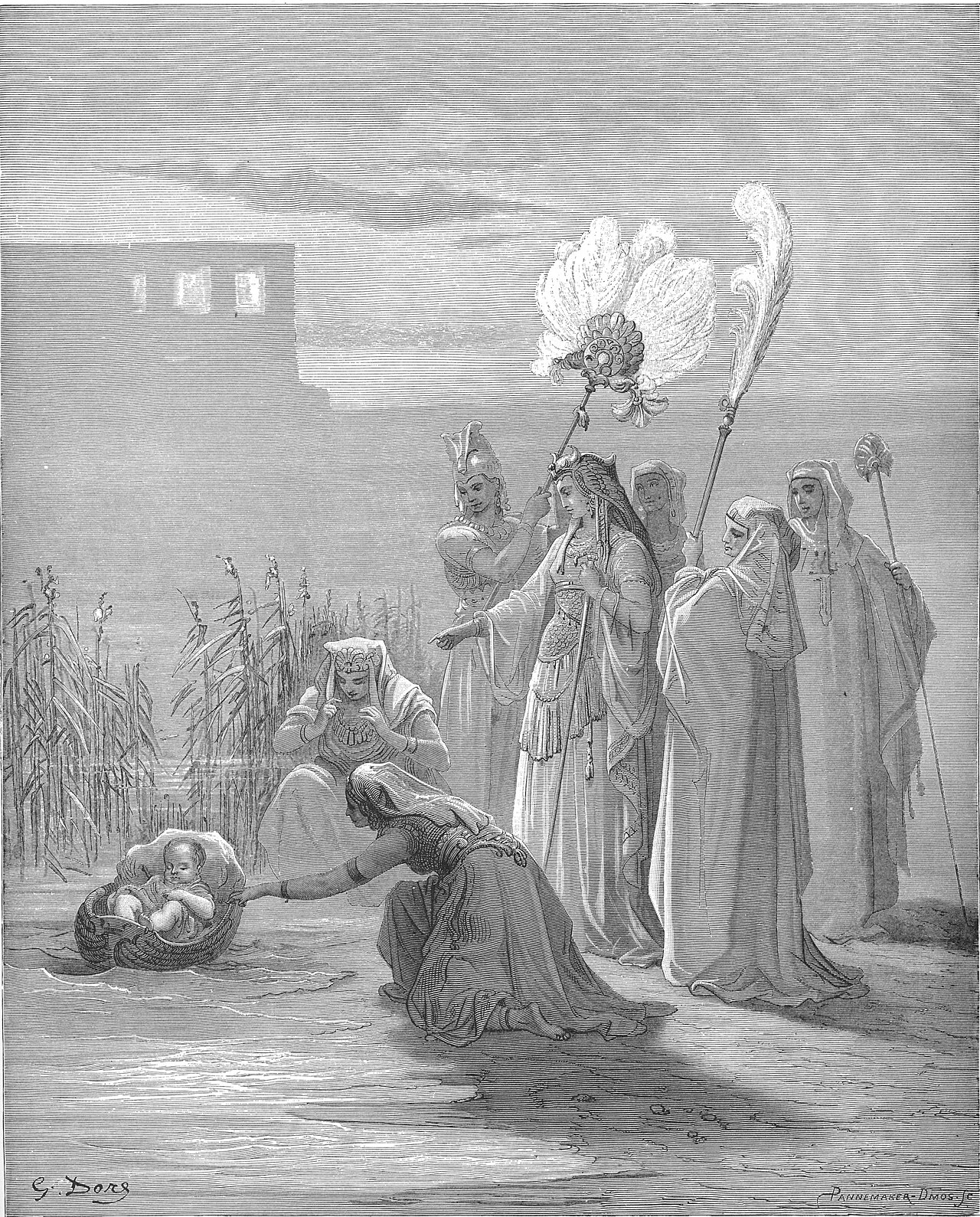
But when she could no longer hide him, she got him a papyrus basket and coated it with tar and pitch. Then she placed the child in the basket and set it among the reeds along the bank of the Nile.
Introduction
Moses, by tradition, The Law, Exodus Overview.
This chapter gives the birth and early life of the man through whom God rescued Israel. Its first hearers were the generation he led out, and many of them had lived under the order that threatened every Hebrew son. The story crosses forty years and two countries in a few short scenes. Listen for water at every turn, and for the women who act while the powerful men look away. The closing lines turn from the man to God, and they tell the reader where the story is going.
Context
- Who
- Israel in the wilderness, learning where the man leading them actually came from
- What
- A narrative chapter covering Moses' birth, rescue, flight from Egypt and marriage in Midian, and closing with God hearing Israel's cry.
- Where
- A Hebrew home in the Nile Delta, the reeds at the river's edge, and a well in Midian east of the Gulf of Aqaba.
- When
- From Moses' birth about 1526 BC to his years in Midian from about 1486 BC on the traditional early dating, with the late dating moving both into the thirteenth century BC.
- Why
- To show God preparing a deliverer before His people asked for one, and remembering His covenant with the fathers.
Historical context
The book is Moses' own by its own claim, at Exodus 17:14, Exodus 24:4 and Exodus 34:27, so this chapter is the writer's account of his own birth and exile. Julius Wellhausen and the critical tradition after him read the book instead as a later compilation from separate sources.
Show the rest of the historical context, 2 more paragraphs
The events fall in the years of slavery, in the eighty years before the exodus, and the chapter fixes them only by the life of one man. The first scene stands in the eastern Nile Delta at the river's margin, and the second in Midian, the caravan country east of the Gulf of Aqaba, among tent-dwelling herdsmen and metalworkers. The occasion is the decree of Exodus 1:22, which put every Hebrew son into the river.
A first hearer knew the craft of the basket. It is papyrus sealed with bitumen and pitch, which is the standard light-craft construction of the Nile, and it is set among the reeds at the margin where the current is slack. He knew that royal women bathed in the river, and that the name Moses sits inside Egyptian naming practice, where mose, born of, forms names like Thutmose and Ahmose. He also knew the politics of a desert well. Shepherds drive off the weaker party, and water is the standing flashpoint, so a stranger who defends seven daughters earns a place at their father's table.
Significance
The deliverer spent forty years learning Egypt from the inside and forty more learning the desert Israel would have to cross. Neither half was wasted.
Show the rest of the significance, 1 more paragraph
The chapter also ends with God rather than with Moses. The people groaned, and God heard, and remembered his covenant with Abraham, Isaac and Jacob. The rescue starts there.
This chapter in Jewish lifeWhat this chapter is in Jewish life and reading.
How it is read
Rashi fills the gaps of the birth story from the tradition. At verse 1 he holds that Amram had separated from his wife under Pharaoh's decree and then took her back. At verse 2 he carries the saying that when Moses was born "the whole house became filled with light" (Rashi on Exodus 2:2:1). At verse 6 he gives the plain sense first, that Pharaoh's daughter saw the child. Then he gives the midrashic reading, that "she saw the Shechina with him" (Rashi on Exodus 2:6:1). He names the two quarrelling Hebrews of verse 13 as Dathan and Abiram (Rashi on Exodus 2:13:1). At verse 16 he reads the priest of Midian as a man who had left the idol worship of his people and been banished for it (Rashi on Exodus 2:16:1). The text is the Rosenbaum and Silbermann Rashi of 1929 to 1934, in the public domain. Ibn Ezra's notes on Miriam at the river and on Jethro's daughters stand by reference alone (Ibn Ezra on Exodus 2:4:1 and 2:18:1).
What the rabbis say
The rabbis take up the marriage of verse 1 at Bava Batra 119b:13, and the birth of verse 2 at Avot DeRabbi Natan 2:5. On the ark of bulrushes they taught in Bereshit Rabbah 31:9. On the daughter of Pharaoh at the river they taught in Bamidbar Rabbah 14:1. The Mekhilta reads the killing of the Egyptian at Tractate Amalek 3:26, and Midrash Lekach Tov, Exodus 2:22:1 carries the naming of Gershom.
Sources: Rashi, Rashi on Exodus 2:1:1, 2:2:1, 2:6:1, 2:13:1 and 2:16:1, Pentateuch with Rashi's commentary by M. Rosenbaum and A. M. Silbermann, 1929 to 1934 (public domain); Ibn Ezra, Ibn Ezra on Exodus 2:4:1 and 2:18:1, cited by ref alone under the corpus licence rule; The Babylonian Talmud, Bava Batra 119b:13, cited by ref; The Midrash, Avot DeRabbi Natan 2:5, Bereshit Rabbah 31:9, Bamidbar Rabbah 14:1, Mekhilta DeRabbi Yishmael, Tractate Amalek 3:26, and Midrash Lekach Tov, Exodus 2:22:1, cited by ref.
The heads below are this chapter's scenes. The numbered points under each are its verses.
Drawn Out of the Water
Exodus 2:1-2
Neither parent is named in this chapter, and the genealogy at Exodus 6:20 supplies Amram and Jochebed after the fact. The mother sees that the child is goodly and hides him three months against a standing royal order, which Hebrews 11:23 credits to faith and says the parents were not afraid of the king's commandment. Stephen describes the same infant at Acts 7:20 as exceeding fair.
Exodus 2:1
“There went a man - Amram, son of Kohath, son of Levi, Exo 6:16-20. A daughter of Levi, Jochebed, sister to Kohath, and consequently both the wife and aunt of her husband Amram, Exo 6:20; Num 26:59. Such marriages were at this time lawful, though they were afterwards forbidden, Lev 18:12. But it is possible that daughter of Levi means no more than a descendant of that family, and that probably Amram and Jochebed were only cousin germans.”
Adam Clarke · Commentary on the Bible (1810-1826)evangelical
she hid him for three months: Moses' mother saw that her son was a beautiful child and hid him from Pharaoh's order for three months. Hebrews 11:23 credits the hiding to the faith of his parents. Adam Clarke notes that Moses was a younger child, since Aaron was three years older and a sister, probably Miriam, older still. Jamieson, Fausset and Brown see here reliance on God's word joined with wise action.
Exodus 2:2
“Bare a son - This certainly was not her first child, for Aaron was fourscore and three years old when Moses was but fourscore, see Exo 7:7: and there was a sister, probably Miriam, who was older than either; see below, Exo 2:4, and see Num 26:59. Miriam and Aaron had no doubt been both born before the decree was passed for the destruction of the Hebrew male children, mentioned in the preceding chapter.”
Adam Clarke · Commentary on the Bible (1810-1826)evangelical
1 more voice on this verse
Exodus 2:2
“Hence it is said to have been done by faith (Heb 11:23), either in the general promise of deliverance, or some special revelation made to Amram and Jochebed--and in this view, the pious couple gave a beautiful example of a firm reliance on the word of God, united with an active use of the most suitable means.”
Jamieson, Fausset & Brown · Commentary Critical and Explanatory on the Whole Bible (1871)reformed
The basket is called an ark, and the Hebrew word is tebah, the word used of Noah's vessel through Genesis 6 to 9. Those are the only two places the word occurs in the Old Testament, and both vessels are sealed with pitch, at Genesis 6:14 and here. Each one carries life through water while a whole generation is being destroyed in it. Pharaoh's decree at Exodus 1:22 was that every son be cast into the river, and the mother puts her son into the river inside an ark.
Exodus 2:3
“The ark was made of the papyrus which was commonly used by the Egyptians for light and swift boats. The species is no longer found in the Nile below Nubia. It is a strong rush, like the bamboo, about the thickness of a finger, three cornered, and attains the height of 10 to 15 feet. It is represented with great accuracy on the most ancient monuments of Egypt.”
1 more voice on this verse
Exodus 2:3
“Boats of this description are seen daily floating on the surface of the river, with no other caulking than Nile mud (compare Isa 18:2), and they are perfectly watertight, unless the coating is forced off by stormy weather. flags--a general term for sea or river weed.”
Jamieson, Fausset & Brown · Commentary Critical and Explanatory on the Whole Bible (1871)reformed
ConnectionsGenesis 6:14
Exodus 2:4-6
The sister posts herself downstream to see what will be done, and the chapter leaves her unnamed, though Exodus 15:20 and Numbers 26:59 give her as Miriam. Pharaoh's daughter identifies the child correctly the moment she opens the ark, saying that this is one of the Hebrews' children, and she keeps him. The decree of Exodus 1:22 is broken inside Pharaoh's own house by Pharaoh's own daughter.
Exodus 2:4
“6 And when she had opened it, she saw the child: and, behold, the babe wept. And she had compassion on him, and said, This is one of the Hebrews' children. 7 Then said his sister to Pharaoh's daughter, Shall I go and call to thee a nurse of the Hebrew women, that she may nurse the child for thee?”
Matthew Henry · Commentary on the Whole Bible (1707-1721)puritan
the daughter of Pharaoh went down to bathe: Pharaoh's daughter came to bathe in the Nile, saw the basket among the reeds and sent her maidservant to bring it. Albert Barnes notes that the traditional names given to her are conjecture, and that Egyptian princesses kept households of their own with considerable independence. Jamieson, Fausset and Brown suggest that her bathing place was fenced against crocodiles and that the way to it was known to Moses' mother.
Exodus 2:5
The water was there fenced off as a protection from the crocodiles; and doubtless the princess had an enclosure reserved for her own use, the road to which seems to have been well known to Jochebed. walked along--in procession or in file. she sent her maid--her immediate attendant. The term is different from that rendered "maidens."
Jamieson, Fausset & Brown · Commentary Critical and Explanatory on the Whole Bible (1871)reformed
1 more voice on this verse
Exodus 2:5
“The traditions which give a name to the daughter of Pharaoh are merely conjectural. Egyptian princesses held a very high and almost independent position under the ancient and middle empire, with a separate household and numerous officials. This was especially the case with the daughters of the first sovereigns of the 18th Dynasty.”
the little boy was crying: The princess opened the basket, found the baby crying and was moved to pity. She knew at once that he was one of the Hebrew children, the sons her father had ordered thrown into the Nile. Her compassion sets aside the decree of 1:22 inside Pharaoh's own house. Albert Barnes, on the verse before, notes that Egyptian princesses held a high and almost independent position.
Exodus 2:6
“She had compassion on him - The Egyptians regarded such tenderness as a condition of acceptance on the day of reckoning. In the presence of the Lord of truth each spirit had to answer, “I have not afflicted any man, I have not made any man weep, I have not withheld milk from the mouths of sucklings” (‘Funeral Ritual’). There was special ground for mentioning the feeling, since it led the princess to save and adopt the child in spite of her father’s commands.”
1 more voice on this verse
Exodus 2:6
“She had compassion on him - The sight of a beautiful babe in distress could not fail to make the impression here mentioned; see Clarke on Exo 2:2 (note). It has already been conjectured that the cruel edict of the Egyptian king did not continue long in force; see Exo 1:22. And it will not appear unreasonable to suppose that the circumstance related here might have brought about its abolition.”
Adam Clarke · Commentary on the Bible (1810-1826)evangelical
Exodus 2:7-9
The sister's question puts the child back into the arms of his own mother, and the mother is then paid wages out of the Egyptian court to nurse her own son. An order to drown the Hebrew boys ends with Pharaoh's household funding the upbringing of the man who will lead them out. Those first years with a Hebrew woman are what stand behind Hebrews 11:24, where a grown man refuses to be called the son of Pharaoh's daughter.
Exodus 2:7
“Shall I go and call a nurse - Had not the different circumstances marked here been placed under the superintendence of an especial providence, there is no human probability that they could have had such a happy issue. The parents had done every thing to save their child that piety, affection, and prudence could dictate, and having done so, they left the event to God.”
Adam Clarke · Commentary on the Bible (1810-1826)evangelical
the girl went and called: The princess accepted the sister's offer, and the girl went and brought back the child's own mother. The Hebrew word for girl here describes a young woman, and the sister goes unnamed in this chapter. Adam Clarke thinks she was probably Miriam. John Gill, on the next verse, notes that the mother was then paid to nurse her own son.
Exodus 2:8
“And Pharaoh's daughter said unto her, go,.... She fell in at once with the proposal, being, no doubt, overruled, by the providence of God, to agree to have such a person called: and the maid went and called the child's mother; and her own, whose name was Jochebed the wife of Amram, as observed in Exo 2:1.”
Pharaoh's daughter hired the boy's own mother to nurse him and promised to pay her wages. The mother who had been forced to hide her son now raised him openly under royal protection. John Gill notes that she was paid for nursing her own child, and cites a Jewish writer who set the wage at two pieces of silver a day.
Exodus 2:9
“And Pharaoh's daughter said unto her,.... Being come, having made all possible haste: take this child away, and nurse it for me, and I will give thee thy wages; by which means she had not only the nursing of her own child, but was paid for it: according to a Jewish writer (t), Pharaoh's daughter agreed with her for two pieces of silver a day. (t) Dibre Hayamim; sive Chronicon Mosis, fol. 4. 1.”
An Egyptian princess gives the name and the verse explains it in Hebrew, Because I drew him out of the water, from a root meaning to draw out. Egyptian names built on the element mes were common in the period, Ahmose and Thutmose among them, and commentators have long read this name from both languages at once. Acts 7:22 says he was learned in all the wisdom of the Egyptians, and the child drawn out of water will take a nation through it in chapter 14.
Moses Kills and Flees
Exodus 2:11-12
Moses goes out to his brethren and looks on their burdens, and his first recorded act as a grown man is to defend someone who cannot defend himself. Acts 7:23 puts his age at forty and Acts 7:25 says he supposed his brethren would have understood that God would deliver them by his hand. He looks this way and that way before he strikes, and readers have long divided over the act, with Stephen at Acts 7:24 reporting it as the avenging of a man oppressed and Matthew Henry faulting the manner of it.
Exodus 2:11
“Went out unto his brethren - At the end of 40 years. The Egyptian princess had not concealed from him the fact of his belonging to the oppressed race, nor is it likely that she had debarred him from contact with his foster-mother and her family, whether or not she became aware of the true relationship. An Egyptian - This man was probably one of the overseers of the workmen, natives under the chief superintendent Exo 1:11. They were armed with long heavy scourges, made of a tough pliant wood imported from Syria.”
After looking this way and that: Moses looked around, saw no one, killed the Egyptian and hid the body in the sand. His care to be unseen shows he knew the act would be judged, and verse 14 shows it had been seen after all. Interpreters divide over it. John Wesley holds that Moses acted by special warrant from heaven, while Albert Barnes holds the killing unjustified and says it delayed Israel's deliverance for many years.
Exodus 2:12
“Moses indeed killed the Egyptian and became a fugitive from the land of Egypt, in order to avoid the tyrant of that land. But he would not have killed that Egyptian man before he had first killed the Egyptian man of spiritual wickedness within himself, and had renounced the luxury of regal honors, considering the reproach of Christ a greater inheritance than the treasures of Egypt.”
Ambrose of Milan · written before 397 · On Cain and Abel 2.4.14patristic
3 more voices on this verse
Exodus 2:12
“The slaying of the Egyptian is not to be justified, or attributed to a divine inspiration, but it is to be judged with reference to the provocation, the impetuosity of Moses’ natural character, perhaps also to the habits developed by his training at the court of Pharaoh. The act involved a complete severance from the Egyptians, but, far from expediting, it delayed for many years the deliverance of the Israelites. Forty years of a very different training prepared Moses for the execution of that appointed work.”
Exodus 2:12
“He slew the Egyptian - Probably it was one of the Egyptian task-masters, whom he found abusing his Hebrew slave. By special warrant from heaven (which makes not a precedent in ordinary cases) Moses slew the Egyptian, and rescued his oppressed brother.”
John Wesley · Explanatory Notes upon the Old Testament (1765)evangelical
Exodus 2:12
“But we must not judge of his action in such a country and age by the standard of law and the notions of right which prevail in our Christian land; and, besides, not only is it not spoken of as a crime in Scripture or as distressing the perpetrator with remorse, but according to existing customs among nomadic tribes, he was bound to avenge the blood of a brother.”
Jamieson, Fausset & Brown · Commentary Critical and Explanatory on the Whole Bible (1871)reformed
Exodus 2:13-14
On the second day the man Moses corrects is a Hebrew, and the answer he gets is a refusal of his standing. Who made thee a prince and a judge over us is the sentence Stephen quotes at Acts 7:27, and at Acts 7:35 he answers it, saying that this Moses whom they refused was the one God sent to be a ruler and a deliverer. The rejection by his own people comes forty years before the deliverance rather than after it.
Exodus 2:13
“Thy fellow - “Thy neighbor.” the reproof was that of a legislator who established moral obligations on a recognized principle. Hence, in the following verse, the offender is represented as feeling that the position claimed by Moses was that of a Judge. The act could only have been made known by the Hebrew on whose behalf Moses had committed it.”
The Hebrew in the wrong rejected Moses' right to rebuke him and threw the killing of the Egyptian in his face. Moses realized the deed was known and was afraid. Stephen cites this rejection in Acts 7:27 and 7:35 as part of Israel's pattern of refusing those God sent. John Chrysostom answers the man's question by saying that Moses' deeds already showed him fit to lead.
Exodus 2:14
“Moses, for reproving him is immediately charged with a design to kill him. An attempt upon his sin was interpreted an attempt upon his life; and his having killed the Egyptian was thought sufficient to justify the suspicion; as if Moses made no difference between an Egyptian and a Hebrew.”
Matthew Henry · Commentary on the Whole Bible (1707-1721)puritan
1 more voice on this verse
Exodus 2:14
“For so Moses for the sake of those he ruled left so great riches and treasures untold, "choosing to suffer affliction with the people of God," and before his appointment was leader of the people by his actions. Wherefore also very foolishly did that Hebrew say to him, "Who made thee a ruler and a judge over us?" What sayest thou? Thou seest the actions and doubtest of the title?”
John Chrysostom · written before 407 · HOMILIES ON 2 CORINTHIANS 15.4patristic
Cross references
Exodus 2:14
- Quoted inActs 7:27“But the man who was abusing his neighbor pushed Moses aside and said, ‘Who made you ruler and judge over us?”
'Who made thee a ruler and a judge over us?' (Moses rejected)
Moses leaves the court he was raised in and ends the verse sitting at a water hole in a foreign country. Genesis stages that scene twice, with Abraham's servant at Genesis 24:11 and with Jacob at Genesis 29:2, and the same shape runs a third time from here to verse 21. Hebrews 11:27 says he forsook Egypt not fearing the wrath of the king while verse 14 says Moses feared, and readers take the two either as different moments or as fear of a man set beside faith in God.
Exodus 2:15
“The headquarters of Jethro are supposed to have been where Dahab-Madian now stands; and from Moses coming direct to that place, he may have travelled with a caravan of merchants. But another place is fixed by tradition in Wady Shuweib, or Jethro's valley, on the east of the mountain of Moses. sat down by a well--(See on Ge 29:3).”
Jamieson, Fausset & Brown · Commentary Critical and Explanatory on the Whole Bible (1871)reformed
1 more voice on this verse
Exodus 2:15
“No Egyptian king would have left; such an offence unpunished. But the position of Moses, as an adopted son of a princess, made it necessary even for a despotic sovereign to take unusual precautions. The land of Midian - The Midianites occupied an extensive district from the eastern coast of the Red Sea to the borders of Moab.”
A Stranger in the Land of Midian
Exodus 2:16-17
the priest of Midian had seven daughters: Women come to draw water, shepherds drive them off, and Moses stands up and waters the flock himself. It is the same act he did in Egypt at verse 12, taking the part of people being pushed around, so his first recorded deed in each country is of one kind. The Genesis versions of the scene put the service at the water in other hands, Rebekah watering the camels at Genesis 24:19 and Jacob rolling the stone from the well at Genesis 29:10.
Exodus 2:16
“The priest of Midian - Or prince, or both; for the original כהן cohen has both meanings. See it explained at large at Gen 15:18 (note). The transaction here very nearly resembles that mentioned Genesis 29 (note) concerning Jacob and Rachel.”
Adam Clarke · Commentary on the Bible (1810-1826)evangelical
Moses rose up to help them: Shepherds drove off the priest's daughters at the well, and Moses stood up for them and watered their flock. The scene echoes Jacob meeting Rachel at a well in Genesis 29, and it shows Moses again acting against injustice, this time without violence. Adam Clarke reads the Hebrew as saying the shepherds drove away the women's flocks in order to use the water the women had drawn.
Exodus 2:17
“The shepherds - drove them - The verb יגרשים yegareshum, being in the masculine gender, seems to imply that the shepherds drove away the flocks of Reuel’s daughters, and not the daughters themselves. The fact seems to be, that, as the daughters of Reuel filled the troughs and brought their flocks to drink, the shepherds drove those away, and, profiting by the young women’s labor, watered their own cattle. Moses resisted this insolence, and assisted them to water their flocks, in consequence of which they were enabled to return much sooner than they were wont to do, Exo 2:18.”
Adam Clarke · Commentary on the Bible (1810-1826)evangelical
Exodus 2:18-20
The daughters run home and tell their father, as Rebekah did at Genesis 24:28 and Rachel at Genesis 29:12, and the stranger is called in to eat bread. They report him as an Egyptian, which is what his dress and his speech made him to a Midianite eye. The priest is Reuel here and Jethro at Exodus 3:1 and 18:1, and Numbers 10:29 names Raguel as the father of Hobab, so some read Reuel as the clan head or grandfather while others read the two names as belonging to one man.
Exodus 2:18
“Reuel, their father - In Num 10:29 this person is called Raguel, but the Hebrew is the same in both places. The reason of this difference is that the ע ain in רעואל is sometimes used merely as vowel, sometimes as g, ng, and gn, and this is occasioned by the difficulty of the sound, which scarcely any European organs can enunciate.”
Adam Clarke · Commentary on the Bible (1810-1826)evangelical
The daughters call Moses an Egyptian, and John Gill thinks his dress and speech gave that impression. They report that he rescued them and drew water for the flock. Gill notes that the Hebrew doubles the verb for drawing, meaning he drew readily and in abundance, which is why they came home early.
Exodus 2:19
“And they said, an Egyptian delivered us out of the hand of the shepherds,.... A man, who by his habit and by his speech appeared to them to be an Egyptian, and upon their inquiry he might tell them so, being born in Egypt, though of Hebrew parents: and also drew water enough for us; or "in drawing drew" (t); drew it readily, quickly and in abundance: and watered the flock; by which means their business was done, and they returned home earlier than usual. (t) דלה דלה "hauriendo bausit", Pagninus, Montanus, Piscator.”
Reuel rebukes his daughters for leaving behind the man who helped them and tells them to invite him to a meal. Hospitality to a stranger was a duty in the ancient Near East, and this invitation leads to Moses settling in Midian and marrying in the next verse. The Hebrew says bread, which Adam Clarke notes stood for food of every kind.
Exodus 2:20
“That he may eat bread - That he may be entertained, and receive refreshment to proceed on his journey. Bread, among the Hebrews, was used to signify all kinds of food commonly used for the support of man’s life.”
Adam Clarke · Commentary on the Bible (1810-1826)evangelical
Exodus 2:21-22
The scene closes the way the other two closed, with the traveller taken into the household and a marriage following, as at Genesis 24:51 and Genesis 29:28. The son is called Gershom because Moses says he has been a stranger in a strange land, and stranger is the word of the promise at Genesis 15:13, that thy seed shall be a stranger in a land that is not theirs. The man who will lead Israel out of its sojourning names his own son after his.
Exodus 2:21
“Zipporah his daughter - Abul Farajius calls her “Saphura the black, daughter of Rewel the Midianite, the son of Dedan, the son of Abraham by his wife Keturah.” The Targum calls her the granddaughter of Reuel. It appears that Moses obtained Zipporah something in the same way that Jacob obtained Rachel; namely, for the performance of certain Services, probably keeping of sheep: see Exo 3:1.”
Adam Clarke · Commentary on the Bible (1810-1826)evangelical
Moses named him Gershom: Moses named his first son Gershom and gave the reason, that he had become a foreigner in a foreign land. The name sounds like the Hebrew for a sojourner there, and it records how Moses felt his exile. Adam Clarke notes that the Vulgate, the Syriac and other ancient versions add the naming of a second son, Eliezer, at this point, while the Hebrew names him at 18:4.
Exodus 2:22
“Called his name Gershom - Literally, a stranger; the reason of which Moses immediately adds, for I have been an Alien in a strange land. The Vulgate, the Septuagint, as it stands in the Complutensian Polyglot, and in several MSS., the Syriac, the Coptic, and the Arabic, add the following words to this verse: And the name of the second he called Eliezer, for the God of my father has been my help, and delivered me from the hand of Pharaoh.”
Adam Clarke · Commentary on the Bible (1810-1826)evangelical
God Hears Their Groaning
The king dies and the bondage stands, and the verse says by reason of the bondage twice in one breath. The Hebrew root behind that word is abad, the root Exodus 1:13 and 1:14 used five times over for the labour laid on Israel, and the same root carries the worship Pharaoh will be told to release them for at Exodus 8:1. The text records the cry with no one named as its hearer, saying only that it came up unto God.
Exodus 2:23
“In process of time - Nearly forty years Act 7:30. This verse marks the beginning of another section. We now enter at once upon the history of the Exodus. Their cry came up unto God - This statement, taken in connection with the two following verses, proves that the Israelites retained their faith in the God of their Fathers. The divine name, “God,” אלהים 'ĕlohı̂ym, is chosen because it was that which the Israelites must have used in their cry for help, that under which the covenant had been ratified with the Patriarchs (compare Jas 5:4).”
Exodus 2:24-25
Four verbs fall in two verses with God as the subject of every one, heard, remembered, looked and had respect. Remembered is the verb used of Noah at Genesis 8:1 and of Rachel at Genesis 30:22, and in each place it marks God acting on a promise rather than recalling something he had lost track of. The covenant named is the one cut with Abraham at Genesis 15, where the affliction and the coming out were both told in advance, so what begins in chapter 3 is the keeping of a word already given.
Exodus 2:24
“God remembered his covenant - God’s covenant is God’s engagement; he had promised to Abraham, to Isaac, and to Jacob, to give their posterity a land flowing with milk and honey, etc. They are now under the most oppressive bondage, and this was the most proper time for God to show them his mercy and power in fulfilling his promise. This is all that is meant by God’s remembering his covenant, for it was now that he began to give it its effect.”
Adam Clarke · Commentary on the Bible (1810-1826)evangelical
1 more voice on this verse
Exodus 2:24
“The name of God is here emphatically prefixed to four different expressions of a kind intention towards them. [1.] God heard their groaning; that is, he made it to appear that he took notice of their complaints.”
Matthew Henry · Commentary on the Whole Bible (1707-1721)puritan
God saw the Israelites and took notice: The chapter ends with the last of four verbs in verses 24 and 25, saying God heard, remembered, saw and knew. The Hebrew for took notice is the verb to know, which carries personal concern. Adam Clarke reads it as God's approval of His people and the ground of His resolve to deliver them. Matthew Henry notes that the name of God stands before each of the four verbs.
Exodus 2:25
“And God had respect unto them - וידע אלהים vaiyeda Elohim, God knew them, i.e., he approved of them, and therefore it is said that their cry came up before God, and he heard their groaning. The word ידע yada, to know, in the Hebrew Bible, as well as γινωσκω in the Greek Testament, is frequently used in the sense of approving; and because God knew - had respect for and approved of, them, therefore he was determined to deliver them.”
Adam Clarke · Commentary on the Bible (1810-1826)evangelical
How this psalm is built
The form: Narrative prose, the birth and the exile of the deliverer, told in three scenes with a water source in each, as Keil and Delitzsch classes it.
The patterns in this chapter
| Device | What it does | Where to see it |
|---|---|---|
| The basket the text calls an ark | The Hebrew word for the basket is tebah, the word used of Noah's vessel through Genesis 6 to 9. Those are the only two places the word stands in the Old Testament, and both vessels are sealed with pitch, at Genesis 6:14 and here. Each one carries life through water while a generation is being destroyed in it. Pharaoh's decree at Exodus 1:22 sent every son into the river, and the mother puts her son into the river inside an ark.Keil and Delitzsch, Biblical Commentary on the Old Testament: The Pentateuch. | Exodus 2:3 |
| A name given in Egypt and explained in Hebrew | An Egyptian princess gives the name and the verse explains it in Hebrew, from a root meaning to draw out. Egyptian names built on the element mes were common in the period, Ahmose and Thutmose among them. Commentators have long read the name from both languages at once. The child drawn out of water takes a nation through water in chapter 14.Adam Clarke, Commentary on the Bible. | Exodus 2:10 |
| One deed done twice, once in each country | At verse 12 Moses strikes an Egyptian who is beating a Hebrew. At verse 17 he stands up for seven women whom shepherds have driven off, and waters their flock himself. His first recorded deed in Egypt and his first recorded deed in Midian are of one kind, which is taking the part of people who are being pushed around.Matthew Henry, Commentary on the Whole Bible. | Exodus 2:12, Exodus 2:17 |
| The chapter runs on questions put to Moses and by him | Five questions carry the chapter forward. The sister asks Pharaoh's daughter whether she shall call a nurse at verse 7. Moses asks a Hebrew why he strikes his fellow at verse 13. The man answers with the question that drives Moses out, who made you ruler and judge over us, at verse 14. Reuel asks his daughters why they are home early at verse 18 and where the man is at verse 20. | Exodus 2:7, Exodus 2:13, Exodus 2:14, Exodus 2:18, Exodus 2:20 |
| Four verbs with God as the subject of each | Verses 24 and 25 give four verbs in two verses, heard, remembered, looked and had respect. Remembered is the verb used of Noah at Genesis 8:1 and of Rachel at Genesis 30:22, where it marks God acting on a promise. The covenant named is the one cut with Abraham at Genesis 15. Nothing is asked of Israel in these two verses and no man acts in them.Matthew Henry, Commentary on the Whole Bible. | Exodus 2:24, Exodus 2:25 |
The chapter answers the decree the chapter before it ended with. Pharaoh ordered every Hebrew son into the Nile at Exodus 1:22. This chapter puts one son into the river inside a sealed ark, has Pharaoh's own daughter draw him out, and has the Egyptian court pay his mother to raise him. The decree is broken inside the house that issued it.
11 more paragraphs on the patterns
What runs through the chapter is a man taking the part of the weaker side and being refused for it. He is refused by the Hebrew at verse 14 and he leaves the country. Forty years later the same people accept him, at Exodus 4:31, and then turn on him again in chapter 5.
The chapter also sets the promise clock running. Gershom is named at verse 22 because Moses had become a foreigner in a foreign land. The word behind it stands in the promise at Genesis 15:13, where Abram was told his seed would be a stranger in a land that is not theirs. The man who will lead Israel out of its sojourning names his own son after his.
The New Testament's use
Hebrews 11:23 reads the hiding of the child as faith, and says the parents were not afraid of the king's commandment. Stephen describes the same infant at Acts 7:20 as exceeding fair. Acts 7:22 says Moses was learned in all the wisdom of the Egyptians, and Hebrews 11:24 has the grown man refuse to be called the son of Pharaoh's daughter.
Stephen works through the middle of the chapter verse by verse. Acts 7:23 puts the visit to his brethren at forty years of age. Acts 7:24 reports the killing of the Egyptian as the avenging of a man oppressed, and Acts 7:25 says Moses supposed his brethren would understand that God would deliver them by his hand. Acts 7:27 quotes the refusal of verse 14, and Acts 7:35 answers it, saying that this Moses whom they refused was the man God sent to be a ruler and a deliverer.
The debated point
The killing at verse 12 is read two ways by teachers this site cites. Stephen reports it at Acts 7:24 as the avenging of a man who was oppressed, which reads the act as the deliverer's first work. Matthew Henry faults the manner of it, taking the looking this way and that way at verse 12 as the mark of a man acting on his own. No verdict is stated here.
The father of Zipporah is called Reuel at verse 18 and Jethro at Exodus 3:1 and 18:1, while Numbers 10:29 names Raguel as the father of Hobab. Some readers take Reuel as the clan head or the grandfather, and others take the two names as belonging to one man.
Hebrews 11:27 says Moses forsook Egypt and did not fear the wrath of the king, and verse 14 of this chapter says Moses feared. Readers take the two either as different moments or as the fear of a man set beside faith in God.
Where to go deeper
The scene at the river is laid out at Moses in the bulrushes. The sister who stands at a distance in verse 4 is laid out at Miriam. The country the chapter opens in is laid out at Egypt, and the deliverance the last three verses set in motion is laid out at the Exodus.
Keep studying
Studies5
Places1
Words12
Trails1
Sources for this chapter
The summary
Jamieson, Fausset & Brown, Commentary Critical and Explanatory; John Calvin, Commentaries; John Wesley, Notes on the Old Testament and Matthew Henry, Complete Commentary.
The context
Jamieson, Fausset & Brown, Commentary Critical and Explanatory on the Whole Bible and Matthew Henry, Commentary on the Whole Bible.
The form and classifications
Keil and Delitzsch, Biblical Commentary on the Old Testament: The Pentateuch, on Exodus 2 and Matthew Henry, Commentary on the Whole Bible, on Exodus 2.
The exposition
Adam Clarke, Commentary on the Bible; Albert Barnes, Notes, Explanatory and Practical, on the Old and New Testaments; Jamieson, Fausset and Brown, Commentary Critical and Explanatory on the Whole Bible; John Calvin, Commentary on the Four Last Books of Moses Arranged in the Form of a Harmony; John Chrysostom, Homilies on 2 Corinthians 15.4; John Gill, Exposition of the Old Testament; John Wesley, Explanatory Notes upon the Old Testament; Keil and Delitzsch, Biblical Commentary on the Old Testament: The Pentateuch and Matthew Henry, Commentary on the Whole Bible.