
Exoduschapter 10
29 verses · Moses, by tradition · 15th or 13th century BC · The Law
Even our livestock must go with us; not a hoof will be left behind, for we will need some of them to worship the LORD our God, and we will not know how we are to worship the LORD until we arrive.”
Introduction
Moses, by tradition, The Law, Exodus Overview.
This chapter carries the eighth and ninth plagues and leaves Egypt waiting for the last one. It was written for Israelite families, and it says so, for fathers to tell their children and grandchildren. By now the land was stripped and the king's own court had turned against him. Listen for the bargaining over who may go and what they may take, and for the answer Moses keeps giving. The chapter closes on a threat and a silence that lead straight into the night of the Passover.
Context
- Who
- Israel after the exodus, charged to tell the story to their children
- What
- A narrative chapter reporting the plagues of locusts and darkness and Pharaoh's last bargaining before the final plague.
- Where
- Pharaoh's court and the whole land of Egypt, with light in the homes of the Israelites.
- When
- About 1446 BC on the traditional early date, in the spring just before the Passover.
- Why
- To give Israel an account to hand down to its children and grandchildren so that they would know the LORD.
Historical context
Exodus presents itself as Moses' own writing, at 17:14, 24:4 and 34:27, where he writes at the LORD's command. Moses had fled to Midian and come back at the call given at the bush, and at this chapter he carries the demand to Pharaoh with Aaron beside him.
Show the rest of the historical context, 2 more paragraphs
When the exodus happened is disputed, and no verdict is stamped on it here. The early date puts it at about 1446 BC, read from the four hundred and eighty years of 1 Kings 6:1 by Eugene Merrill, Bryant Wood and Andrew Steinmann. The late date puts it in the thirteenth century BC, read from the store cities of Exodus 1:11 by Kenneth Kitchen and James Hoffmeier. The place is Egypt, its fields and its houses, with the district of Goshen in light while the rest of the country stood still. The occasion is the eighth and ninth strokes of the contest over Israel's release, and the last bargaining before the firstborn die.
A first hearer knew who was being struck, since Egyptian officials invoked a god named Senehem against pests, so the locusts fell on ground already thought of as defended. The sun was worshipped as Ra, the chief deity of the country, and Pharaoh himself was called the son of Ra, so three days of darkness over Egypt was a verdict on the throne. A hearer also knew what the offer of the men alone at verse 11 amounted to, since a man who leaves his wife and his children behind comes back.
Significance
God states the purpose in the chapter's own words, that a man may tell his children and grandchildren what was done in Egypt. The account was made to be retold, and Israel was given its teaching before the sequence had finished.
Show the rest of the significance, 1 more paragraph
For a people whose parents had feared Egypt all their lives, hearing Pharaoh's own officials beg him to give in was the sound of an empire cracking.
This chapter in Jewish lifeWhat this chapter is in Jewish life and reading.
How it is read
Rashi takes the word God uses of Himself in verse 2 at its full strength. It means "I HAVE MOCKED", he says, and he sets the same verb beside its use of Balaam's donkey and of the Philistines (Rashi on Exodus 10:2:1). At verse 13 he explains the direction of the wind by the map. An east wind carried the locusts in because Egypt lay to the south and west of the land of Israel (Rashi on Exodus 10:13:1). At verse 14 he weighs this plague against the locusts of Joel. Joel's were heavier, he holds, because they were many species together, while these "consisted of only one species" and had no equal of their kind (Rashi on Exodus 10:14:1). At verse 21 he reads the darkness as night made worse, so that "the darkness of night shall become even more black and dark" (Rashi on Exodus 10:21:1). At verse 8 he notes that Moses and Aaron were fetched back to Pharaoh by messengers sent after them (Rashi on Exodus 10:8:1). The text is the Rosenbaum and Silbermann Rashi of 1929 to 1934, in the public domain. Ibn Ezra comments at seven places and stands by reference alone (Ibn Ezra on Exodus 10:9:1 and 10:23:1).
What the rabbis say
The rabbis take up the locusts at Makkot 16a:2 and Mekhilta DeRabbi Yishmael, Tractate Vayehi Beshalach 5:11. On Pharaoh's offer to let the men go they taught in Bereshit Rabbah 48:11. On the sacrifices Moses demanded of Pharaoh they taught at Avodah Zarah 24a:19. The Mekhilta carries the bargaining of this chapter at Tractate Pischa 13:22 and 13:23.
Sources: Rashi, Rashi on Exodus 10:2:1, 10:8:1, 10:13:1, 10:14:1 and 10:21:1, Pentateuch with Rashi's commentary by M. Rosenbaum and A. M. Silbermann, 1929 to 1934 (public domain); Ibn Ezra, Ibn Ezra on Exodus 10:9:1 and 10:23:1, cited by ref alone under the corpus licence rule; The Babylonian Talmud, Makkot 16a:2 and Avodah Zarah 24a:19, cited by ref; The Midrash, Bereshit Rabbah 48:11 and Mekhilta DeRabbi Yishmael, Tractate Pischa 13:22 and 13:23 and Tractate Vayehi Beshalach 5:11, cited by ref.
The heads below are this chapter's scenes. The numbered points under each are its verses.
Locusts Threatened; Pharaoh Bargains
Exodus 10:1-2
for I have hardened his heart: The reason for the whole sequence is stated here and it is instruction rather than punishment, that a man might tell in the ears of his son and his grandson what things I have wrought in Egypt. The command Go in unto Pharaoh puts this plague in the same slot as the frogs at 8:1 and the murrain at 9:1, warned in the palace rather than at the river, which is how each triad of three is built. From 9:12 the text has made the LORD the subject of the hardening and it never changes back, so 10:1, 10:20 and 10:27 all read the same way.
Exodus 10:1
“Hardened his heart - God suffered his natural obstinacy to prevail, that he might have farther opportunities of showing forth his eternal power and Godhead.”
Adam Clarke · Commentary on the Bible (1810-1826)evangelical
tell your children and grandchildren: The LORD gives a further purpose for the signs: Israel is to tell them to its children and grandchildren. The plagues become a record for later generations, so that all Israel may know that He is the LORD. Adam Clarke, on verse 1, reads the hardening as God allowing Pharaoh's natural obstinacy to prevail, giving further occasion to show His power.
Exodus 10:2
“And that thou mayest tell . . . of thy son, and of thy son's son, &c.--There was a further and higher reason for the infliction of those awful judgments, namely, that the knowledge of them there, and the permanent record of them still, might furnish a salutary and impressive lesson to the Church down to the latest ages.”
Jamieson, Fausset & Brown · Commentary Critical and Explanatory on the Whole Bible (1871)reformed
1 more voice on this verse
Exodus 10:2
“That thou mayest tell in the ears of thy son - That the miracles wrought at this time might be a record for the instruction of the latest posterity, that Jehovah alone, the God of the Hebrews, was the sole Maker, Governor, and Supporter of the heavens and the earth. Thus we find God so did his marvelous works, that they might be had in everlasting remembrance.”
Adam Clarke · Commentary on the Bible (1810-1826)evangelical
This is the last of the seven times the demand is made with its purpose attached, let my people go, that they may serve me, running from 4:23 through 7:16, 8:1, 8:20, 9:1 and 9:13. After this verse the argument is no longer over whether Israel goes but over who and what goes with them. Pharaoh's own servants pick up the opening words in verse 7 and aim the question at Moses instead.
Exodus 10:3
“How long wilt thou refuse to humble thyself - Had it been impossible for Pharaoh, in all the preceding plagues, to have humbled himself and repented can we suppose that God could have addressed him in such language as the preceding?”
Adam Clarke · Commentary on the Bible (1810-1826)evangelical
1 more voice on this verse
Exodus 10:3
“PHARAOH is the type and image of proud men. God permitted him to be left to the natural hardness of his heart and he stood up against Jehovah in a very remarkable way. Those who are students of the ancient history of Egypt, those especially who have seen the remains of the colossal statues of the kings and those tremendous pyramids which probably were the places of their sepulture, will know that man worship was carried on to the very highest degree in connection with the ancient kingdom of Egypt.”
Charles Spurgeon · written before 1892 · The Metropolitan Tabernacle Pulpit, Sermon No. 2503: “The Question Between the Plagues” (lightly modernized text, CCEL edition)Particular Baptist
Exodus 10:4-6
The word locust occurs here for the first time in Scripture, and the threat is that it will finish what the hail began, eating the residue of that which is escaped. Exodus 9:31 and 9:32 had said the flax and the barley were smitten while the wheat and the rie were not grown up, so the two plagues take the harvest in stages. Moses then uses the measure the text keeps for these last strokes, a thing which the fathers and their fathers had never seen, already spoken of the hail at 9:18 and 9:24, and he turns and walks out before Pharaoh has answered.
Exodus 10:4
“To-morrow will I bring the locusts - The word ארבה arbeh, a locust, is probably from the root רבה rabah, he multiplied, became great, mighty, etc.; because of the immense swarms of these animals by which different countries, especially the east, are infested. The locust, in entomology, belongs to a genus of insects known among naturalists by the term Grylli; and includes three species, crickets, grasshoppers, and those commonly called locusts; and as they multiply faster than any other animal in creation, they are properly entitled to the name ארבה arbeh, which might be translated the numerous or multiplied insect.”
Adam Clarke · Commentary on the Bible (1810-1826)evangelical
They will cover the face of the land: The locusts will be so many that the ground disappears beneath them. They will eat whatever the hail left, including every tree in the fields, completing the ruin of Egypt's crops. John Gill notes that the Hebrew speaks of covering the eye of the earth, meaning either its visible surface or the eye of anyone looking at it.
Exodus 10:5
“And they shall cover the face of the earth, that one cannot be able to see the earth,.... Or, "cover the eye of the earth" (z); either the appearance and colour of the earth, so as they could not be discerned for the multitude of the locusts on it; so the word is used in Num 11:7 or the eye of man looking upon the earth, which would not be able to see it, because the locusts would be between his eye and the earth.”
Then Moses turned and left Pharaoh’s presence: The locusts will fill the houses of Pharaoh, his officials and every Egyptian, beyond anything their fathers or grandfathers had seen. Moses then turns and leaves without waiting for an answer. Adam Clarke cites the traveller Shaw, who saw locusts enter houses and bedchambers like so many thieves.
Exodus 10:6
“They shall fill thy houses - Dr. Shaw mentions this circumstance; “they entered,” says he, “Into our very houses and bed-chambers, like so many thieves.” - Ibid. p. 187.”
Adam Clarke · Commentary on the Bible (1810-1826)evangelical
The court breaks with the king, which chapter 9 had prepared when some of his servants feared the word of the LORD and brought their cattle in out of the hail at 9:20. They borrow the words Moses used four verses earlier and turn them around, asking how long a man rather than how long a refusal. Their own account of the country, knowest thou not yet that Egypt is destroyed, is given before the eighth plague has fallen.
Exodus 10:7
“For the first time the officers of Pharaoh intervene before the scourge is inflicted, showing at once their belief in the threat, and their special terror of the infliction. Also, for the first time, Pharaoh takes measures to prevent the evil; he does not indeed send for Moses and Aaron, but he permits them to be brought into his presence. Let the men go - i. e. the men only, not all the people. See Exo 10:8.”
Exodus 10:8-9
Pharaoh grants the words Go, serve the LORD your God and then asks for the terms, and the terms are what the rest of the chapter is fought over. Moses answers with everyone and everything, the young and the old, the sons and the daughters, the flocks and the herds, and grounds it on the request first made at 5:1, that we must hold a feast unto the LORD. The reason he gives is the service itself, which is the thread the book carries from the bondage of 1:13 and 1:14 to the order of worship in chapter 40.
Exodus 10:8
“Who are they that shall go? - Though the Egyptians, about fourscore years before, wished to destroy the Hebrews, yet they found them now so profitable to the state that they were unwilling to part with them.”
Adam Clarke · Commentary on the Bible (1810-1826)evangelical
Pharaoh has asked who will go, and Moses answers that everyone will: young and old, sons and daughters, with the flocks and herds. A feast to the LORD requires the whole people and their animals. Albert Barnes notes that the demand fit Egyptian custom, since great festivals were kept by the whole population.
Exodus 10:9
“With our young ... - The demand was not contrary to Egyptian usage, as great festivals were kept by the whole population.”
Exodus 10:10-11
The first counteroffer of the chapter cuts the party down to the men, and it belongs to a series: sacrifice in the land at 8:25, go not very far away at 8:28, the men only here, and leave the flocks at 10:24. Moses turns down every one of them and holds to the whole household with its cattle, because a service with parts kept back in Egypt would still be Egypt's service. Pharaoh has the two men driven out from his presence, and at 11:1 he is told he will thrust the whole nation out.
Exodus 10:10
“Let the Lord be so with you - This is an obscure sentence. Some suppose that Pharaoh meant it as a curse, as if he had said, “May your God be as surely with you, as I shall let you go!” For as he purposed not to permit them to go, so he wished them as much of the Divine help as they should have of his permission.”
Adam Clarke · Commentary on the Bible (1810-1826)evangelical
only the men may go and worship the LORD: Pharaoh offers a partial release: the men may go, and the families stay behind, which would bind the men to return. He claims this is all Israel had asked, and Moses and Aaron are driven out. Origen reads such concessions as proof that the signs softened Pharaoh in part, and he uses this against the common reading of the words about God hardening his heart.
Exodus 10:11
“And the briefly recorded fact that the heart of Pharaoh experienced a kind of softening when he said, "But you shall not proceed far; you shall go a three days' journey and leave your wives behind," and whatever else he spoke when yielding before the marvelous works makes it clear that these signs had some effect even on him, though they did not entirely accomplish their object. Yet not even this would have happened if the idea held by most people about the words, "I will harden Pharaoh's heart," rightly represented what was wrought by him, that is, by God.”
Origen of Alexandria · written before 253 · ON FIRST PRINCIPLES 3.1.11patristic
Locusts Devour Every Green Thing
Exodus 10:12-13
The hand is commanded and the rod does the work, the same shepherd's stick handed to Moses at the bush in 4:2, which swallowed the magicians' rods at 7:12 and turned the river at 7:20. The agent is an east wind that blows a full day and a full night, and the same wind blows all night at 14:21 to open the sea. An east wind had blasted the ears of corn in the dream of Genesis 41:6, the dream that brought Israel down into Egypt in the first place.
Exodus 10:12
“Even the locust, by divine grace, penetrates everywhere, and when it has filled the width of each region with its dense swarm, it first strikes without harm, and feeds on the barren land only after receiving the divine signal of permission. Indeed, just as we read in Exodus, it also acts as the celestial executor of righteous vengeance.”
Ambrose of Milan · written before 397 · The Six Days of Creation 5.23.82patristic
the LORD sent an east wind across the land: Moses stretches out his staff, and the LORD drives an east wind over Egypt for a day and a night until it brings the locusts. The text names the means the LORD used as well as the LORD who used them. Albert Barnes observes that Moses takes care to record the natural cause, while the scale and timing of the plague mark it as the work of God.
Exodus 10:13
“An east wind - See Exo 10:4. Moses is careful to record the natural and usual cause of the evil, portentous as it was both in extent and in connection with its denouncement.”
Exodus 10:14-15
Every green thing goes, the herbs of the field and the fruit of the trees the hail had left, so the stroke takes the food of the coming year and not only the crop standing in the field. The text gives it the superlative it gave the hail at 9:18 and 9:24 and will give the death of the firstborn at 11:6, that there were none like these before and none shall be after. Joel 1:4 and Revelation 9:3 both reach for locusts when they describe a day of judgment.
Exodus 10:14
“Went up - At a distance the locusts appear hanging, as it were, like a heavy cloud over the land; as they approach they seem to rise, and they fill the atmosphere overhead upon their arrival. Over all the land - Travelers mention a cloud of locusts extending over 500 miles, and so compact while on the wing that it completely hid the sun. This passage describes a swarm unprecedented in extent.”
2 more voices on this verse
Exodus 10:14
“And the locusts went up over all the land of Egypt,.... Being raised up by the wind in the places where they were generated, they flew and spread themselves all over the land, being in a wonderful manner produced and multiplied by the power of God: and rested in all the coasts of Egypt; in every part of it where the Egyptians dwelt, and where there were meadows, pastures, fields, gardens, orchards; here they lighted and fed, excepting the land of Goshen, where Israel dwelt, which must be thought to be exempted from this plague, as from the rest.”
Exodus 10:14
“Before them there were no such locusts, etc. - They exceeded all that went before, or were since, in number, and in the devastations they produced. Probably both these things are intended in the passage. See Exo 10:15.”
Adam Clarke · Commentary on the Bible (1810-1826)evangelical
Nothing green was left on any tree: The locusts cover the land until it turns black and eat every plant and every fruit the hail had spared. After the hail and the locusts, the fields and orchards of Egypt stand bare. John Gill, on verse 5, explains the covering of the land as hiding the ground from anyone who looked at it.
Exodus 10:15
“There remained not any green thing - See Clarke’s note on Exo 10:4.”
Adam Clarke · Commentary on the Bible (1810-1826)evangelical
Exodus 10:16-17
This is the second time Pharaoh says I have sinned, after 9:27 where he added that the LORD is righteous, and 9:27 is the first place in Scripture where anyone is recorded saying the words. What he asks to have taken away is the death and not the sin, and the word only carries his request twice over. Matthew Henry reads the confession as fear of the plague rather than a change of mind, and verse 20 puts a hardened heart directly after it.
Exodus 10:16
“Then Pharaoh called for Moses and Aaron in haste,.... Or, "hastened to call them" (t); sent messengers in all haste to fetch them, and desire them to come as soon as possible to him.”
please forgive my sin once more: Pharaoh asks for forgiveness and for prayer, and he calls the locusts this death. John Wesley observes that Pharaoh prays against the locusts while leaving the plague of his hard heart in place. Albert Barnes adds that Pharaoh now admits the danger his officials named in verse 7.
Exodus 10:17
“Pharaoh desires their prayers that this death only might be taken away, not this sin: he deprecates the plague of locusts, not the plague of a hard heart.”
John Wesley · Explanatory Notes upon the Old Testament (1765)evangelical
1 more voice on this verse
Exodus 10:17
“This death only - Pliny calls locusts a pestilence brought on by divine wrath. Pharaoh now recognizes the justice of his servants’ apprehensions, Exo 10:7.”
Exodus 10:18-19
Moses prays for the country that is holding his people, as he did at 8:12, 8:30 and 9:33, so the man who brings the plague is also the man who asks for its removal. The wind that carried the locusts in is answered by a mighty strong west wind that carries them out and casts them into the Red sea, and this verse is the first place in Scripture the Red sea is named. The water that swallows the plague here swallows the army at 14:28 and is named again in the song at 15:4.
Exodus 10:18
“He never desired the woeful day, though he threatened it. His commission indeed ran against Egypt, but his intercession was for it, which was a good reason why they should love him, though they feared him. It was also as strong an argument for their repentance as the judgment itself; for by this it appeared that God is ready to forgive, and swift to show mercy.”
Matthew Henry · Commentary on the Whole Bible (1707-1721)puritan
a very strong west wind: The LORD turns the wind, and a strong west wind carries every locust into the Red Sea. The plague leaves as completely as it came, with not a single locust remaining. Albert Barnes notes that the Hebrew calls it a sea wind, blowing from the sea to the northwest of Egypt, and John Wesley observes that east wind and west wind alike carry out the word of God.
Exodus 10:19
“West wind - Literally, “a sea wind,” a wind blowing from the sea on the northwest of Egypt. Red sea - The Hebrew has the “Sea of Suph”: the exact meaning of which is disputed. Gesenius renders it “rush” or “seaweed;” but it is probably an Egyptian word. A sea-weed resembling wood is thrown up abundantly on the shores of the Red Sea. The origin of the name “Red” Sea is uncertain: (naturalists have connected it with the presence of red infusoria, Exo 7:17).”
1 more voice on this verse
Exodus 10:19
“An east-wind brought the locusts and now a west-wind carried them off. Whatever point of the compass the wind is in, it is fulfilling God's word, and turns about by his counsel; the wind blows where it listeth for us, but not where it listeth for him; he directeth it under the whole heaven.”
John Wesley · Explanatory Notes upon the Old Testament (1765)evangelical
This is one of nineteen statements about Pharaoh's heart in the book, and from 9:12 onward the LORD is the subject of every one of them. Through the first five plagues the text either puts the act on Pharaoh or leaves it stative, at 7:13, 7:22, 8:15, 8:19, 8:32 and 9:7, and the order of those statements matters to both sides of the argument. Romans 9:17 quotes Exodus 9:16 and Romans 9:18 draws the words whom he will he hardeneth out of it. Sproul reads the whole sequence as one act with two true descriptions, divine sovereignty and human responsibility each real, while the free-will reading takes the order as God confirming a man in the direction he had already chosen.
Exodus 10:20
“But the Lord hardened Pharaoh's heart,.... For as yet he had not brought all his judgments on him he designed to bring: so that he would not let the children of Israel go: though he had promised to do it, and that he would never offend more in this way.”
Darkness That Could Be Felt
Exodus 10:21-22
The ninth plague arrives with no warning and no demand attached to it, which closes the third triad the way the lice at 8:16 and the boils at 9:8 closed the first two. The phrase darkness which may be felt occurs nowhere else in Scripture, and the darkness holds for three days. Readings that match each plague to a named Egyptian god, with Ra standing behind this one, are taught by Chuck Missler and others; what Exodus itself says is at 12:12, that against all the gods of Egypt I will execute judgment, and it names no deity.
Exodus 10:21
“And the Lord said unto Moses,.... About the eleventh day of the month Abib: stretch out thine hand toward heaven; where the luminaries are, and from whence light comes: that there may be darkness over the land of Egypt, even darkness which may be felt; that is, what caused it, the gross vapours and thick fogs; for otherwise darkness itself, being a privation of light, cannot be felt: Onkelos paraphrases it,"after that the darkness of the night is removed;''so Jonathan; that it might appear to be different from that, and be much grosser.”
2 more voices on this verse
Exodus 10:21
“Darkness - This infliction was specially calculated to affect the spirits of the Egyptians, whose chief object of worship was the Sun-god; and its suddenness and severity in connection with the act of Moses mark it as a preternatural withdrawal of light. Yet, it has an analogy in physical phenomena. After the vernal equinox the southwest wind from the desert blows some 50 days, not however, continuously but at intervals, lasting generally some two or three days.”
Exodus 10:21
“The plague of darkness brought upon Egypt, and a most dreadful plague it was, and therefore is put first of the ten in Ps. cv. 28 , though it was one of the last; and in the destruction of the spiritual Egypt it is produced by the fifth vial, which is poured out upon the seat of the beast, Rev. xvi. His kingdom was full of darkness.”
Matthew Henry · Commentary on the Whole Bible (1707-1721)puritan
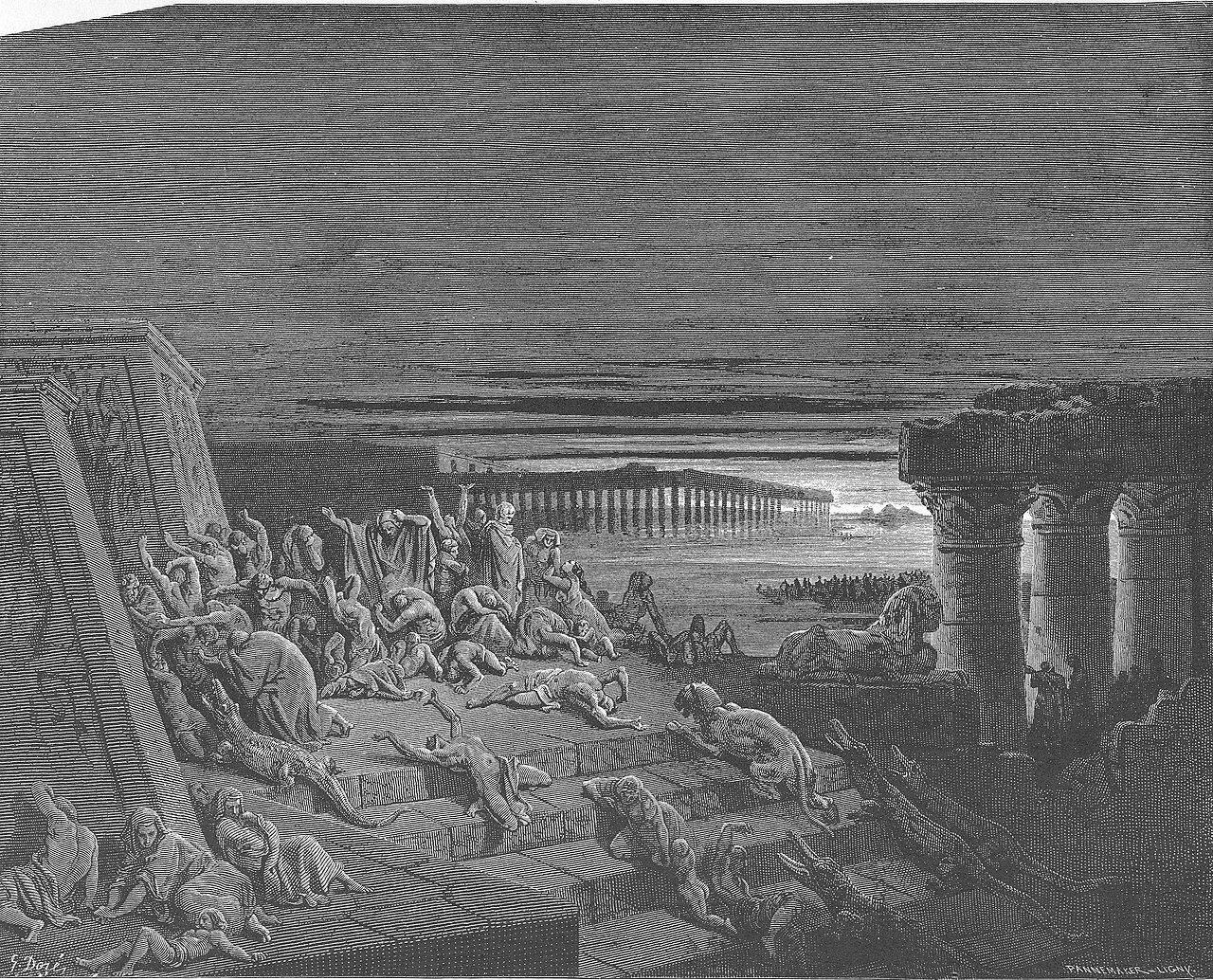
total darkness covered all the land: Moses stretches out his hand toward heaven, and darkness covers Egypt for three days. The ninth plague comes with no warning to Pharaoh, as the third and the sixth did. Matthew Henry reports the Jewish tradition that the Egyptians were terrified in this darkness by evil spirits or by their own consciences, and he notes the view that Psalm 78 refers to it.
Exodus 10:22
“The tradition of the Jews is that in this darkness they were terrified by the apparitions of evil spirits, or rather by dreadful sounds and murmurs which they made, or (which is no less frightful) by the horrors of their own consciences; and this is the plague which some think is intended (for, otherwise, it is not mentioned at all there) Ps. lxxviii.”
Matthew Henry · Commentary on the Whole Bible (1707-1721)puritan
Egypt is stopped where it stands for three days while the children of Israel have light in their dwellings, and the division between the two peoples has now been stated at four plagues running, at 8:22, 9:4, 9:26 and here. The line is drawn by dwelling rather than by desert, which is the shape the blood on the door takes at 12:13, where the sign is what God sees and not who is inside. The chapter says nothing about how the light in Goshen was kept.
Exodus 10:23
“Had light in their dwellings - The sandstorm, if such were the cause, may not have extended to the district of Goshen; but the expression clearly denotes a miraculous intervention, whether accomplished or not by natural agencies.”
Exodus 10:24-25
The last counteroffer keeps the cattle back, which would send Israel out to a feast with nothing to offer at it. Pharaoh has moved from the men only in verse 11 to letting the little ones go as well, so the ground has narrowed to the herds, and the herds are the part the service actually needs. Moses answers that the sacrifices and burnt offerings have to come out of their own animals.
Exodus 10:24
“Only let your flocks and your herds be stayed - Pharaoh cannot get all he wishes; and as he sees it impossible to contend with Jehovah, he now consents to give up the Israelites, their wives and their children, provided he may keep their flocks and their herds. The cruelty of this demand is not more evident than its avarice.”
Adam Clarke · Commentary on the Bible (1810-1826)evangelical
Pharaoh has allowed the children to go but wants the flocks kept behind. Moses answers that Pharaoh must also let them have animals for sacrifices and burnt offerings, and in verse 26 he insists that every animal will go. John Gill reads the demand as leave to take Israel's own cattle, and he reports the view of Jarchi that Pharaoh was to supply them from his herds.
Exodus 10:25
“And Moses said, thou must give us also sacrifices and burnt offerings,.... Sheep, rams, and goats for sacrifices, and oxen for burnt offerings; and that of his own, as Jarchi interprets it; but rather the meaning is, that besides having their little ones with them, they must be allowed also to take their cattle for sacrifices and burnt offerings: that we may sacrifice unto the Lord our God; might have wherewith to offer up in sacrifice to him as he shall require.”
Moses gives the reason and it is the one the whole book turns on, for thereof must we take to serve the LORD our God. Then he adds a line a reader can pass over, that they do not know with what they must serve until they come thither, so nothing can be handed over in advance because nothing yet knows what it will be needed for. Charles Spurgeon preached this verse as Full Redemption and read the hoof as the measure of how much of a man belongs to God.
Exodus 10:26
“We know not with what we must serve the Lord, etc. - The law was not yet given; the ordinances concerning the different kinds of sacrifices and offerings not known. What kind and what number of animals God should require to be sacrificed, even Moses himself could not as yet tell. He therefore very properly insists on taking the whole of their herds with them, and not leaving even one hoof behind.”
Adam Clarke · Commentary on the Bible (1810-1826)evangelical
1 more voice on this verse
Exodus 10:26
“I SHALL have five texts—one of them a good one, the other four bad. The first text is good. It is God's text. That is God's text and the whole sermon will illustrate it by exposing the compromises with which it was met. The other four are Pharaoh's texts, or, if you like, the devil's, for that is exactly what the devil says to men. Exodus 8:25— "Pharaoh called for Moses and for Aaron, and said, Go you, sacrifice to your God in the land." That is his first proposal.”
Exodus 10:27-29
Pharaoh ends the audience with a threat of death, see my face no more, and Moses takes the words as settled, Thou hast spoken well, I will see thy face again no more. Chapter 11 verses 4 to 8 have Moses speaking to Pharaoh again and going out from him in a great anger, and readers differ over it: Adam Clarke takes those words as spoken at this same interview, while others read them as a later meeting. Either way the bargaining is over, and what comes next is announced to Pharaoh rather than negotiated with him.
Exodus 10:27
“The Lord hardened Pharaoh’s heart - He had yet another miracle to work for the complete conviction of the Egyptians and triumph of his people; and till that was wrought he permitted the natural obstinacy of Pharaoh’s haughty heart to have its full sway, after each resistance of the gracious influence which was intended to soften and bring him to repentance.”
Adam Clarke · Commentary on the Bible (1810-1826)evangelical
1 more voice on this verse
Exodus 10:27
“But the Lord hardened Pharaoh's heart,.... Yet more and more: and he would not let them go; his heart was set against it, his will was resolute, and he was determined never to let them go.”
Pharaoh ends the talks in anger and threatens Moses with death if he comes before him again. After nine plagues the king shuts the door on further dealings. Adam Clarke observes that Pharaoh had kept the way open for negotiation until now, and here dismisses the ambassador of the LORD.
Exodus 10:28
“See my face no more - Hitherto Pharaoh had left the way open for negotiation; but now, in wrath against Jehovah, he dismisses his ambassador, and threatens him with death if he should attempt any more to come into his presence.”
Adam Clarke · Commentary on the Bible (1810-1826)evangelical
Moses accepts Pharaoh's words and says he will never see his face again. The exchange closes the long series of warnings and broken promises between them. Adam Clarke suggests that the words of 11:4 to 8 may have been spoken at this same interview, which would make it the last meeting between Moses and Pharaoh.
Exodus 10:29
“I will see thy face again no more - It is very likely that this was the last interview that Moses had with Pharaoh, for what is related, Exo 11:4-8, might have been spoken on this very occasion, as it is very possible that God gave Moses to understand his purpose to slay the first-born, while before Pharaoh at this time; so, in all probability, the interview mentioned here was the last which Moses had with the Egyptian king.”
Adam Clarke · Commentary on the Bible (1810-1826)evangelical
How this psalm is built
The form: A plague account in narrative prose, carrying the eighth and ninth strokes with the bargaining over who and what goes, as Keil and Delitzsch classes it.
The patterns in this chapter
| Device | What it does | Where to see it |
|---|---|---|
| The demand with its purpose attached, for the last time | Verse 3 is the seventh and last place the demand carries its purpose clause, after 4:23, 7:16, 8:1, 8:20, 9:1 and 9:13. Keil and Delitzsch and Matthew Henry list the seven. After this verse the argument is over who and what goes with the people.Keil and Delitzsch, Biblical Commentary on the Old Testament: The Pentateuch. | Exodus 10:3 |
| The hardening sentences with the LORD as their subject | All three statements about the king's heart in this chapter have the LORD as their subject, at verses 1, 20 and 27. From 9:12 forward the text never puts the act back on Pharaoh. Matthew Henry and Adam Clarke read verse 1 as the reason for the whole sequence, which verse 2 then states as instruction for the children.Matthew Henry, Commentary on the Whole Bible. | Exodus 10:1, Exodus 10:20, Exodus 10:27 |
| Everyone and everything named in Moses' answer | At verse 9 Moses answers the king's question about who will go by naming the young and the old, the sons and the daughters, the flocks and the herds. At verse 26 he closes the list with the words not a hoof will be left behind. Matthew Henry and John Gill read the list against Pharaoh's offers, which cut the party down to the men at verse 11 and keep the animals back at verse 24.Matthew Henry, Commentary on the Whole Bible. | Exodus 10:9, Exodus 10:26 |
| The court turning Moses' own question back on him | Moses asks the king at verse 3 how long he will refuse to humble himself. Four verses later Pharaoh's own officials borrow the opening words and aim them at Moses, asking how long this man will be a snare to them. Jamieson, Fausset and Brown and Matthew Henry read the echo as the court breaking with the king, which 9:20 had prepared.Jamieson, Fausset & Brown, Commentary Critical and Explanatory on the Whole Bible. | Exodus 10:3, Exodus 10:7 |
| The wind that brings the locusts and the wind that takes them | The eighth plague opens and closes on a wind. An east wind blows a full day and a full night and brings the locusts in at verse 13, and a strong west wind carries them into the Red Sea at verse 19. Verse 19 is the first place in Scripture that names the Red Sea, and the same water closes over the army at 14:28.Keil and Delitzsch, Biblical Commentary on the Old Testament: The Pentateuch. | Exodus 10:13, Exodus 10:19 |
The chapter stands at the end of the nine and immediately before the last stroke. The demand that has run through the book is made for the last time with its purpose attached at verse 3, and after that the argument narrows to terms. Verse 1 states that the LORD has hardened the king and his officials, and verses 20 and 27 repeat it, so the sequence that began at 9:12 holds to the end.
11 more paragraphs on the patterns
The counteroffers finish here. A sacrifice inside the land at 8:25, no great distance at 8:28, the men alone at verse 11, and the flocks and herds left behind at verse 24. Each offer grants the worship and keeps part of the people or their property in Egypt. Moses refuses each one on the same ground, that the service needs the whole household with its animals.
The division between the two peoples reaches its fourth plague running at verse 23, after 8:22, 9:4 and 9:26. Here it is drawn by dwelling, since Israel has light where they live while Egypt cannot move, and that is the shape the blood on the door takes at 12:13.
The locusts take what the hail left, at verse 5 and verse 15, so the two strokes together take the harvest in stages. The text gives both the same measure, that nothing like it had been seen before, at 9:18, 9:24, verse 6 and verse 14. It gives the death of the firstborn the same measure at 11:6.
The New Testament's use
Revelation 9:3 reaches for locusts to describe a day of judgment, and Joel 1:4 had done the same in the prophets. The hardening at verse 20 belongs with the material Paul takes up in Romans 9:17 and 9:18, where he quotes 9:16 of this book as Scripture speaking to Pharaoh.
The debated point
Who hardens Pharaoh's heart is one of the four debated readings the dossier for this book carries, and this chapter supplies three of the statements, at verses 1, 20 and 27. One reading holds that Pharaoh hardened his own heart first and repeatedly, and that God's hardening confirms a choice already made. The dossier names its holders as the majority evangelical reading. That reading rests on the order of the statements, since the self-hardening at 8:15, 8:32 and 9:34 stands in the account before any divine hardening is recorded.
The other reading holds that God's hardening is sovereign and purposeful from the start, part of raising Pharaoh up to display His own power. The dossier names it as a reading leaning on Paul's use of Pharaoh in Romans 9:17 and 9:18, held within parts of the Reformed tradition. R. C. Sproul, in Chosen by God, reads the sequence as one act with two true descriptions, divine sovereignty and human responsibility each real. No verdict is stamped here.
A smaller question stands at the close. Adam Clarke takes 11:4 to 11:8 as spoken at this same interview, and other readers take them as a later meeting.
Where to go deeper
The sequence these two strokes close is argued at The Ten Plagues. The night that follows them is argued at The Firstborn and at The Lamb. The deliverance itself is argued at The Exodus, and the country is set out at Egypt.
Keep studying
Studies1
Places1
Sources for this chapter
The summary
Jamieson, Fausset & Brown, Commentary Critical and Explanatory; John Calvin, Commentaries; John Wesley, Notes on the Old Testament and Matthew Henry, Complete Commentary.
The form and classifications
Keil and Delitzsch, Biblical Commentary on the Old Testament: The Pentateuch.
The exposition
Adam Clarke, Commentary on the Bible; Albert Barnes, Notes, Explanatory and Practical, on the Old and New Testaments; Charles Spurgeon, The New Park Street Pulpit, Sermon No. 309: Full Redemption; Chuck Missler, Learn the Bible in 24 Hours; Jamieson, Fausset & Brown, Commentary Critical and Explanatory on the Whole Bible; John Gill, Exposition of the Old Testament; John Wesley, Explanatory Notes upon the Old Testament; Keil and Delitzsch, Biblical Commentary on the Old Testament: The Pentateuch; Matthew Henry, Commentary on the Whole Bible; Origen of Alexandria, On First Principles and R.C. Sproul, Chosen by God.