
1 Samuelchapter 20
42 verses · BSB1 Samuel book hub →
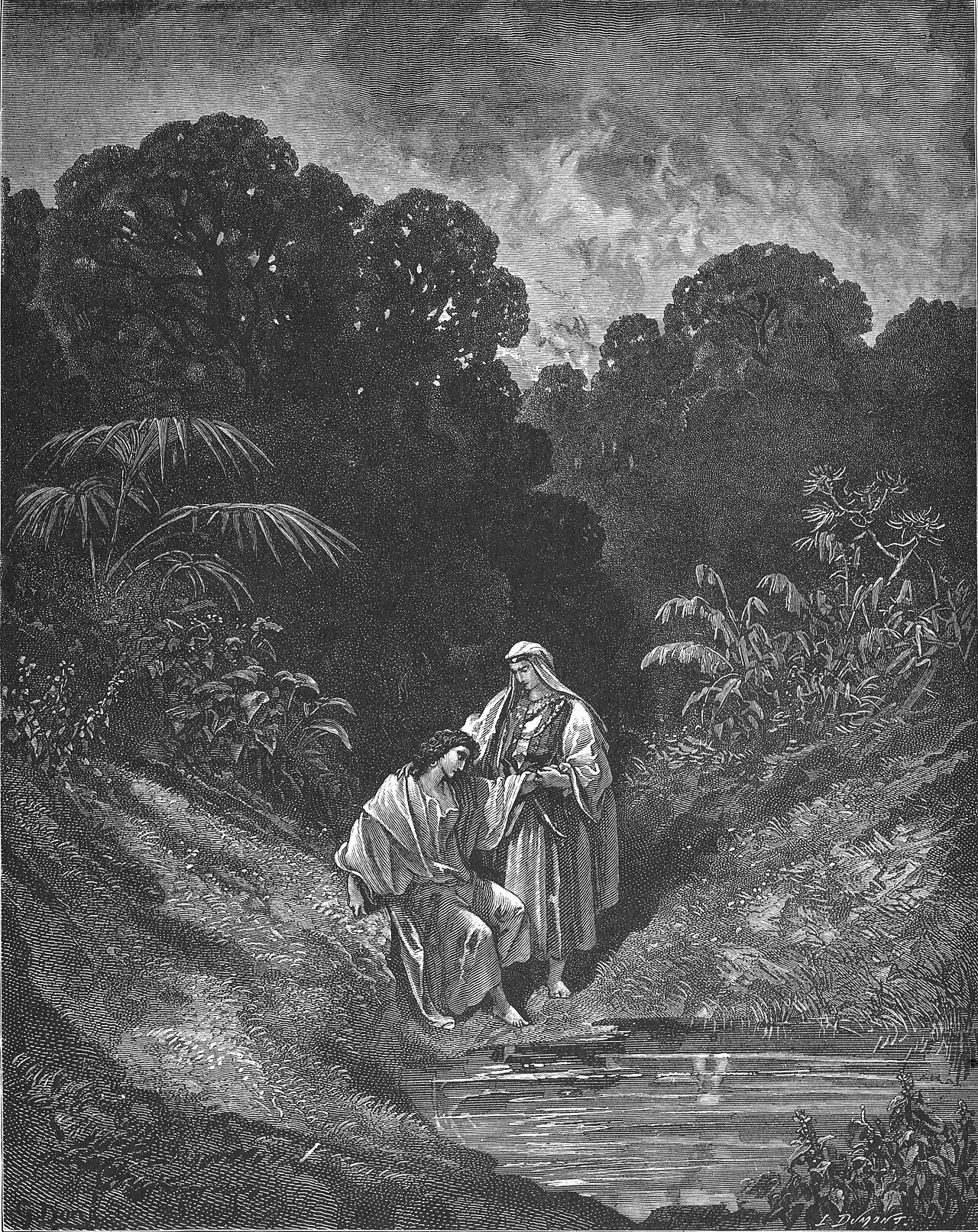
David and Jonathan, Gustave Doré, Doré's English Bible (1866), public domain
Key verse
And as long as I live, treat me with the LORD’s loving devotion, that I may not die,
It stands in scene B of the chapter, verses 12 to 23.
The chapter
Chapter summary
The friendship carries the plot. David asks what he has done; Jonathan cannot believe his father hides such a thing from him. They set a test at the new moon feast and swear a covenant that outlives them both (cut not off thy kindness from my house for ever), with arrows in the field as the signal. Saul's rage at the empty seat exposes everything: as long as the son of Jesse liveth, thy kingdom shall not be established. He casts the spear at his own heir. The friends kiss and weep, David the most, parting on the words: Jehovah be between me and thee, and between my seed and thy seed, for ever.
Context
History · Samuel, Nathan, Gad · 1 Samuel overview
Where the chapter sits
1 Samuel 20 falls in David's rise in Saul's shadow (chapters 16–31). David anointed in secret; Goliath; Jonathan's covenant; Saul's pursuit; the cave of Adullam; Nabal and Abigail; the Philistine sanctuary; Saul's death at Gilboa.
Before it: Saul's reign: promise and rejection, chapters 9–15.
The whole shape of 1 Samuel→The world behind this chapter
1 Samuel 20The history
The new moon opened each month in Israel's calendar and was marked with sacrifices and a feast. Attendance at the king's table on such a day was expected of his officers and family, and seating was fixed by rank, which is why an empty place is visible to everyone in the room and why Saul says nothing on the first day, assuming ritual uncleanness, and everything on the second.
David's cover story is a yearly family sacrifice at Bethlehem, and clan sacrifices were a real institution, the extended family gathering at its ancestral town. It is a plausible excuse precisely because it outranks a royal summons in the ordinary run of things.
The rest of the history, and what it meant to them
The covenant the two men cut is a formal one with a self-curse attached, and its most striking clause looks past both their lifetimes: do not cut off your steadfast love from my house forever. Jonathan is asking the future king to spare his descendants, which means Jonathan already knows how this ends and is arranging for it. Years later David keeps that clause by seating Jonathan's crippled son at his own table.
The arrow signal is designed for a conversation held at a distance in the open, where any watcher would see only a man practicing archery with a servant boy. The words shouted to the boy, the arrows are beyond you, are the message, and the boy who carries them never knows he is a courier.
Saul's rage at his own son is the sharpest family scene in the book. He calls Jonathan the son of a perverse, rebellious woman, tells him plainly that as long as the son of Jesse lives, neither you nor your kingdom shall be established, and throws his spear at him, the same weapon he had thrown at David. Jonathan now knows he is not safe either, and the text says he grieved for David, because his father had disgraced him.
What it meant to them
Jonathan is the heir who has understood what his father cannot accept, and he chooses the anointed man over his own succession. For first hearers under David's dynasty, that choice made Jonathan the model of covenant loyalty in the whole story.
The parting in the field, with both men weeping and David weeping the most, is the last time they meet as free men. The oath they swore in the LORD's name outlived them both.
Sources cited
- Roland de Vaux, Ancient Israel: Its Life and Institutions
- Keil and Delitzsch, Biblical Commentary on the Old Testament: The Books of Samuel
A. What have I done? A covenant renewed out in the field
1. (vv. 1-3)
a.David flees the company of prophets at Naioth in Ramah, where the previous chapter left him, and goes straight to Jonathan rather than into hiding. His three questions ask for a specific charge, and Jonathan cannot yet believe his father's oath at 19:6 has already been broken. Both men swear the same oath twice over, that there is but a step between me and death, and the chapter opens on the covenant already sworn at 18:3 about to be tested and renewed.
1 Samuel 20:1, 1 voiceWhat preachers and commentators have said about these verses, in their own words.
1 Samuel 20:1
“While Saul was under the constraining influence of the spirit of prophecy, David escaped from Naioth, and, probably by Samuel’s advice, returned to Saul’s court to commune with Jonathan. Nothing could be a better evidence of his innocence than thus putting himself in Jonathan’s power. Perhaps something passed between Samuel and Saul on the subject, since it appears from 1Sa 20:5, 1Sa 20:25, 1Sa 20:27, that Saul expected David at the feast of the new moon.”
1 Samuel 20:2, 1 voice
1 Samuel 20:2
“My father will do nothing - Jonathan thought that his father could have no evil design against David, because of the oath which he had sworn to himself 1Sa 19:6; and at any rate, that he would do nothing against David without informing him.”
Adam Clarke· Commentary on the Bible (1810-1826)evangelical
1 Samuel 20:3, 2 voices
1 Samuel 20:3
“THIS was David's description of his own condition. King Saul was seeking to destroy him. The bitter malice of that king would not be satisfied with anything short of the blood of his rival. Jonathan did not know this. He could not believe so badly of his father as that he could wish to kill the champion of Israel, the brave, true-hearted young David. And so he assured David that it could not be so—that he had not heard of any plots against him. But David, who knew better, said, "It is certainly so. Your father seeks my blood and there is but a step between me and death." Now, it was by knowing his danger that David escaped. Had he remained as ignorant of his own peril as his friend Jonathan had been, he would have walked into the lion's mouth and he would have fallen by the hand of Saul. But to be forewarned is to be forearmed—he was, therefore, able to save his life because he perceived his danger. It would have been a very unwise person who would have said, "Do not tell David about it. You see that he is very happy in Jonathan's company. Do not disturb him. It will only make him fret. Do not tell him about Saul's anger." But a true and wise friend would acquaint David of his danger, in order that he might seize the opportunity to escape. So also, tonight, somebody might say, "Many people now present are in great danger and do not dare to think about death. Do not mention the unpleasant subject to them." Well, Sirs, if my objective were to please you; if my desire were to seem as one who plays a merry tune upon a goodly instrument, I certainly would not speak to you of death and danger. But, then, it would be infamous to allow men and women to stand in infinite jeopardy and not to warn them! And it is kindness to speak to those who are carelessly at ease and tell them salutary truth.”
Charles Spurgeon· The Metropolitan Tabernacle Pulpit, Sermon No. 1870: “But a Step” (lightly modernized text, CCEL edition) (1885)Particular (Reformed) Baptist / Five-point Calvinist / 1689 LBCF / 19th-c. evangelical
1 Samuel 20:3
“And David sware moreover - Rather, “yet again.” He met Jonathan’s denial by repeating his statement and confirming it with an oath.”
2. (vv. 4-6)
a.Jonathan's blank promise becomes the shape of the test David proposes: the new moon feast, a monthly sacrifice and meal the king kept publicly, will show whether Saul still means to kill him. David's excuse, if he is missed, is a yearly family sacrifice at Bethlehem, his own city, the same town that sent him to this court as a shepherd boy in chapter 16. An absence that draws anger rather than the disappointment a family occasion would explain will answer David's question without a word spoken to Saul.
1 Samuel 20:5, 1 voice
1 Samuel 20:5
“The new moon, or beginning of each month, was celebrated with especial sacrifices and blowing of trumpets (marginal references.) The feast was kept with great solemnity as “a day of gladness,” and we may presume that the “peace offerings” offered on the occasion furnished the tables of those that offered.”
1 Samuel 20:6, 1 voice
1 Samuel 20:6
“They kept a day of thanksgiving in their family for the comforts they enjoyed, and of prayer for the continuance of them. By this it appears that the family David was of was a very religious family, a house that had a church in it.”
Matthew Henry· Commentary on the Whole Bible (1707-1721)puritan
3. (vv. 7-9)
a.David reads Saul's temper as the sign itself, calm meaning peace and wrath meaning a settled purpose to kill. He asks Jonathan to remember that he has brought his servant into a covenant of the LORD, and offers to let Jonathan be his own executioner if any real iniquity is found in him. Jonathan's answer, far be it from thee, refuses even to entertain the alternative and closes a question David never doubted the answer to.
4. (vv. 10-11)
a.David's practical question forces the two friends out of the palace and into a field belonging to Gibeah, where no servant of Saul can overhear them. The privacy the scene requires is itself evidence of how far things have fallen: a king's son and the king's own son in law can no longer plan safely inside the king's house. The move outdoors sets up both the covenant oath of verses 12 to 17 and the archery signal that follows it.
1 Samuel 20:10, 1 voice
1 Samuel 20:10
“Then said David to Jonathan, who shall tell me?.... The disposition of Saul's mind towards him, whether he gave a kind answer to the report of Jonathan concerning him: or what if thy father answer thee roughly? or hard words, as the Targum, whether he answers in a kind, loving, and smooth manner, or whether in a rough and angry one: the question is here, how he should be informed of this, since especially, if in the latter, it would not be safe for Jonathan to come himself to him, nor could he well trust the message with any other.”
1 Samuel 20:11, 1 voice
1 Samuel 20:11
“And Jonathan said unto David, come, and let us go out into the field,.... That they might more fully, and freely, and familiarly talk of this affair between them, without any danger of being overheard by the servants of Saul, as they were in his palace, where they now were: and they went out both of them into the field; which belonged to Gibeah.”
B. The sign of the arrows agreed on
1. (vv. 12-13)
a.Jonathan swears by the LORD God of Israel that he will sound his father's mind and send word either way, binding the promise with a curse on himself if he fails to keep it. His closing line, the LORD be with thee, as he hath been with my father, is spoken by Saul's own heir, and reads as a plain admission that the LORD's presence has already passed from the father's house to David. Clarke takes the remark as evidence Jonathan already knew the kingdom had been appointed to David before either man says so openly.
1 Samuel 20:12, 1 voice
1 Samuel 20:12
“Jonathan said - O Lord God of Israel - There is, most evidently, something wanting in this verse. The Septuagint has, The Lord God of Israel doth Know. The Syriac and Arabic, The Lord God of Israel is Witness. Either of these makes a good sense.”
Adam Clarke· Commentary on the Bible (1810-1826)evangelical
1 Samuel 20:13, 1 voice
1 Samuel 20:13
“The Lord be with thee, as he hath been with my father - From this, and other passages here it is evident that Jonathan knew that the Lord had appointed David to the kingdom.”
Adam Clarke· Commentary on the Bible (1810-1826)evangelical
2. (vv. 14-15)
a.Jonathan asks first for himself, that David deal with him in the kindness of the LORD while he lives, then widens the request in verse 15 to cover his whole house forever, even after the LORD has cut off every enemy of David from the earth. The same word returns once more in these two books, at 2 Samuel 9:3, where David asks whether any of Saul's house remains that he might shew him the kindness of God, and finds Mephibosheth. Jonathan is asking here for exactly what David will grant there, years before Saul's line has fallen and before David has any throne to grant it from.
1 Samuel 20:14, 2 voices
1 Samuel 20:14
“Show me the kindness of the Lord - When thou comest to the kingdom, if I am alive, thou shalt show kindness to me, and thou shalt continue that kindness to my family after me.”
Adam Clarke· Commentary on the Bible (1810-1826)evangelical
1 Samuel 20:14
“I die not - That thou do not kill me or mine, as princes of another line use to kill the nearest relations of the former line, from whom the kingdom was translated to them. A covenant - The covenant which before was personal, he now extends to the whole house of David, expecting a reciprocal enlargement of it on David's side, which doubtless he obtained.”
John Wesley· Explanatory Notes upon the Old Testament (1765)evangelical
1 Samuel 20:15, 1 voice
1 Samuel 20:15
“But also thou shalt not cut off thy kindness from my house for ever,.... His family should partake of it as well as himself: no, not when the Lord hath cut off the enemies of David, everyone from the face of the earth; Saul and his sons, and everyone that should oppose his settlement in the kingdom: Jonathan's meaning is, that the covenant between them should not be only between them personally, but include their posterity, as follows.”
3. (vv. 16-17)
a.made a covenant with the house of David: The covenant sworn person to person at 18:3 is now formalized between houses, sealed with an oath calling on the LORD to require it at the hand of either side's enemies should the pledge be broken. Verse 17 has Jonathan make David swear yet again, for the same reason already given at 18:1 and 18:3, because he loved him as he loved his own soul. The repeated swearing is not padding in the text; it marks how many separate times this one bond gets restated before the chapter ends.
1 Samuel 20:16, 1 voice
1 Samuel 20:16
“Note, True friends cannot but covet to transmit to theirs after them their mutual affections. Thy own friend, and thy father's friend, forsake not. He calls the kindness of the Lord, because it is such kindness as God shows to those he takes into covenant with himself; for he is a God to them and to their seed; they are beloved for the fathers' sakes.”
Matthew Henry· Commentary on the Whole Bible (1707-1721)puritan
4. (vv. 18-19)
a.Jonathan restates the plan David already laid out at verse 5, then adds the meeting point for verse 19, the stone Ezel, and a three day span for David to stay hidden before returning to that place. The name Ezel is otherwise unknown in Scripture, and older readers who take it to mean departure treat the naming as fitting rather than as proof of anything. The plan now has a place, a signal yet to come, and a deadline, all arranged before either man knows what Saul will actually do.
5. (vv. 20-23)
a.Three arrows and a lad sent to fetch them give Jonathan a way to warn David without a word spoken face to face, the number matching the three days David is to wait at the stone. Verse 23 closes the exchange with a second oath formula, the LORD be between thee and me for ever, sealing the covenant of verses 12 to 17 rather than opening a new one. The care Jonathan takes to build deniability into an innocent afternoon of archery shows how far Saul's court has already turned from open dealing.
1 Samuel 20:20, 2 voices
1 Samuel 20:20
“And I will send three arrows near him, etc. And I, the Church says to the Lord, with you dwelling in the hearts of the perfect, will send preachers of the holy and undivided Trinity, who, with wings of virtues, will be quick-flying, penetrating with …”
Bede· written before 735· Commentary on Samuelpatristic
1 Samuel 20:20
“I will shoot three arrows - Jonathan intended that David should stay at the stone Ezel, where probably there was some kind of cave, or hiding place; that, to prevent all suspicion, he would not go to him himself, but take his servant into the fields, and pretend to be exercising himself in archery; that he would shoot three arrows, the better to cover his design; and that, if he should say to his servant, who went to bring back the arrows, “The arrows are on this side of thee,” this should be a sign to David that he might safely return to court, no evil being designed; but if he should say, “The arrows are beyond thee,” then David should escape for his life, Saul having determined his destruction.”
Adam Clarke· Commentary on the Bible (1810-1826)evangelical
1 Samuel 20:23, 1 voice
1 Samuel 20:23
“And as touching the matter which thou and I have spoken of,.... The covenant they had made between them and their families: behold, the Lord be between me and thee for ever: as a witness of the covenant, and a revenger of those that should break it; so the Targum,"behold, the Word of the Lord be between me and thee a witness for ever.''”
C. An empty seat at the new moon feast
1. (vv. 24-26)
a.The plan from verses 18 to 23 is carried out exactly, and the feast begins with Saul in his usual seat, Jonathan across from him, Abner at the king's side, and David's place left empty. Saul says nothing the first day, assuming ceremonial uncleanness has kept David from the peace offerings, a reasonable explanation any Israelite would reach for before assuming treachery. The silence itself is telling: only four men sit at that table, so one empty seat cannot go unnoticed for long.
1 Samuel 20:25, 1 voice
1 Samuel 20:25
“The king sat upon his seat - It seems that there was one table for Saul, Jonathan, David, and Abner; Saul having the chief seat, that next to the wall. As only four sat at this table, the absence of any one would soon be noticed.”
Adam Clarke· Commentary on the Bible (1810-1826)evangelical
1 Samuel 20:26, 1 voice
1 Samuel 20:26
“He is not clean - The new moon being a religious feast, and the meat to be eaten being peace-offerings, no one could assist at the feast who had any ceremonial uncleanness upon him (marginal references).”
2. (vv. 27-29)
a.By the second day the ordinary explanation has run out, and Saul asks Jonathan directly, still calling David only the son of Jesse rather than by name. Jonathan gives the same excuse rehearsed at verse 6, a family sacrifice at Bethlehem and a brother's summons, true as far as it goes even though it is not the whole truth. Bethlehem covers for David a second time in this book, the same town that already sent him to Saul's court as an errand boy in chapter 17.
1 Samuel 20:27, 1 voice
1 Samuel 20:27
“It is a bad thing for us, except in case of necessity, to omit an opportunity of statedly attending on God in solemn ordinances. Thomas lost a sight of Christ by being once absent from a meeting of the disciples. But that which displeased Saul was that hereby he missed the opportunity he expected of doing David a mischief.”
Matthew Henry· Commentary on the Whole Bible (1707-1721)puritan
1 Samuel 20:29, 1 voice
1 Samuel 20:29
“Our family hath a sacrifice - Such sacrifices were undoubtedly festal ones; the beasts slain for the occasion were first offered to God, and their blood poured out before him; afterwards all that were bidden to the feast ate of the flesh. This was a family entertainment, at the commencement of which God was peculiarly honored.”
Adam Clarke· Commentary on the Bible (1810-1826)evangelical
3. (vv. 30-31)
a.Saul's rage finally says outright what the narrative has been showing since chapter 16, that as long as David lives Jonathan's own kingdom cannot be established. His insult against Jonathan's mother is aimed at Jonathan's loyalty rather than at any fact about her, the kind of charge a father makes when he has no other to bring. The son who gave away his robe and sword at 18:4 is now told plainly that he has thrown away a crown, and it is Saul who says so, not Jonathan.
1 Samuel 20:30, 2 voices
1 Samuel 20:30
“The principle on which it is founded seems to be, that to a genuine filial instinct it is a more inexpiable offense to hear the name or character of a parent traduced, than any personal reproach. This was, undoubtedly, one cause of "the fierce anger" in which the high-minded prince left the table without tasting a morsel.”
Jamieson, Fausset & Brown· Commentary Critical and Explanatory on the Whole Bible (1871)reformed
1 Samuel 20:30-31
“It will prove to our advantage at last, however for the present it may be thought a disparagement, and a prejudice to our secular interest. It is probable Saul knew that David was anointed to the kingdom by the same hand that anointed him, and then not Jonathan, but himself, was the fool, to think to defeat the counsels of God.”
Matthew Henry· Commentary on the Whole Bible (1707-1721)puritan
1 Samuel 20:31, 1 voice
1 Samuel 20:31
“How necessary it is to put a hook in its nose and a bridle in its jaws! Jonathan was fully satisfied that evil was determined against David, which put him out of frame exceedingly: he rose from table, thinking it high time when his life was struck at, and would eat no meat, for they were not to eat of the holy things in their mourning.”
Matthew Henry· Commentary on the Whole Bible (1707-1721)puritan
4. (vv. 32-34)
a.Jonathan's question gets no answer in words. Saul throws his javelin at his own son, the same weapon he had already thrown at David twice, at 18:11 and 19:10, so that the spear meant for one target in this book finally reaches the other. Jonathan rises from the table in grief rather than in fear for himself, and the text is careful to say he is grieved for David and for the shame his father has done him, not for the blow he himself avoided.
1 Samuel 20:34, 1 voice
1 Samuel 20:34
“Jonathan arose - in fierce anger - We should probably understand this rather of Jonathan’s grief than of his anger, the latter clause explaining the former: for he was grieved for David. He was grieved for his father - he was grieved for his friend.”
Adam Clarke· Commentary on the Bible (1810-1826)evangelical
D. The lad sent home; two friends part weeping
1. (vv. 35-38)
a.The plan reaches its appointed hour, with a boy present who knows nothing of what the arrows mean. Jonathan shoots one arrow beyond the lad, the signal agreed at verse 22, then calls after him to hurry, words the boy hears as urgency about retrieving arrows but David hears as urgency about his own life. Every word Jonathan speaks in this scene is aimed past the lad at David hiding within earshot, a second meaning running under an ordinary morning of target practice.
1 Samuel 20:38, 2 voices
1 Samuel 20:38
“And Jonathan cried after the lad, make speed, haste, stay not,.... But bring the arrows to him directly, that he might dismiss him; for, observing that no man was passing by, he was desirous of embracing the opportunity for a few minutes to have an interview with David alone before he fled: and Jonathan's lad gathered up the arrows; for though the textual reading is singular, the marginal is plural, to show, as Kimchi observes, that he cast three arrows, as he said he would, 1Sa 20:20; and came to his master; with them.”
1 Samuel 20:38
“Make speed, haste, stay not - Though these words appear to be addressed to the lad, yet they were spoken to David, indicating that his life was at stake, and only a prompt flight could save him.”
Adam Clarke· Commentary on the Bible (1810-1826)evangelical
2. (vv. 39-40)
a.The narrator states plainly that the boy is kept innocent of the whole arrangement, and Jonathan sends him back into the city carrying the bow and arrows, his part in the story ending without his ever learning what he carried out. Only two men in the whole kingdom know what the arrows meant, which is exactly how a covenant Saul would kill to break has to be kept. The lad's ignorance protects him as much as it protects the secret; he can report nothing because there is nothing in his knowledge to report.
1 Samuel 20:40, 3 voices
1 Samuel 20:40
“And Jonathan gave his artillery unto his lad,.... "His vessels" (l) or instruments; his arms, as the Targum, his quiver, bow, and arrows: and said unto him, go, carry them to the city; to Gibeah, to Jonathan's house, or to his apartments at court there. (l) את כליו "vasa sua", Montanus; "instrumenta sua", Piscator; "arma sua", V. L. Tigurine version.”
1 Samuel 20:40
“Jonathan gave his artillery - I believe this to be the only place in our language where the word artillery is not applied to cannon or ordnance. The original (כלי keley) signifies simply instruments, and here means the bow, quiver, and arrows.”
Adam Clarke· Commentary on the Bible (1810-1826)evangelical
1 Samuel 20:40
“Jonathan gave his artillery unto his lad--that is, his missive weapons. The French word artillerie, signifies "archery." The term is still used in England, in the designation of the "artillery company of London," the association of archers, though they have long disused bows and arrows.”
Jamieson, Fausset & Brown· Commentary Critical and Explanatory on the Whole Bible (1871)reformed
3. (vv. 41-42)
a.David comes out of hiding to bow three times before Jonathan, the subject bowing to the king's son even though both men now know the throne is passing the other way. Their weeping is mutual, but the text notes David's grief runs further, since Jonathan returns to a father's house and a place at court while David walks away from every comfort he has known. The parting oath in verse 42 restates the covenant a final time, the LORD be between me and thee, and between my seed and thy seed for ever, the vocabulary of kindness from verses 14 and 15 now sworn over children neither man yet has.
1 Samuel 20:41, 2 voices
1 Samuel 20:41
“A place toward the south - An unintelligible description; one expects a repetition of the description of David’s hiding-place in 1Sa 20:19. The Septuagint in both places has “argab,” a word meaning a “heap of stones.” If this be the true reading, David’s hiding-place was either a natural cavernous rock which was called “Argab,” or some ruin of an ancient building, equally suited for a hiding-place.”
1 Samuel 20:41
“The separation of two such faithful friends was equally grievous to them both, but David's case was the more deplorable; for, when Jonathan was returning to his family and friends, David was leaving all his comforts, even those of God's sanctuary, and therefore his grief exceeded Jonathan's, or perhaps it was because his temper was more tender and his passions were stronger.”
Matthew Henry· Commentary on the Whole Bible (1707-1721)puritan
1 Samuel 20:42, 1 voice
1 Samuel 20:42
“Jonathan went into the city - From which one may infer, what the after history also indicates, that Jonathan’s filial duty and patriotism prevented a complete rupture with his father. Jonathan’s conduct in this, as in everything, was most admirable.”
The text of this chapter
This page carries no textual note on 1 Samuel 20. Where this site has examined a place the manuscripts differ, the examination is in the manuscripts room. Every place this site examines →
This page draws on 9 works. Open for the list.
This page draws on Adam Clarke; Albert Barnes; Bede, Commentary on Samuel; Charles Spurgeon, The Metropolitan Tabernacle Pulpit, Sermon No. 1870: “But a Step” (lightly modernized text, CCEL edition) (1885); Jamieson, Fausset & Brown; John Gill; John Wesley, Explanatory Notes upon the Old Testament (1765); Keil and Delitzsch, Biblical Commentary on the Books of Samuel and Matthew Henry.
Keep studying
On this page