
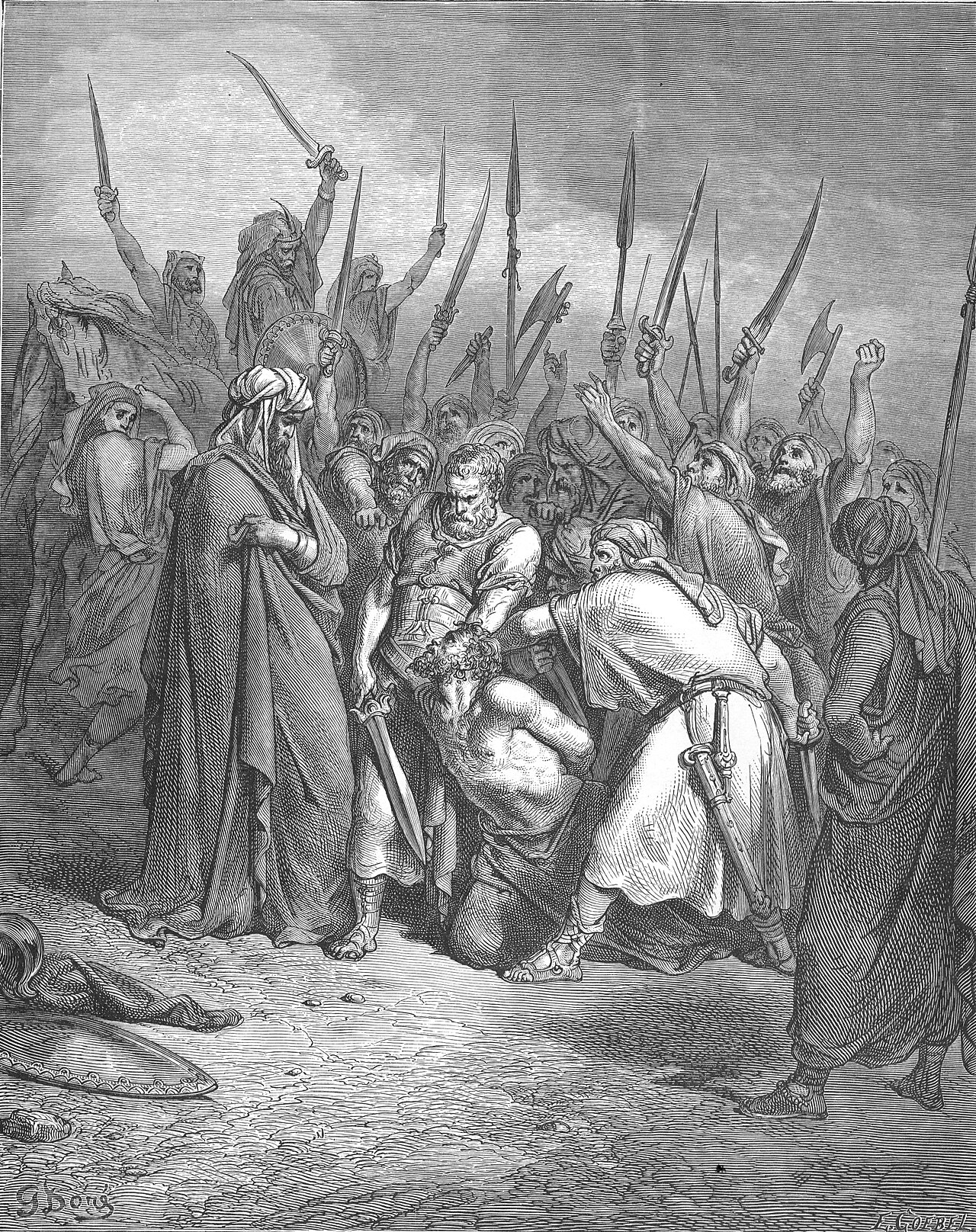
1 Samuelchapter 15
35 verses · Samuel, Nathan and Gad, by tradition · 10th century BC · History
But Saul and the people spared Agag, and the best of the sheep, and of the oxen, and of the fatlings, and the lambs, and all that was good, and would not utterly destroy them: but every thing that was vile and refuse, that they destroyed utterly.
Introduction
Samuel, Nathan and Gad, by tradition, History, 1 Samuel Overview.
This chapter closes the part of the book given to Saul's own reign. It was written for readers who knew the old sentence on Amalek from the days of the exodus. A prophet gives the king one clear command and then comes to see how it was kept. Listen for the religious language Saul uses and what it covers. Listen for Samuel's reply, which Israel quoted for centuries after. The chapter asks what the LORD wants from those who worship Him.
Context
- Who
- Israelites who remembered why Amalek was under sentence in the first place
- What
- An account of the war against Amalek, Saul's partial obedience, and the LORD's rejection of him as king.
- Where
- The Amalekite country in the Negev south of Judah, then Carmel of Judah and Gilgal.
- When
- About 1030 BC on the traditional reckoning.
- Why
- To show that obedience is better than sacrifice, and that the LORD judges the heart behind worship.
Historical context
Samuel comes to Saul here first with a commission and then with a sentence, and he is the prophet who anointed him. Saul is at the height of his military reach, mustering an army large enough to sweep a country.
Show the rest of the historical context, 3 more paragraphs
The time is about 1030 BC. The places are the Amalekite country in the Negev on the southern fringe of Judah, Carmel of Judah where Saul stops on the way back, and Gilgal. The occasion is a standing sentence carried out.
Amalek was a desert people of the Negev and the Sinai fringe, who attacked the exodus generation from behind, striking the stragglers and the exhausted. The LORD swore then to blot out their memory, so what happens here is a sentence carried out four centuries late. The command is the ban, the Hebrew word herem, under which nothing was taken as personal profit, and the same idea appears on the Moabite Mesha Stele.
Kings in that world routinely set up victory stelae carrying their own names, which is what Saul does at Carmel with a win that was not his to keep. The hem and corner of a garment carried a man's identity and authority, and Mesopotamian legal documents were sometimes sealed with the impression of a robe's hem.
Significance
Saul's defence is that the animals were kept to sacrifice to the LORD your God, which is religious language laid over a disobedient choice. Samuel's reply became one of the most quoted lines in Israel's memory, that obedience is better than sacrifice and attentiveness better than the fat of rams.
Show the rest of the significance, 1 more paragraph
For first hearers the last detail was the saddest. Saul confesses, and then asks Samuel to honour him before the elders and the people anyway. He fears losing face more than losing God, and Samuel never comes to see him again.
This chapter in Jewish lifeWhat this chapter is in Jewish life and reading.
How it is read
Rashi is the only commentator the corpus carries with text on this chapter, in the Metsudah Tanach series, Lakewood, N.J., under CC-BY. The command against Amalek is the hardest place in this book for a card, and the two traditions read it differently. This site carries the question with the holders of each position, in src/components/book/dossier-content/1-samuel.ts, and argues it in full at /featured/the-canaanite-conquest. This card states no verdict, and reports what the Jewish commentators make of the chapter. How this site reads rabbinic material as a Christian reader is set out at /featured/reading-rabbinic-sources-as-a-christian. On Samuel's opening charge Rashi says Saul had acted foolishly before, and is now warned to be careful (Rashi on I Samuel 15:1:1). On the oxen and sheep he gives a reason for their destruction that a reader will not expect. They were sorcerers, he says, "and they would change themselves to appear as animals" (Rashi on I Samuel 15:3:1). He records Radak's different reason beside it, that nothing was to remain of which one might say it had belonged to Amalek (same ref). On the summoning of the people he glosses the verb as announcing (Rashi on I Samuel 15:4:1). On the fighting in the valley he hands on an argument the Rabbis put in Saul's mouth (Rashi on I Samuel 15:5:1). If the Torah orders a calf killed in a valley for the sake of one life, Saul reasoned, how much more for all these lives (same ref). Rashi adds the question that follows from it, that if man has sinned, what have the animals sinned (same ref). On the Kenites he identifies them as the descendants of Jethro, living in the wilderness of Judah (Rashi on I Samuel 15:6:1). They had gone to Jabez to learn Torah, and Arad, where they lived, is Amalek (same ref). On the fattened cattle he says the word has no likeness in Scripture, and takes it from the word for double (Rashi on I Samuel 15:9:1). They are doubled over with flesh and fat, he says (same ref). On the LORD's word that He had reconsidered he gives it as a thought risen concerning the kingship (Rashi on I Samuel 15:11:1). On the place Saul set up for himself he reads it as an altar, and gives the Targum's reading, room to divide the spoil (Rashi on I Samuel 15:12:1). On the head of the tribes he gives the Targum, that Benjamin crossed the sea ahead of all the people (Rashi on I Samuel 15:17:1). On the rushing he reads the verb from the word for a bird of prey (Rashi on I Samuel 15:19:1). On the best of what was to be destroyed he takes the word as the first and best part, and gives the Targum beside it (Rashi on I Samuel 15:21:1). On the verse that sets obedience above sacrifice he states that the LORD prefers a command kept to a voluntary offering (Rashi on I Samuel 15:22:1). On defiance and stubbornness he says the penalty for stubbornness is the penalty for idolatry (Rashi on I Samuel 15:23:1). He gives the Targum beside it, which makes it the sin of any person "who adds [to the words of a prophet]" (same ref). On Saul's plea that he feared the people he names one man, Doeg the Edomite, "who was as important as all of them" (Rashi on I Samuel 15:24:1). He points to Maseches Sanhedrin 106b for it (same ref). Radak and Metzudat David comment at eight verses, and the corpus holds no English version of either, so they stand as citations. They are Radak on I Samuel 15:2:1, 15:7:1, 15:15:1 and 15:20:1, and Metzudat David on I Samuel 15:13:1, 15:14:1, 15:25:1 and 15:26:1.
What the rabbis say
The corpus records forty rabbinic locators on this chapter, thirty-four of them Midrash and six Talmud, each a locator without text. Samuel's opening charge draws Bereshit Rabbah 45:2 and Yalkut Shimoni on Torah 79:1. The word about Amalek draws Bereshit Rabbah 53:5, Megillah 30a:24 and Midrash Lekach Tov on Esther, Introduction 2. The command about the oxen and sheep draws Ein Yaakov (Glick Edition), Yoma 2:2 and Esther Rabbah, Petichta 7. The summoning of the people draws Bamidbar Rabbah 2:11 and Ein Yaakov (Glick Edition), Yoma 2:1. The fighting in the valley draws Ein Yaakov (Glick Edition), Shabbat 5:8 and Ein Yaakov, Shabbat 5:13. The Kenites draw Berakhot 63b:21 and Ein Yaakov (Glick Edition), Berakhot 9:20. The fattened cattle spared draw Bamidbar Rabbah 1:12 and Bereshit Rabbati, Parashat Vayechi 32. The word that the LORD had reconsidered draws Bamidbar Rabbah 3:2 and Ein Yaakov (Glick Edition), Taanit 1:14. The place Saul set up for himself draws Mekhilta DeRabbi Shimon Ben Yochai 14:22 and Mekhilta DeRabbi Yishmael, Tractate Pischa 11:16. At verse 14 the corpus records Midrash Tehillim 100:1 and Sifrei Aggadah on Esther, Midrash Abba Guryon 5:1, and at verse 15, Avodah Zarah 24b:2 and Jerusalem Talmud Avodah Zarah 2:1:4. The rushing on the spoil draws Pirkei DeRabbi Eliezer 44:10, and at verse 20 the corpus records Midrash Tanchuma, Ha'Azinu 7:1. The best of what was to be destroyed draws Ein Yaakov (Glick Edition), Yevamot 8:3. Obedience set above the offering draws Avot DeRabbi Natan, Recension B 8:1 and Pesikta Rabbati 44:1. Defiance and stubbornness draw Eikhah Rabbah, Petichta 23 and Midrash Aggadah, Numbers 13:4:1. At verse 27 the corpus records Ruth Rabbah (Lerner) 7:12:3 and Ruth Rabbah 7:12, and at verse 28, Esther Rabbah 4:9 and Kohelet Rabbah 3:8:2. At verse 29 it records Aggadat Bereshit 28:4 and Midrash Lekach Tov, Genesis 6:6:1, and at verse 32, Bereshit Rabbati, Parashat Vayechi 17 and Eikhah Rabbah 3:22. The last two stand at verse 33, Esther Rabbah 7:13 and Introductions to Tanaitic Literature, Introductions to Tractates of the Mishnah, Nazir 8. The rabbis teach in these places, and this site reports them as their teaching rather than as a rule of the text.
Sources: Rashi, Rashi on I Samuel 15:1:1, 15:3:1, 15:4:1, 15:5:1, 15:6:1, 15:9:1, 15:11:1, 15:12:1, 15:16:1, 15:17:1, 15:18:1, 15:19:1, 15:21:1, 15:22:1, 15:23:1 and 15:24:1, the Metsudah Tanach series, Lakewood, N.J., CC-BY; Radak, Radak on I Samuel 15:2:1, 15:7:1, 15:15:1 and 15:20:1, cited only, no English version in the corpus; Metzudat David, Metzudat David on I Samuel 15:13:1, 15:14:1, 15:25:1 and 15:26:1, cited only; MannaFest, the 1 Samuel dossier, src/components/book/dossier-content/1-samuel.ts, for the contested point on the command against Amalek, 2026.
The heads below are this chapter's scenes. The numbered points under each are its verses.
Amalek devoted: and Agag kept alive
1 Samuel 15:1-3
Samuel reminds Saul that his crown came by anointing, so obedience is the condition of the office. The command reaches back to Exodus 17:14 to 16, where the LORD swore war with Amalek for the ambush on the way from Egypt, and to Deuteronomy 25:17 to 19. The words "devote to destruction" render the Hebrew herem, a ban that spares nothing, and set the standard for every later verse.
1 Samuel 15:1
“Their territory extended over the whole of the eastern portion of the desert of Sinai to Rephidim--the earliest opponent (De 25:18; Ex 17:8-16) --the hereditary and restless enemy of Israel (Nu 14:45; 6:3), and who had not repented (1Sa 14:48) of their bitter and sleepless hatred during the five hundred years that had elapsed since their doom was pronounced.”
Jamieson, Fausset & Brown · Commentary Critical and Explanatory on the Whole Bible (1871)reformed
John Gill dates the ambush four hundred years before this command. The LORD of Hosts had witnessed it and kept it in memory all that time. Adam Clarke places the Amalekites between Egypt and Canaan, and at Exodus 17:8 they struck the rear of the Israelites, where the faint and weary walked.
1 Samuel 15:2
“Thus saith the Lord of hosts,.... Of the celestial host of angels, and of the army of Israel, yea, of all the armies of the earth: this is premised to engage the attention of Saul: I remember that which Amalek did to Israel; four hundred years ago: how he laid wait for him in the way when he came up from Egypt; in the valley of Rephidim, just before they came to Mount Sinai, and fell upon the rear of them, and smote the feeble, and faint, and weary, see Exo 17:8.”
2 more voices on this verse
1 Samuel 15:2
“I remember that which Amalek did - The Amalekites were a people of Arabia Petraea, who had occupied a tract of country on the frontiers of Egypt and Palestine. They had acted with great cruelty towards the Israelites on their coming out of Egypt. (See Exo 17:8 (note), and the notes there). They came upon them when they were faint and weary, and smote the hindermost of the people - those who were too weak to keep up with the rest. (See Deu 25:18).”
Adam Clarke · Commentary on the Bible (1810-1826)evangelical
1 Samuel 15:2
“SAUL had been commanded to utterly slay all the Amalekites and their cattle. Instead of doing so he preserved the king and suffered his people to take the best of the oxen and of the sheep. When called to account for this he declared that he did it with a view of offering sacrifice to God—but Samuel met him at once with the assurance that such sacrifices were no excuse for an act of direct rebellion.”
Albert Barnes reads the ban by Leviticus 27:28. Every living thing under it died, and no share of the spoil went to the soldiers, which left Saul's army nothing to keep at verse 9. John Wesley answers the hardest clause, the children and infants, by naming God the Lord of every life, who may call it back when He wills.
1 Samuel 15:3
“Utterly destroy - Rather, “devote to destruction” (Lev 27:28 note). When a city or people were thus made cherem, everything living was to be destroyed, and no part of the spoil fall to the conquerors (compare 1Sa 15:21). The valuables were put into the sacred treasury.”
1 more voice on this verse
1 Samuel 15:3
“The longer judgment is delayed many times the more severe it is when it comes. God chooses out instruments to do his work that are fittest for it. This was bloody work, and therefore Saul who was a rough and severe man must do it.”
Matthew Henry · Commentary on the Whole Bible (1707-1721)puritan
1 Samuel 15:4-6
Saul musters 200,000 foot soldiers and 10,000 men of Judah at Telaim, then warns the Kenites away before the attack. They are spared because "you showed kindness to all the Israelites when they came up out of Egypt," the kindness clause used of Rahab and later of Ruth. Saul can distinguish when mercy is the question, and his failure is to distinguish where the command left no room.
1 Samuel 15:4
“Two hundred thousand - and ten thousand - The Septuagint, in the London Polyglot, have Four Hundred thousand companies of Israel, and Thirty thousand companies of Judah. The Codex Alexandrinus has Ten thousand of each. The Complutensian Polyglot has Two Hundred thousand companies of Israel, and Ten thousand of Judah. And Josephus has Four Hundred thousand of Israel, and Thirty thousand of Judah. All the other versions are the same with the Hebrew text; and there is no difference in the MSS.”
Adam Clarke · Commentary on the Bible (1810-1826)evangelical
1 more voice on this verse
1 Samuel 15:4
“Saul gathered the people together--The alacrity with which he entered on the necessary preparations for the expedition gave a fair, but delusive promise of faithfulness in its execution.”
Jamieson, Fausset & Brown · Commentary Critical and Explanatory on the Whole Bible (1871)reformed
Adam Clarke reads the phrase as the city Amalek, the tribe's capital called by the tribe's own name. Verse 2 charged Amalek with an ambush on the road from Egypt. Saul now answers it with an ambush of his own.
1 Samuel 15:5
“Saul came to a city of Amalek - I believe the original should be translated, and Saul came to the city Amalek; their capital being called by the name of their tribe.”
Adam Clarke · Commentary on the Bible (1810-1826)evangelical
Adam Clarke traces the kindness shown when Israel came up out of Egypt to Jethro, the Kenite father-in-law of Moses, and to Hobab, who guided Israel through the wilderness. By Judges 1:16 they held land near Arad. Jamieson, Fausset and Brown note that the Kenites had come to live among the Amalekites while holding no share in Amalek's guilt.
1 Samuel 15:6
“Said unto the Kenites - The Kenites were an ancient people. Jethro, the father-in-law of Moses, was a Kenite. Hobab his son (if the same person be not meant) was guide to the Hebrews through the wilderness. They had a portion of the promised land, near to the city Arad. See Jdg 1:16; and for more particulars concerning them and the Amalekites, see the notes on Num 26:20-21 (note).”
Adam Clarke · Commentary on the Bible (1810-1826)evangelical
2 more voices on this verse
1 Samuel 15:6
“When destroying judgments are abroad God will take care to separate between the precious and the vile, and to hide the meek of the earth in the day of his anger. It is dangerous being found in the company of God's enemies, and it is our duty and interest to come out from among them, lest we share in their sins and plagues, Rev. xviii.”
Matthew Henry · Commentary on the Whole Bible (1707-1721)puritan
1 Samuel 15:6
“Though now intermingled with the Amalekites, they were not implicated in the offenses of that wicked race; but for the sake of their ancestors, between whom and those of Israel there had been a league of amity, a timely warning was afforded them to remove from the scene of danger.”
Jamieson, Fausset & Brown · Commentary Critical and Explanatory on the Whole Bible (1871)reformed
1 Samuel 15:7-9
Saul carries the campaign from Havilah to Shur and takes Agag alive. Verse 9 states the failure plainly, since Saul and the troops spared Agag and "the best of the sheep and cattle" and destroyed only what was worthless. Barnes reads the sparing of Agag as a king’s calculation, a captive kept to be paraded, and the text gives no motive beyond an appetite for what was good.
1 Samuel 15:7
“The district here described would stretch from Havilah on the extreme east to Shur, either near Suez, or further north on the coast road from Gaza to Egypt.”
1 more voice on this verse
1 Samuel 15:7
“To Shur - That is, from one end of their country to the other; he smote all that he met with: but a great number of them fled away upon the noise of his coming, and secured themselves in other places, 'till the storm was over. Now they paid dear for the sin of their ancestors. They were themselves guilty of idolatry and numberless sins, for which they deserved to be cut off.”
John Wesley · Explanatory Notes upon the Old Testament (1765)evangelical
John Gill and Jamieson, Fausset and Brown take Agag as the standing title of Amalek's kings, as Pharaoh was the title in Egypt. Balaam had already named an Agag at Numbers 24:7, where Israel's king is set above him. Of all Amalek, Saul spared the king.
1 Samuel 15:8
“They were idolaters, and were guilty of many other sins, for which they deserved to fall under the wrath of God; yet, when God would reckon with them, he fastened upon the sin of their ancestors in abusing his Israel as the ground of his quarrel. Lord, How unsearchable are thy judgments, yet how incontestable is thy righteousness!”
Matthew Henry · Commentary on the Whole Bible (1707-1721)puritan
Albert Barnes reads the Hebrew behind the fat calves as the second best, sheep and cattle in their prime. He judges the reading probably corrupt, and dainty portions may be the first wording. Either way Saul and his troops spared the best by choice.
1 Samuel 15:9
“The fatlings - The present Hebrew text cannot be so rendered. It can only mean “the second best” (compare the margin), i. e., sheep of the age to cut or shed the two teeth, sheep in their prime. But it is probable that the reading is corrupt, and that “fat or dainty bits” is the true reading.”
What means this bleating? To obey is better than sacrifice
1 Samuel 15:10-11
The LORD’s word to Samuel opens the chapter’s first statement of divine regret, "I regret that I have made Saul king," and Samuel cries out to the LORD all night. He is a prophet who does not carry the sentence lightly. Most of the older commentators read the regret as a real change in the LORD’s dealings answering Saul’s change, not in His purpose, as verse 29 states.
1 Samuel 15:10
“Then came the word of the Lord unto Samuel,.... The word of prophecy, as the Targum; this came to him in a dream or vision, or by an articulate voice: saying; as follows.”
Albert Barnes reads Samuel's distress as anger, the word used of Jonah at Jonah 4:1, a prophet displeased that his own anointed king was set aside. John Wesley notes that turned away means Saul had once followed. Tertullian defended this verse against Marcion, who took God's regret for fickleness.
1 Samuel 15:11
“It grieved Samuel - “Samuel was angry, or displeased,” as Jonah was Jon 4:1, and for a similar reason. Samuel was displeased that the king whom he had anointed should be set aside. It seemed a slur on his prophetic office. He cried unto the Lord - With the wild scream or shriek of supplication. (See 1Sa 7:8-9; 1Sa 12:18.) The phrase and the action mark Samuel’s fervent, earnest character.”
2 more voices on this verse
1 Samuel 15:11
“Repenteth - Repentance implies grief of heart, and change of counsels, and therefore cannot be in God: but it is ascribed to God when God alters his method of dealing, and treats a person as if be did indeed repent of the kindness he had shewed him. All night - To implore his pardoning mercy for Saul, and for the people. Is turned back - Therefore he did once follow God.”
John Wesley · Explanatory Notes upon the Old Testament (1765)evangelical
1 Samuel 15:11
“Furthermore, with respect to the repentance which occurs in his conduct you interpret it with similar perverseness just as if it were with fickleness and improvidence that he repented, or on the recollection of some wrongdoing; because he actually said, "I repent that I have set up Saul to be king," very much as if he meant that his repentance savored of an acknowledgment of some evil work or error. Well, this is not always implied.”
Tertullian · written before 220 · AGAINST MARCION 2.24patristic
1 Samuel 15:12-13
Samuel learns that Saul has gone to Carmel and "set up a monument for himself" before coming down to Gilgal. Saul greets him with two claims, a blessing and "I have carried out the LORD’s instructions," and the next verse lets neither stand. Gill treats the monument as the tell, since a man does not raise a memorial for a campaign he believes unfinished.
1 Samuel 15:12
“Saul came to Carmel--in the south of Judah (Jos 15:55; 1Sa 25:2). he set him up a place--that is, a pillar (2Sa 18:18); literally, a hand, indicating that whatever was the form of the monument, it was surmounted, according to the ancient fashion, by the figure of a hand, the symbol of power and energy.”
Jamieson, Fausset & Brown · Commentary Critical and Explanatory on the Whole Bible (1871)reformed
1 more voice on this verse
1 Samuel 15:12
“He set him up a place - Literally, a hand, יד yad. Some say it was a monument; others, a triumphal arch: probably it was no more than a hand, pointing out the place where Saul had gained the victory. Absalom’s pillar is called the hand of Absalom, 2Sa 18:18.”
Adam Clarke · Commentary on the Bible (1810-1826)evangelical
Saul meets Samuel with a blessing and says he has carried out the LORD's instructions. Jamieson, Fausset and Brown weigh two readings of the words, self-deceit or bold hypocrisy, and Albert Barnes takes the second. He says Saul now adds falsehood to his self-will.
1 Samuel 15:13
“Saul said unto him, Blessed be thou of the Lord: I have performed the commandment of the Lord--Saul was either blinded by a partial and delusive self-love, or he was, in his declaration to Samuel, acting the part of a bold and artful hypocrite. He professed to have fulfilled the divine command, and that the blame of any defects in the execution lay with the people.”
Jamieson, Fausset & Brown · Commentary Critical and Explanatory on the Whole Bible (1871)reformed
2 more voices on this verse
1 Samuel 15:13
“They - That is, the people. Thus, he lays the blame upon the people; whereas they could not do it without his consent; and he should have used his power to over-rule them.”
John Wesley · Explanatory Notes upon the Old Testament (1765)evangelical
1 Samuel 15:13
“Gilgal being within 15 miles of Ramah, Samuel might easily have come from Ramah that morning. Self-will and rashness had hitherto been Saul’s chief faults. He now seems to add falsehood and hypocrisy.”
1 Samuel 15:14-15
Samuel answers Saul’s claim with what his ears hear, "this bleating of sheep and lowing of cattle," animals that should not exist if verse 3 had been kept. Saul shifts the blame to the troops and dresses disobedience as piety, a sacrifice "to the LORD your God" at Gilgal. Henry reads "your God," rather than my God, as a slip showing Saul’s distance from the God he claims to honor.
Saul's pronouns divide the work. The best was kept by the troops, while Saul counts himself in only for the destruction of the rest. Albert Barnes calls it a mean attempt to move the weight of the order from the king's own shoulders to the people's.
1 Samuel 15:15
“There is something thoroughly mean in his attempt to shift the responsibility of what was done from his own kingly shoulders to those of the people. Every word uttered by Saul seems to indicate the breaking down of his moral character.”
1 Samuel 15:16-19
Samuel's rebuke returns Saul to the beginning, "Although you were once small in your own eyes," the smallness Saul claimed at his anointing. The command is restated in full, "devote to destruction the sinful Amalekites," closing off any reading that the order was partial. Verse 19 names the offense without softening it, since Saul rushed "upon the plunder" and did "evil in the sight of the LORD."
1 Samuel 15:16
“Samuel now acquiesces in the wisdom and justice of the sentence which 1Sa 15:11 he had so strenuously resisted at first. What before was known only to the Searcher of hearts, had now been displayed to Samuel by Saul himself.”
Gregory the Great read the verse as the pattern of power working on a humble man. Saul was preferred for his humility and rejected for his pride. Once propped up by rule, Gregory says, he no longer saw himself small.
1 Samuel 15:17
“Thus Saul, after merit of humility, became swollen with pride, when in the height of power: for his humility he was preferred, for his pride rejected; as the Lord attests, Who says, "When thou wast little in thine own sight, did I not make thee the head of the tribes of Israel?" He had before seen himself little in his own eyes, but, when propped up by temporal power, he no longer saw himself little. For, preferring himself in comparison with others because he had more power than all, he esteemed himself great above all.”
Gregory the Dialogist · written before 604 · The Book of Pastoral Rule, Part 2, Chapter 6patristic
Samuel restates the commission as a mission with an end point, to fight until Amalek was wiped out. Matthew Henry calls it honourable work. Had Saul set aside his own profit and destroyed all that was Amalek's, Henry says, he would have lost nothing by it at the last.
1 Samuel 15:18
“The work was honourable, to destroy the sworn enemies of God and Israel; and had he denied himself, and set aside the consideration of his own profit so far as to have destroyed all that belonged to Amalek, he would have been no loser by it at last, nor have gone this warfare on his own charges.”
Matthew Henry · Commentary on the Whole Bible (1707-1721)puritan
Samuel's two questions press the one point of the charge, the plunder taken against the word of the LORD, and leave the victory from Havilah to Shur aside. Athanasius drew the rule of a fair trial from it. A defence on one count, he wrote, wins no acquittal on another.
1 Samuel 15:19
“And when Saul was charged with negligence and a breach of the law, he did not benefit his cause by alleging his conduct on other matters. For a defence on one count will not operate to obtain an acquittal on another count; but if all things should be done according to law and justice, a man must defend himself in those particulars wherein he is accused, and must either disprove the past, or else confess it with the promise that he will desist, and do so no more.”
Athanasius of Alexandria · written before 373 · LETTER TO THE BISHOPS OF EGYPT 1.11patristic
1 Samuel 15:20-21
Saul answers with a flat claim, "But I did obey the LORD," while the sheep and the captured king stand as evidence against him. Verse 21 hands the excuse back to the troops, framing the kept plunder as sacrifice for Gilgal. The narrator's own phrase for it, "the best of the things devoted to destruction," judges the excuse before Samuel answers.
Albert Barnes hears a rebuke of Samuel in the words your God. Saul casts the spared herds as an offering to the prophet's own God, so that the man blaming him stands as the one blocking worship. Samuel answers that claim in verse 22.
1 Samuel 15:21
“The Lord thy God - There is an implied censure of Samuel in this phrase. Saul says that Samuel blames him for what was done in honor of Samuel’s God; as if be had more zeal for the glory of God than was felt by Samuel.”
1 Samuel 15:22-23
Samuel’s answer is one of Scripture’s clearest statements on ritual and obedience, that "obedience is better than sacrifice, and attentiveness is better than the fat of rams" on the altar. Verse 23 sets rebellion "like the sin of divination," reaching forward to Saul’s visit to the medium at Endor in chapter 28. The verse closes with the sentence the chapter carries out, that the LORD "has rejected you as king."
1 Samuel 15:22
“Samuel, that great man, no less clearly reproved Saul, saying, "Is not the word better than a gift?" For hereby one fulfills the law and pleases God, as he says, "The sacrifice of praise shall glorify me." Let one "learn what this means, I will have mercy, and not sacrifice," and I will not condemn the adversaries.”
Athanasius of Alexandria · written before 373 · Letter 19.5patristic
2 more voices on this verse
1 Samuel 15:22
“Sacrifice - Because obedience to God is a moral duty, constantly and indispensably necessary; but sacrifice is but a ceremonial institution, sometimes unnecessary, as it was in the wilderness: and sometimes sinful, when it is offered by a polluted hand, or in an irregular manner. Therefore thy gross disobedience to God's express command, is not to be compensated with sacrifice.”
John Wesley · Explanatory Notes upon the Old Testament (1765)evangelical
1 Samuel 15:22
“Obedience is enjoyed by the eternal law of nature, but sacrifice only by a positive law. Obedience was the law of innocency, but sacrifice supposes sin come into the world, and is but a feeble attempt to take that away which obedience would have prevented. God is more glorified and self more denied by obedience than by sacrifice.”
Matthew Henry · Commentary on the Whole Bible (1707-1721)puritan
Gregory the Great asked why resistance is set beside divination and idolatry, and answered that the man who refuses a command judges he knows the divine will better. John Wesley reads He has rejected you as a sentence pronounced. Saul keeps the throne for years, and David still owns him as king.
1 Samuel 15:23
“Stubbornness - Contumacy in sin, justifying it, and pleading for it. Iniquity - Or, the iniquity of idolatry. Rejected - Hath pronounced the sentence of rejection: for that he was not actually deposed by God before, plainly appears, because not only the people, but even David, after this, owned him as king.”
John Wesley · Explanatory Notes upon the Old Testament (1765)evangelical
1 more voice on this verse
1 Samuel 15:23
“He probably did 99 percent of what he was told to do. Yet God called his nearly complete obedience—rebellion (1 Sam. 15:23)!”
The torn skirt, and Agag hewn in pieces at Gilgal
1 Samuel 15:24-25
because I feared the people, and obeyed their voice: Saul's confession names the sin, "I have sinned," and its cause in the same breath, "because I feared the people and obeyed their voice," a king ruled by his subjects. His request in verse 25 asks Samuel to return with him to worship, seeking restored standing before showing any change. Wesley and Gill read the confession as sincere in naming the act but shallow in what it asks.
1 Samuel 15:24
“David, though convinced by the ministry of Nathan, yet, in his confession, has his eye to God alone, not to Nathan. 4 Against thee only have I sinned. But Saul, ignorantly enough, confesses his sin as a transgression of Samuel's word; whereas his word was no other than a declaration of the commandment of the Lord.”
Matthew Henry · Commentary on the Whole Bible (1707-1721)puritan
2 more voices on this verse
1 Samuel 15:24
“I have sinned - because I feared the people - This was the best excuse he could make for himself; but had he feared God more, he need have feared the People less.”
Adam Clarke · Commentary on the Bible (1810-1826)evangelical
1 Samuel 15:24
“I have sinned - It does by no means appear, that Saul acts the hypocrite herein, in assigning a false cause of his disobedience. Rather, he nakedly declares the thing as it was.”
John Wesley · Explanatory Notes upon the Old Testament (1765)evangelical
Adam Clarke gives the Hebrew of forgive as bear, to lift a sin and carry it away. Saul asks this of a man. Clarke hears a plea for Samuel to stand as intercessor with God and to come back with him to worship.
1 Samuel 15:25
“Pardon my sin - Literally, bear my sin; take it away; forgive what I have done against thee, and be my intercessor with God, that he may forgive my offense against him; turn again with me, that I may worship the Lord.”
Adam Clarke · Commentary on the Bible (1810-1826)evangelical
1 more voice on this verse
1 Samuel 15:25
“Pardon my sin - Neither can it be proved that there was any hypocrisy in this. Rather charity requires us to believe, that he sincerely desired pardon, both from God and man, as he now knew, he had sinned against both.”
John Wesley · Explanatory Notes upon the Old Testament (1765)evangelical
1 Samuel 15:26-28
Samuel refuses outright, "I will not return with you," and repeats the sentence of rejection. When Saul grabs the hem of his robe and it tears, Samuel reads the tear as a sign that "The LORD has torn the kingdom of Israel from you today" and given it to another. The "neighbor who is better than you" goes unnamed here, and chapter 16 supplies the name, David.
1 Samuel 15:26
“And Samuel said unto Saul, I will not return with thee,.... Not being satisfied with his repentance and confession, he still extenuating his sin, and laying the blame of it on the people.”
1 more voice on this verse
1 Samuel 15:26
“This may relieve many perplexed consciences, who think themselves obliged to do what they have said they would do, though they see just cause to change their minds. Hath rejected thee, &c. - But he does not say, he "hath rejected thee from salvation." And who besides hath authority to say so?”
John Wesley · Explanatory Notes upon the Old Testament (1765)evangelical
John Gill pictures Samuel turning toward his own town of Ramah, meaning to have nothing more to do with Saul. Saul caught the edge of the mantle to hold him back. Gill says the robe tore as Samuel pulled free.
1 Samuel 15:27
“And as Samuel turned about to go away,.... From Saul, a different way from Gilgal, perhaps towards his own city Ramah, with an intention to have nothing more to say to Saul, or to do with him, or to see his face no more; so displeased was he with him: he laid hold upon the skirt of his mantle; in order to detain him, and prevent his departure from him, and his going a different way: and it rent; Samuel twitching away from him with great vehemence and warmth.”
1 more voice on this verse
1 Samuel 15:27
“As the thing appeared to him upon the first view, he thought it altogether unfit for him so far to countenance one whom God had rejected as to join with him in giving thanks to God for a victory which was made to serve rather Saul's covetousness than God's glory.”
Matthew Henry · Commentary on the Whole Bible (1707-1721)puritan
Samuel turns the torn robe into the sentence. Matthew Henry ties the scene to chapter 24, where David cuts the edge from Saul's own robe. Augustine noted that the Greek text of his day read that the kingdom was torn from Israel from Saul's hand, the two phrases naming one loss.
The chapter’s second statement stands against the first, since "the Glory of Israel does not lie or change His mind" as a man does. Barnes notes that this title occurs nowhere else in Scripture, chosen for its weight of permanence. The older commentators read two levels of language, verses 11 and 35 describing the LORD’s grief and changed dealing, verse 29 His unchanging character.
1 Samuel 15:29
“The strength of Israel - A phrase which occurs only here. The word means, perpetuity, truth, glory, victory, and trust, or confidence.”
2 more voices on this verse
1 Samuel 15:29
"He is determined to depose thee, and he will not change his purpose. He is not a man that should repent. " Men are fickle and alter their minds, feeble and cannot effect their purposes; something happens which they could not foresee, by which their measures are broken.
Matthew Henry · Commentary on the Whole Bible (1707-1721)puritan
1 Samuel 15:29
“But God needs no such artifices; he can do whatsoever he pleaseth by his absolute power. Repent - That is, nor change his counsel; which also is an effect of weakness and imperfection, either of wisdom or power. So that this word is not here used in the sense it commonly is when applied to God, as in Jer. xi, 1-23, and elsewhere.”
John Wesley · Explanatory Notes upon the Old Testament (1765)evangelical
1 Samuel 15:30-31
Saul's second confession repeats "I have sinned" but asks again for honor "before the elders of my people and before Israel" rather than for mercy. Samuel goes back with him and Saul worships, which the commentators read as Samuel preserving the people's confidence in their king without approving the request. Samuel accompanies Saul in public and still carries out the sentence.
1 Samuel 15:30
“The pertinacity with which Saul clings to Samuel for support is a striking testimony to Samuel’s integrity. With all his worldly-mindedness Saul could perceive and appreciate the purity of Samuel’s character as a man of God. The Lord thy God - As above, 1Sa 15:15.”
Jamieson, Fausset and Brown give a second reason for the return: Samuel stayed at Gilgal to carry out the sentence on Agag that Saul had left undone. The verse gives the worship to Saul alone. Samuel's own act follows in the next two verses.
1 Samuel 15:31
“Samuel turned again after Saul--not to worship along with him; but first, that the people might have no ground, on pretense of Saul's rejection, to withdraw their allegiance from him; and secondly, to compensate for Saul's error, by executing God's judgment upon Agag.”
Jamieson, Fausset & Brown · Commentary Critical and Explanatory on the Whole Bible (1871)reformed
1 Samuel 15:32-33
Surely the bitterness of death is past: Agag comes cheerfully, expecting a captured king’s courtesy, and thinks "Surely the bitterness of death is past" as he comes. Samuel’s sentence answers Agag’s own record, "As your sword has made women childless, so your mother will be childless among women," and he does what Saul left undone. Esther 3:1 names Haman the Agagite, and his descent from this king is tradition rather than stated genealogy.
1 Samuel 15:32
“Agag came unto him delicately - The Septuagint have τρεμων, trembling; the original, מעדנת maadannoth, delicacies; probably איש ish, man, understood; a man of delights, a pleasure-taker: the Vulgate, pinguissimus et tremens, “very fat and trembling.” Surely the bitterness of death is past - Almost all the versions render this differently from ours. Surely death is bitter, is their general sense; and this seems to be the true meaning.”
Adam Clarke · Commentary on the Bible (1810-1826)evangelical
Albert Barnes finds this verb for hacking nowhere else. Samuel's sword before the LORD at Gilgal finished what verse 3 devoted to destruction and Saul had spared. John Wesley adds that Samuel acted on the LORD's command, which gives no other man a warrant to take up the sword.
1 Samuel 15:33
“Samuel hewed Agag--This cruel tyrant met the retribution of a righteous Providence. Never has it been unusual for great or official personages in the East to perform executions with their own hands. Samuel did it "before the Lord" in Gilgal, appointing that same mode of punishment (hitherto unknown in Israel) to be used towards him, which he had formerly used towards others.”
Jamieson, Fausset & Brown · Commentary Critical and Explanatory on the Whole Bible (1871)reformed
3 more voices on this verse
1 Samuel 15:33
“Hewed - This he did by divine instinct, and in pursuance of God's express command, which being sinfully neglected by Saul, is now executed by Samuel. But these are no precedents for private persons to take the sword of justice into their hands.”
John Wesley · Explanatory Notes upon the Old Testament (1765)evangelical
1 Samuel 15:33
“Hewed in pieces - Only found in this passage. Samuel thus executed the חרם chērem 1Sa 15:3 which Saul had violated, and so both saved the nation from the guilt of a broken oath, and gave a final example to Saul, but apparently in vain, of uncompromising obedience to the commandments of God. There is something awful in the majesty of the prophet rising above and eclipsing that of the king (compare 1Ki 21:20; Jer 38:14 ff; Dan 2:46; Dan 4:27).”
1 Samuel 15:33
“He trod in the steps of his ancestors' cruelty, and those under him, it is likely, did the same; justly therefore is all the righteous blood shed by Amalek required of this generation, Matt. xxiii. Agag, that was delicate and luxurious himself, was cruel and barbarous to others.”
Matthew Henry · Commentary on the Whole Bible (1707-1721)puritan
1 Samuel 15:34-35
Then Samuel went to Ramah: Samuel goes to Ramah and Saul to Gibeah, and "to the day of his death, Samuel never again visited Saul" after this parting. Samuel mourns for him, a grief the older writers read as sorrow over a king he had anointed, not a relenting of the sentence. The chapter’s third statement of regret closes the account, and the next chapter sends Samuel to anoint the neighbor of verse 28.
1 Samuel 15:34
“Then Samuel went to Ramah,.... His native place, and where was his usual residence: and Saul went up to his house to Gibeah of Saul; which was also his birth place, and where was his father's house, and where he had his palace, and kept his court; and took its name from him, to distinguish it from another Gibeah; and so Josephus (w) says it was called Gabathsaoule, and was about thirty furlongs or four miles from Jerusalem. (w) De Bello Jud. l. 5. c. 2. sect. 1.”
John Wesley reads visited as a visit of honour to King Saul, or one to seek the LORD's counsel for him. Matthew Henry says Samuel mourned for Saul in prayer. The LORD had regretted making Saul king, and those prayers left His word standing.
1 Samuel 15:35
“He mourned for his everlasting state, having no hopes of bringing him to repentance. When he wept for him, it is likely, he made supplication, but the Lord had repented that he had made Saul king, and resolved to undo that work of his, so that Samuel's prayers prevailed not for him. Observe, We must mourn for the rejection of sinners, 1.”
Matthew Henry · Commentary on the Whole Bible (1707-1721)puritan
1 more voice on this verse
1 Samuel 15:35
“To see Saul - That is, to visit him, in token of respect or friendship: or, to seek counsel from God for him. Otherwise he did see him chap. xix, 24. Though indeed it was not Samuel that came thither with design to see Saul, but Saul went thither to see Samuel, and that accidentally.”
John Wesley · Explanatory Notes upon the Old Testament (1765)evangelical
How this psalm is built
The form: Narrative prose carrying a commission, a campaign report and a prophetic lawsuit, closing on a sentence executed and two men who never meet again, as Keil and Delitzsch classes it.
The patterns in this chapter
| Device | What it does | Where to see it |
|---|---|---|
| The three statements about God changing His mind | Verse 11 has the LORD say He regrets making Saul king. Verse 29 has Samuel say that the Glory of Israel does not lie or change His mind. Verse 35 closes the chapter with the same regret as verse 11. The chapter states both things inside twenty-four verses and holds them together without dissolving either.Albert Barnes, Notes on the Old Testament, 1834 to 1885, on 1 Samuel 15:29. | 1 Samuel 15:11, 1 Samuel 15:29, 1 Samuel 15:35 |
| What was commanded and what was kept | Verse 3 names what was to be destroyed, item by item. Verse 9 reports what was spared in the same terms, Agag and the best of the flocks and herds, and states that only what was worthless was destroyed. Samuel restates the command in full at verse 18, which closes the reading that the order was ever open to a judgment about what counted as good.Albert Barnes, Notes on the Old Testament, 1834 to 1885, on 1 Samuel 15:9. | 1 Samuel 15:3, 1 Samuel 15:9, 1 Samuel 15:18 |
| The one Hebrew word for hearing and obeying | The book's own word ladder carries shama, Strong's h8085, glossed to hear, to listen, to obey. The dossier states that Hebrew uses one word for hearing and for obeying, and that this is the whole force of 15:22. Verse 1 opens the chapter by telling Saul to listen to the words of the LORD, and verse 22 closes the argument with the same verb behind it. The same word answers the call at Shiloh in 3:10.the book's own word ladder, src/components/book/dossier-content/1-samuel.ts, the wordLadder entry for h8085, copied from the site's lexicon_entries row. | 1 Samuel 15:1, 1 Samuel 15:22, 1 Samuel 3:10 |
| The command to listen and the verdict on listening | Samuel opens at verse 1 by grounding the office in the anointing and telling Saul to listen. He closes the case at verses 22 and 23 by weighing obedience against sacrifice and naming the rejection of the word of the LORD as the cause. The chapter's first instruction and its final verdict are about the same act.Keil and Delitzsch, Biblical Commentary on the Books of Samuel, 1864, on 1 Samuel 15:22 and 23. | 1 Samuel 15:1, 1 Samuel 15:22, 1 Samuel 15:23 |
The structure
10 more paragraphs on the patterns
Six units. The commission and the ban, verses 1 to 3. The muster and the warning to the Kenites, verses 4 to 6. The campaign and what was kept, verses 7 to 9. The word to Samuel and the night of grief, verses 10 to 12. The lawsuit, the verdict and the torn robe, verses 13 to 31. Agag executed and the two men parted, verses 32 to 35.
His own words returned to him
Samuel opens the rebuke at verse 17 by returning Saul to the beginning, when he was little in his own sight. That is Saul's own measure of himself at 9:21, where he answered Samuel by calling himself a Benjamite of the smallest tribe and the least clan. The chapter that takes the office away is written in the words of the chapter that gave it.
The monument and the robe
Samuel finds that Saul has gone to Carmel and set up a monument to himself before reaching Gilgal. John Gill treats the monument as the evidence, since a man does not raise himself a memorial for a campaign he believes he left unfinished.
Saul seizes the hem of Samuel's robe at verse 27 and it tears. Samuel reads the accident as a sign handed to him, that the LORD has torn the kingdom of Israel away. The neighbour better than Saul goes unnamed at verse 28, and chapter 16 supplies the name in the very next scene.
Where the chapter reaches
Verse 23 sets rebellion beside the sin of divination and stubbornness beside idolatry. Chapter 28 has Saul end his reign consulting a medium at En-dor, and the dossier carries that chapter's three readings with their holders at its own door.
Agag's line is picked up at Esther 3:1, which names Haman son of Hammedatha the Agagite. The descent from this king to that enemy of the Jews is the church's tradition rather than a stated genealogy, and it is held here as tradition.
The weighing of obedience against sacrifice is the line the prophets after Samuel build on, which is the dossier's own statement of it. Hosea 6:6 puts the same weighing in God's own mouth, that He desires mercy rather than sacrifice, and Jesus quotes that verse at Matthew 9:13 and again at Matthew 12:7.
Keep studying
Studies5
Words12
Sources for this chapter
The summary
Jamieson, Fausset & Brown, Commentary Critical and Explanatory; John Wesley, Notes on the Old Testament and Matthew Henry, Complete Commentary.
The context
John Gill, Exposition of the Old Testament and Matthew Henry, Commentary on the Whole Bible.
The form and classifications
Keil and Delitzsch, Biblical Commentary on the Books of Samuel, 1864, on 1 Samuel 15; Matthew Henry, Commentary on the Whole Bible, 1708 to 1710, on 1 Samuel 15:13 to 23 and the book page's own guide, src/components/book/guides/1-samuel/Book1SamuelGuide.tsx, the turning point at chapter 15.
The exposition
Adam Clarke, Commentary on the Bible; Albert Barnes; Athanasius of Alexandria, LETTER TO THE BISHOPS OF EGYPT 1.11; Augustine of Hippo, City of God 17.7; Gregory the Dialogist; Jamieson, Fausset & Brown, Commentary Critical and Explanatory on the Whole Bible; Jamieson, Fausset and Brown, Commentary Critical and Explanatory on the Whole Bible; John Gill; John Wesley, Explanatory Notes upon the Old Testament; Keil and Delitzsch, Biblical Commentary on the Books of Samuel; Matthew Henry, Commentary on the Whole Bible; Tertullian, AGAINST MARCION 2.24 and W. G. Blaikie, The First Book of Samuel (Expositor's Bible).