
1 Samuel 15:27
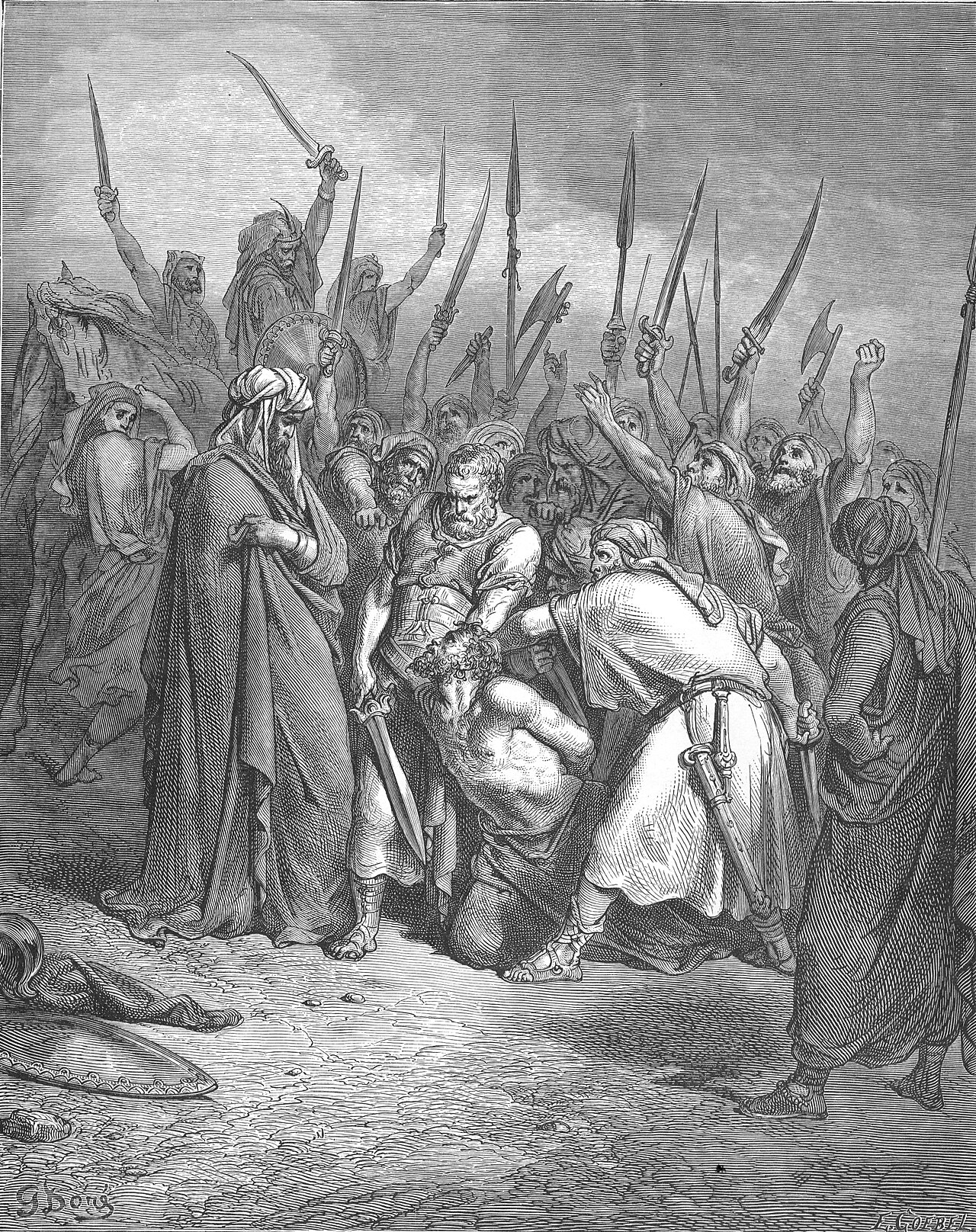
in 1 Samuel 15As Samuel turned to go, Saul grabbed the hem of his robe, and it tore.
BSB
The same verse in ASV and KJV ▾
ASV
And as Samuel turned about to go away, Saul laid hold upon the skirt of his robe, and it rent.
KJV
And as Samuel turned about to go away, he laid hold upon the skirt of his mantle, and it rent.
⋯
This verse in 1 Samuel 15
Commentary
11 notes on this verseAnd as Samuel turned about to go away,.... From Saul, a different way from Gilgal, perhaps towards his own city Ramah, with an intention to have nothing more to say to Saul, or to do with him, or to see his face no more; so displeased was he with him: he laid hold upon the skirt of his mantle; in order to detain him, and prevent his departure from him, and his going a different way: and it rent; Samuel twitching away from him with great vehemence and warmth.
This site's exposition
I will not return with you
on 1 Samuel 15:26-28
Samuel refuses outright, "I will not return with you," and repeats the sentence of rejection. When Saul grabs the hem of his robe and it tears, Samuel reads the tear as a sign that "The LORD has torn the kingdom of Israel from you today" and given it to another. The "neighbor who is better than you" goes unnamed here, and chapter 16 supplies the name, David.
This site's exposition
Saul grabbed the hem of his robe
John Gill pictures Samuel turning toward his own town of Ramah, meaning to have nothing more to do with Saul. Saul caught the edge of the mantle to hold him back. Gill says the robe tore as Samuel pulled free.
The record, by era
The Church Fathers2 voices
In many Latin versions we find one of the above verses in the following form: "The Lord has torn the kingdom of Israel from your hand." But I have quoted from the Greek text: "The Lord has torn the kingdom from Israel from your hand"—the expression "from Israel" being equivalent to "from your hand." In this way, Samuel stood figuratively for the people of Israel which was to lose the kingdom when our Lord Jesus Christ would come to reign—spiritually, not carnally—in the New Testament. The reference to him in the words "and he has given it to your neighbor" is an allusion to the racial relationship, for Christ in the flesh derived from Israel just as did Saul.
Again Saul sinned by disobedience, and again Samuel addressed to him the Lord's word: "Inasmuch, therefore, as you have rejected the word of the Lord, the Lord has also rejected you as king." And again, because of the same sin, when Saul admitted it and sought pardon, beseeching Samuel to go back with him and appease God, the prophet said, "I will not return with you, because you have rejected the word of the Lord, and the Lord has rejected you as king over Israel." And Samuel turned about to go away; but he grabbed hold of the skirt of his mantle, and it tore. And Samuel said to him, "The Lord has torn the kingdom from Israel from your hand this day and has given it to your neighbor who is better than you, and Israel shall be divided in two. But the triumpher in Israel will not spare and will not be moved to repentance; for he is not a man that he should repent. He threatens and does not persist."Actually, the man to whom these words were spoken, "The Lord shall reject you as king over Israel," and, "The Lord has torn the kingdom of Israel from you this day," ruled over Israel for forty years—for the same duration as David did—and he heard this pronouncement in the early part of his reign. Accordingly, we are to understand it to mean that no one of Saul's posterity was to rule after him—an admonition to look to David's stock whence was to stem, according to the flesh, Jesus Christ, the Mediator between God and humanity.
The Medieval Church3 voices
And Samuel turned to depart, etc. When the grace of prophecy turned away because of sins to depart from the Jews, they did not grasp the full garment of prophetic reading by which they could warm their souls with faith and adorn them with works; …
A commentator
Gregory the DialogistCommentary on 1 Kings, Book 6, Chapter 2 · Written before 604.
proposed
29. What are the garments of a teacher, if not to teach the qualities of the subjects adhering to him? Concerning these garments, indeed, a promise is made to the great shepherd through the prophet: 'As I live, says the Lord, you shall clothe yourself with all these as with a garment' (Isa. 49:18). And through the Psalmist it is sung: 'The Lord has reigned, He has put on beauty; the Lord has put on strength' (Ps. 93:1). For He put on beauty, who joined to Himself the splendid minds of the faithful, as it were garments.
Political prosperity is the business of emperors; the condition of the church is the concern of shepherds and teachers. Any other method is piracy, brothers. Saul tore Samuel's cloak, and what was the consequence? God tore the kingdom away from him and gave it to David the meek.… We will obey you, O emperor, in those matters which pertain to our daily lives: payments, taxes, tributes; these are your due, and we will give them to you. But as far as the government of the church is concerned, we have our pastors, and they have preached the word to us; we have those who interpret the ordinances of the church.
3 more voices on this verse
The Puritans and the Awakening3 voices
As the thing appeared to him upon the first view, he thought it altogether unfit for him so far to countenance one whom God had rejected as to join with him in giving thanks to God for a victory which was made to serve rather Saul's covetousness than God's glory.
), not that he cared for Samuel, but he feared that if Samuel forsook him the people would do so too. Many seem zealously affected to good ministers and good people only for the sake of their own interest and reputation, while in heart they hate them. But his expression was very gross when he said (
quarantine:debris (2026-07-29) — leading-punctuation
), so loth was he to part with the prophet; but Samuel put a construction upon this accident which none but a prophet could do. He made it to signify the rending of the kingdom from him (
quarantine:debris (2026-07-29) — leading-punctuation
The words behind it
7 Hebrew wordsEvery Hebrew word of this verse in the order it stands, with what it means and the door to its own study. The last column counts the times a word stands in the whole Bible: the rarer the word, the more the places it appears belong together.
| Hebrew | Sound | Meaning | Word study | In the Bible |
|---|---|---|---|---|
| וַיִּסֹּ֥ב | vaiyiso | and he turned round | H5437 → | 161 times |
| שְׁמוּאֵ֖ל | shemuel | Samuel | H8050 → | 141 times |
| לָלֶ֑כֶת | lalekhet | to go | H1980 → | 1546 times |
| וַיַּחֲזֵ֥ק | vaiyachazek | and he took hold | H2388 → | 291 times |
| בִּכְנַף־ | bikhnaf- | on [the] skirt of | H3671 → | 109 times |
| מְעִיל֖וֹ | meilo | robe his | H4598 → | 28 times |
| וַיִּקָּרַֽע׃ | vaiyikara' | and it tore | H7167 → | 63 times |
וַיִּסֹּ֥בand he turned round
vaiyisoH5437 →161 times
שְׁמוּאֵ֖לSamuel
shemuelH8050 →141 times
לָלֶ֑כֶתto go
lalekhetH1980 →1546 times
וַיַּחֲזֵ֥קand he took hold
vaiyachazekH2388 →291 times
בִּכְנַף־on [the] skirt of
bikhnaf-H3671 →109 times
מְעִיל֖וֹrobe his
meiloH4598 →28 times
וַיִּקָּרַֽע׃and it tore
vaiyikara'H7167 →63 times
A shaded row is a word that stands 400 times or fewer in the Bible.
Where this verse is studied
On this page
Studies3
On this verse
On this chapter
About 1 Samuel
Who and where
2 names in this verse with a page on the site.
- PersonJudges to monarchySamuelAsked of God by Hannah and lent to the LORD at Shiloh; the last judge and first of the prophets after Moses, who anointed both Sau…
- PersonUnited monarchySaulIsrael's first king, head and shoulders above the people; began in humility, ended in rejection — sparing what God devoted, consul…
This page draws on Augustine of Hippo, City of God 17.7; Bede, Commentary on Samuel; Gregory the Dialogist, Commentary on 1 Kings, Book 6, Chapter 2; John Damascene, ON DIVINE IMAGES 2.12; John Gill, Exposition of the Old Testament (1748-1763); Keil and Delitzsch, Biblical Commentary on the Books of Samuel; Matthew Henry, Commentary on the Whole Bible and W. G. Blaikie, The First Book of Samuel (Expositor's Bible).