
Matthew 17:5
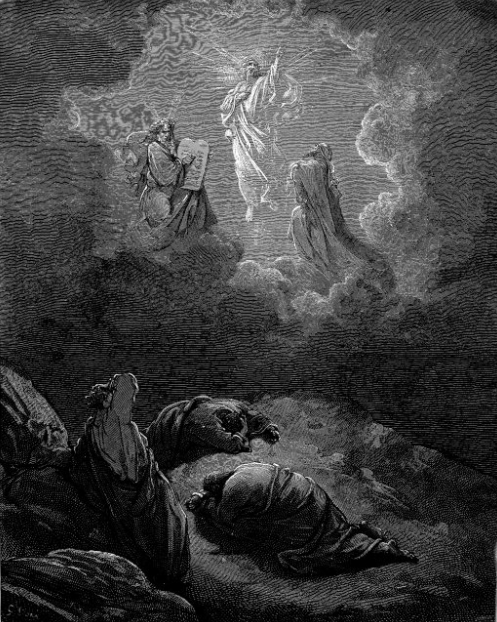
in Matthew 17While Peter was still speaking, a bright cloud enveloped them, and a voice from the cloud said, “This is My beloved Son, in whom I am well pleased. Listen to Him!”
BSB
The same verse in ASV and KJV ▾
ASV
While he was yet speaking, behold, a bright cloud overshadowed them: and behold, a voice out of the cloud, saying, This is my beloved Son, in whom I am well pleased; hear ye him.
KJV
While he yet spake, behold, a bright cloud overshadowed them: and behold a voice out of the cloud, which said, This is my beloved Son, in whom I am well pleased; hear ye him.
⋯
This verse in Matthew 17
Commentary
23 notes on this verseWhile they thought only of an earthly tabernacle of boughs or tents, they are overshadowed by the covering of a bright cloud; While he yet spake, there came a bright cloud and overshadowed them. (Exod. 19:9, 16.) Forasmuch as Peter had asked unwisely, he deserves not any answer; but the Father makes answer for the Son, that the Lord's word might be fulfilled, He that sent me, he beareth witness of me. (John 5:37.)
This site's exposition
a bright cloud overshadowed them
The bright cloud is the Shekinah, the same visible glory that filled the tabernacle and the temple, and the voice from it repeats the baptism's own words, this is my beloved Son, in whom I am well pleased, with one addition, hear ye him. Barnes reads that addition as the Father's own answer to Peter's proposal, since it sets Jesus apart from Moses and Elijah rather than alongside them, echoing Deuteronomy 18:15's promised prophet like unto Moses whom Israel must hear. The Law and the Prophets have spoken through their representatives; now the Father directs all attention to the one greater than both.
The record, by era
The Church Fathers5 voices
I think that God, wishing to dissuade Peter from making three tabernacles, under which so far as it depended on his choice he was going to dwell, shows him a better tabernacle, so to speak, and far superior: the cloud. It is the function of a tabernacle to give shade to one who is in it and to shelter him, and the bright cloud overshadowed them. So God made, as it were, a more divine tabernacle, inasmuch as it was bright, that it might be to them a pattern of the resurrection to come. For the shining cloud gives shade to the righteous and at the same time protects them, gives them light and illuminates them. What would the shining cloud that gives shade to the righteous be? Is it perhaps the Father's power, from which comes the Father's voice saying that this is his Son in whom he is well pleased, urging those that are shaded by it to listen to him and to no one else? He speaks—just as of old so also for all times—through those whom he wishes. Perhaps the shining cloud is the Holy Spirit, giving shade to the righteous and announcing the words of God at work within it and saying, "This is my beloved Son in whom I am well pleased." I would even venture to say that the shining cloud is our Savior.
The bright cloud overshadowing the Saints is the Power of the Father, or perhaps the Holy Spirit; or I may also venture to call the Saviour that bright cloud which overshadows the Gospel, the Law, and the Prophets, as they understand who can behold His light in all these three. The voice out of the cloud speaks either to Moses or Elias, who desired to see the Son of God, and to hear Him; or it is for the teaching of the Apostles.
This is the Son, this the Beloved, this the Accepted; and He it is who is to be heard, as the voice out of the cloud signifies, saying, Hear ye Him. For He is a fit teacher of doing the things He has done, who has given the weight of His own example to the loss of the world, the joy of the cross, the death of the body, and after that the glory of the heavenly kingdom.
He says therefore, Hear ye Him, as much as to say, Let the shadow of the Law be past, and the types of the Prophets, and follow ye the one shining light of the Gospel. Or He says, Hear ye Him, to show that it was He whom Moses had foretold, The Lord your God shall raise up a Prophet unto you of your brethren like unto me, Him shall ye hear. (Deut. 18:18.) Thus the Lord had witnesses on all sides; from heaven the voice of the Father, Elias out of Paradise, Moses out of Hades, the Apostles from among men, that at the name of Jesus every thing should bow the knee, of things in heaven, things on earth, and things beneath.
But, behold, with an abundance (of evidence) the Father from heaven replies, for the purpose of testifying to the Son: "This is my beloved Son, in whom I am well pleased; hear ye Him." So, again, in that asseveration, "I have both glorified, and will glorify again," how many Persons do you discover, obstinate Praxeas? Are there not as many as there are voices? You have the Son on earth, you have the Father in heaven.
16 more voices on this verse
The Church Fathers4 voices
A voice from the cloud said, This is my beloved Son, with whom I am well pleased; listen to him. I am manifested through his preaching. I am glorified through his humility. So listen to him without hesitation. He is the truth and the life. He is my strength and wisdom. "Listen to him" whom the mysteries of the law foreshadowed, of whom the mouths of the prophets sang. "Listen to him" who by his blood redeemed the world, who binds the devil and seizes his vessels, who breaks the debt of sin and the bondage of iniquity. "Listen to him" who opens the way to heaven and by the pain of the cross prepares for you the steps of ascent into his kingdom.
(Verse 5) While he was still speaking, behold, a bright cloud overshadowed them. And behold, a voice from the cloud, saying, This is my beloved Son, with whom I am well pleased; listen to him. Because he had asked foolishly, he does not deserve an answer from the Lord, but the Father speaks for the Son, so that the word of the Lord may be fulfilled: I do not testify of myself, but the Father who sent me, he testifies of me (John 5:37 and 8:18). But the cloud is seen as both bright and shadowed: like those who sought the tabernacle from the fleshly leaves or tents, they would be covered by the shadow of the bright cloud. Moreover, the voice of the Father speaking from heaven is heard, which also testifies to the Son; and through Peter, with error removed, teaches the truth: even through Peter to the other apostles. This is, he says, my beloved Son: to him the tabernacle must be affixed, to him obedience must be given. Here is the son, those slaves are: Moses and Elias themselves must prepare a tabernacle for the Lord with you in the innermost depths of their heart.
because Peter considered Moses and Elias to be equal in honour to the Lord, seeing that with reference to their equality he reckoned the number of the tabernacles, assigning one to each, the evangelist Luke notes this and in these terms: Not knowing what he …
A commentator
John ChrysostomHomily on the Gospel of Matthew 56 · Written in the 5th century.
proposed
What then? He Himself speaks nothing, nor Moses, nor Elias, but He that is greater than all, and more worthy of belief, the Father, uttereth a voice out of the cloud. Wherefore out of the cloud? Thus doth God ever appear. "For a cloud and darkness are round about Him;" and, "He sitteth on a light cloud;" and again, "Who maketh clouds His chariot;" and, "A cloud received Him out of their sight;" and, "As the Son of Man coming in the clouds." In order then that they might believe that the voice proceeds from God, it comes from thence. And the cloud was bright. For "while he yet spake, behold, a bright cloud overshadowed them; and, behold, a voice out of the cloud, which said, This is My beloved Son, in whom I am well pleased; hear ye Him." For as, when He threatens, He shows a dark cloud; as on Mount Sinai; for "Moses," it is said, "entered into the cloud, and into the thick darkness; and as a vapor, so went up the smoke;" and the prophet said, when speaking of His threatening, "Dark water in clouds of the air;" so here, because it was His desire not to alarm, but to teach, it is a bright cloud. And whereas Peter had said "Let us make three tabernacles," He showed a tabernacle not made with hands. Wherefore in that case it was smoke, and vapor of a furnace; but in this, light unspeakable and a voice. Then, to signify that not merely concerning some one of the three was it spoken, but concerning Christ only; when the voice was uttered, they were taken away. For by no means, had it been spoken merely concerning any one of them, would this man have remained alone, the two being severed from Him. Why then did not the cloud likewise receive Christ alone, but all of them together? If it had received Christ alone, He would have been thought to have Himself uttered the voice. […]
The Medieval Church3 voices
Then follows the testimony: and while he was yet speaking, behold a bright cloud overshadowed them, etc. Peter was speaking foolishly, therefore he was unworthy of an answer. He wanted a material testimony; therefore the Lord willed to show that the saints do not need …
(ap. Anselm.) It is to be observed, that the mystery of the second regeneration, that, to wit, which shall be in the resurrection, when the flesh shall be raised again, agrees well with the mystery of the first which is in baptism, when the soul is raised again. For in the baptism of Christ is shown the working of the whole Trinity; there was the Son incarnate, the Holy Ghost appealing in the figure of a dove, and the Father made known by the voice. In like manner in the transfiguration, which is the sacrament of the second regeneration, the whole Trinity appeared; the Father in the voice, the Son in the man, and the Holy Spirit in the cloud. It is made a question how the Holy Spirit was shown there in the dove, here in the cloud. Because it is His manner to mark His gifts by specific outward forms. And the gift of baptism is innocence, which is denoted by the bird of purity. But as in the resurrection, He is to give splendour and refreshment, therefore in the cloud are denoted both the refreshment and the brightness of the rising bodies. It follows, And when the disciples heard it, they fell on their faces, and feared greatly.
While he yet spake, behold, a bright cloud overshadowed them: and behold a voice out of the cloud, which said, This is My beloved Son, in whom I am well pleased; hear ye Him. You, Peter, desire tabernacles made with hands, but the Father has …
The Puritans and the Awakening1 voice
While he yet spake,....
The Nineteenth Century8 voices
A commentator
Albert Barnes1798–1870
Notes, Explanatory and Practical, on the Old and New Testaments (1832-1869)
A bright cloud overshadowed them - The word “overshadow” here means, rather, to “be diffused” or “spread” over them. It does not mean that it made a shade. A cloud was the symbol of the divine presence. Thus, God went before the Israelites in a cloudy pillar - dark by day and bright by night Exo 14:19-20; he appeared on Mount Sinai in a cloud bright by fire Exo 24:15-17; and a cloud, the symbol of the divine presence - called the Shechinah - dwelt continually in the most holy place in the temple, 1Ki 8:10-11; Eze 1:4; Eze 10:
These verses contain one of the most remarkable events in our Lord’s earthly ministry, the event commonly called the transfiguration. The order in which it is recorded is beautiful and instructive. The latter part of the last chapter showed us the cross; here we are graciously allowed to see something of the coming reward. The hearts which have just been saddened by a plain statement of Christ’s sufferings are at once gladdened by a vision of Christ’s glory. Let us mark this. We often lose much by not tracing the connection between chapter and chapter in the Word of God.
A commentator
Charles Spurgeon1834–1892
The Metropolitan Tabernacle Pulpit, Sermon No. 3440: “Attention!” (lightly modernized text, CCEL edition) · Written before 1892.
WHEN our Lord Jesus Christ was transfigured, there came a Voice from the bright, overshadowing cloud, which said, "This is My Beloved Son, in whom I am well pleased. Hear you Him." It was the Voice of the Father concerning His Son—a testimony to His Person, a notification of His office, an announcement of His authority to teach and to legislate. You can understand how imperative it then was for those who heard it to heed Him. But now He is gone up from us.
These verses contain one of the most remarkable events in our Lord’s earthly ministry, the event commonly called the transfiguration. The order in which it is recorded is beautiful and instructive. The latter part of the last chapter showed us the cross; here we are graciously allowed to see something of the coming reward. The hearts which have just been saddened by a plain statement of Christ’s sufferings are at once gladdened by a vision of Christ’s glory. Let us mark this. We often lose much by not tracing the connection between chapter and chapter in the Word of God. There are some mysterious things, no doubt, in the vision here described. It must needs be so. We are yet in the body. Our senses are conversant with gross and material things; our ideas and perceptions about glorified bodies and dead saints must necessarily be vague and imperfect. Let us content ourselves with endeavoring to mark out the practical lessons which the transfiguration is meant to teach us. In the first place we have in these verses a striking pattern of the glory in which Christ and his people will appear when he comes the second time. There can be little question that this was one main object of this wonderful vision. It was meant to encourage the disciples by giving them a glimpse of good things yet to come. That face “shining as the sun” and that raiment “white as the light” were intended to give the disciples some idea of the majesty in which Jesus will appear to the world when he comes the second time, and all his saints with him. The corner of the veil was lifted up to show them their Master’s true dignity. They were taught that if he did not yet appear to the world in the guise of a King, it was only because the time for putting on his royal apparel was not yet come. It is impossible to draw any other conclusion from St. Peter’s language when writing on the subject.
IT is exceedingly important to have clear evidences of the truth of our holy religion. Sometimes, I dare say, you have wished that God would speak out of Heaven in your hearing, or that He would work some extraordinary marvel before your eyes, that you might know beyond all question the truth of the Gospel of Jesus. This desire for signs and wonders is no new thing.
IT is exceedingly important to have clear evidences of the truth of our holy religion. Sometimes, I dare say, you have wished that God would speak out of Heaven in your hearing, or that He would work some extraordinary marvel before your eyes, that you might know beyond all question the truth of the Gospel of Jesus. This desire for signs and wonders is no new thing. Ah, my dear Friends, we know not what we ask, nor what we desire, for if such a voice were to come to us out of a bright cloud—we are made of the same flesh and blood as Peter, James and John, and it would, therefore, produce the same effect upon us as upon them—we would fall on our faces and be sorely afraid. Spirituals must grow out of spirituals—saving faith can never be produced by carnal sight and hearing. The Holy Spirit can work faith in us apart from any form of miracle and, miracle, alone, can never create a spiritual faith. Do we wish to receive a sign in order to confirm our belief in God? Suppose that we had it—we would soon need to have it repeated, for unbelief dies hard. I cannot tell how often we should need to hear the voice out of the cloud, but certainly life would soon become a misery to us, for we should be so frequently lying on our faces, so often cast into a swoon of fear, that we should be shattered, nervous and incapable of the ordinary duties of life! Like Israel at Sinai, we would begin to entreat that the Lord would not speak to us any more! The fact is that the voice of God, as absolute God, is too awful, too majestic for mortal ears—and the sight of overwhelming miracles would put such a strain upon the human mind that it is better for us to be without them.
A commentator
Charles Spurgeon1834–1892
The Metropolitan Tabernacle Pulpit, Sermon No. 3440: “Attention!” (lightly modernized text, CCEL edition) · Written before 1892.
proposed
WHEN our Lord Jesus Christ was transfigured, there came a Voice from the bright, overshadowing cloud, which said, "This is My Beloved Son, in whom I am well pleased. Hear you Him." It was the Voice of the Father concerning His Son—a testimony to His Person, a notification of His office, an announcement of His authority to teach and to legislate. You can understand how imperative it then was for those who heard it to heed Him. But now He is gone up from us. He has entered into the excellent Glory—He no more teaches in our streets, yet still, as though present with us, He speaks to us. By the written Word, His sayings are handed down to us Infallibly. Often times, when the Holy Spirit rests upon God's servants, they become as the voice of Christ to us, and when that same blessed Spirit, as the Comforter, brings to our remembrance the things of Christ, does it not seem as though Jesus, Himself, spoke to our souls? The admonition is not out of date—it has not lost its telling point or its vital force. Still does the Father say to us concerning His well-beloved Son, "Hear you Him." Let us proceed to meditate on this sacred charge. The three little words may give rise to four short questions. Why? What? How? When? I. WHY SHOULD WE HEAR HIM? It might serve for a sufficient answer, had we no other reply, because God, Himself, commands us! This injunction comes of the Father, "Hear you Him." Over and over again are we enjoined to listen to the voice of Christ. Every messenger from God ought to have our respectful attention—how much more the greatest of all messengers—that Messenger of the Covenant, the Messiah, the Sent One, the Apostle and High Priest of our profession? Did not Jehovah, Himself, say, "This is My Son"? It seemed reasonable that the Son should receive more reverence than any of the servants.
A bright cloud overshadowed them - Or as six MSS. and Ephraim read it, a cloud of light, νεφελη φωτος; which reading Griesbach has admitted into the text. As a bright cloud, or a cloud of light could not overshadow, or cast any kind of shade, the word επεσκιασεν should be translated, surrounded them. A cloud was frequently the symbol of the Divine presence; but such a cloud had always something very remarkable in its appearance. Ezekiel, Eze 1:4, represents it as a great cloud, and a fire unfolding itself, and a brightness about it, and out of the midst thereof, as the color of amber out of the midst of the fire; and in Eze 1:28, he tells us that this was the appearance of the likeness of the glory of the Lord. See also Exo 16:10; Exo 40:33, etc.; Eze 43:2, and 1Ch 5:14. But it was generally in a thick, dark cloud, that God manifested himself under the law; see Exo 19:9; Exo 20:21. This might be designed as emblematical of the old covenant, which was but the shadow of the good things which were to come, Heb 10:1; and the cloud of light mentioned here, the emblem of that glorious display of God, in his Gospel, by which life and immortality were brought to light, 2Ti 1:10. This is my beloved Son - Ουτος εϚιν ο υιος μου ο αγαπητος, εν ω ευδοκησα, This is my Son, the beloved one, in who I have delighted, or, been well pleased. […]
The words behind it
27 Greek wordsEvery Greek word of this verse in the order it stands, with what it means and the door to its own study. The last column counts the times a word stands in the whole Bible: the rarer the word, the more the places it appears belong together.
| Greek | Sound | Meaning | Word study | In the Bible |
|---|---|---|---|---|
| Ἔτι | eti | While yet | G2089 → | 140 times |
| αὐτοῦ | autou | when he | G846 → | 5565 times |
| λαλοῦντος | lalountos | is speaking | G2980 → | 294 times |
| ἰδοὺ | idou | behold | G2400 → | 200 times |
| νεφέλη | nephele | a cloud | G3507 → | 25 times |
| φωτεινὴ | photeine | bright | G5460 → | |
| ἐπεσκίασεν | epeskiasen | overshadowed | G1982 → | |
| αὐτούς, | autous | them, | G846 → | 5565 times |
| καὶ | kai | and | G2532 → | 9120 times |
| ἰδοὺ | idou | behold | G2400 → | 200 times |
| φωνὴ | phone | a voice | G5456 → | 139 times |
| ἐκ | ek | out of | G1537 → | 911 times |
| τῆς | tes | the | G3588 → | 19766 times |
| νεφέλης | nepheles | cloud | G3507 → | 25 times |
| λέγουσα· | legousa | saying; | G3004 → | 1325 times |
| οὗτός | houtos | This | G3778 → | 1381 times |
| ἐστιν | estin | is | G1510 → | 2333 times |
| ὁ | ho | the | G3588 → | 19766 times |
| υἱός | huios | Son | G5207 → | 377 times |
| μου | mou | of Mine | G3165 → | 1936 times |
| ὁ | ho | the | G3588 → | 19766 times |
| ἀγαπητὸς | agapetos | beloved | G27 → | 61 times |
| ἐν | en | in | G1722 → | 2738 times |
| ᾧ | ho | whom | G3739 → | 1405 times |
| εὐδόκησα· | eudokesa | I am well pleased; | G2106 → | 21 times |
| ἀκούετε | akouete | do listen | G191 → | 425 times |
| αὐτοῦ. | autou | to Him. | G846 → | 5565 times |
ἜτιWhile yet
etiG2089 →140 times
αὐτοῦwhen he
autouG846 →5565 times
λαλοῦντοςis speaking
lalountosG2980 →294 times
ἰδοὺbehold
idouG2400 →200 times
νεφέληa cloud
nepheleG3507 →25 times
φωτεινὴbright
photeineG5460 →
ἐπεσκίασενovershadowed
epeskiasenG1982 →
αὐτούς,them,
autousG846 →5565 times
καὶand
kaiG2532 →9120 times
ἰδοὺbehold
idouG2400 →200 times
φωνὴa voice
phoneG5456 →139 times
ἐκout of
ekG1537 →911 times
τῆςthe
tesG3588 →19766 times
νεφέληςcloud
nephelesG3507 →25 times
λέγουσα·saying;
legousaG3004 →1325 times
οὗτόςThis
houtosG3778 →1381 times
ἐστινis
estinG1510 →2333 times
ὁthe
hoG3588 →19766 times
υἱόςSon
huiosG5207 →377 times
μουof Mine
mouG3165 →1936 times
ὁthe
hoG3588 →19766 times
ἀγαπητὸςbeloved
agapetosG27 →61 times
ἐνin
enG1722 →2738 times
ᾧwhom
hoG3739 →1405 times
εὐδόκησα·I am well pleased;
eudokesaG2106 →21 times
ἀκούετεdo listen
akoueteG191 →425 times
αὐτοῦ.to Him.
autouG846 →5565 times
A shaded row is a word that stands 400 times or fewer in the Bible.
The walk
8 stopsEach card is a verse this one points to, and under it the verses that one points to in turn. Where several paths arrive at the same place, that place is listed first: the text keeps returning to it.
Through
Matthew 12:18“Here is My Servant, whom I have chosen, My beloved, in whom My soul delights. I will put My Spirit on Him, and He will proclaim justice to the nations.
it leads to
- Isaiah 42:1
“Here is My Servant, whom I uphold, My Chosen One, in whom My soul delights. I will put My Spirit on Him, and He will bring justice to the nations.
Reached by 2 separate paths from here.
- Isaiah 42:1
Through
Deuteronomy 18:15The LORD your God will raise up for you a prophet like me from among your brothers. You must listen to him.
it leads to
- Acts 3:22–23
For Moses said, ‘The Lord your God will raise up for you a prophet like me from among your brothers. You must listen to Him in everything He tells you.
- Acts 7:37
This is the same Moses who told the Israelites, ‘God will raise up for you a prophet like me from among your brothers.’
- John 1:45
Philip found Nathanael and told him, “We have found the One Moses wrote about in the Law, the One the prophets foretold—Jesus of Nazareth, the son of Joseph.”
- Deuteronomy 18:18–19
I will raise up for them a prophet like you from among their brothers. I will put My words in his mouth, and he will tell them everything I command him.
- Acts 3:22–23
Through
Matthew 3:17And a voice from heaven said, “This is My beloved Son, in whom I am well pleased!”
it leads to
- Psalms 2:7
I will proclaim the decree spoken to Me by the LORD: “You are My Son; today I have become Your Father.
- Luke 9:35
And a voice came from the cloud, saying, “This is My Son, whom I have chosen. Listen to Him!”
- Matthew 12:18
“Here is My Servant, whom I have chosen, My beloved, in whom My soul delights. I will put My Spirit on Him, and He will proclaim justice to the nations.
- Psalms 2:7
Where this verse is studied
On this page
About Matthew
This page draws on 21 works. Open the list of works
This page draws on Adam Clarke, Commentary on the Bible; Albert Barnes, Notes, Explanatory and Practical, on the Gospels; Albert Barnes, Notes, Explanatory and Practical, on the Old and New Testaments (1832-1869); Charles Spurgeon, The Metropolitan Tabernacle Pulpit, Sermon No. 3440: “Attention!” (lightly modernized text, CCEL edition); Charles Spurgeon, The Metropolitan Tabernacle Pulpit, Sermon No. 1727: “The Voice from the Cloud and the Voice of the Beloved” (lightly modernized text, CCEL edition); Cosmas Indicopleustes, The Christian Topography, Book 5; Glossa Ordinaria, Catena Aurea by Aquinas; Hilary of Poitiers, Catena Aurea by Aquinas; J.C. Ryle, Expository Thoughts on the Gospels: Matthew; Jamieson, Fausset & Brown, Commentary Critical and Explanatory on the Whole Bible; Jerome, Catena Aurea by Aquinas; Jerome, Commentary on Matthew; John Chrysostom, Homily on the Gospel of Matthew 56; John Gill, Exposition of the New Testament (1746-1748); Leo the Great, SERMON 38.7; Origen of Alexandria, COMMENTARY ON MATTHEW 12.42; Origen of Alexandria, Catena Aurea by Aquinas; Remigius of Rheims, Catena Aurea by Aquinas; Tertullian, Against Praxeas; Theophylact of Ohrid, Commentary on Matthew and Thomas Aquinas, Commentary on Matthew.