MANNAFEST

Poetry · Lamentations

Grief That Will Not Lie, Mercy That Will Not Let Go

Five funeral-dirges over a fallen city — grief that owns the judgment as just and refuses to soften the horror. Chapters 1, 2, and 4 march one Hebrew letter per verse over the ruin; chapter 3 intensifies to three verses per letter, the most tightly ordered poem in the book — and at that exact center, the voice that has “seen affliction” turns: mercies new every morning, great is thy faithfulness. Then chapter 5 keeps the count but drops the letters — because some grief outruns even that discipline.

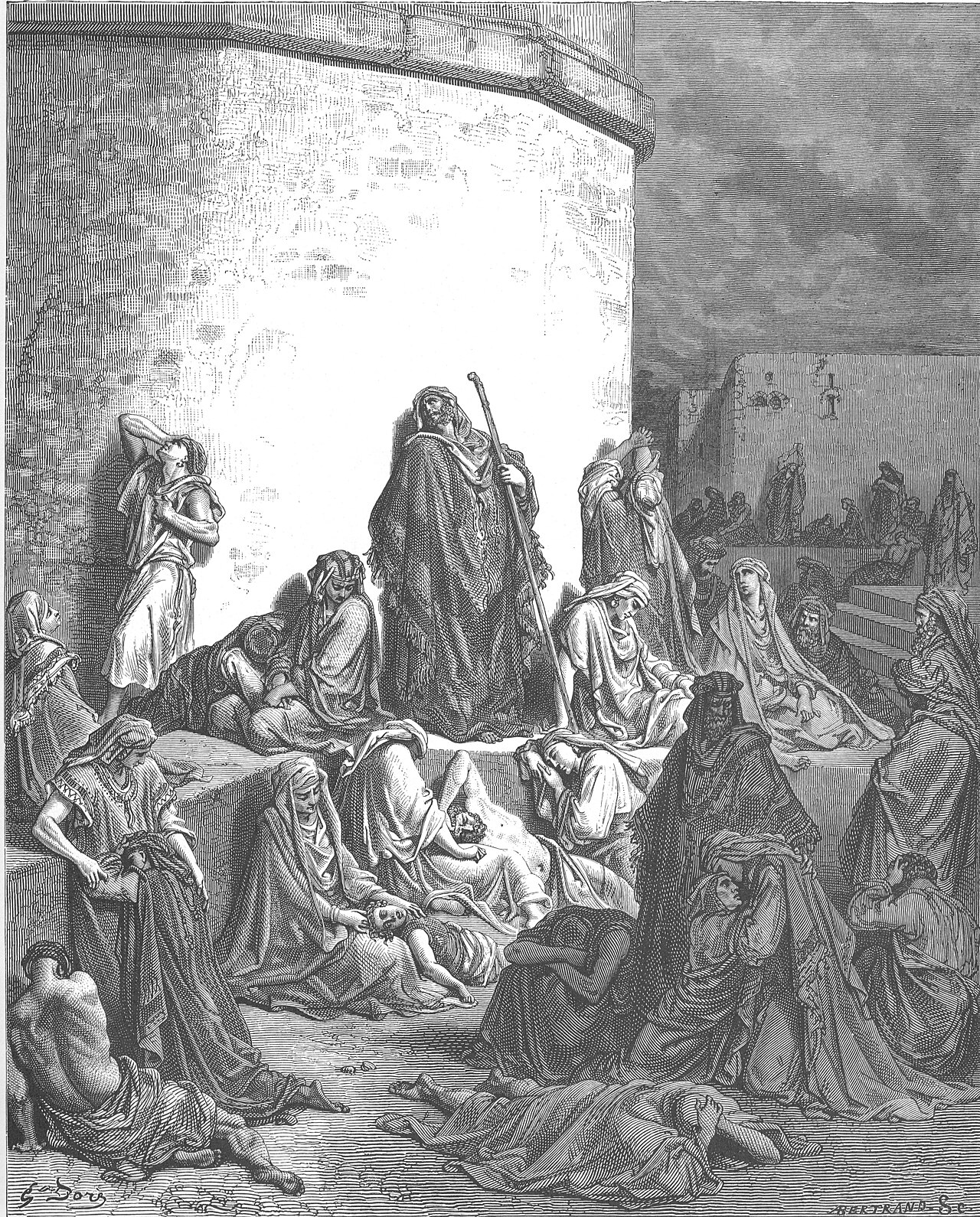
People Mourn over the Destruction of Jerusalem — Gustave Doré
The people mourn over the destruction of Jerusalem — the city sits solitary — Gustave Doré, Doré’s English Bible (1866), public domain · Lamentations 1:1

The Five Dirges

the alphabet marched over grief — every cell computed, none hand-placed

Form itself becomes an act of faith. Chapters 1, 2, and 4 run the Hebrew alphabet once, aleph to tav — grief that can be begun and finished, letter by letter, rather than grief that spirals without end. Chapter 3 triples the discipline: three verses per letter, 66 in all, the single most ordered chapter in the Hebrew Bible outside Psalm 119 — and it is exactly there that the book turns to hope. Chapter 5 keeps the number the alphabet would need, 22 verses, and drops the alphabet itself.

Lamentations 1Jerusalem's DesolationAcrostic · one verse per letter · standard order

The city as a widow, “none to comfort her” (1:2, 9, 16, 17, 21) — narrator and the city's own first-person voice interwoven, closing in confession: “Jehovah is righteous.”

Lamentations 2The LORD's Anger Against His Own SanctuaryAcrostic · one verse per letter · archaic order (pe before ayin)

God himself as the adversary — the horror of the siege named without flinching (2:11–12, 20), and the false prophets who failed to warn of it indicted (2:14).

Lamentations 3The Man Who Has Seen AfflictionTriple acrostic · three verses per letter · 66 verses · archaic order

One voice — the gever — laments (3:1–18), turns to hope (3:19–24), moves through confidence and self-examination (3:25–51) to testimony (3:52–58) and imprecation (3:59–66).

Gold band = 3:22–24, the turn to hope — the LORD's mercies, new every morning.

Lamentations 4The Siege RememberedAcrostic · one verse per letter · archaic order

The famine, the fall of “the anointed of Jehovah” (4:20), and a taunt turned oracle of coming judgment against Edom, who gloated over the ruin (4:21–22).

Lamentations 5A Communal Prayer22 verses — the acrostic's number, but NOT alphabetic

The nation itself speaks — “we,” throughout — cataloging the humiliation, then pleading: “turn thou us unto thee” (5:21). It closes on an open, trembling question (5:22).

No letters here on purpose — 22 verses, the acrostic's count, but no alphabetic order.

Chapters 2, 3, and 4 preserve an older Hebrew letter order — pe before ayin — against the standard order chapter 1 uses; the pe-ayin abecedary evidence (ʾIzbet Ṣarṭah, Tel Zayit, Kuntillet ʾAjrud) is a genuine composition datum, not rendered here.

The Argument

the whole book in three sentences
Attribution
Anonymous in the Hebrew text; ascribed to Jeremiah by the LXX, Talmud, and tradition
Date
The immediate aftermath of Jerusalem's fall to Babylon, 586 BC
Genre
Five qinah — funeral dirges over a fallen city
Shape
5 chapters · 4 acrostics (one tripled) · 1 broken pattern
  1. 1

    Jerusalem — Daughter Zion, personified as a widowed, weeping woman “great among the nations” now become a slave — has been devastated by the LORD's own hand as the covenant curse his own Torah foretold, and the book will not soften that verdict: “Jehovah is righteous; for I have rebelled against his commandment.”

  2. 2

    Yet at the exact structural center of the most intensely ordered poem in the book, the individual voice that has “seen affliction” breaks from complaint into hope: because of the LORD's mercies we are not consumed, they are new every morning, great is his faithfulness.

  3. 3

    The book closes with a plea for restoration that dares not presume — “renew our days as of old” — ending on an open, unresolved question rather than rushing the reader past grief into premature comfort.

Christ in Lamentations

typology and devotional application, labeled honestly as such
“Is it nothing to you?” — the church's Passion application1:12 → Holy Week liturgy

Spoken by the personified city in its own grief, this verse became one of the most famous texts in Christian devotional history: the Tenebrae responsory “O vos omnes” draws on it directly, and Spurgeon preached a celebrated sermon applying it to Christ's sufferings. Present as the church's long history of devotional and typological application — Daughter Zion's grief read as foreshadowing the Man of Sorrows — not as the verse's original predictive sense, which is Jerusalem's own catastrophe.

The man who hath seen affliction → the Man of Sorrows3:1 → Isaiah 53:3

The gever of chapter 3 — “I am the man that hath seen affliction by the rod of his wrath” — echoes the same register as Isaiah's Servant, “a man of sorrows, and acquainted with grief.” Both figures bear affliction representatively — the gever for the nation, the Servant for the world — and both move through suffering toward vindication. A thematic resonance, not a linear prediction.

Open the study →
Jesus weeping over the same city1:12; ch. 2 → Luke 19:41–44; Matt 23:37–39

Jesus' lament over the city that would not receive him — “O Jerusalem, Jerusalem, that killeth the prophets… how often would I have gathered thy children together… and ye would not!” — stands in the same tradition as Lamentations' grief over the same city under judgment for the same root sin, and anticipates its second catastrophic fall in AD 70. Weeping-prophet-over-doomed-Jerusalem is the strongest typological thread linking Lamentations to its companion book.

Open the study →
Mercies new every morning → the ground of the New Covenant3:22–23 → Jeremiah 31:31–34

The same covenant loyalty (chesed) that keeps Judah from total consumption in Lamentations 3 is the same divine character that grounds the New Covenant Jeremiah announces — “their sin will I remember no more.” The God who disciplines his own without abandoning them is the God who, in Christ, forgives definitively. A thematic-theological continuity within the same prophetic corpus, not a direct citation chain.

Open the study →

The Hinge

3:22–24 — the thread the whole book hangs from
Lamentations 3:22–24 →

“It is of Jehovah's lovingkindnesses that we are not consumed, because his compassions fail not. They are new every morning; great is thy faithfulness. Jehovah is my portion, saith my soul; therefore will I hope in him.”

Structurally, this falls inside the book's most tightly-ordered chapter — the triple acrostic — near the point where its complaint turns to hope: maximum formal control framing the maximum turn (the acrostics lens's own flagship reading for this book). Theologically, it is the thin but unbreakable thread the whole book hangs from — not that the suffering is minimized, but that it is not the final word.

Thomas O. Chisholm's 1923 hymn “Great Is Thy Faithfulness” draws its title directly from 3:23 — the best-known English-language cultural echo of this verse, a hymn rather than Scripture, worth naming rather than singing into the page. The full study →

Themes

six load-bearing lines through the book
01

Judgment owned, not excused

Lamentations 1:18; 2:17

“Jehovah is righteous; for I have rebelled” — no protest that God was unjust. The covenant curses of Deuteronomy 28 and Leviticus 26 are read as having landed exactly as promised.

02

Grief that will not be rushed

Lamentations 2:11–12, 20; 4:2, 10

The book refuses to sanitize the horror. The qinah's limping 3+2 meter exists to give catastrophic grief a controlled, repeatable liturgical shape — a discipline against both denial and despair.

03

Daughter Zion, the personified city

Lamentations 1:1, 8, 12

Jerusalem figured as a widow who was once a princess, stripped and shamed, weeping with none to comfort her — the device that makes national catastrophe personal and gives the book's grief a face.

04

The individual within the communal

Lamentations ch. 3

Where chs. 1, 2, 4, 5 speak as the city or the nation, ch. 3 gives one man's voice — traditionally Jeremiah's own — moving from affliction through hope to self-examination: “let us search and try our ways.”

05

Grief given to prayer, not silence

Lamentations 5:19–22

The final chapter turns the communal catalog of humiliation into direct address to God: “Thou, O Jehovah, abidest for ever” — and a plea that dares not presume: “renew our days as of old.”

06

The book's refusal to resolve

Lamentations 5:22

Unlike most Scripture laments, which pivot to praise and stay there, Lamentations ends on an open, unresolved question — a genuine literary and theological datum, not an accident, and not to be smoothed over.

The Approved Voices on Lamentations

the roster applied — the specific work named, so you can go to it
Charles Spurgeonpublic domain

“Is It Nothing to You?” (sermon on Lam 1:12) — exact volume ⚠VERIFY

The single most important roster voice for this book — the model text for the ch. 1 Passion application. He also preached on 3:22–23's “mercies… new every morning” (exact title ⚠VERIFY).

Chuck Misslercite-only ≤50w

whole-Bible survey approach — dedicated Lamentations product ⚠VERIFY

Marcus Brown's formative teacher. Reads the acrostic as deliberate authorial craft — form itself testifying that ordered grief can hold real hope at its center.

R. C. Sproulcite-only ≤50w

The Holiness of God (1985)

Strong on 1:18: a people who can say “Jehovah is righteous” in the moment of their own ruin have understood something about God comfortable people rarely do. Flag: amillennial/cessationist; his doctrine-of-God weight is carried without his eschatology.

Leonard Ravenhillcite-only ≤50w

Why Revival Tarries

The natural roster voice for grief-as-prayer: national catastrophe as the fruit of a prayerless church, and weeping over sin honored as the mark of genuine intercession.

Dutch Sheetscite-only ≤50w

Intercessory Prayer

Lamentations 5 as a textbook instance of identificational, communal repentance — the nation owning corporate sin while still daring to ask for restoration.

A. W. Tozercite-only ≤50w

The Knowledge of the Holy — specific Lamentations passage ⚠VERIFY

On God's chastening of those he loves as itself an act of covenant faithfulness — relevant to holding judgment and mercy together without collapsing either.

John Calvinpublic domain

Commentaries on the Book of the Prophet Jeremiah and the Lamentations (5 vols., 1563)

The monumental PD set covering both books; its Lamentations volume anchors the quote pool here.

Keil & Delitzschpublic domain

Commentary on Jeremiah, Lamentations

Rigorous PD Hebrew exegesis, strongest on the acrostic structure and grammar.

Matthew Henry · JFB · John Gill · E. W. Bullingerpublic domain

Commentary on the Whole Bible · Jamieson–Fausset–Brown · Exposition · Companion Bible

The PD floor beneath the page: Gill strong on the Tishah b'Av background; Bullinger's structural notes on the acrostic pattern pair naturally with the Missler reading.

Iain Provan · Elie Assis · C. S. Lewiscite-only ≤50w

Lamentations (NCB, 1991) · “The Alphabetic Acrostic in Lamentations,” CBQ 69 (2007) · A Grief Observed (1961)

Moderns, cite-only, for balance and scholarship: Provan on the anonymity case, Assis as the acrostics brief's own source, Lewis as a thematic resonance on honest grief before God — used sparingly, labeled devotional resonance only.

Marcus Brown's own commentary leads above all; within a tier, all voices are equal — no single voice, Spurgeon included, is elevated above its rating.

Contested Points

presented at full strength, then MannaFest's flag

Authorship — the Jeremianic tradition vs. anonymity

The Jeremianic case

The Masoretic Hebrew carries no superscription, but the LXX's added superscription names Jeremiah, affirmed by the Talmud and nearly universal Jewish and Christian tradition. 2 Chr 35:25 shows Jeremiah as a known composer of laments in exactly this genre, and the book's weeping-prophet vocabulary and eyewitness intimacy with the fallen city fit him closely.

The anonymity case

The earliest and most authoritative witness — the Hebrew MT itself — names no author, and the LXX superscription may be an inference rather than independent knowledge. Some scholars (e.g. Iain Provan, cite-only) note tensions: 4:17's hoped-for Egyptian aid sits oddly beside Jeremiah's own condemnation of reliance on Egypt, and 4:20's tone toward the captured king reads warmer than his usual criticism of Zedekiah.

MannaFest flag — MannaFest follows the traditional Jeremianic ascription — early, nearly universal, and coherent with the known facts of his life and grief-vocabulary — while presenting the anonymity case fairly. A communal qinah voiced through a personified city need not match its author's private polemic verse-for-verse; the tensions raised are real but not decisive.

God's role in the catastrophe — just judgment and genuine grief held together

Judgment-forward reading

The catastrophe is the precise, promised outworking of the covenant curses (Deut 28:53–57; Lev 26:29) — so the book's purpose is to teach the exiled community to own the judgment rather than blame God unjustly. A holy God who did not judge covenant-breaking at this scale would not be holy.

Grief-forward reading

The book does not stop at doctrinal acknowledgment — it protests, lingers over horror in loving detail, and voices something close to accusation against God (3:44) without being rebuked for doing so. The gever's complaint stands as legitimate speech to God, the same territory as Job's speeches and the individual lament psalms.

MannaFest flag — Hold both without collapsing either: judgment fully owned as just, and grief fully and honestly expressed, including its harder edges. This is not a contradiction to resolve but the book's pastoral achievement — permission to tell God the truth about pain while still confessing his righteousness.

The acrostic's purpose — and chapter 5's abandonment of it

Form as the discipline of controlled grief

The acrostic imposes the completeness idiom (“from aleph to taw”) and gives catastrophic emotion a bounded, traversable shape. The intensification to a triple acrostic in ch. 3, at the exact point the book turns to hope, supports this: maximal formal control accompanies the maximal emotional turn.

Chapter 5's collapse as its own statement

If the acrostic is the discipline that makes grief speakable, ch. 5's deliberate abandonment of it — while keeping the 22-verse count, so the absence is conspicuous — reads as an honest admission that some grief finally exceeds even that discipline, or that a fully communal voice no longer needs the alphabet's individual-verse containment.

MannaFest flag — Present both readings side by side as a live literary-theological question; do not force a single interpretation. This is exactly the kind of claim — a formal choice means something — that must stay disciplined and flagged as interpretive, not asserted as fact.

The Cast

a book with almost no named characters, and one unforgettable personification
Jeremiah (traditional author)No superscription names a writer; tradition, from the LXX forward, ascribes the book to him. See Contested Points.
Daughter ZionThe personified city — a widow who was a princess (1:1), stripped and shamed (1:8), weeping with none to comfort her.
The gever, “the man”Chapter 3's individual sufferer — traditionally Jeremiah himself, or read representatively for the whole afflicted community.
The anointed of Jehovah4:20 — almost certainly Zedekiah, captured fleeing the city (2 Kgs 25:4–7), mourned even in his failure as the Davidic figure whose fall marks the dynasty's nadir.

Places

JerusalemThe entire book's subject — “How doth the city sit solitary, that was full of people!” (1:1).Zion“The perfection of beauty, the joy of the whole earth” (2:15), now besieged.
The sanctuaryViolently taken away “as if it were of a garden” (2:6) — the site of the priests' and prophets' slaughter (2:20).

Keep studying

— more from The Prophets

Artwork: Rembrandt van Rijn, Jeremiah Lamenting the Destruction of Jerusalem — public domain. Drafted from MannaFest's research brief on Lamentations — public-domain commentators (Calvin, Keil & Delitzsch, Henry, JFB, Gill, Bullinger) and the founder's approved-voices roster, cite-only for moderns. Scripture ASV. Every cited work — the sources registry →